23 Jul 2009: Opinion

A Total Ban on Whaling?
New Studies May Hold the Key

As the International Whaling Commission debates whether to ban all whaling or to expand the limited hunts now underway, recent research has convinced some scientists that the world’s largest mammal should never be hunted again.

by fred pearce

The International Whaling Commission is lurching from crisis to stasis, unable to impose a complete ban on whaling, yet equally unwilling to allow a formal resumption. So the IWC meets every year and watches ever more whaling ships depart from Iceland, Japan, and Norway in contravention of the spirit — and sometimes the letter — of its 23-year-old whaling moratorium.

At one level, there is a crisis of rhetoric and perception. Japan’s annual hunt, sanctioned under a loophole allowing whaling in the interests of scientific research, is clearly bogus. But would-be whalers say that some proponents of a true moratorium — including former great whaling nations like the U.S. and Britain — are equally guilty of pretend science: They deny that whale populations have recovered enough during the moratorium for whaling to resume, when in fact they oppose resumption of whaling under any circumstances.

But behind this rancid politics, there is a real unanswered scientific question: Have some whale populations, such as Atlantic humpbacks, rebounded sufficiently to allow “sustainable” harvesting? Or have numbers been so decimated by centuries of past hunting that any resumption would be dangerous both for whale populations themselves, and for wider marine ecosystems?

One of the IWC’s main management objectives is to prohibit all catches where a particular population is at less than 54 percent of its original population level — sometimes referred to as the ocean’s “carrying capacity.” Whalers say many stocks have now risen above this benchmark. But have they? How many whales once swam the world’s seas?

At a recent meeting in Vancouver, scientists engaged in the decade-long Census of Marine Life agreed that, in the words of Irish delegate Poul Holm, “human pressure on marine life was much earlier, much larger and much more significant than previously thought.” That conclusion, they said, applied especially to marine mammals, including whales.

This is a bombshell for marine biologists. Their conventional view, held at the IWC and elsewhere, is that whale numbers were largely unchanged

Enlarge Image
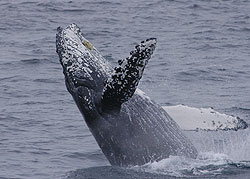
Whales

Photo by Barbara LaCorte / National Marine Sanctuaries
prior to the arrival of industrial whaling, generally defined as the advent of explosive harpoons in the mid-19th century and — at the start of the 20th century — factory ships with ramps that could load large numbers of slaughtered whales for processing. But this, it increasingly appears, is nonsense. Seventeenth and 18th century whalers — in the heyday of chasing whales for oil to make candles, light street lamps, and lubricate machinery — wrecked most of the world’s whale stocks long before the arrival of industrial whaling.

It seems that old sailors’ chronicles of oceans filled to the horizon with whales were not hyperbolic fantasies. They were often literal truth.

Why do the census historians conclude this? First, because the sheer volume of historical evidence makes it ever harder to disbelieve. And second, because new population modeling, some of it based on DNA evidence, provides strong corroboration for the chroniclers.

The History of Marine Animal Populations (HMAP) project, part of the Census of Marine Life, has so far collected records on 70,000 whale encounters that build up a picture of past super-abundance, says Andy Rosenberg of the University of New Hampshire. Meanwhile, the genetic variation found in a handful of whale populations so far analyzed suggests that those that remain came from much larger populations than previous supposed. The analysis is based on the fact that, with succeeding generations, DNA is altered through subtle mutations: The larger the original population, the greater the genetic “drift” evident in the current population.

For instance, based on its own records, the IWC had concluded that the number of humpback whales swimming the North Atlantic before whalers began to reduce their numbers was around 20,000. With the current population estimated at 10,000, the humpback population could soon be considered sufficiently large to allow the resumption of whaling. But when Stanford University’s Stephen Palumbi and Joe Roman analyzed the population’s DNA in 2003, they concluded that the pre-exploitation figure was 12 times greater, with a population once numbering 240,000.

This suggested that the North Atlantic’s original humpback whale population was more than 20 times larger than the present population, and any claims that the population has recovered sufficiently to allow a resumption of whaling are well wide of the mark. Palumbi’s findings also suggest that the global population of humpbacks may once have been around 1.5 million, rather than the 100,000 estimated by the IWC.

Among the best documented stories of whale extermination is that of Arctic bowheads. England’s most famous whaler, William Scoresby, was one of hundreds of Dutch and English whaling captains who headed into the iceberg-infested waters around Greenland in the late 18th century to catch bowhead whales. They only had wooden vessels powered by wind and sail, and hand-held harpoons. But, guided by Scoresby — a brilliant sailor who invented the crow’s nest as a lookout for ice and whales — they sailed audaciously among the ice floes, where the whales congregated each spring, and brought back ever-larger hauls of blubber, to be boiled up on the dockside at ports like Scoresby’s home town of Whitby.

According to Robert Allen of the University of British Columbia in Vancouver, who modeled rates of harvesting and the reproductive rates of the species, eastern Arctic bowheads numbered almost a million animals when the Greenland hunt began. But within a few decades, the bowheads were virtually all gone. Whitby whalers gave up going north in the 1830s.

Today, almost 200 years on, the population of bowheads west of Greenland is still only around 1,200, and that east of Greenland, once the biggest whaling ground in the world, has simply disappeared altogether.

Whaling before the explosive harpoon and the factory ship may have been technically primitive, but it was a huge industry, with thousands of ships setting sail. The New England port of New Bedford, Massachusetts, was once known as the “the city that lit the world” because of its production of lamp oil from whale blubber.

One whale population after another was decimated, before the fleets moved on through the oceans, heading finally for southern waters. HMAP researchers estimate that in the 18th century, the waters off New Zealand were home to around 27,000 southern right whales. But by 1925, they had been reduced to 25 reproducing females.

“The systematic destruction of the great whales was a stupendous act of modern ecological folly...” Jeremy Jackson of Scripps Institution of Oceanography in San Diego writes in a recent paper in Whales, Whaling and Ocean Ecosystems. “(T)he ecological consequences of the removal of so many behemoths must have been profound.”

He argues that the new findings on the past profusion of whales show our conventional view of marine food chains is upside down. Modern oceans are dominated by small and lowly creatures. They comprise most of the biomass, with larger species further up the food chain comprising ever less biomass.

But, says Jackson, this “trophic pyramid” may be an artifact of human hunting over the centuries rather than the natural state. In the natural state, he argues, the trophic pyramid was probably the other way around, with biomass dominated by megafauna. Millions upon millions of whales were eating out the oceans as fast as they could go.

Most marine biologists, Jackson says, continue to dismiss this idea out of hand, despite “the most careful and detailed historical descriptions [which are] are commonly dismissed as untestable anecdotes.” They do this, he says, because anecdotes of past huge whale numbers — though numerous — lack scientific rigor. And some argue that the DNA evidence relies on the assumption that distinct populations of whales did not interbreed in the past. Jackson calls this “unbridled anti-historical determinism that flies in the face of everything we have learned about… ecosystems.”

Jackson offers a startling new picture of life on Earth, a world in which giants ruled, and ruled in huge numbers. And if Jackson is right, then even the most “recovered” of today’s whale populations are only a tiny fraction of their former numbers.

That is one cause for thinking very hard before allowing any resumption of whaling. Another is that the world is only now learning the true scale of the abuse of science and wholesale flouting on IWC hunting quotas that has marked most of the six decades since the commissions was established in 1946.

We may have known how boats paid for by Unilever hunted the oceans with such vigor in the 1930s that an entire fleet was impounded by concerned Norwegians authorities in 1936 — one of the incidents that led to the commission’s formation. We may know how Greek shipping magnate Aristotle Onassis made a whaling fortune in the 1950s and reportedly covered the bar stools in his favourite yacht with the downy skin from the scrotums of sperm whales.

But it is only in the past two years that the Marine Fisheries Review has published in English the memoirs of Russian whaling scientists, supposedly monitoring fleets in the 1950s and 1960s to ensure they complied with IWC rules. Former inspector Alfred Berzin described how the most notorious flouter of IWC law, Alexei Solyanik, killed 25,000 humpback whales off Antarctica in two seasons from 1959 to 1961, almost all outside the five-day legal hunting season.

At the start, said Berzin, “there were so many whales that the helicopter pilots joked they could make an emergency landing on the backs of humpbacks that were close to each other.” By the end, they were mostly gone, and Solyanik moved on to take other species like sperm and minke whales. Meanwhile, Australian biologists reported some catastrophic loss of the humpback population, but it was decades before the truth emerged that Russian whalers had decimated the population.

Such flagrant breaches of whaling law might not be possible today. The story suggests, however, that when greed is involved on the high seas, the chances of tightly controlling the size of catches is small. But the bigger story may be that whenever a harpoon enters a beleaguered whale, we are not harvesting a sustainable resource, we are messing with the remnant giants of deeply traumatized ecosystems about which we know staggeringly little.

POSTED ON 23 Jul 2009 IN Biodiversity Energy Forests Oceans Policy & Politics Pollution & Health Water North America 

COMMENTS


And sharks? Tuna? Groupers? Surely they would all benefit from at least the same (minimal) level of protection as whales?
Posted by Fiona Wilmot on 23 Jul 2009


Given that their track record thus far stinks - of lies, exaggeration and macho posturing - the Japanese whaling companies (all underwritten and subsidized by the ever-compliant Japanese tax-payer) need to demonstrate that their "harvests" do NOT pose any threat to whale populations and marine ecosystems. Not the other way round, as currently, where those who advise caution after decades of outright plunder have to try to implement some sense in further exploitation.
Posted by Dominic Belfield on 24 Jul 2009


As the new film "The Cove" reveals, those cetaceans called dolphins are not covered by the IWC restrictions on whaling because Japan bought off the vote of many Caribbean nations to get dolphins exempt. The result is the bloody slaughter of dolphins by Japan in the town of Taiji; most are sold to commercial marine Disney World-like for entertainment and those not sold are slaughtered in a roundup that turns the Taiji cove deep blood red. The mercury contaminated flesh is being consumed all over Japan. The issue not being raised at the IWC or indeed elsewhere is whether intelligent, sentient marine mammals should be killed at all. They are not needed for food at al, any more than primates, tigers, rhinos, leopards, wolves, elephants or bears.

Why should any animals be killed, even if their populations are abundant and sustainable, except for subsistence? Killing animals not needed for food is nothing more than trophy hunting. It is time to expand the IWC concerns to address this profoundly important ethical issue.

Discussion of animal killing must consider more than sustainability.
Posted by Lorna Salzman on 14 Aug 2009


Arguments about what whale populations used to be might inform us as to what populations levels are desirable, but don`t really tell us what levels of harvesting are sustainable.

The best spur to protect whales would be to allocate property rights in them. which would give even harvesters incentives to ensure a growing population, and would enable all those concerned to cut deals as to when, where and how many whales are harvested. Similar incentives are being successfully introduced in fisheries, and are also protecting elephants.

The key to ending tragedies of the commons is ending the race to exploit and establishing property rights regimes.
Posted by TokyoTom on 30 Sep 2009


I hope finally people will get that whales are dieing a lot more then they were before and not that hunting isn't bad it just killing WAY too many.

Just help the whales because we were the smartest species on planet earth. So do something to help it and the earth will return the favor.

Posted by amy on 01 Nov 2009


As a hunter and fisher i can understand the deisre to do so and i can also understand the want to eat my kill or otherwise make it usefull, but only with moderation. There is absolutly NO excuse for the systematic rape of our oceans that is being commited. This is just ridiculous.

Posted by AvP on 23 May 2011


Comments have been closed on this feature.
fred pearceABOUT THE AUTHOR
Fred Pearce is a freelance author and journalist based in the UK. He is environment consultant for New Scientist magazine and author of the recent books When The Rivers Run Dry and With Speed and Violence. His latest book is Confessions of an Eco-Sinner: Tracking Down the Sources of My Stuff (Beacon Press, 2008). In earlier articles for Yale Environment 360 Pearce has written about the issues of overconsumption and overpopulation, and about the responsibility of developing nations in any global climate agreement.
MORE BY THIS AUTHOR


RELATED ARTICLES


The Vital Chain: Connecting
The Ecosystems of Land and Sea

A new study from a Pacific atoll reveals the links between native trees, bird guano, and the giant manta rays that live off the coast. In unraveling this intricate web, the researchers point to the often little-understood interconnectedness between terrestrial and marine ecosystems.
READ MORE

Africa’s Ambitious Experiment
To Preserve Threatened Wildlife

Five nations in southern Africa are joining together to create a huge conservation area that will extend across their borders and expand critical territory for elephants. But can these new protections reverse decades of decline for area wildlife while also benefiting the people who live there?
READ MORE

Fighting A Last-Ditch Battle
To Save the Rare Javan Rhino

Rhinoceroses worldwide are under siege as their habitat shrinks and poachers slaughter hundreds annually for their valuable horns. Now, in Indonesia, conservation groups are engaged in a desperate struggle to save the last 40 Javan rhinos on earth.
READ MORE

In Fight to Save Coral Reefs,
Finding Strategies that Work

In four decades as a marine biologist, Nancy Knowlton has played a key role in documenting the biodiversity of coral reefs and the threats they increasingly face. In an interview with Yale Environment 360, she assesses the state of the world’s corals and highlights conservation projects that offer hope of saving these irreplaceable ecosystems.
READ MORE

Monitoring A Grim Rise
In the Illegal Ivory Trade

For two decades, TRAFFIC’s Tom Milliken has tracked the illicit ivory trade that has led to the continued slaughter of Africa’s elephants. In an interview with Yale Environment 360, Milliken talks about the recent increase in ivory seizures and the criminal gangs that supply Asia’s black market for ivory.
READ MORE


MORE IN Opinion


Besieged by Climate Deniers,
A Scientist Decides to Fight Back

by michael e. mann
Climate scientist Michael Mann, who has faced years of attacks from climate-change skeptics, explains why he believes bad-faith assaults on science have no place in a functioning democracy and why the truth about global warming will inevitably gain wide acceptance.
READ MORE

The Folly of Big Agriculture:
Why Nature Always Wins

by verlyn klinkenborg
Large-scale industrial agriculture depends on engineering the land to ensure the absence of natural diversity. But as the recent emergence of herbicide-tolerant weeds on U.S. farms has shown, nature ultimately finds a way to subvert uniformity and assert itself.
READ MORE

Shunning Nuclear Power
Will Lead to a Warmer World

by spencer r. weart
A physicist argues that if we allow our overblown and often irrational fears of nuclear energy to block the building of a significant number of new nuclear plants, we will be choosing a far more perilous option: the intensified burning of planet-warming fossil fuels.
READ MORE

Innovation is Not Enough:
Why Polluters Must Pay

by gernot wagner
Innovative energy technologies are certainly essential if the world is to curb carbon emissions. But in response to a recent e360 article by the co-founders of the Breakthrough Institute, an economist argues we must also cap emissions or put a price on carbon in order to avoid the worst impacts of climate change.
READ MORE

Beyond Cap and Trade,
A New Path to Clean Energy

by ted nordhaus and michael shellenberger
Putting a price and a binding cap on carbon is not the panacea that many thought it to be. The real road to cutting U.S. emissions, two iconoclastic environmentalists argue, is for the government to help fund the development of cleaner alternatives that are better and cheaper than natural gas.
READ MORE

On the Road Back to Rio,
Green Direction Has Been Lost

by fred pearce
Twenty years ago, an historic environmental summit in Rio de Janeiro produced groundbreaking treaties and high hopes that pressing issues would be addressed. But as organizers prepare for the Rio+20 conference in June, there is little on the agenda to suggest any substantive action will be taken.
READ MORE

As Roads Spread in Rainforests,
The Environmental Toll Grows

by william laurance
From Brazil to Borneo, new roads are being built into tropical forests at a dizzying pace, putting previously intact wilderness at risk. If we hope to preserve rainforests, a leading researcher says, new strategies must be adopted to limit the number of roads and reduce their impacts.
READ MORE

Solar Power Off the Grid:
Energy Access for World’s Poor

by carl pope
More than a billion people worldwide lack access to electricity. The best way to bring it to them — while reducing greenhouse gas emissions — is to launch a global initiative to provide solar panels and other forms of distributed renewable power to poor villages and neighborhoods.
READ MORE

In Australia’s New Carbon Tax,
A Host of Missed Opportunities

by richard denniss
The Australian government will begin imposing a tax on carbon emissions in mid-2012. But large giveaways to industry mean Australia’s scheme doesn’t go nearly far enough in reducing the nation’s CO2 emissions or providing economic stimulus.
READ MORE

Making the Case for the
Value of Environmental Rules

by gernot wagner
Some U.S. politicians have been attacking environmental regulations, arguing that they hurt the economy and that the costs outweigh the benefits. But four decades of data refute that claim and show we need not choose between a clean environment and economic growth.
READ MORE


e360 digest
Yale
Yale Environment 360 is
a publication of the
Yale School of Forestry
& Environmental Studies
.

SEARCH e360


Donate to Yale Environment 360

CONNECT

Twitter: YaleE360
e360 on Facebook
Donate to e360
View mobile site
Bookmark
Share e360
Email newsletter
Subscribe to our feed:
rss


ABOUT

About e360
Contact
Submission Guidelines
Reprints

e360 VIDEO

Warriors of Qiugang
The Warriors of Qiugang, a Yale Environment 360 video that chronicles the story of a Chinese village’s fight against a polluting chemical plant, was nominated for a 2011 Academy Award for Best Documentary (Short Subject). Watch the video.


DEPARTMENTS

Opinion
Reports
Analysis
Interviews
e360 Digest
Video Reports

TOPICS

Biodiversity
Business & Innovation
Climate
Energy
Forests
Oceans
Policy & Politics
Pollution & Health
Science & Technology
Sustainability
Urbanization
Water

REGIONS

Antarctica and the Arctic
Africa
Asia
Australia
Central & South America
Europe
Middle East
North America

e360 VIDEO REPORT

When the Water Ends
As temperatures rise and water supplies dry up, tribes in East Africa increasingly are coming into conflict. A Yale Environment 360 video reports on a phenomenon that could become more common: how worsening drought will pit groups — and nations — against one another. Watch the video.

e360 MOBILE

Mobile
The latest
from Yale
Environment 360
is now available for mobile devices at e360.yale.edu/mobile.


header image
Top Image: aerial view of Iceland. © Google & TerraMetrics.

e360 VIDEO REPORT

Leveling Appalachia
Leveling Appalachia: The Legacy of Mountaintop Removal Mining, an e360 video examining the environmental and human impacts of this mining practice, won the award for best video in the 2010 National Magazine Awards for Digital Media. Watch the video.


OF INTEREST


Yale