Few people have as much stake in the outcome of the upcoming climate talks in Copenhagen as Rajendra Pachauri, chairman of the Intergovernmental Panel on Climate Change. Yet despite growing pessimism that a substantive treaty can be forged in Copenhagen, Pachauri believes a flurry of eleventh-hour negotiations may lead to an agreement, although the United States may not initially be a part of it.
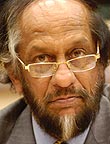 Rajendra Pachauri
In an interview with Yale Environment 360, Pachauri expressed disappointment that the U.S. has not yet committed itself to firm greenhouse gas reduction targets, saying “one expected a lot more to have happened in the U.S. by now.” During the eight years of the Bush administration there was a “complete absence of responsibility” in tackling global warming, Pachauri said, and while the Obama administration is moving swiftly to make up lost ground, climate legislation remains bogged down in Congress.
As a result, Pachauri explained, the world community may move ahead with a treaty without the U.S., creating a “small window of opportunity for the U.S. to take a little more time and come back and make its own commitments.” One reason the U.S. Congress may feel compelled to act, Pachauri suggested, is that American business — particularly in the renewable energy sector — may suffer if the U.S. is left out of a global climate treaty.
Speaking with Roger Cohn, editor of Yale Environment 360, Pachauri — who is director of the Yale Climate and Energy Institute and the The Energy and Resources
Institute in India — laid out the three requirements for success in Copenhagen, and said the world community would be making a “grave mistake” if it fails to act in Copenhagen. Said Pachauri, “I don’t think the world can afford the luxury of not arriving at an agreement.”
Yale Environment 360: I wanted to start by asking you about the obvious thing that’s on everybody’s mind, the upcoming conference in Copenhagen in December. It’s obviously a key conference and there’s been a great deal of pessimism in recent weeks about the chance for really substantive action in Copenhagen on climate change. What do you see as the picture for heading into Copenhagen at this point, and what do you think can realistically be accomplished there?
Rajendra Pachauri: Well, I am cautiously optimistic because undoubtedly, there’s very slow progress as far as negotiations are concerned. And that to some extent is to be expected, because different countries and parties are jockeying for position. They are trying to carry out maneuvers by which they protect their own positions and try to get the best of the deal that’s expected over there.
If the rest of the world is willing to move toward low-carbon technologies, U.S. business doesn’t want to be left behind.”
But the good news is that all the leaders of the world realize that this is a problem that cannot be ignored much longer. And therefore we have a remarkable opportunity during COP15 [the Conference of the Parties inCopenhagen], when hopefully the leadership of the major countries in the world will bring to bear on the negotiators, their negotiators, what needs to be done, what kinds of compromises to make. So I’m expecting that in the remaining few weeks, we will see some hectic activity as a result of which, possibly down to the midnight hour, we might get an agreement. I hope it’s a reasonably satisfactory agreement because the last thing that the world needs today is a weak agreement that doesn’t really help in mounting an effort at the level that’s required globally. So I remain cautiously optimistic, and I’m hoping that things will work out in the end.
e360: But you’re cautiously optimistic and you said you’re hoping we might get an agreement. That’s far different than it looked earlier in the year. Have things made a lot less progress and look a lot bleaker than they did earlier in the year?
Pachauri: Yes, well, to be quite honest, one expected a lot more to have happened in the U.S. by now. But as you know, legislation is bogged down in Congress. We have the Waxman-Markey bill having gone through the House of Representatives, and now we have the Kerry-Boxer bill in the Senate. But it’s not quite clear whether that would get passage within this year, and before the Copenhagen meeting. But I think the world will have to find some way by which they’re able to make a special provision for the U.S. if we don’t get this legislation in place.
e360: A special provision meaning, for instance?
Pachauri: In other words, the U.S. may have to be given some more time to get its act together, and that I think will hopefully put some pressure on Congress and the public in this country. And I hope even business and industry would realize the benefit of being part of the global agreement and being behind it. Because let’s face it, if the rest of the world is willing to move ahead towards low-carbon technologies, U.S. business doesn’t want to be left behind, because if they are, they’ll lose market share all over the world.
e360: Are you suggesting that there could be some kind of agreement reached in Copenhagen of which the U.S. would not be a part, and could that really happen and be substantive?
Pachauri: Well, the U.S. will have to be a part in some form or another. But I’m only
speculating, if there isn’t complete involvement on the part of the U.S., then the U.S. may be given some additional time to come up with commitments that hopefully will be ratified by the next COP.
e360: So you see a situation where no firm agreements would come out of Copenhagen and there would be plans for a subsequent meeting?
Pachauri: No, I’m expecting that we get an agreement, but the missing party at the table would be the U.S. And there might be a clear provision that the U.S. will come back by so and so date with a clear commitment, which of course all the parties will have to agree to, for meeting the requirements of this agreement, and to ensure that the U.S. will also reduce emissions by 2020 at an acceptable and satisfactory level.
e360: But if there’s nothing passed in Congress by that time, how can the U.S. guarantee or commit itself to doing that?
Pachauri: That’s entirely true. The U.S. will not be able to make a commitment. I don’t know how one might be able to find language in an agreement that allows the U.S. a little bit of time, while the others take on firm commitments by 2020. I think if that happens, my own belief is there’ll be so much moral pressure on the U.S., and possibly a great deal of pressure from business and industry, to get things in place, that hopefully something will happen.
e360: Do you think without U.S. involvement or a U.S. commitment in Copenhagen, with the U.S. being one of the world’s two largest emitters of carbon, do you think it’s realistic to think that other nations will have the incentive to do so?
I think there’s a record of complete absence of responsibility on the part of the U.S.”
Pachauri: Well, I agree, the U.S. not being part of the deal, or part of a common deal, is clearly a major handicap, because in Europe and other parts of the world, this is one stumbling block which is preventing anagreement at this point in time. But I believe there’s enough resolve in Europe, in Japan, and other parts of the world to move on, that we might actually see an agreement which involves all the other parties, but leaves a small window of opportunity for the U.S. to take a little more time and come back and make its own commitments. So basically, one would be allowing the U.S. to remain outside the deal, but give it time to come back and make its commitments, which of course all the parties will have to agree to.
e360: What is the minimum that you think needs to be accomplished in Copenhagen?
Pachauri: I think there are three things that’ll have to be part of an agreement. Firstly, commitment to reduce emissions by the developed countries, through 2020. I think that’s essential. And that also accords with what the IPCC [Intergovernmental Panel on Climate Change] has brought out in the Fourth Assessment Report, where we clearly said that if you want to limit temperature increase to 2 to 2.4 degrees Celsius, then 2015 is the year when global emissions will have to peak, and then decline thereafter. Now that clearly implies that you ought to have very clear targets for 2020 at the latest. So I think that’s one important element of an agreement.
The second would be some commitment to provide money on the table to help the developing countries, both in adaptation as well as mitigation actions. And the third would be to provide some facilitation for access to technologies that are required in the rest of the world. So I think if these three things are there, then perhaps the majority of the countries that are part of COP will agree to a deal.
e360: But these commitments would need to be more than targets. They would need to be binding?
Pachauri: They’ll have to be binding, and there will have to be some provisions for penalties for those who don’t comply with the targets, because we’ve seen that with the Kyoto Protocol [of 1997]. A lot of parties are way behind even the commitments that they accepted [as part of the Kyoto Protocol]. So we really can’t allow that to continue in the future, and this agreement will have to be binding in every sense of the term.
e360: You mentioned technology transfer and adaptation in developing countries, and funds for that. That’s something that India’s Environmental Minister has been pushing hard for. Do you see action on that happening in Copenhagen, and what specific action do you see in those areas of technology transfer and adaptation?
I don’t think the world can afford the luxury of not arriving at an agreement.”
Pachauri: Well, I see two possibilities. You might have some kind of a fund, global technology fund or whatever one wants to call it, that wouldessentially provide money for commercial transfer of technologies of some specific types that may or may not be specified. The other possibility would be to provide low-interest financing for some of these technology deals that would take place, transferring know-how and technological knowledge from the North to the South. So I think these are being discussed, and I frankly don’t see too much of a problem in agreement on that.
e360: What kind of price tag do you see involved in the technology transfer and adaptation measures?
Pachauri: Well, you know, some time back, Prime Minister Gordon Brown of the UK had come up with this figure of $100 billion a year as being the sort of target that the developed world must have for helping the rest of the world with climate change actions. So to me, that seems like something to begin with. It may not happen immediately, but maybe in the next two or three years, you could have a fund, you could have a total package of support, which reaches something close to $100 billion.
e360: And that’s just for technology transfer?
Pachauri: No, this would be…
e360: And adaptation?
Pachauri: This would be everything, yes, including mitigation… How this will be carved up and who’s going to implement it is really an issue.
e360: But it’s been an issue. Haven’t the developed nations agreed to this in the past and not delivered?
Pachauri: That’s true, that’s entirely true. But I think the pressure now is strong enough and it seems to me that there’s a shift in position on the part of the developed countries that might make this a feasible program, at least after COP15.
e360: So you really seem to be saying that the failure of the U.S. to act on this has been the major stumbling block to progress. Do you feel that’s true?
Pachauri: Well, I think it’s a huge gap. It just presents a major gap in the overall global picture. I don’t fault the current administration. They have done their best. They have clearly moved very rapidly in a short period of time, but, you know, you have eight-plus years of backlogs when the U.S. completely denied, firstly the fact that there was any such thing as human-induced climate change, and secondly, they just felt that there was no need for multilateral action. So I think there’s a record of complete absence of responsibility on the part of the U.S. And now for this administration to make up that gaping hole is not going to be easy, and it’s certainly not proving easy. So the U.S. certainly, for historical reasons, has been completely a missing quantity in this whole initiative.
e360: As there’s been growing concern that Copenhagen is not going to accomplish all that had been hoped and thought was necessary, there’s been talk already that there’s going to need to be some follow-up meetings in 2010, so what had originally thought to be accomplished this year can be accomplished next year. Do you think that’s going to be necessary, and do you support that idea?
Pachauri: Well, I think our efforts should be to see that we arrive at a final deal in December. But one expects that there will be a few loose ends. I mean, if you take the case of the U.S., perhaps the U.S. will have to come back with its own plan of action. There might be other loose ends to tie up, but I think the basic structure and the major provisions of the agreement should certainly fall in place by December. And whatever is required in 2010 by way of tidying up any loose ends certainly may require additional meetings, or maybe one additional meeting.
But I don’t think the world can afford the luxury of not arriving at an agreement. That to me would be a grave mistake. That’s going to sap confidence all around, because after three years of negotiations, if we still can’t arrive at an agreement, when the science has been so compelling, the public awareness on the subject has been so widespread, and the leadership of the world has at least expressed its commitment to do something, then despite all these assets, if we’re not able to arrive at an agreement, that spells very bad news for the future.
e360: You attracted widespread attention some months ago when you said, as an individual, not as chairman of the IPCC, you supported calls to reduce atmospheric CO2 concentrations at a level of below 350 parts per million. What led you to take that position, and knowing that it would be controversial, why did you choose to go public with that?
Pachauri: Well, you know, I’ve been getting increasingly concerned at several observations all around. If you look at sea level rise, and this is something that you can take out of the IPCC Fourth Assessment Report, even with a 2 degree increase in temperature, we will get sea level rise on account of thermal expansion alone, of 0.4 to 1.4 meters. So let’s say we were to end up in the middle of that range, you’re talking about at least 2 feet of sea level rise. Now if that happens, it’s bad news for several parts of the world. The Maldive Islands, which are barely a meter above sea level, most of those islands, extensive areas of Bangladesh, a country of 160 million people, and there are other regions, including parts of the U.S., that will be completely devastated. And therefore even the 2-degree limit that we’re talking about, which corresponds to say about 450 parts per million, is pretty bad news. I just couldn’t keep my eyes closed to that reality.
And you see so much happening all around. Look at the melting of the glaciers all over the world. What are the implications of that? Look at the impacts on agriculture. We ourselves in the IPCC have projected that as early as 2020, we would see certain African countries suffering a decline of 50 percent in agriculture, and these are countries that have massive malnutrition, hunger all around. And if they have a decline of 50 percent, what does that mean? We are asking for disaster.
As a human being, I just couldn’t keep quiet in the face of all this overwhelming evidence. I know it’s probably not right for me to take a position such as this, but on the other hand, I think it would be totally immoral on my part not to take a position, so I came out and said so.