In the summer of 2000, Canadian park warden Angus Simpson and his colleagues were camped along the north coast of the Yukon Territory near the Alaskan border, conducting a survey of archeological sites. With little warning, a powerful storm blew in, driving a surge of water from the Beaufort Sea onto the land and forcing Simpson’s group to make a harrowing trip through 12-foot high waves to get to safety on Herschel Island, a few miles off the coast.
At the height of the gale, Inuit families camped on low-lying land along the Arctic coast had to be airlifted out by helicopter. Inuit elders said the storm was one of the worst they had ever seen: The historic whaling settlement of Herschel Island was flooded, several important archeological sites along the coast of the Yukon and Alaska were swept into the sea, and the Inuit community of Tuktoyaktuk was 10 meters closer to dropping into the ocean.
The gale and the wall of water that swept over the low-lying land along the Yukon shore were typical of a growing phenomenon in the Arctic, one with important environmental and social implications: As Arctic Ocean ice disappears and waves build over ever-larger stretches of open water, the Arctic coastline is being buffeted by more intense gales that are driving storm surges onto the land and into freshwater river deltas. Among the consequences are not only the accelerating erosion of Arctic coastline, but the destruction and transformation of parts of some freshwater ecosystems because of saltwater intrusion.
One stretch of Alaska coastline lost 28 feet of land per year between 2002 and 2007.
A recent study conducted by Benjamin Jones of the U.S. Geological Survey found that a 40-mile stretch of Alaska coastline along the Beaufort Searetreated an average of 6.8 meters (22 feet) per year between 1955 and 1979; over the next 23 years, that rate increased by another six feet per year. The low-lying coastline then lost 28 feet of land per year between 2002 and 2007, and 45 feet between 2008 and 2009. These extreme losses are due not only to greater exposure of the land to storms from an increasingly ice-free Arctic, but also to melting permafrost that hastens crumbling of the coastline.
A study published last month showed another insidious impact of the growing number of Arctic storm surges. Canadian scientists researched the effects of a massive surge of seawater from the Beaufort Sea that in 1999 pushed 12 miles inland along the Mackenzie River delta in Canada’s western Arctic, flooding lakes, streams, and hundreds of square kilometers of tundra vegetation. The effect of that influx of seawater into the delta transformed the affected areas, killing nearly 90 percent of the alders, which shriveled in the now-salty soil. In addition, scientists documented a dramatic increase in a salt-loving algae — Navicula salinarum — in one inland lake, suggesting that the freshwater system affected by the flooding was being transformed into a new, more saline ecosystem.
John Smol, a biologist at Queen’s University in Ontario and co-author of the paper on the Mackenzie River delta, which appeared in the Proceedings of the National Academy of Sciences, said that “where there was once an abundance of freshwater species, there is now only those that can live in sea water.” The Inuit say that the so-called dead zone has become inhospitable territory for the caribou, muskoxen, and freshwater shore birds that traditionally grazed and nested in this region.
According to Smol and his colleagues, the impact of this surge of water was unlike anything seen in the last thousand years.
‘Arctic storms are increasingly going to take their toll on larger and larger tracts of land,’ says one expert.
“Much of it is still a dead zone,” says Smol. “It changed the chemistry of the lakes and the soil in a very fundamental way. What little has come in to replace it is nothing like what was once there. In my mind, this is a bellwether of things to come in the Arctic now that climate change is accelerating. As sea levels rise, permafrost thaws, and sea ice melts, Arctic storms of the future are increasingly going to take their toll on larger and larger tracts of land.”
To date, the surges have been most intensely felt in northwestern Canada and northeast Alaska, where winds blowing over ice-free water in the summer can create large storm surges. These surges are particularly bad in the Beaufort and Chukchi seas and parts of the Bering Sea because of the shallow water there. The water being pushed towards shore has to go somewhere. If it is deep, the water can simply descend to greater depths when it nears the coast. If it is shallow, however, the water is forced up onto the land.
The impact of this relatively warm, salty water coming onto shore is exacerbated by the fact that 50 to 70 percent of the soil consists of frozen water — a “dirty iceberg,” as geomorphologist Robert Anderson of the University of Colorado at Boulder describes it. Once it comes into contact with the warmer water, it falls apart and slips into the sea.
Anderson and other researchers believe that as the Arctic Ocean becomes increasingly ice-free, storm surges will affect ever-larger areas of shoreline in the Arctic basin, including Russia’s immense Arctic coastline, which stretches many thousands of miles.
“No other coastal landscape in the world is as vulnerable,” says Anderson, who has a research camp on the north coast of Alaska between Barrow and Prudhoe bays. “From the western Arctic of Canada to the north slope of Alaska and Siberia, the landscape is very flat. When you fly over this territory, you can see how even the smallest surges can have an impact when there is little or no sea ice.”
A History of Surges
Storm surges have hit the Arctic coastline throughout recorded history. Scientists at the University of Alaska Fairbanks reported evidence of 90 storm surges, some as high as 13 feet, on the west coast of Alaska from 1898 to 1980. The big difference now, however, is that the surges are becoming more frequent and intense as the rapid loss of sea ice alters the physics of storms and wave action in the Arctic Ocean.
The farther away the pack ice is from shore, the greater the distance of open water over which the wind can blow, which is known as fetch. That means that more energy is transferred to the water, creating larger waves.
The situation is expected to worsen considerably if sea levels rise by 3 to 6 feet this century.
“The greater the fetch,” says storm surge modeler David Atkinson of the University of Victoria in Canada, “the greater potential for a surge.”
In addition, notes Atkinson, land-fast sea ice protects the coastline from surges. And the less ice floating on the ocean, the more opportunity for the wind to transfer its energy to the water, since floating ice tends to absorb wave energy. “No floating ice equals no wasted energy,” says Atkinson.
The situation is expected to worsen considerably if, as many experts project, sea levels rise this century by as much as 3 to 6 feet as ice sheets and glaciers melt.
The impact of storm surges and wave action on coastlines in the western Arctic is now being well documented. Anderson, for example, has seen signs of surges sweeping onto the tundra and killing the vegetation. What concerns him even more is the coastal erosion threatening thousands of freshwater lakes and river deltas lining the western Arctic shoreline. As the thin strips of land that separate the coast’s freshwater lakes from the Arctic Ocean disappear, many of these lakes are draining into the sea.
“I am not a biologist, but it doesn’t require a lot imagination to see how all those geese and ducks that we see flying to the Arctic each year to nest on these tundra lakes will be affected,” says Anderson.
It’s not just geese and ducks, or muskoxen and caribou, that are vulnerable. Eskimo communities such as Shismareef in Alaska will likely have to be relocated for similar reasons, as little can be done to stop those coastal communities from sliding into the sea.
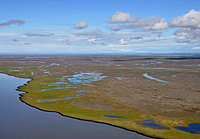
The impact of the 1999 surge on parts of the Mackenzie River delta is a sign of how Arctic coastal ecosystems could change as the sea and storm surges work their way inland. That surge was the largest yet documented in Canada’s western Arctic; Smol says it is probably a sign of things to come.
He and colleagues from Queen’s and Carleton universities collected tree ring samples from live, stressed, and dead specimens at 10 sites in the flood zone. They found that more than half the alders dried up within a year. Over the next four years, 37 percent of the remaining trees were killed by the salty soil. Ten years after the surge, high salt concentrations still contaminate the soil. And an examination of sediments from inland lakes showed a pronounced shift in the affected area from a freshwater to a saltwater ecosystem. These striking changes in vegetation and wildlife were first noticed by the region’s Inuit, who brought the situation to the scientists’ attention and helped them conduct their research.
Comprised of 45,000 shallow lakes, the Mackenzie Delta is one of the largest and most productive freshwater Arctic deltas in the world. But it is just a small part of a vast network of deltas and wetlands in the Arctic vulnerable to surges. No one has yet done a study of these surges in many other Arctic regions, but given their proximity to the coastline, it’s likely that many of these wetlands have been similarly affected.
“This was one of the biggest surge events in the past 1,000 years,” says Smol. “Understanding the impact it had on this ecosystem will help us better understand how vulnerable other places like it are along the coastlines of the Arctic.”