10 Nov 2011: Report

Military Bases Provide Unlikely
Refuge for South’s Longleaf Pine

The expanses of longleaf pine forest that once covered the southeastern United States have been whittled away to just 3 percent of their original range. But as scientists are discovering, this threatened forest ecosystem has found a sanctuary in an unexpected place — U.S. military installations.

by bruce dorminey

Down a narrow dirt road at the Third Infantry Division’s home base of Fort Stewart, Georgia, Joe Veldman pulls into a sand-hill landscape covered with turkey oak, saw palmetto, and, most crucially, a healthy stand of longleaf pine.

At first glance, this hardscrabble ecosystem on one of the U.S. Army’s largest installations appears to have seen better days. But Veldman, a plant ecologist at the University of Wisconsin, politely demurs. “If every place in the Southeast were like this, we wouldn’t be doing any research,” he said. “This area is in good shape.”

From Virginia to Texas, the longleaf pine has seen its historical habitat reduced to a mere 3 percent of its original 92 million-acre range. Centuries of logging and farming have exacted a heavy toll on these ecosystems, and in recent decades the Southeast’s economic boom has led to large tracts of longleaf pine being razed for housing, malls, and office parks.

As it turns out, however, military bases such as Fort Stewart have become a key refuge for longleaf pine. And now the U.S. Department of Defense is funding several independent, long-term studies on how to restore some of
‘That the military keeps large chunks of intact land is a godsend for these ecosystems.’
the pine’s ecosystems — one of the most biodiverse environments north of the tropics — to their former glory. Data gleaned from these studies will help the broader longleaf research community conduct longleaf restoration on government and private land across the Southeast; conservationists have set a 15-year goal of restoring the longleaf pine from its current 3.4 million acres to 8 million acres, or levels approaching 9 percent of its historical range.

“Longleaf pine habitat usually gets chopped down and paved,” said John Orrock, a conservation biologist at the University of Wisconsin and the Fort Stewart understory study’s onsite project leader. “That the military actually keeps large chunks of intact land is a godsend because the danger for these ecosystems is that they get developed into something like Walmart.”

Orrock and Veldman are a part of a $1.8 million study, involving some 25 researchers at three locations: Fort Stewart; Fort Bragg, North Carolina; and South Carolina’s Savannah River nuclear site. The study’s main goal is to understand how best to restore the longleaf’s diverse understory.
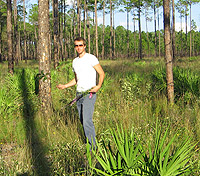
Pineleaf ecosystem
Bruce Dorminey
Plant ecologist Joe Veldman in a longleaf pine ecosystem in Fort Stewart, Georgia
For its part, the military has found longleaf pine habitat ideal for troop maneuvers. “The openness of the longleaf pine and the thin stands provides visibility and maneuverability that is very consistent with what a mechanized force like the Third Infantry division likes to fight in,” said Tim Beaty, a U.S. Army wildlife biologist.

And while it may seem counter-intuitive, military bases have proven to be hospitable places for longleaf pine ecosystems. This ancient, fire-resistant species depends on random fires to thin the understory and rid itself of competitors, creating an unexpected synergy between live-ammunition maneuvers — which often lead to small blazes — and a thriving longleaf pine ecosystem.

“When it comes to longleaf pine management, the military is by far the best,” said John Kush, a forest ecologist at Auburn University.


In the early 19th century, vast expanses of longleaf pine stretched inland from the coasts of the Atlantic and Gulf of Mexico for hundreds of miles, creating a sense of unrelenting monotony. Travelers in Georgia reported a feeling of dread and loneliness upon entering seemingly endless stretches of this forest, where row upon row of tall, straight longleaf pines towered over an understory rife with astors, morning glories, rosemary, huckleberries, wax myrtle, winged sumac, and wiregrass. Deer, feral pigs, rattlesnakes, wild turkey, and bobwhite quail were found in abundance.

Today, some 66 percent of longleaf pine forest remains in private hands, primarily in southwest Georgia, the Florida panhandle, and south Alabama. Much of this land is being logged or farmed, although today a younger generation of owners is only too willing to sell their inheritance to developers.

The Alabama-based Longleaf Alliance — the nation’s oldest longleaf conservation group — is working to educate private owners about both the aesthetic and economic benefits of maintaining a longleaf ecosystem. Longleaf pine is still in high demand as timber, primarily for utility poles,
Agriculture can spoil longleaf habitat for up to a century after cultivation.
and selective logging can preserve these ecosystems.

Rhett Johnson, a forest ecologist and the president of the Longleaf Alliance, said that restoring longleaf forests on former agricultural land is a major challenge, since plant seeds that once made up the ecosystem’s diverse understory have often disappeared. This is where the scientific work on military bases may be helpful, as Orrock and his colleagues are now studying how best to restore former farmland.

Almost half of Fort Stewart’s 279,270 acres lie in longleaf pine ecosystems; but before it became a military base some 70 years ago much of its acreage was either under cultivation or grazed. Orrock and his team have established 36 experimental sites at Fort Stewart alone and are placing an emphasis on how to restore the diverse understory found in pristine longleaf pine ecosystems. The team’s preliminary results indicate that agriculture can spoil longleaf habitat for decades — even a century — after cultivation. Restoration of former farmland, often now covered in loblolly pines, would likely require clear-cutting and starting from scratch.

“Our work shows that sites that were in agriculture many years ago still have much less diverse communities,” said Orrock. “The exciting part for us is whether or not these lasting effects of the past can be undone with our current experiments.”

The military base studies also are underscoring that in longleaf pine ecosystems, fires are as welcome as a healthy rain. Longleaf pine seedlings actually need fire to ensure the ecosystem maintains an open canopy, providing the young, shade-intolerant pines with sunlight. Without fire, broadleaf trees like sweetgum and water oak thrive and eventually cast the understory in permanent shade.

Joe Veldman noted the importance of fire as he drove me to research plots scattered around Fort Stewart. We headed along a two-lane blacktop that threads its way through thousands of acres of mixed woodland and Army live-fire ranges. Veldman stopped at an area known as sector E-22, not far from a Cold War-era mock enemy interrogation camp. Much of E-22 is an area of formerly cultivated farms, and the things growing there now — loblolly, jasmine, and wild vines of the muscadine grape — typically colonize old fields.

Later, walking through a stand of longleaf pine, Veldman pointed to a nearby seedling that could be easily mistaken for an oversized clump of grass. Such young seedlings can remain within two feet of the surface for
In longleaf pine ecosystems, fires are as welcome as a healthy rain.
five years or more, then enter a phase where they can quickly spurt by as much as four to five feet per year. But as long as the seedling’s dominant growth bud is below or near the surface, Veldman explains, fires can burn right over it, leaving it unscathed. Mature longleaf pine, which have potential lifespans of 500 years or more, are relatively immune from the ravages of wildfire, since their thick bark offers them protection.

Orrock, Veldman, and their colleagues are testing the assumption that understory diversity is maintained by a longleaf pine ecosystem that thrives on frequent fire. “Within the span of one square meter,” said Orrick, “it’s exciting to see 30 to 40 different plant species in really pristine longleaf pine understories.”

From ground level, it’s clear why the military would like this type of landscape for training. There's enough territory and tree cover for camouflage maneuvers, and during live-fire exercises there is ample room to maneuver tanks and Humvees in a park-like landscape. And if their ordnance happens to start a fire? So much the better.

Depending on drought conditions, as many as 200 wildfires per year are started by ordnance, smoke grenades, and signal or illumination flares. On average, these training-related fires consume no more than 2,000 acres per year, and most are allowed to burn out on their own, except when they present a significant safety danger due to smoke.

In addition to funding studies of longleaf pine restoration, the Department of Defense is readying itself for an era in which its military bases have to account for their carbon footprint. Longleaf pine ecosystems can help the military do that through carbon sequestration. Another five-year, military-funded study — led by Lisa Samuelson, an eco-physiologist at Auburn University — will focus on measuring carbon storage and ecosystem biomass at Camp Lejeune, North Carolina; Fort Polk, Louisiana; and Fort Benning, Georgia. The project’s ultimate goal is to help the Department of Defense develop a carbon sequestration plan.

MORE FROM YALE e360

What’s Killing the Great
Forests of the American West?

What’s Killing the Great Forests of the American West?
Across western North America, huge tracts of forest are dying off at an extraordinary rate, mostly because of outbreaks of insects. Scientists are now seeing such forest die-offs around the world and are linking them to changes in climate, science journalist Jim Robbins reports.
READ MORE
The military is also charged with helping retain and restore threatened species on military bases. At Fort Stewart, these include the red-cockaded woodpecker and the gopher tortoise, which relies on the uncluttered understory of longleaf ecosystems to move through the landscape.

Even though aesthetics and endangered wildlife might seem to be the least of the Army’s worries, it’s hard not to be impressed when standing in the midst of such an ancient ecosystem. Near the end of a rutted fire road that disappeared into a longleaf horizon, Veldman and I stood and took it all in. The only sound was the lonely swoosh of wind in the pines. Standing there, it was easy to imagine these pines as they once were, ubiquitous and untouched.

POSTED ON 10 Nov 2011 IN Biodiversity Forests Oceans Policy & Politics Water North America North America 

COMMENTS


The statement, 'the military has found longleaf pine habitat ideal for troop maneuvers ... "The openness of the longleaf pine and the thin stands provides visibility and maneuverability that is very consistent with what a mechanized force like the Third Infantry division likes to fight in,” said Tim Beaty, a U.S. Army wildlife biologist.' makes me wonder when such ideal conditions for mech ops would be available. In the "real world" are such ideal areas proper training fields for future combat? Or just wishful thinking for a mech infantry disneyland?

Posted by pete saussy on 10 Nov 2011


Where is H. H. Chapman when we need him?

Check his work on longleaf pine in the 1930's and 40's.

Posted by Francis H. Clifton, MF. "48 on 10 Nov 2011


Yes, it is good to see that H H Chapman's observations are still valid.

Posted by Lester Bradford on 10 Nov 2011


There's so much potential for good within the military establishment that one almost feels it's a microcosm of the larger society--the constant battle to promote its better angels comes to mind.

Posted by TRB on 19 Nov 2011


TRB, love that, "promote its better angels". I think much of the good the military does isn't promoted. I lived on Camp Pendleton when I was a teenager in the 80s and remember being told it was a wildlife refuge. Whether that was true or not while I lived there I saw a mountain lion just across the street from my house and many coyotes and coyote puppies. If you found a rattlesnake you didn't kill it, you called to have it removed. And if you had small animals you made sure they were inside at night so the coyotes wouldn't get them.

Posted by J. Bernier on 24 Nov 2011


I enjoyed the article. It is very true about what the military is doing for the longleaf ecosystem. I am a forest technician at Ft. Rucker, Al. We work very hard to preserve, maintain, and restore the longleaf habitat. We took a core sample of one the flatten topped longleaf that was over 130 years old. It was very cool. Thanks, Troy Dunn.

Posted by Troy Dunn on 09 Feb 2012


POST A COMMENT

Comments are moderated and will be reviewed before they are posted to ensure they are on topic, relevant, and not abusive. They may be edited for length and clarity. By filling out this form, you give Yale Environment 360 permission to publish this comment.

Name 
Email address 
Comment 
 

bruce dormineyABOUT THE AUTHOR
Bruce Dorminey is a science journalist and author of the book Distant Wanderers: The Search for Planets Beyond the Solar System. A former Hong Kong bureau chief for Aviation Week & Space Technology magazine and a former Paris-based technology correspondent for the Financial Times, he has written about everything from potato blight to dark energy. He is a frequent contributor to Astronomy magazine and has written about climate change and the environment for The Daily Climate, Climate Central.org and Miller-McCune.com.


RELATED ARTICLES


Fighting A Last-Ditch Battle
To Save the Rare Javan Rhino

Rhinoceroses worldwide are under siege as their habitat shrinks and poachers slaughter hundreds annually for their valuable horns. Now, in Indonesia, conservation groups are engaged in a desperate struggle to save the last 40 Javan rhinos on earth.
READ MORE

As Threats to Biodiversity Grow,
Can We Save World’s Species?

With soaring human populations and rapid climate change putting unprecedented pressure on species, conservationists must look to innovative strategies — from creating migratory corridors to preserving biodiversity hotspots — if we are to prevent countless animals and plants from heading to extinction.
READ MORE

Digital Defenders: Tribal People
Use GPS to Protect Their Lands

From the rainforests of central Africa to the Australian outback, indigenous people armed with GPS devices are surveying their territories and producing maps they can use to protect them from logging and other outside development.
READ MORE

Busting the Forest Myths:
People as Part of the Solution

The long-held contention that rural forest communities are the prime culprits in tropical forest destruction is increasingly being discredited, as evidence mounts that the best way to protect rainforests is to involve local residents in sustainable management.
READ MORE

As Roads Spread in Rainforests,
The Environmental Toll Grows

From Brazil to Borneo, new roads are being built into tropical forests at a dizzying pace, putting previously intact wilderness at risk. If we hope to preserve rainforests, a leading researcher says, new strategies must be adopted to limit the number of roads and reduce their impacts.
READ MORE


MORE IN Reports


Africa’s Ambitious Experiment
To Preserve Threatened Wildlife

by caroline fraser
Five nations in southern Africa are joining together to create a huge conservation area that will extend across their borders and expand critical territory for elephants. But can these new protections reverse decades of decline for area wildlife while also benefiting the people who live there?
READ MORE

Melting Sea Ice Could Lead
To Pressure on Arctic Fishery

by ed struzik
With melting sea ice opening up previously inaccessible parts of the Arctic Ocean, the fishing industry sees a potential bonanza. But some scientists and government officials have begun calling for a moratorium on fishing in the region until the true state of the Arctic fishery is assessed.
READ MORE

Solar Windows: Transforming
Buildings Into Energy Producers

by dave levitan
The vast amount of glass in skyscrapers and office buildings represents enormous potential for an emerging technology that turns windows into solar panels. But major questions remain as to whether solar windows can be sufficiently inexpensive and efficient to be widely adopted.
READ MORE

Fighting A Last-Ditch Battle
To Save the Rare Javan Rhino

by rhett butler
Rhinoceroses worldwide are under siege as their habitat shrinks and poachers slaughter hundreds annually for their valuable horns. Now, in Indonesia, conservation groups are engaged in a desperate struggle to save the last 40 Javan rhinos on earth.
READ MORE

Insurance Companies Face
Increased Risks from Warming

by ben schiller
If the damages related to climate change mount in the coming decades, insurance companies may face the prospect of paying larger disaster claims and being dragged into global warming lawsuits. But many firms, especially in the U.S., have barely begun to confront the risks.
READ MORE

Hopes Fade for Cleanup
In Nigeria’s Oil-Rich Delta

by fred pearce
The Ogoniland region of Nigeria has long been badly polluted by decades of oil production that has fouled the delta and contaminated drinking water. A United Nations report has recommended a massive recovery initiative, but so far the Nigerian government has shown few signs it will agree to the cleanup project.
READ MORE

Betting on Technology to
Help Turn Consumers Green

by marc gunther
U.S. consumers tell researchers they want to buy environmentally friendly products, but so far they haven’t been doing that on a large scale. Now a host of companies and nonprofits are trying to use new technology — from smartphones to social networking — to make it easier for buyers to make the green choice.
READ MORE

U.S. Fossil Fuel Boom
Dims Glow of Clean Energy

by keith schneider
A surge in gas and oil drilling in the U.S. is helping drive the economic recovery and is enhancing energy security. But as the situation in Ohio shows, cheaper energy prices and the focus on fossil fuels has been bad news for the renewable energy industry.
READ MORE

Can Reforming the Farm Bill
Help Change U.S. Agriculture?

by jim robbins
For decades, farm bills in the U.S. Congress have supported large-scale agriculture. But with the 2012 Farm Bill now up for debate, advocates say seismic shifts in the way the nation views food production may lead to new policies that tilt more toward local, sustainable agriculture.
READ MORE

Scientists Warn of Low-Dose
Risks of Chemical Exposure

by elizabeth grossman
A new study finds that even low doses of hormone-disrupting chemicals — used in everything from plastics to pesticides – can have serious effects on human health. These findings, the researchers say, point to the need for basic changes in how chemical safety testing is conducted.
READ MORE


e360 digest
Yale
Yale Environment 360 is
a publication of the
Yale School of Forestry
& Environmental Studies
.

SEARCH e360


Donate to Yale Environment 360

CONNECT

Twitter: YaleE360
e360 on Facebook
Donate to e360
View mobile site
Bookmark
Share e360
Email newsletter
Subscribe to our feed:
rss


ABOUT

About e360
Contact
Submission Guidelines
Reprints

e360 VIDEO

Warriors of Qiugang
The Warriors of Qiugang, a Yale Environment 360 video that chronicles the story of a Chinese village’s fight against a polluting chemical plant, was nominated for a 2011 Academy Award for Best Documentary (Short Subject). Watch the video.


DEPARTMENTS

Opinion
Reports
Analysis
Interviews
e360 Digest
Video Reports

TOPICS

Biodiversity
Business & Innovation
Climate
Energy
Forests
Oceans
Policy & Politics
Pollution & Health
Science & Technology
Sustainability
Urbanization
Water

REGIONS

Antarctica and the Arctic
Africa
Asia
Australia
Central & South America
Europe
Middle East
North America

e360 VIDEO REPORT

When the Water Ends
As temperatures rise and water supplies dry up, tribes in East Africa increasingly are coming into conflict. A Yale Environment 360 video reports on a phenomenon that could become more common: how worsening drought will pit groups — and nations — against one another. Watch the video.

e360 MOBILE

Mobile
The latest
from Yale
Environment 360
is now available for mobile devices at e360.yale.edu/mobile.


header image
Top Image: aerial view of Iceland. © Google & TerraMetrics.

e360 VIDEO REPORT

Leveling Appalachia
Leveling Appalachia: The Legacy of Mountaintop Removal Mining, an e360 video examining the environmental and human impacts of this mining practice, won the award for best video in the 2010 National Magazine Awards for Digital Media. Watch the video.


OF INTEREST


Yale