08 Dec 2008: Opinion

Regulators Are Pushing
Bluefin Tuna to the Brink

The international commission charged with protecting the giant bluefin tuna is once again failing to do its job. Its recent decision to ignore scientists’ recommendations for reducing catch limits may spell doom for this magnificent – and endangered – fish.

by carl safina

It’s one of the biggest, fastest, and most beautiful fish in the sea. It has captured the imaginations of people from Homer to Salvador Dali. But end-times loom for the giant bluefin tuna, whose chances of survival were greatly diminished in late November by the international commission charged with its care.

Once again, that body – the International Commission for the Conservation of Atlantic Tunas – refused to take strong action to prevent the runaway overfishing of the giant bluefin tuna in its sole remaining, yet rapidly disappearing, stronghold: the Mediterranean.

One of the sea’s few elite warm-blooded fish, bluefin tuna can reach three-quarters of a ton, swim at highway speeds, migrate across oceans, and visit coasts of distant continents. They’re also the world’s most valued fish (once they’re dead), and therein they hang by the tail.

Too valuable everywhere to be allowed to live anywhere, the giant bluefin tuna may be worth more money to a person who kills one than any other animal on the planet, elephants and rhinos included. A few years ago, a single 444-pound bluefin tuna sold wholesale in Japan for $173,600. One fish.

A 43-nation commission has public-trust management authority and a mandate to conserve. But the International Commission for the

Enlarge image
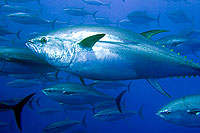
Tuna swim

Greenpeace
Bluefin tuna can grow to more than 1,000 pounds and migrate the full length of the Atlantic
Conservation of Atlantic Tunas has for its 40-year history merely acted as the fishing industry’s official, tax-funded conglomerate. Think of it as the International Conspiracy to Catch All the Tuna, and its record starts making sense. The commission’s resume on bluefin tuna graphs as plunging populations, down more than half in the Mediterranean and now free-falling, and down more than 90 percent in the west Atlantic.
The increasing rarity of bluefin—and escalating worldwide sushi madness—has only intensified fishing efforts. And as the fish diminish, demand further drives up the price of bluefin meat. As extinction nears, the fishing keeps escalating.

Fishing has already demolished bluefin populations. The last few decades have seen gold-rush bluefin fisheries disappear off Brazil, in the North Sea, and the southwest Pacific. Wherever they still swim, they are aggressively hunted.

Atlantic bluefin breed in only two places: the Mediterranean and Gulf of Mexico. From these two spawning areas they migrate throughout the whole North Atlantic, mingling in many fishing areas. But fish from these two populations do not interbreed; they are separate breeding stocks that, when not breeding, mix in many areas where they’re fished.

Either population could thrive or go extinct. Right now, both are in trouble. European and Mediterranean fishing is out of control. But the fish native to

More From Yale e360

Click below to read more on
oceans and fisheries from
Yale Environment 360.

A Corporate Approach to Rescuing the World’s Fisheries | Carbon’s Burden on the World’s Oceans
the North American side of the ocean are actually faring far worse. Catches reflect these different trajectories. While Europeans are killing almost twice their legal limit, U.S. fishermen are finding only a fraction of the fish they caught just ten years ago. So few fish remain in the west Atlantic’s bluefin population that in the last few years U.S. commercial bluefin fishers have been able to catch less than 15 percent of what they were allowed. In a word: collapse.

So, what did fishery managers just do? As they have for 20 years, they ignored their own scientists. For the east Atlantic and Mediterranean, the scientists had recommended drastic and immediate catch reduction from nearly 30,000 tons annually to 15,000 tons. Yet despite official warnings and calls for a catch ban, the sleepwalking ICCAT commissioners on Nov. 25 set the catch limit nearly half again as high: 22,000 tons. Having by incompetence, greed, and reckless industry interference caused the depletion of this magnificent and commercially important fish, the commissioners agreed to ensure further decline.

Excessive catch limits will ultimately prove self-defeating, yet short-term thinking prevails. For the Mediterranean and eastern Atlantic, ICCAT’s managers have allowed fishermen to catch half again what their own scientists recommended. And fishermen have ended up taking double what they’re allowed (the actual catch in 2008 was 61,000 metric tons), making every second bite at the sushi bar illegal.

What else is going on here? "The EU has bankrolled the decimation of bluefin stocks by subsidizing the new large fishing vessels that are responsible for overfishing, to the detriment of certain traditional fishing fleets,” said European Parliament member Raül Romeva, who attended the tuna commission meeting. “When the stocks are gone, the same ship owners who lobbied to overexploit bluefin tuna will come cap in hand for more EU money.”

The U.S. has justifiable indignation over catches on the other side of the ocean. Bluefin tuna originating in the Mediterranean migrate to American fishing grounds, and rampant overfishing on that side of the Atlantic hurts fishing in U.S. waters. So the U.S. has an immediate interest in trying to inject some sanity to the fishing there.

But the U.S. should also have an interest in fixing its own problems at home, too. And it doesn't. The west Atlantic is fished by the U.S., Canada,
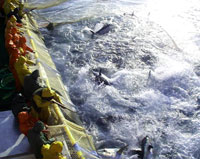
Tuna nets
As commercial fishing continues, bluefin populations continue to plummet on both sides of the Atlantic.
Mexico, and Japan. These countries agreed last month to cut the catch limit for the western Atlantic from the current 2,100 metric tons to 1,800 metric tons by the year 2010. Noble, right? No, not at all. Here’s the catch, literally: 1,600 tons. That’s the amount caught by the countries fishing the west Atlantic in 2007, a number that is actually less than what the “limit” will be reduced to two years from now. In other words, the limit is higher than the catch, so it’s not a limit at all. Effectively, it’s catch-as-catch-can. And yet in the U.S. National Oceanic and Atmospheric Administration’s press release on the tuna commission meeting’s outcome, America praised itself while expressing “extreme disappointment” at Europe. Finger-pointing by the U.S. obscures the fact that its own Gulf-spawning bluefin tuna population is in worse shape than the one spawned in the Mediterranean.

Gulf-spawned fish migrate up the east coast and into Canadian waters, spend about 12 years growing up, and then — if they’re still alive — return to the Gulf as giants to spawn. The NOAA press release highlights Europe’s failings (the dodge-tactic pioneered by U.S. fishermen), and most environmental groups join the chorus. But the fact is: While our last few native giants trickle in to the Gulf of Mexico to breed, our own fisheries agency allows U.S. boats to catch spawning fish. They’re allowed to keep one bluefin per trip while ostensibly fishing for other kinds of fish. But high prices mean the big tuna get targeted. And because they fish with hundreds of hooks and can keep only one bluefin, they kill — and dump — numerous spawners. If one were designing an extermination campaign, it would work just like this.

The World Conservation Union lists west Atlantic bluefin tuna as “critically endangered.” More dithering could doom the population—and for what? This kind of negligent management drives U.S. boats out of business anyway because ultimately the fish population is lost, and everyone loses. The United States could immediately fix this problem. It has full control of the west Atlantic population’s Gulf of Mexico spawning ground. Yet the killing continues, while U.S. fishery managers stonewall all criticism on the matter.

The United States can — and must now — suspend tuna fishing on the bluefin tuna’s U.S. spawning grounds during breeding season. Then we need an Atlantic-wide bluefin tuna fishing moratorium. After years of inaction and continuous decline, letting them spawn free of constant harassment and giving the populations a five-year cease-fire seems the only hope for saving the giant fish.

Conservationists must work to get the west Atlantic bluefin population listed under the Endangered Species Act. Meanwhile, the U.S. should seek legal action against European fishing countries under the Pelly Amendment for undermining the efficacy of officially agreed-to fishing limits. And management of international trade in bluefin tuna should be turned over to the Convention on International Trade in Endangered Species [CITES], which enacted the ban on ivory that saved Africa’s elephants. After all, it’s the export to Japan that drives this whole bloody mess.

POSTED ON 08 Dec 2008 IN Biodiversity Climate Energy Oceans Policy & Politics Policy & Politics Europe North America North America 

COMMENTS


Great summation Carl. One would think that policy makers would get this logic but they don't. As one person who wants to make a difference I started a social network @ http://www.savethebluefin.com. Here concerned individuals can have a voice. The one part that is missing from this fight is the voice of the public. A groundswell needs to happen here to move stakeholders further. Thanks for posting about this situation as every voice counts.
Posted by John 4 Bluefin on 08 Dec 2008


What a disgrace the ICCAT is. For years, they've favored the interests of the fishing industry over the fish. This time, it looks like they may really be delivering a death sentence for the bluefin.
Posted by Andrew Ruffalo on 11 Dec 2008


With half a century of living, traveling and working throughout the Americas in aquaculture and fisheries, I would say that your call for a ban on longline fishing in the Bluefin spawning grounds during its season is sensible and sufficient in itself to save the species, provided that the water quality is amenable to egg and fry survival, which is most often the problem when harvests are falling in such species.
Your five year moratorium is way over-reaching!
This type of irrational demand is what makes others think that none of your advice should be taken seriously.
Stop asking for the moon, and you will get what you really need to save this species.
Posted by Larry M. Adenl on 22 Dec 2008


Sadly, a five year moratorium may not be enough to save the Blue Fin. We consumers must look long and hard at what species we are threatening-- just by eating them up! I for one have given up sushi and all other tuna products as well.
Posted by Summer Rhodes on 31 Jan 2009


The only people pushing for a five year
moratorium do so for political alarmist
manipulation reasons, and not rebuilding the stock.
It's disgusting to see such immediate, knee-jerk
anti-statements posted after a thoughtful response
based on fifty years of experience. But this is the
Progressive Way - word games and fear, not facts.
How sad that such important issues are used for
mere leftist power politics - no wonder they fold
against the power of corporate interests, they
waste the power of their inherent truth on mindless
spin.
Posted by T. Salles on 11 Feb 2009


Seeing how much a a large tuna goes for here in Japan, it's not surprising that Japanese fisherman would not want to lower the limit. But similar to the whole gas thing, we need to start looking at what is best for everyone and everything rather than our own immediate benefit.
Posted by japanese words on 07 Mar 2009


There are some errors with this article that I would like to point to.

1) The Atlantic bluefin tuna West and East are not listed as critically endangered under IUCN redlist. At the moment is listed a Data defficient.

2) The ivory ban has done little to stop illegal trade and elephants are in danger of going extinct by 2020.


Posted by Juan Vasconselos on 09 Dec 2009


I totally agree. I think the issue should be brought to greater light. Social awareness should be created. Programs must be organized you should also submit press release to get noticed by media and public alike
Posted by submit press release on 25 May 2010


Comments have been closed on this feature.
carl safinaABOUT THE AUTHOR
Carl Safina, a marine biologist, is president of the Blue Ocean Institute, an adjunct professor at Stony Brook University, and a MacArthur Fellow. He is the author of the award-winning books Song of the Blue Ocean and Eye of the Albatross. His last article for Yale e360 focused on the effects of carbon dioxide on oceans.
MORE BY THIS AUTHOR


RELATED ARTICLES


On China’s Beleaguered Yangtze,
A Push to Save Surviving Species

The Yangtze has been carved up by dams, used as an open sewer, and subjected to decades of overfishing. Now, Chinese scientists — alarmed by the disappearance of the Yangtze river dolphin and other creatures — are calling for a 10-year moratorium on fishing in the world’s third-longest river.
READ MORE

Enlisting Endangered Species
As a Tool to Combat Warming

Environmentalists in the U.S. are increasingly trying to use the Endangered Species Act to ease the impact of global warming on numerous animals and plants, including the American pika. The goal is not only to protect the habitat of at-risk species but also to force reductions in greenhouse gas emissions.
READ MORE

After Two Decades of Delay,
A Chance to Save Bluefin Tuna

The obscenely profitable market for bluefin tuna in Japan has led to years of overfishing and left the world’s bluefin population badly depleted. A ban on the bluefin trade, if adopted at international talks this month, would go a long way toward giving this magnificent fish a chance to recover.
READ MORE

In Search of New Waters,
Fish Farming Moves Offshore

As wild fish stocks continue to dwindle, aquaculture is becoming an increasingly important source of protein worldwide. Now, a growing number of entrepreneurs are raising fish in large pens in the open ocean, hoping to avoid the many environmental problems of coastal fish farms.
READ MORE

Previous Eras of Warming
Hold Warnings for Our Age

By 2100, the world will probably be hotter than it’s been in 3 million years. In an interview with Yale Environment 360, paleoecologist Anthony D. Barnosky describes the unprecedented challenges that many species will face in this era of intensified warming.audio
READ MORE


MORE IN Opinion


As Final U.S. Decision Nears,
A Lively Debate on GM Salmon

In an online debate for Yale Environment 360, Elliot Entis, whose company has created a genetically modified salmon that may soon be for sale in the U.S., discusses the environmental and health impacts of this controversial technology with author Paul Greenberg, a critic of GM fish.
READ MORE

Should Polluting Nations Be
Liable for Climate Damages?

by fred pearce
An international agreement to study how to redress developing nations for damages from climate change illustrates how ineffective climate diplomacy has been over the last two decades. But this move may pave the way for future court suits against polluting countries and companies.
READ MORE

Hurricane Sandy Relief Bill
Fails to Face Coastal Realities

by rob young
As part of the sorely-needed aid package to help victims of Hurricane Sandy, Congress is also considering spending billions on ill-advised and environmentally damaging beach and coastal rebuilding projects that ignore the looming threats of rising seas and intensifying storms.
READ MORE

In U.S., the Lure of Export May
Further Fuel Natural Gas Boom

by shaun goho
As the United States experiences a glut of natural gas, a host of facilities are being proposed that would convert gas to a liquid and export it. But before embracing a gas export boom, the nation should carefully weigh the implications for both the economy and the environment.
READ MORE

Will President Obama Seize
Moment on Climate Change?

by william becker
Climate change received scant attention in the election campaign. But with public concern about global warming growing in the wake of Hurricane Sandy, President Obama has an unprecedented opportunity to take bold action on climate and clean energy.
READ MORE

Forget the Kyoto Accord
And Tax Carbon Consumption

by dieter helm
Given the failure of international climate negotiations, a tax on carbon consumption is the most effective way of lowering CO2 emissions. If nations are serious about addressing climate change, then they must pay for the carbon pollution caused by what they consume.
READ MORE

Why Are Environmentalists
Taking Anti-Science Positions?

by fred pearce
On issues ranging from genetically modified crops to nuclear power, environmentalists are increasingly refusing to listen to scientific arguments that challenge standard green positions. This approach risks weakening the environmental movement and empowering climate contrarians.
READ MORE

A Summer of Extremes
Signifies the New Normal

by bill mckibben
This summer has seen record heat waves and wildfires in the U.S, the worst flooding in Beijing’s modern history, and droughts that devastated the U.S. corn crop and led India to set up “refugee camps” for livestock. These extreme events were not freak occurrences — this is how the earth works now.
READ MORE

Natural Gas and Its Role
In the U.S. Energy Endgame

by kevin doran and adam reed
The boom in natural gas production has undeniable benefits for the United States. But two policy analysts argue that embracing a monolithic energy future dominated by gas will mean the loss of a golden opportunity: Leveraging cheap, abundant gas to create a sustainable future based on renewable power.
READ MORE

Fifty Years After Silent Spring,
Attacks on Science Continue

by frank graham jr.
When Silent Spring was published in 1962, author Rachel Carson was subjected to vicious personal assaults that had nothing do with the science or the merits of pesticide use. Those attacks find a troubling parallel today in the campaigns against climate scientists who point to evidence of a rapidly warming world.
READ MORE


e360 digest
Yale
Yale Environment 360 is
a publication of the
Yale School of Forestry
& Environmental Studies
.

SEARCH e360


Donate to Yale Environment 360

CONNECT

Twitter: YaleE360
e360 on Facebook
Donate to e360
View mobile site
Bookmark
Share e360
Email newsletter
Subscribe to our feed:
rss


ABOUT

About e360
Contact
Submission Guidelines
Reprints

e360 PHOTO GALLERY

To Catch a Rhino Welz
South African photojournalist Adam Welz documents the harrowing relocation of six white rhinos to a region that has lost all its rhinos to poaching. View the gallery.


DEPARTMENTS

Opinion
Reports
Analysis
Interviews
e360 Digest
Podcasts
Video Reports

TOPICS

Biodiversity
Business & Innovation
Climate
Energy
Forests
Oceans
Policy & Politics
Pollution & Health
Science & Technology
Sustainability
Urbanization
Water

REGIONS

Antarctica and the Arctic
Africa
Asia
Australia
Central & South America
Europe
Middle East
North America

e360 VIDEO

Into Heart of Ecuador Yasuni
A Yale Environment 360 video explores Ecuador’s threatened Yasuni Biosphere Reserve with scientists inventorying its stunning forests and wildlife. Watch the video.

e360 MOBILE

Mobile
The latest
from Yale
Environment 360
is now available for mobile devices at e360.yale.edu/mobile.

e360 VIDEO

Colorado River Video
In a Yale Environment 360 video, photographer Pete McBride documents how increasing water demands have transformed the Colorado River, the lifeblood of the arid Southwest. Watch the video.


header image
Top Image: aerial view of Iceland. © Google & TerraMetrics.

e360 VIDEO

Warriors of Qiugang
The Warriors of Qiugang, a Yale Environment 360 video that chronicles the story of a Chinese village’s fight against a polluting chemical plant, was nominated for a 2011 Academy Award for Best Documentary (Short Subject). Watch the video.


OF INTEREST


Yale