30 Jun 2009: Analysis

Report Gives Sobering View
of Warming’s Impact on U.S.

A new U.S. government report paints a disturbing picture of the current and future effects of climate change and offers a glimpse of what the nation’s climate will be like by century’s end.

by michael d. lemonick

For anyone wondering whether climate change has already hit the United States, a recent U.S. government report says it has — and in a big way.

Witness these trends: In the northeastern U.S., winter temperatures have increased by 4 degrees F since 1970; in the Pacific Northwest, the depth of the Cascade Mountain snowpack on April 1 has declined by 25 percent over the last half century, while spring runoff from the Cascades now occurs nearly a month earlier than 50 years ago; and in Alaska, winter temperatures have increased a stunning 6.3 degrees F in the last 50 years.

Those are just some of the sobering signs of rapid warming spelled out this month in a new report by a U.S. government body that almost no one has heard of: the United States Global Change Research Program (USGCR), which by law is required to report to Congress every ten years on the causes, effects, and possible responses to climate change in the U.S.

If the changes that the U.S. already has experienced make you uneasy, then perhaps you shouldn’t read the the downloadable document itself: It makes quite clear that if the U.S. and the world do little or nothing to slow greenhouse gas emissions, then the climate in the U.S. will be far hotter — and decidedly unpleasant — by the end of this century.

For those inclined to dismiss the USGCR’s report, it should be noted that the group’s scientific pedigree is impeccable. The study is a joint effort of the departments of Energy, Commerce, Defense, State, Interior, Transportation, Health and Human Services, and Agriculture — plus the Environmental Protection Agency, NASA, the Smithsonian Institution, the National Science Foundation, and the Agency for International Development.

The report, which includes new material not contained in the 2007 report

Click to Enlarge
climate

U.S. Global Change Research Program
of the Intergovernmental Panel on Climate Change, brings climate change down to the level where people live. For each region of the U.S., the report describes some of the changes that have already been observed, then looks at what’s likely to happen under both a low-emissions scenario (in which emissions of greenhouse gases are cut substantially) and a high-emissions scenario (where the world pretty much stays on the course it’s now following).

Either way, the authors say, significant changes are coming. Substantial emissions cuts are under active debate, but they remain hypothetical so far; the highlights cited here will therefore focus on the business-as-usual scenario — not in order to be alarmist, but to stay in the realm of the concrete.

NORTHEAST

Since 1970, average temperatures in the Northeast have risen by 2 degrees F. There’s more rain and less snow in the winter, with mountain snowpack correspondingly smaller. Summers are longer, winters shorter, and sea level has begun to rise.

If emissions continue on their current trajectory, these changes are likely to intensify. Cities like Boston, where 100 degree-plus days are now rare in summer, can expect about 20 of them every year. Cities like Hartford and Philadelphia could have up to 30. The hottest stretch of summer could begin three weeks earlier than it does now, and last three weeks longer in the fall. In winter, the snow season in the mountainous, northern part of the region could be only half as long; partly as a result, droughts lasting from one to three months are likely to occur as often as once a summer in those same areas.

These changes could have a significant impact on regional economies. Dairy farming, for example, is worth $3.6 billion, but the report says heat stress on cows is projected to cut milk production by up to 20 percent by century’s end. Areas of the Northeast that now produce apples, blueberries, and cranberries may become inhospitable, and sugar maple habitat may shift so far northward that maple syrup could largely become an imported delicacy. Winter recreation including skiing and snowmobiling, which bring in $7.6 billion annually, could suffer dramatically.

Because the Northeast has an extensive seacoast (New York State alone, observes the report, has more than $2.3 trillion in insured coastal property), the sea-level rise associated with climate change poses a major risk: the kind of coastal flood that inundates New York City once a century, for example, will happen ten times as often.

SOUTHEAST

Like many regions, the Southeast will experience both more intense downpours — in large part because of more water evaporating from warmer oceans — and longer periods of drought. Already in the Southeast, average autumn precipitation is up 30 percent since 1901, while areas experiencing moderate to severe spring and summer drought have expanded 12 to 14 percent since the mid-1970s.

Without major cutbacks in greenhouse-gas emissions, add about 10 degrees to the average summer day in Atlanta or Birmingham and you’ll have a pretty good idea what’s in store by 2100. In the 1960s and 1970s, north Florida experienced about 60 days a year with temperatures above 90 degrees; by the end of this century, that number could be 165 days, and in the southern part of the state, it could be more than 180 days.

The Southeast is especially prone to hurricanes, which are expected to get more powerful (but not necessarily more frequent) by century’s end. By itself, that would inevitably cause more destruction, but the threat will be made worse by rising sea levels.

MIDWEST AND GREAT PLAINS

In the Midwest — a region far from the moderating influence of oceans — heat waves have been more frequent in recent decades. Heavy downpours now come twice as often as they did a century ago. If emissions aren’t curbed, heat waves like the one that struck in 1995 — during which temperatures nearly reached 100 degrees and 700 people died — are likely to occur about three times a year. One possible silver lining: The region’s frigid winters will moderate.

Warmer summers — and shorter winters with less ice cover — will also
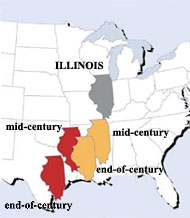
Imagine that by 2100 the state of Illinois will have a climate similar to the Texas Gulf Coast.
cause more evaporation from the Great Lakes. As a result, average lake levels could drop by up to two feet by 2100, disturbing both natural shoreline ecosystems and the lakeshores’ industrial and tourist infrastructure. Shallower Great Lakes will also force ships to carry lighter cargoes — which means shipping costs will go up.

In the crucially important agricultural sector, a longer growing season will be a good thing, but the combination of heat waves and floods, plus potential invasions by heat-loving insects and weeds, could erase any such benefits. These pests would threaten not just crops, but livestock and forests as well. To think about the change in climate conditions, imagine that by 2100 the state of Illinois will have a climate similar to the Texas Gulf Coast.

While rainfall is likely to increase in parts of North Dakota and Montana, it will probably decrease in already-dry West Texas, Oklahoma, and eastern Colorado. The region’s population is currently using underground aquifers for irrigation and drinking water at an unsustainable rate. Stresses on water supply, along with higher temperatures in summer, will have a detrimental impact on cattle ranching and on crops such as wheat, corn, hay, barley, and cotton.

SOUTHWEST

In the past 30 years alone, temperatures in the Southwest — already the hottest part of the U.S. — have averaged 1.5 degrees F higher than the 1960 to 1979 baseline. And thanks to southern California and cities like Phoenix, the region has a large and growing population, which places increasing demands on the region’s water resources. Meanwhile, California’s Central Valley, whose climate is very dry, uses massive irrigation to create one of the most productive areas of cropland in the nation.

So far, the region’s population growth has come during a relatively wet period; but that is already changing, with reduced snowpack in the mountains and significant die-offs in pinon pine populations in the Four Corners area. Periodic droughts are nothing new here, but the current one is being made worse as higher temperatures force already-scarce water to evaporate from the ground more quickly.

Taken together, these factors make water a very scarce and precious resource, one that will come under increasing pressure as springtime precipitation is projected to decrease, while average temperatures are likely
As water resources become scarcer, California’s agricultural economy may be difficult to sustain.
to shoot up by 7 to 10 degrees F. Longer, more severe droughts are pretty much inevitable under any emissions scenario, and under the high-emissions scenario they could be devastating. Scarce water resources would presumably go to people first, leaving California’s economically vital agricultural economy difficult to sustain. The inevitable drawdown of giant reservoirs such as Lake Mead will also reduce the reliability of hydroelectric power.

NORTHWEST

The temperature rise in the Northwest has been smaller overall than in other parts of the nation — roughly 1.5 degrees F over the last century. The effects are clear nevertheless, particularly in the decline of spring snowpack, which means less water flowing into surrounding aquifers and irrigation systems in summer. The drop in snowpack and runoff could also mean a reduction in hydroelectric power, which provides 70 percent of the region’s electricity needs. And as more winter precipitation falls as rain and snowmelt begins and ends earlier, streams will run faster in spring, damaging spawning areas salmon depend on, and then run warmer in summer, threatening the fish themselves, which die when the water temperature is too high.

Pest infestations due to warmer winters are already having a devastating effect on western pine forests, where pine beetles have destroyed 2.5 million acres of Rocky Mountain woodlands. Such infestations will likely become more widespread, creating tinder for forest fires that will intensify during warmer, drier summers.

POSTED ON 30 Jun 2009 IN Climate Climate Forests Policy & Politics Pollution & Health Asia North America 

COMMENTS


The public is worried and those who study climate change are alarmed at clear and present dangers (on numerous national, and world, security fronts). Meanwhile, financially captured governments move to price carbon contamination by a relative few dollars, years hence.

Instead, science indicates we should demonitarize mined materials considered as "fuels," and they should be used primarily as material feedstocks only. These materials are not "an economic good" to set on fire in the twenty-first century. The choice is transition (to truly clean energy strategies) or tragedy.
Posted by James Newberry on 30 Jun 2009


Such documents take advantage of the fact that most people believe that terms like forecast, projection and prediction are the same thing.

It is impossible to predict climate. The models that are used are less than worthless.

It is impossible to attribute weather events to increases in green house gases.

Global sea ice extent is about the same as it was thirty years ago.

Sea level isn't rising at dangerous rates.

The Maldives are not sinking into the sea.
Posted by Chris Lane on 01 Jul 2009


Let me address just one point of your article and that is the temperature rise in Alaska. According to the Alaska Climate Research center temps in Alaska rose 3.1F over the past 60 years, whereas you refer to a 6F rise over 50 years. You cherry-picked your starting point at 1955, a year of very abnormally low Alaskan temperatures.

What is fascinating is that the Alaskan temperature rise took place in a dramatic 3 year period from 1975-1978. The Alaskan temperature does correlate whatsoever with the slowly increasing atmospheric CO2 rise during the 60 year period. The temperature rise in Alaska was caused by a switch in the multi-decade long Pacifici Decadal Oscillation, which results from a change in ocean currents and surface winds. This well accepted phenomena is is of uncertain origin, but it is not related to mans production of CO2.

http://climate.gi.alaska.edu/ClimTrends/Change/TempChange.html

The Pacific Decadal Oscillations can have an ENORMOUS effect on climate and are the result of ocean currents. Their effect can be sudden and dramatic creating many of the climate changes referred to in the above article.

All of the alarmists "data" fall apart when looked at from a scientific standpoint. Do some research before you write and print.
Posted by nofreewind on 02 Jul 2009


You cannot state with anything close to scientific certainty that the temperature trends you cite have been caused by increased CO2 emissions. Similar trends have occurred in the pre-industrial past. Even if it were a scientific certainty, there is no practical way to reduce CO2 output to a level that would stop those trends by 2100 or any other year in our or our children's lifetimes. Any meaningful cut in emissions in the U.S. and Western Europe will come at a horrendous economic and social cost and will be marginalized if not fully offset by inevitable increases in fossil fuel use in China, Russia and India. The diminished economic power (both in relative and real terms) of the climate compliant West will make it even less formidable when trying to "persuade" the climate rogue states to cut emissions. In any event, those rogue states have internal political structures and or social momentum that will withstand even the most focused international pressure to meaningfully reduce CO2.
If the human race thinks continued warming is a threat, they should prepare to deal with the warming instead of sticking fingers in the dike of fossil fuel use.
Posted by marc feeney on 02 Jul 2009


Chris - you're right, predictions forecasts and projections aren't the same thing. But I'd like to see your scientific basis for concluding that detection and attribution are impossible. Thousands of scientists appear to agree on the general principles; what is it that you know (rather than opine) that demonstrates an alternative explanation?

Nofreewind, it's easy to find situations in which our understanding is incomplete and the PDO (together with ENSO, which modifies its impact) is indeed a complex phenomenon. The fact that PDO CAN influence climate is not the same as saying that it did in fact result in the observed climate changes; and even if PDO were very important for PNW USA (which it may be) we
cannot therefore rubbish the entire global picture on the strength of it. You are in danger of the very error you point out - generalising at a gross scale from specific observed phenomena.

Perhaps you need to take your own advice?
Posted by Funtipoom on 03 Jul 2009


These days the only people that comment on climate change articles seems to be the "anti-climate change" people. They pick and pick at the data, saying this and that is reason for increased temps. Saying its impossible to predict climate (why do they even have the "Weather" on the news then) and thats its all Pacific Decadal Oscillations causing the problems.
I am here to say, average people with average brain can connect the dots and see there is a big change going on and its not "Natural thing".

I live in the midwest, winter snows are gone, its hot all the time. You used to need a 4 wheel drive to get by in the snow but now you need it for the mud. Smog is not natural, yet its fog is worst than ever over the cities. I see the pictures and read about the biggest loses of sea ice ever recorded, happening more and more. I actually believe what the the departments of Energy, Commerce, Defense, State, Interior, Transportation, Health and Human Services, and Agriculture — plus the Environmental Protection Agency, NASA, the Smithsonian Institution, the National Science Foundation, and the Agency for International Development are saying.
I also give what these people say a lot more weight than the Super Intelligent comment writers (Data is based on the wrong start data, hmmmm I guess that means we are just imagining the temps going up and ice is melting).

Trust your own minds people, trust what you see around you (like extra smog), trust what you feel (like warm winters and hotter summers). Trust what your grandparents say (its never been like this before). Trust in real experts, not a armchair scientist commenter like me.
You are smart enough to see the changes and you are smart enough to know that "unnatural" smoke stacks are pumping out more CO2 than ever before in the history of the world. The truth can be found without a degree or any studies.

Ignore the people that are almost telling you SMOG is good. They are either REALLY REALLY Dumb or they work for oil or coal or one of the many many Corps that are in that loop.
Use your own brain.
lifeshard
Posted by lifeshard on 03 Jul 2009


Perhaps the climate material should be presented in terms of risk, compared with other risks that we all understand at a gut level. It is curious that so much scoffing and indifference arises within a society that is remarkably risk-averse. I bet that some of the scoffers have children who solemnly wear helmets to ride tricycles on their very own driveways with a parent on guard—as my own grandchild does, and a good thing too. Helmets are an excellent habit. But does anyone really think those children are much at risk, with or without their helmets? Yet look at all the care!

A little protection for those children's future planet seems not much to ask, if only in the spirit of insurance. The scoffers buy insurance, do they not? And probably against contingencies rather less likely—being killed in an airplane crash, let us say—than runaway climate change, now that methane's bubbling up in the Arctic.

The issue is insurance, people! Let's go sell it!
Posted by Elise Hancock on 04 Jul 2009


Even if it were a scientific certainty, there is no practical way to reduce CO2 output to a level that would stop those trends by 2100 or any other year in our or our children's lifetimes. Any meaningful cut in emissions in the U.S. and Western Europe will come at a horrendous economic and social cost and will be marginalized if not fully offset by inevitable increases in fossil fuel use in China, Russia and India. The diminished economic power (both in relative and real terms) of the climate compliant West will make it even less formidable when trying to "persuade" the climate rogue states to cut emissions. In any event, those rogue states have internal political structures and or social momentum that will withstand even the most focused international pressure to meaningfully reduce CO2.

Posted by alternative energy on 08 Jun 2011


I'm puzzled why "alternative energy" reposted some of the well-worn but false objections from an earlier (2009) posting. Scientific certainty was never really questionable...Nuclear scientist Dr. Edward Teller spent quite a few minutes explaining it to the oil industry gathered at their hundredth anniversary symposium in 1959 (http://www.drivehq.com/folder/p8520307/045419382.aspx). Practicable measures have been all around us...but not put to use, in most cases because of market inertia. Inevitable increases in the world's most populous countries - China, India and Indonesia - are happening, but have only brought them per capita up to 22%, 6% and 9%, respectively, of United States per capita fossil fuel use (2008 data, World Bank, 2011). Total energy use of two average people from each of these three nations (that is, 6 people) so far totals only 80% the total energy use of one average U.S. resident. And far from being rogue states, these nations also are making prodigious efforts toward renewable energy production and energy efficiency. China for instance, has a similar automobile efficiency standard in place today to California's dreaded 35.6 average mpg 2009-2016. To be fair China falls down on commercial and pickup trucks, and imported gas guzzlers (all unregulated per http://www.un.org/esa/dsd/resources/res_pdfs/csd-19/Background-paper3-transport.pdf).

To me, the data clearly indicate that United States of America more nearly fits the quoted description of "rogue state" -- "internal political structures and or social momentum that will withstand even the most focused international pressure to meaningfully reduce CO2." As the federal budget impasse continues to degrade the quality of soverign U.S. bonds, we may soon discover that it was not courageous leadership on global warming but rather narrow partisan bickering that caused my country to risk continued economic marginalization and concomitant fall in international status.

Posted by Paul M. Suckow on 14 Jul 2011


Comments have been closed on this feature.
michael d. lemonickABOUT THE AUTHOR
Michael D. Lemonick is the senior writer at Climate Central, a nonpartisan organization whose mission is to communicate climate science to the public. Prior to joining Climate Central, he was a senior writer at Time magazine, where he covered science and the environment for more than 20 years. He has also written four books on astronomical topics and has taught science journalism at Princeton University for the past decade. In a recent article for Yale Environment 360, Lemonick wrote about new evidence that makes the 2007 report by the Intergovernmental Panel on Climate Change already outdated.
MORE BY THIS AUTHOR


RELATED ARTICLES


The Clean Water Act at 40:
There’s Still Much Left to Do

The Clean Water Act of 1972, one of the boldest environmental laws ever enacted, turns 40 this year, with an impressive record of cleaning up America's waterways. But from New York Harbor to Alaska’s Bristol Bay, key challenges remain.
READ MORE

Taking Green Chemistry Out
Of The Lab and into Products

Paul Anastas pioneered the concept of green chemistry and has led the effort to rethink the way we design and make the products we use. In an interview with Yale Environment 360, he talks about the challenges of bringing this approach to policy making and the frustrations of tackling environmental issues in a politically polarized era.
READ MORE

Insurance Companies Face
Increased Risks from Warming

If the damages related to climate change mount in the coming decades, insurance companies may face the prospect of paying larger disaster claims and being dragged into global warming lawsuits. But many firms, especially in the U.S., have barely begun to confront the risks.
READ MORE

Betting on Technology to
Help Turn Consumers Green

U.S. consumers tell researchers they want to buy environmentally friendly products, but so far they haven’t been doing that on a large scale. Now a host of companies and nonprofits are trying to use new technology — from smartphones to social networking — to make it easier for buyers to make the green choice.
READ MORE

U.S. Fossil Fuel Boom
Dims Glow of Clean Energy

A surge in gas and oil drilling in the U.S. is helping drive the economic recovery and is enhancing energy security. But as the situation in Ohio shows, cheaper energy prices and the focus on fossil fuels has been bad news for the renewable energy industry.
READ MORE


MORE IN Analysis


The Vital Chain: Connecting
The Ecosystems of Land and Sea

by carl zimmer
A new study from a Pacific atoll reveals the links between native trees, bird guano, and the giant manta rays that live off the coast. In unraveling this intricate web, the researchers point to the often little-understood interconnectedness between terrestrial and marine ecosystems.
READ MORE

Could a Changing Climate
Set Off Volcanoes and Quakes?

by fred pearce
A British scientist argues that global warming could lead to a future of more intense volcanic eruptions and earthquakes. And while some dismiss his views as preposterous, he points to a body of recent research that shows a troubling link between climate change and the Earth’s most destructive geological events.
READ MORE

China’s Looming Conflict
Between Energy and Water

by christina larson
In its quest to find new sources of energy, China is increasingly looking to its western provinces. But the nation’s push to develop fossil fuel and alternative sources has so far ignored a basic fact — western China simply lacks the water resources needed to support major new energy development.
READ MORE

As Threats to Biodiversity Grow,
Can We Save World’s Species?

by lee hannah
With soaring human populations and rapid climate change putting unprecedented pressure on species, conservationists must look to innovative strategies — from creating migratory corridors to preserving biodiversity hotspots — if we are to prevent countless animals and plants from heading to extinction.
READ MORE

Linking Weird Weather to
Rapid Warming of the Arctic

by jennifer francis
The loss of Arctic summer sea ice and the rapid warming of the Far North are altering the jet stream over North America, Europe, and Russia. Scientists are now just beginning to understand how these profound shifts may be increasing the likelihood of more persistent and extreme weather.
READ MORE

Rethinking Carbon Dioxide:
From a Pollutant to an Asset

by marc gunther
Three startup companies led by prominent scientists are working on new technologies to remove carbon dioxide from the atmosphere. The scientific community is skeptical, but these entrepreneurs believe the process of CO2 removal can eventually be profitable and help cool an overheating planet.
READ MORE

Busting the Forest Myths:
People as Part of the Solution

by fred pearce
The long-held contention that rural forest communities are the prime culprits in tropical forest destruction is increasingly being discredited, as evidence mounts that the best way to protect rainforests is to involve local residents in sustainable management.
READ MORE

China’s Reforestation Programs:
Big Success or Just an Illusion?

by jon r. luoma
China has undertaken ambitious reforestation initiatives that have increased its forest cover dramatically in the last decade. But scientists are now raising questions about just how effective these grand projects will turn out to be.
READ MORE

As Coal Use Declines in U.S.,
Coal Companies Focus on China

by jonathan thompson
With aging coal-fired U.S. power plants shutting down, major American coal companies are exporting ever-larger amounts of coal to China. Now, plans to build two new coal-shipping terminals on the West Coast have set up a battle with environmentalists who want to steer the world away from fossil fuels.
READ MORE

The New Story of Stuff:
Can We Consume Less?

by fred pearce
A new study finds that Britons are consuming less than they did a decade ago, with similar patterns being seen across Europe. Could this be the beginning of a trend in developed countries? Might we be reaching “peak stuff”?
READ MORE


e360 digest
Yale
Yale Environment 360 is
a publication of the
Yale School of Forestry
& Environmental Studies
.

SEARCH e360


Donate to Yale Environment 360

CONNECT

Twitter: YaleE360
e360 on Facebook
Donate to e360
View mobile site
Bookmark
Share e360
Email newsletter
Subscribe to our feed:
rss


ABOUT

About e360
Contact
Submission Guidelines
Reprints

e360 VIDEO

Warriors of Qiugang
The Warriors of Qiugang, a Yale Environment 360 video that chronicles the story of a Chinese village’s fight against a polluting chemical plant, was nominated for a 2011 Academy Award for Best Documentary (Short Subject). Watch the video.


DEPARTMENTS

Opinion
Reports
Analysis
Interviews
e360 Digest
Video Reports

TOPICS

Biodiversity
Business & Innovation
Climate
Energy
Forests
Oceans
Policy & Politics
Pollution & Health
Science & Technology
Sustainability
Urbanization
Water

REGIONS

Antarctica and the Arctic
Africa
Asia
Australia
Central & South America
Europe
Middle East
North America

e360 VIDEO REPORT

When the Water Ends
As temperatures rise and water supplies dry up, tribes in East Africa increasingly are coming into conflict. A Yale Environment 360 video reports on a phenomenon that could become more common: how worsening drought will pit groups — and nations — against one another. Watch the video.

e360 MOBILE

Mobile
The latest
from Yale
Environment 360
is now available for mobile devices at e360.yale.edu/mobile.


header image
Top Image: aerial view of Iceland. © Google & TerraMetrics.

e360 VIDEO REPORT

Leveling Appalachia
Leveling Appalachia: The Legacy of Mountaintop Removal Mining, an e360 video examining the environmental and human impacts of this mining practice, won the award for best video in the 2010 National Magazine Awards for Digital Media. Watch the video.


OF INTEREST


Yale