22 Sep 2008: Analysis

Saving the Seeds of the
Next Green Revolution

With food prices skyrocketing and climate change looming, the world needs a green revolution like the one a generation ago. But many valuable seed varieties have been lost – and scientists now are scrambling to protect those that remain before they vanish down the genetic drain.

by fred pearce

Suddenly plant breeding is sexy. In recent months, soaring prices of food, coupled with fears of runaway climate change, have brought calls for a renaissance in agricultural research — to boost crop yields and deliver new varieties that can stand the heat and drought of a greenhouse world.

The world needs a repeat of the advances made during the last green revolution a generation ago, which doubled global food output.

But the truth is that this new revolution is hobbled before it starts. Decades of underinvestment since the last green revolution have left the world’s crops in genetic meltdown. In many cases, the feedstocks for a new push for plant breeding simply aren’t there.

Enlarge image
CIMMYT
CIMMYT
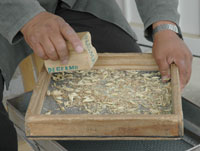
Seed at the CIMMYT Seed Health Laboratory in Mexico is cleaned of dust and chaff, then dried to keep it viable.
Two things have gone wrong. First, the standardized varieties produced during the last green revolution proved so successful that they have taken over the world’s fields, elbowing out thousands of traditional varieties bred by farmers over the years. Second, many of the backup stocks of those varieties, held in the world’s seed banks, have suffered from government inattention and penny-pinching, resulting in the decimation of collections.

The world’s heritage of seed diversity is the product of thousands of years of experimental plant breeding by millions of farmers across the world. The crops that humanity has painstakingly bred from wild plants are the kernels of our civilization. When the first farmers planted the first crops 10,000 years ago, the planet could support just 5 million people. Today, thanks to seeds, it feeds 7 billion.

Our future harvests continue to depend on this heritage because the genes found in millions of crop varieties contain vital traits that plant breeders need to improve modern varieties, raising yield, protecting them against new diseases, and adapting them to climate change.

Any variety could be vital. Some of the great successes of modern plant breeding have arisen from serendipitous finds. A hedgerow in India yielded a wild rice plant that had resistance to a killer virus. That gene is now bred into rice plants grown across 100,000 square kilometers of Asia. Veteran American researcher Jack Harlan traveled for days on a donkey in eastern Turkey in the 1940s to find a single wheat seed that rescued the U.S. crop from stripe rust disease and is still worth millions of dollars a year to farmers.

Far from making them redundant, new technologies such as genetic engineering only increase the potential benefits from such finds.

But this man-made genetic treasure trove is found in only a few places — much of it in ancient geographical heartlands, known as Vavilov centers after the Russian seed collector and plant scientist Nicolai Vavilov, who first identified them in the 1920s and 1930s.

Enlarge image
CIMMYT
CIMMYT
About 24,000 unique samples of maize seed and 168,000 samples of wheat are kept at -3 degrees Celsius at the CIMMYT research center.
These seed varieties are disappearing even faster than nature’s biodiversity. Many of the varieties lost from fields were assumed to be preserved deep-frozen in a network of 1,400 national and international seed banks, many of them located in the Vavilov centers. They include maize at CIMMYT, the international maize and wheat research center outside Mexico City; the International Rice Research Institute among the rice paddies of the Philippines; and the International Potato Center high in the Peruvian Andes.

Once these centers were the well-funded engine rooms of the green revolution. But since the 1980s, agricultural research has been chronically underfunded. Why bother to maintain these banks, many governments asked, when the world is awash with cheap food?

Many of the gene banks have been poorly run. Some irreplaceable seed collections have been destroyed in wars and floods and ransacked by looters and terrorists. Others have been lost through incompetence, or when power supplies broke down and the freezers thawed out.

Take maize. It is the world’s most widely grown crop. But Suketoshi Taba, head of CIMMYT, says around 80 percent of traditional varieties have been lost from fields. And at least half of the varieties supposedly stored for future breeding programs in seed banks are actually unable to germinate. CIMMYT’s store may be safe, but much of the rest is lost.

Meanwhile, across Asia, thousands of varieties of rice have disappeared. One of the worst genetic disasters occurred in one of rice’s most important homelands, Cambodia. Numerous traditional rice varieties were lost during Pol Pot’s “Year Zero” rule in the 1970s, when paddies were turned over to collective farming and seed banks were shut down.

Enlarge image
CIMMYT
CIMMYT
The “doomsday vault,” a large concrete cavern dug inside a frozen mountain 1,000 kilometers from the North Pole at Svalbard, Norway.
Fields at the International Potato Center in Peru were ransacked by invading Maoist guerrillas in the 1980s. Following the U.S. invasion of Iraq in 2003, looters pillaged a key store of wheat, lentil, and chickpea seeds at Abu Ghraib outside Baghdad.

In a budget-cutting move, dozens of cabbage varieties at a Dutch research center, the Center for Genetic Resources in Wageningen, were culled. Meanwhile, the Pacific Regional Germplasm Center in Suva, Fiji, has given up trying to preserve unique collections of local staple foods, such as taro and yams, which were planted in research fields.

Is there hope? Well, much has been lost. Many plants with specific genetic traits that now might be critically needed are no more. Nothing can be done about that. But the curators of the world’s seed banks hope that renewed interest in global food supplies will revive funding for their work and help protect what is left before it disappears down the genetic drain. And they are already constructing a permanent repository for the world’s seeds to preserve what remains.

They call it the “doomsday vault” — a large concrete cavern hewn out of a frozen mountain just 1,000 kilometers from the North Pole at Svalbard, Norway. The future of humanity could one day depend on the contents of this newly excavated vault, which is now being filled with seeds of the millions of crop varieties that have fed humanity for the last 10,000 years.

This scientific Ark of the Covenant, being assembled by the Global Crop Diversity Trust, is a survival kit for the world. It will eventually contain backup copies of the world’s entire surviving collections of banked seed varieties.

At Mexico’s CIMMYT center recently, I watched as the staff packaged corn samples assembled from around the world, including the bank’s own unparalleled collection, for shipping to Svalbard. Eventually the world’s entire known diversity of maize seeds — perhaps a quarter-million varieties — will be represented in the Arctic.

When first proposed at the turn of the millennium, the notion of a doomsday vault seemed scientifically quixotic. The idea was that, in the event of a global holocaust like an asteroid hit, runaway climate change, a deadly pandemic, or a nuclear conflagration, survivors would be able to track down the contents of the vault — and start civilization afresh.

But that was when food prices worldwide were at record lows and climate change seemed far less urgent. That’s all changed, and now there are serious questions both about whether the world can feed itself, and whether it can do so at prices that do not provoke riot and revolution in the megacities of the developing world.

The Arctic collection now looks vital not just for some hypothetical “doomsday,” but to preserve what is left in the world’s dysfunctional seed banks. It turns out we may need those seeds far sooner than we thought.

POSTED ON 22 Sep 2008 IN Biodiversity Climate Policy & Politics Science & Technology Sustainability Antarctica and the Arctic Central & South America 

COMMENTS


For further information on this topic, consider
reading Gary Paul Nabhan's new book Where
Our Food Comes From.

In it, Nabhan contends that seeds should be in the hands of traditional farmers where they can
more easily adapt to the changing climate in a
more rapid and resilient way.
www.whereourfoodcomesfrom.org.
Posted by Island Press on 24 Sep 2008


MY BOOKLET global warming is a myth is a scientific analysis of the subject.the following topics have been discussed:
1)the cooling earth-it radiates heat into outer space as it is hotter than the latter
2)is co2 the villain?-it is only 0.035 percent.i have explained how nature mmaintains this
3)role of hydrology-water molecules carry heat from the interior of earth to the sea bottom and from there to the atmosphere.ice sheets around the poles prevent heat from escaping into the atmosphere.
4)history-quotations from THOMMAS MILNER'S
book written in 1853
for the booklet-contact-waterfriendkks@gmail.com
Posted by K.K.SUBRAMANIAN on 26 Sep 2008


While the center-of-origin of potatoes is indeed the high Peruvian Andes, the International Potato Center is located in the low-lying coastal city of Lima.
Posted by Maywa Montenegro on 12 Oct 2008


Comments have been closed on this feature.
fred pearceABOUT THE AUTHOR
Fred Pearce is a freelance author and journalist based in the UK. He is environment consultant for New Scientist magazine and author of recent books When The Rivers Run Dry and With Speed and Violence (Beacon Press). His next, Confessions of an Eco Sinner, will be published in the fall. Pearce's most recent article for Yale e360 was about world population trends.
MORE BY THIS AUTHOR


RELATED ARTICLES


Probing Impact of Warming
On the World's Food Supply

One of the few potential advantages attributed to soaring carbon dioxide levels has been enhanced crop growth. But in an interview with Yale Environment 360, botanist Stephen Long talks about his research showing why rising temperatures and an increase in agricultural pests may offset any future productivity gains.
READ MORE

Should Environmentalists
Just Say No to Eating Beef?

Conservation organizations are working with industry to try to make beef production more sustainable. But some are questioning whether green groups should be accepting funds from the beef industry or whether they should instead be urging consumers to stop eating beef.
READ MORE

Why Are Environmentalists
Taking Anti-Science Positions?

On issues ranging from genetically modified crops to nuclear power, environmentalists are increasingly refusing to listen to scientific arguments that challenge standard green positions. This approach risks weakening the environmental movement and empowering climate contrarians.
READ MORE

Helping U.S. Farmers Increase
Production and Protect the Land

American agriculture is steeped in a chemical-intensive system that wastes money and pollutes the environment. But by making use of new technology and innovative approaches, farmers can boost production and profits — while at the same time improving soil quality, enhancing biodiversity, and protecting habitat.
READ MORE

The Folly of Big Agriculture:
Why Nature Always Wins

Large-scale industrial agriculture depends on engineering the land to ensure the absence of natural diversity. But as the recent emergence of herbicide-tolerant weeds on U.S. farms has shown, nature ultimately finds a way to subvert uniformity and assert itself.
READ MORE


MORE IN Analysis


True Nature: Revising Ideas
On What is Pristine and Wild

by fred pearce
New research shows that humans have been transforming the earth and its ecosystems for millenniums — far longer than previously believed. These findings call into question our notions about what is unspoiled nature and what should be preserved.
READ MORE

Probing the Reasons Behind
The Changing Pace of Warming

by fred pearce
A consensus is emerging among scientists that the rate of global warming has slowed over the last decade. While they are still examining why, many researchers believe this phenomenon is linked to the heat being absorbed by the world’s oceans.
READ MORE

Blocked Migration: Fish Ladders
On U.S. Dams Are Not Effective

by john waldman
Fishways on rivers in the U.S. Northeast are failing, with less than 3 percent of one key species making it upriver to their spawning grounds, according to a new study. The researchers’ findings provide a cautionary tale for other nations now planning big dam projects.
READ MORE

The Scientist as Guardian:
A Tool for Protecting the Wild

by william laurance
An expanding body of evidence shows that the presence of field biologists and their assistants is playing an important part in deterring poaching, illegal logging, and other destructive activities in the world’s parks and wildlife reserves.
READ MORE

Giant Sequoias Face Looming
Threat from Shifting Climate

by bruce dorminey
The world’s largest living species, native to California’s Sierra Nevada, faces a two-pronged risk from declining snowpack and rising temperatures. The threat to sequoias mirrors a growing danger to trees worldwide, with some scientists saying rapid warming this century could wipe out many of the planet’s old trees.
READ MORE

Biodiversity in Logged Forests
Far Higher Than Once Believed

by fred pearce
New research shows that scientists have significantly overestimated the damage that logging in tropical forests has done to biodiversity, a finding that could change the way conservationists think about how best to preserve species in areas disturbed by humans.
READ MORE

Will Reform Finally End The
Plunder of Europe’s Fisheries?

by christian schwägerl
Maria Damanaki, Europe’s crusading fisheries minister, is making major headway in changing a cozy, “old boys” network that over-subsidized the European fishing industry and brought about the severe overfishing of the continent’s marine bounty.
READ MORE

Mercury’s Silent Toll
On the World’s Wildlife

by rebecca kessler
Scientists are only beginning to understand the impacts of mercury contamination on birds, fish, and other wildlife populations. But what they are finding is alarming — even low levels can cause harm, and chronic exposure has unexpected and troubling effects.
READ MORE

Black Carbon and Warming:
It’s Worse than We Thought

by carl zimmer
A new study indicates soot, known as black carbon, plays a far greater role in global warming than previously believed and is second only to CO2 in the amount of heat it traps in the atmosphere. Reducing some forms of soot emissions — such as from diesel fuel and coal burning — could prove effective in slowing down the planet’s warming.
READ MORE

Without Congress, There’s Still a
Path to U.S. Progress on Climate

by john carey
Don’t expect the U.S. Congress to take any action on climate change in the next four years. But by continuing to use its regulatory authority and working with the states, the Obama administration can make significant progress on reducing greenhouse gas emissions.
READ MORE


e360 digest
Yale
Yale Environment 360 is
a publication of the
Yale School of Forestry
& Environmental Studies
.

SEARCH e360


Donate to Yale Environment 360

CONNECT

Twitter: YaleE360
e360 on Facebook
Donate to e360
View mobile site
Bookmark
Share e360
Email newsletter
Subscribe to our feed:
rss


ABOUT

About e360
Contact
Submission Guidelines
Reprints

e360 PHOTO GALLERY

To Catch a Rhino Welz
South African photojournalist Adam Welz documents the harrowing relocation of six white rhinos to a region that has lost all its rhinos to poaching. View the gallery.


DEPARTMENTS

Opinion
Reports
Analysis
Interviews
e360 Digest
Podcasts
Video Reports

TOPICS

Biodiversity
Business & Innovation
Climate
Energy
Forests
Oceans
Policy & Politics
Pollution & Health
Science & Technology
Sustainability
Urbanization
Water

REGIONS

Antarctica and the Arctic
Africa
Asia
Australia
Central & South America
Europe
Middle East
North America

e360 VIDEO

Into Heart of Ecuador Yasuni
A Yale Environment 360 video explores Ecuador’s threatened Yasuni Biosphere Reserve with scientists inventorying its stunning forests and wildlife. Watch the video.

e360 MOBILE

Mobile
The latest
from Yale
Environment 360
is now available for mobile devices at e360.yale.edu/mobile.

e360 VIDEO

Colorado River Video
In a Yale Environment 360 video, photographer Pete McBride documents how increasing water demands have transformed the Colorado River, the lifeblood of the arid Southwest. Watch the video.


header image
Top Image: aerial view of Iceland. © Google & TerraMetrics.

e360 VIDEO

Warriors of Qiugang
The Warriors of Qiugang, a Yale Environment 360 video that chronicles the story of a Chinese village’s fight against a polluting chemical plant, was nominated for a 2011 Academy Award for Best Documentary (Short Subject). Watch the video.


OF INTEREST


Yale