10 Jul 2008: Report

The Arctic Resource Rush is On

As the Arctic's sea ice melts, energy and mining companies are moving into previously inaccessible regions to tap the abundant riches that lie beneath the permafrost and the ocean floor. The potential environmental impacts are troubling.

by ed struzik

In spring, the shores of the Arctic Ocean in Canada’s Northwest Territories are buried deep in snow and ice, seemingly devoid of all life and resources. But not far under the surface, in the relatively shallow permafrost, lies what could be one of the largest sources of energy ever discovered, a slushy mix of water, ice, and natural gas known as methane hydrates. These days, Arctic geologists are scrambling to find methods to tap into this abundant store of energy.
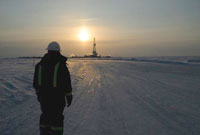
Enlarge image
Methane well
Ed Struzik
A geologist at a site near the Beaufort Sea, where exploratory drilling is taking place for methane hydrates, a potentially enormous source of natural gas.
Gas hydrates — lattice-like ice structures that trap large quantities of methane, the major component of natural gas — are just one of a trove of natural resources in and around the Arctic Ocean. Vast reserves of oil, natural gas, and minerals also lie beneath the frozen sea and land. For centuries, these riches lay out of reach. Indeed, as recently as five years ago, few companies dreamed of investing in the Canadian Arctic because there was no safe and economical way of extracting these resources and shipping them out. In an area nine times as large as California, there was — and is — only one highway, a third of it gravel, which goes to the Arctic Ocean. There is no seaport and no railway.

All that, however, is about to change, as a fast-moving confluence of events is turning the Canadian Arctic — and some northerly regions of Russia and other Arctic nations — into the next Klondike: Just as the Arctic’s summer sea ice is melting at an unprecedented rate, soon opening up the fabled Northwest Passage and other shipping lanes, the booming global economy has created a soaring demand for natural resources, sending prices sky-high. The wealth that has lain untapped beneath the Arctic is now rapidly being opened for exploration.

Soon, not only will ships be steaming across the top of the world, shaving 7,000 kilometers off a Europe-to-Asia voyage that now takes them through the Panama Canal — these vessels will also be able to penetrate previously inaccessible expanses of the Arctic to explore for, extract, and transport natural resources.

These developments will have profound environmental, economic, and global security impacts. Unlike Antarctica, where exploitation of minerals has been indefinitely banned under the Antarctic Treaty System, the Arctic is ripe for exploitation. And the environmental implications of this resource rush are sobering, with fleets of ships and oil tankers moving through a pristine marine environment and legions of workers on land drilling and digging for all manner of mineral wealth.
Enlarge image
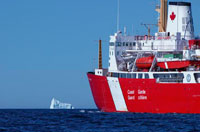
Icebreaker
Ed Struzik
A Canadian Coast Guard icebreaker on the Arctic Ocean. Neighboring countries are making conflicting territorial claims as the resource scramble intensifies.
“It’s only a matter of time before a single tramp steamer takes a run through the Northwest Passage,” says Michael Byers, who holds the Canada Research Chair in International Law and Politics at the University of British Columbia. “Our ability to stop that ship or clean up if it runs aground and spills its load is severely lacking. We have the longest coastline in the world in a region that is covered by ice for most of the year, and we don't even have an all-weather icebreaker.”

With so much money at stake, the Arctic has become a hotbed of territorial disputes as the surrounding countries spar for control of resources. In a report issued earlier this year, two of the European Union’s top foreign policy officials warned of the looming international struggle over this energy rich region. The Bush administration, however, is more sanguine, arguing that existing maritime treaties and regular meetings of the five major nations bordering the Arctic Ocean — Canada, Russia, the United States, Norway, and Denmark — will ensure the Arctic’s peaceful and responsible development.

This focus on the Far North comes as a result of the stunningly swift disappearance of ice in the Arctic Ocean. Scientists estimate that summer sea ice has declined by about 50 percent since the 1950s. Last year, summer sea ice extent reached a record low, and thick, multi-year sea ice now covers less than 30 percent of the ocean, down from more than 50 percent in the mid-1980s. Experts who once believed that the Arctic Ocean would not be largely free of summer ice until mid-to-late century now concede that the ice could be gone within a decade.

As a result, in nearly every corner of this icy world, resource companies are investing heavily. Energy and mining firms have announced a $17 billion Arctic exploration agreement with Russia. Exxon’s Canadian subsidiary, Imperial, has formed a consortium to construct a $16 billion pipeline to send Arctic natural gas to southern Canada and the United States. Last summer, Exxon spent nearly $600 million for the rights to explore a tiny lease in the Beaufort Sea, and this year BP paid $1.2 billion to explore in the same region. French mega-uranium miner Areva, which is one of 40 companies looking for uranium in Nunavut, Canada’s new Inuit territory, is considering developing a huge mine. Theirs is just one of 200 development and exploration proposals the once-neglected territory is grappling with these days.
Enlarge image
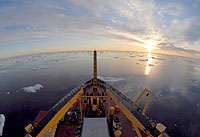
Sunset Icebreaker
Ed Struzik
An increasingly common sight in the Arctic Ocean: open water. Soon, the ocean will be ice-free in summer, opening the way for development.
On Canada’s Baffin Island — a huge mountain of snow and ice that is home to less than 10,000 people, mainly Inuit — plans are underway to develop a $4.6 billion iron mine and railroad. At Bathurst Inlet in the central Arctic, the Inuit themselves are contemplating construction of a seaport and a new 160 mile-long highway that would open up the Slave Geological Province, widely regarded as the richest untapped mineral deposit in the world. The road also would service three existing diamond mines, with more to come.

Recently, along the shores of the Beaufort Sea in Canada’s western Arctic, I got a sense of both the magnitude of these resources and the forbidding terrain that has so far kept them locked up. With the springtime temperature at -35 F (-37 C), I watched as scientists from the Geological Survey of Canada tapped into methane hydrates buried under the permafrost not far from the frozen shoreline. The gas rose quickly in the well before being capped by technicians.

Although methane hydrates are found deep in marine shelves worldwide, the biggest and most accessible reserves lie in the Arctic’s relatively shallow permafrost zones and on the Arctic Ocean’s continental shelf. The U.S. Geological Survey estimates that there may be more untapped energy stored in gas hydrates than in all of the conventional oil, gas, and coal reserves in the world.

Cognizant of the wealth at stake, many countries, including the U.S. and those in the European Union, are continuing to deny Canada’s long-standing claim of sovereignty over the Northwest Passage, through which most of these resources would be transported. They insist that the passage is, like the Suez Canal, an international strait.

Competing claims over Arctic territory are escalating. In 2002, Denmark planted a territorial flag on Hans Island, a tiny, treeless chunk of rock off the coast of Ellesmere Island, only to have Canada later send its own mission to reclaim the island. In the Beaufort Sea, the U.S. is in a dispute with Canada over the maritime boundary off the coast of Alaska and the Yukon, where billions of barrels of oil could potentially be found. Last summer, the Russians used a submersible to plant a flag on the ocean floor at the North Pole, claiming 460,000 square miles — an area nearly the size of Germany, France, and Italy combined. Much of that seabed already has been claimed by other Arctic countries.

Sovereignty, however, is not the only challenge that Canada faces in the Arctic. The environmental threats, on land and sea, are huge. Both the road that the Inuit want to build and the uranium mine that Areva is contemplating will be situated in the calving grounds of two huge caribou herds. Ships sailing through the Northwest Passage may also disrupt bowhead, beluga, and narwhal migrations. And today only a small portion of the biologically important areas bordering the Arctic Ocean are protected in parks or reserves.

But the biggest threat may well come from the captain of a single-hulled, crude oil tanker who tries to save time and fuel by taking a shortcut through the Northwest Passage. If that ship runs aground or is crushed by melting ice spilling out of the High Arctic, it could make the two-year, $2 billion clean-up of the Exxon Valdez look like a kitchen spill.

Experts all agree that Canada is not prepared to handle such a disaster. With no Arctic seaport, no roads, virtually no Arctic naval capability, and very few airports from which to stage a recovery and cleanup, the government would be hard-pressed to mount an effective response. Gary Sergy — an Environment Canada expert who helped pioneer oil spill cleanup technology in the Arctic — questions the ability of anyone to effectively deal with an Exxon Valdez-like disaster in the Canadian Arctic, where the huge Beaufort Gyre is constantly spiraling, pushing enormous volumes of ice and water through dozens of channels in the archipelago.

“How would you get a cleanup crew on site with no port or airstrip?” asked Sergy. " We just don't have the infrastructure. It all boils down to a logistical nightmare.”

POSTED ON 10 Jul 2008 IN Climate Energy Oceans Oceans Antarctica and the Arctic Antarctica and the Arctic North America 

COMMENTS


It's a terrible shame that we're on the verge of destroying this pristine wilderness.
There seems to be nothing to stop the power of oil companies... Exxon still hasn't been made to account for the Valdez disaster almost 10 years ago.
Posted by Fair Trade on 10 Jul 2008


But perhaps oil exploration can be made safe?
http://www.wri.org/stories/2008/07/could-arctic-oil-exploration-be-made-safe
Posted by Jonathan Talbot on 10 Jul 2008


I'm concerned about upsetting this Arctic environment, but what happens to the rest of the world when all this methane is burned as fuel? It seems like a crazy race to accelerate global warming as quickly as possible.
Posted by Dan Hebert on 11 Jul 2008


Where in Hell have you guys been? This has been
on the front burner for resources and the issue of
the positive feed back of Methyl Hydrates for years
re: climate change.

The albedo impact of an arctic oil spill is hardly
new much less it's longer living impact on fisheries
and wildlife.

Has every one been asleep? or is this a
kindergarden talk to those recently born and
thinking.
Posted by Bindlepete on 13 Jul 2008


Thanks for writing about this important, urgent
issue. I'm from Oceana, the marine conservation
non-profit, and we are working to protect the
Arctic http://www.protectthearctic.org/ from the
resource rush you eloquently discuss here. Please
join us
http://takeaction.oceana.org/t/6207/campaign.jsp?
campaign_KEY=25056 in our efforts to save the
Arctic.


Posted by Emily from Oceana on 16 Jul 2008


Ed Struzik has written an important article. i wonder what he thinks about my idea of polar cities for survivors of global warming in year 2500, if it comes to that? Ed?
Posted by Danny Bloom on 18 Jul 2008


The artic by nature does not belong to anyone. It suprises me that well known countries are so naive to think it belongs to them because they live up in the north. Dubious i say..The earth is for everyone to share.. we all have only one mother and we share her resources it does not belong to anyone period.
Posted by Vanan on 24 Jul 2008


The only way to save the earth is to unify hearts, minds, talents, and resources to do what is needed. We are all of those things, let's do it!
Posted by Marianne on 26 Jan 2009


The environmental threats, on land and sea, are huge. Both the road that the Inuit want to build and the uranium mine that Areva is contemplating will be situated in the calving grounds of two huge caribou herds
Posted by bill on 08 Aug 2009


Comments have been closed on this feature.
ed struzikABOUT THE AUTHOR
Canadian author and photographer Ed Struzik has been writing on the Arctic for the past 27 years. He is the 2007 recipient of the Atkinson Fellowship in Public Policy and was a finalist for this year's Grantham Prize for Excellence in Reporting on the Environment. His next book, The Big Thaw, will be published by John Wiley and Sons in March 2009.
MORE BY THIS AUTHOR


RELATED ARTICLES


Melting Sea Ice Could Lead
To Pressure on Arctic Fishery

With melting sea ice opening up previously inaccessible parts of the Arctic Ocean, the fishing industry sees a potential bonanza. But some scientists and government officials have begun calling for a moratorium on fishing in the region until the true state of the Arctic fishery is assessed.
READ MORE

Linking Weird Weather to
Rapid Warming of the Arctic

The loss of Arctic summer sea ice and the rapid warming of the Far North are altering the jet stream over North America, Europe, and Russia. Scientists are now just beginning to understand how these profound shifts may be increasing the likelihood of more persistent and extreme weather.
READ MORE

As Arctic Sea Ice Declines,
Polar Bear Patrol Gets Busy

Polar bears have long come ashore in Churchill, Manitoba, the self-styled ‘Polar Bear Capital of the World.’ But as summer sea ice steadily disappears in Hudson Bay, bears are being marooned on land for longer periods of time — and that is generating a lot of work for the Polar Bear Alert Team.
READ MORE

Mysteries of Killer Whales
Uncovered in the Antarctic

Two of the world’s leading experts on the world’s top marine predator are now in Antarctica, tagging and photographing a creature whose remarkably cooperative hunting behavior and transmission of knowledge across generations may be rivaled only by humans.
READ MORE

A Vast Canadian Wilderness
Poised for a Uranium Boom

Canada’s Nunavut Territory is the largest undisturbed wilderness in the Northern Hemisphere. It also contains large deposits of uranium, generating intense interest from mining companies and raising concerns that a mining boom could harm the caribou at the center of Inuit life.
READ MORE


MORE IN Reports


Africa’s Ambitious Experiment
To Preserve Threatened Wildlife

by caroline fraser
Five nations in southern Africa are joining together to create a huge conservation area that will extend across their borders and expand critical territory for elephants. But can these new protections reverse decades of decline for area wildlife while also benefiting the people who live there?
READ MORE

Melting Sea Ice Could Lead
To Pressure on Arctic Fishery

by ed struzik
With melting sea ice opening up previously inaccessible parts of the Arctic Ocean, the fishing industry sees a potential bonanza. But some scientists and government officials have begun calling for a moratorium on fishing in the region until the true state of the Arctic fishery is assessed.
READ MORE

Solar Windows: Transforming
Buildings Into Energy Producers

by dave levitan
The vast amount of glass in skyscrapers and office buildings represents enormous potential for an emerging technology that turns windows into solar panels. But major questions remain as to whether solar windows can be sufficiently inexpensive and efficient to be widely adopted.
READ MORE

Fighting A Last-Ditch Battle
To Save the Rare Javan Rhino

by rhett butler
Rhinoceroses worldwide are under siege as their habitat shrinks and poachers slaughter hundreds annually for their valuable horns. Now, in Indonesia, conservation groups are engaged in a desperate struggle to save the last 40 Javan rhinos on earth.
READ MORE

Insurance Companies Face
Increased Risks from Warming

by ben schiller
If the damages related to climate change mount in the coming decades, insurance companies may face the prospect of paying larger disaster claims and being dragged into global warming lawsuits. But many firms, especially in the U.S., have barely begun to confront the risks.
READ MORE

Hopes Fade for Cleanup
In Nigeria’s Oil-Rich Delta

by fred pearce
The Ogoniland region of Nigeria has long been badly polluted by decades of oil production that has fouled the delta and contaminated drinking water. A United Nations report has recommended a massive recovery initiative, but so far the Nigerian government has shown few signs it will agree to the cleanup project.
READ MORE

Betting on Technology to
Help Turn Consumers Green

by marc gunther
U.S. consumers tell researchers they want to buy environmentally friendly products, but so far they haven’t been doing that on a large scale. Now a host of companies and nonprofits are trying to use new technology — from smartphones to social networking — to make it easier for buyers to make the green choice.
READ MORE

U.S. Fossil Fuel Boom
Dims Glow of Clean Energy

by keith schneider
A surge in gas and oil drilling in the U.S. is helping drive the economic recovery and is enhancing energy security. But as the situation in Ohio shows, cheaper energy prices and the focus on fossil fuels has been bad news for the renewable energy industry.
READ MORE

Can Reforming the Farm Bill
Help Change U.S. Agriculture?

by jim robbins
For decades, farm bills in the U.S. Congress have supported large-scale agriculture. But with the 2012 Farm Bill now up for debate, advocates say seismic shifts in the way the nation views food production may lead to new policies that tilt more toward local, sustainable agriculture.
READ MORE

Scientists Warn of Low-Dose
Risks of Chemical Exposure

by elizabeth grossman
A new study finds that even low doses of hormone-disrupting chemicals — used in everything from plastics to pesticides – can have serious effects on human health. These findings, the researchers say, point to the need for basic changes in how chemical safety testing is conducted.
READ MORE


e360 digest
Yale
Yale Environment 360 is
a publication of the
Yale School of Forestry
& Environmental Studies
.

SEARCH e360


Donate to Yale Environment 360

CONNECT

Twitter: YaleE360
e360 on Facebook
Donate to e360
View mobile site
Bookmark
Share e360
Email newsletter
Subscribe to our feed:
rss


ABOUT

About e360
Contact
Submission Guidelines
Reprints

e360 VIDEO

Warriors of Qiugang
The Warriors of Qiugang, a Yale Environment 360 video that chronicles the story of a Chinese village’s fight against a polluting chemical plant, was nominated for a 2011 Academy Award for Best Documentary (Short Subject). Watch the video.


DEPARTMENTS

Opinion
Reports
Analysis
Interviews
e360 Digest
Video Reports

TOPICS

Biodiversity
Business & Innovation
Climate
Energy
Forests
Oceans
Policy & Politics
Pollution & Health
Science & Technology
Sustainability
Urbanization
Water

REGIONS

Antarctica and the Arctic
Africa
Asia
Australia
Central & South America
Europe
Middle East
North America

e360 VIDEO REPORT

When the Water Ends
As temperatures rise and water supplies dry up, tribes in East Africa increasingly are coming into conflict. A Yale Environment 360 video reports on a phenomenon that could become more common: how worsening drought will pit groups — and nations — against one another. Watch the video.

e360 MOBILE

Mobile
The latest
from Yale
Environment 360
is now available for mobile devices at e360.yale.edu/mobile.


header image
Top Image: aerial view of Iceland. © Google & TerraMetrics.

e360 VIDEO REPORT

Leveling Appalachia
Leveling Appalachia: The Legacy of Mountaintop Removal Mining, an e360 video examining the environmental and human impacts of this mining practice, won the award for best video in the 2010 National Magazine Awards for Digital Media. Watch the video.


OF INTEREST


Yale