31 Oct 2011: Analysis

The Triumph of King Coal:
Hardening Our Coal Addiction

Despite all the talk about curbing greenhouse gas emissions, the world is burning more and more coal. The inconvenient truth is that coal remains a cheap and dirty fuel — and the idea of “clean” coal remains a distant dream.

by fred pearce

This year’s UN climate negotiations are in Durban, South Africa. Many delegates will already be looking forward to the chance of going on safari after their labors, visiting Kruger National Park or one of the country’s other magnificent game reserves. But I have another suggestion. Visit the enemy. Just two hours’ drive up the Indian Ocean coast from Durban is Richards Bay, a huge deep-water harbor that is home to the world’s largest coal export terminal.

Anyone seduced by the conference exhibition halls in Durban, filled with the latest renewable energy technology, will get a rude awakening at Richards Bay. For it may tell the real story of our energy futures — and it is scary.

King coal is extending his kingdom. So dysfunctional is the world’s response to climate change that every year, the dirtiest fuel of them all is generating a growing proportion of the world’s energy.
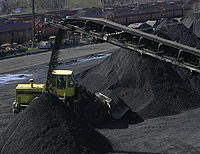
Coal pile Poland
Photo Sean Gallup/Getty Images
Freshly mined coal awaits transport near a coal mine in Katowice, Poland.
All the talks in Durban will be of how to kick the coal habit. But as the climate talks have dragged on — from Nairobi in 2006 to Bali to Poznan to Copenhagen to Cancun and now to Durban — we have been hardening our addiction.

When the talks began half a decade ago, 25 percent of the world’s primary energy came from coal. The figure is now 29.6 percent. Between 2009 and 2010, global coal consumption grew by almost 8 percent.

South Africa may enjoy green plaudits for hosting the Durban conference. And, to be fair, it has offered to reduce the carbon intensity of its economy. But the fact is that today the would-be midwife of a global climate deal has rich-world emissions in a predominantly poor-world country. Per head of population, its CO2 emissions are higher than those in the UK, while its GDP per capita is only a sixth as much. It is responsible for about 40 percent of Africa’s CO2 emissions from fossil fuel burning.

The reason is coal. Making energy by burning coal produces twice as much CO2 as by burning natural gas. And South Africa is one of the most coal-dependent nations on Earth, generating 93 percent of its electricity from the black stuff, compared to China’s 80 percent, India’s 70 percent and the U.S.’s 45 percent.

Besides its domestic reliance on coal, South Africa also helps maintain the rest of the world’s ruinous carbon fix. It is the world’s third-largest
Thanks to coal, the world’s economy is becoming more carbon intensive.
exporter of power-station coal. Its giant mines in Mpumalanga province feed a constant convoy of coal trains headed for Richards Bay. Recently expanded, the export terminal there can now handle 91 million tons of coal a year — enough to produce more than 200 million tons of CO2. Mining giants Anglo American and BHP Billiton ship that coal to Europe, and, increasingly, to the new industrial powerhouses of Asia.

The world is in the middle of a coal rush. That is why last year — despite much political posturing about curbing greenhouse gas emissions — the 5.8-percent rise in global energy-related CO2 emissions marginally exceeded the global rise in energy consumption. Thanks to coal, the world’s economy is becoming more carbon intensive.

Cynics who said tougher carbon controls in rich nations might increase global emissions by outsourcing energy-intensive industries to poorer nations with laxer standards are, for now at least, being proved right. While many Western economies stall, many developing economies are growing fast. And the continuing heavy dependence of many of them on coal is pushing up the global economy’s reliance on the dirtiest fuel.

China may be the world’s largest producer of wind turbines and solar panels, but its coal consumption has doubled in the past eight years. In 2010, an amazing 48 percent of all the coal burned in the world was burned in China. The country’s roads are clogged with coal trucks headed from mines to power stations. Earlier this month, there was a 40-mile traffic backup out of the major coal-mining region in Shaanxi province. Trucks were taking a week to get down the main highway, which carries 160 million tons of coal a year. Last year, 10,000 vehicles were stuck for days on another coal road, out of Inner Mongolia.

Meanwhile, India’s coal consumption has doubled in 12 years. It is expected to have three times as many coal-burning power stations by the end of the decade. India, like China, has huge coal reserves of its own. But its economy is growing so fast that its miners cannot dig the stuff out of the ground quickly enough, causing a surge in imports. South Africa’s Richards Bay is a major supplier, along with Australia and Indonesia, which is likely to become the world’s top coal exporter before the decade is out.

None of this excuses the West. The U.S. remains the world’s second-largest coal burner, after China. Japan is the world’s largest coal importer, and
Industry lobbyists use the phrase “clean coal” to suggest we can have both our coal and our climate.
Germany is the biggest producer of brown coal. The sad truth is that Germany’s plan to shut down its nuclear power plants in the wake of the Fukushima accident in Japan is already resulting in resurgent investment in coal. Analysts Point Carbon predict that the switch will increase German CO2 emissions during the coming decade by around half a billion tons.

Why doesn’t the world care? One reason is expediency. The inconvenient truth is that coal remains the world’s cheapest fuel for electricity generation and industrial heat and power. Another is coal’s PR.

“Clean coal” is its cleverest piece of sophistry. Lobby organizations like the American Coalition for Clean Coal Electricity — sponsored in the past by BHP Billiton, Duke Energy and others — use the phrase to foster the idea we can have both our coal and our climate. Most insidiously, the industry has persuaded many policymakers that dirty coal today can pay for clean coal tomorrow.

Clean coal is a distant vision, which could someday be possible through a technology known as carbon capture and storage — in which CO2 is stripped from stack emissions, liquefied and buried underground. But large-scale deployment of what would be a massive new industry is at least a couple of decades — and tens of billions of R&D dollars — away. And industry will only do it if forced.

Moreover, since the economic downturn in the West, investment in the necessary R&D to develop the technology has dried up. In September, the International Energy Agency warned that government support for CCS around the world was waning. “With current policies, CCS will have a hard time being deployed,” the agency’s deputy executive director, Richard Jones, told a high-level meeting in Beijing. Steve Chu, Barack Obama’s green-minded energy secretary, warned at the same meeting that “we are losing time. It is very important that we get moving.”

MORE FROM YALE e360

After a Strong Counterattack,
Big Coal Makes a Comeback

After a Strong Counterattack, Big Coal Makes a Comeback
With a campaign focused on advertising, lobbying, and political contributions, the U.S. coal industry has beat back a challenge from environmentalists and clean-energy advocates, writes journalist Jeff Goodell.
READ MORE
In the U.S., the FutureGen clean-coal pilot project has been stalled since the Bush administration pulled the plug and ordered a re-evaluation in 2008. Under Obama, a test well is being drilled in western Illinois, but the first carbon won’t be buried until 2016 at the earliest.

In Britain, once in the vanguard of action on climate change, the government is scaling back its green energy investment. An early casualty was its flagship $1.6-billion CCS project in Scotland, which was canceled earlier this month. That represented four wasted years. Denmark also canceled a pilot carbon storage project this month.

Nobody expects a UN climate deal in Durban this year — nor next year, nor the year after. But meanwhile the coal keeps burning. Global production is set to rise by 35 percent in the coming decade, according to industry analysts. The cheapest, most abundant and dirtiest of all the fossil fuels is extending its grip on the world’s energy supply system. And nowhere more so than just up the coast from Durban.

POSTED ON 31 Oct 2011 IN Energy Policy & Politics Policy & Politics Pollution & Health North America North America 

COMMENTS


If a 'cynics' predictions are proved correct - does that not make them a realist? Or at the very least pragmatic and worth listening to?

ie: "Cynics who said tougher carbon controls in rich nations might increase global emissions by outsourcing energy-intensive industries to poorer nations with laxer standards are, for now at least, being proved right."

Posted by Barry Woods on 31 Oct 2011


Quote: "Cynics who said tougher carbon controls in rich nations might increase global emissions by outsourcing energy-intensive industries to poorer nations with laxer standards are, for now at least, being proved right."

Really? Where is the evidence that tougher carbon controls have promoted outsourcing of such industries? This outsourcing has certainly happened -- just look at all the "Made in China" stickers on merchandise in almost any store in the US -- but this trend has been ongoing for years, and the US still doesn't have anything approaching "tougher carbon controls". The outsourcing has happened because of globalization and the flattening of the trade landscape, not carbon regulation.

Posted by Lou Grinzo on 31 Oct 2011


The implications of this article are chilling. Are we simply resigned to burning ever-diminishing grades of energy? Climate change might devour our apathy sooner than we expect, but I wonder if we will then lack the resources necessary to facilitate the major infrastructural changes required.

Cheap fuel and tougher controls (or higher standards in general, whether carbon or
humanitarian or otherwise) promoted outsourcing of industries and will likely continue to do so until the practice is priced out of the market.

To the extent that rich nations export their toxic industrial processes, waste products, undesirable labor, deforestation and habitat destruction in general, locally obscuring the true impact of their lifestyles, where does the US end and China begin?

Richard Heinberg wrote that annually in China, about 200 million tons of coal (10% their annual production and emitting 360 million tons of carbon dioxide) burn in uncontrolled and largely uncontrollable mine fires that will continue to burn for years if not decades.

I really found this short documentary helpful in providing a tangible grasp of industrial conditions in China; one example of a community affected by industrial processes:

http://e360.yale.edu/feature/the_warriors_of_qiugang/2358/


Posted by Josh Balik on 31 Oct 2011


Excellent post on Coal and Greenhouse Emissions.

Though a lot of talk is there on harnessing Renewables around the globe coal remains mainstay for power production in many countries including China.

According to the World Coal Association statistics, coal-fired power plants generate 41 per cent of the global power. Coal is primary fuel for 49 per cent power generating capacity in the US, 79 per cent in China and 69 per cent in India.

China produced the largest quantity of coal -- 3162 million tonnes -- in 2010, followed by the USA 932 million tonnes, India 538 million tonnes, Australia 353 million tonnes and South Africa 255 million tonnes. China and India imported 177 million tonnes and India 90 million tonnes last year.

Though coal is considered as a 'dirty fuel' by the environmentalists across the globe, its use, instead of any decline, is likely to increase phenomenally, at least, in the short-term because of its abundance.

Here are statistics of Coal production and Coal import by some countries:

Coal
Top hard coal and brown coal producers (Mt)

            2005      2008      2009
1      China
2,226      2,761      2,971
2      United States
1,028      1,076      985
3      India
430      521      561
4      Australia
372      397      399
5      Indonesia
318      284      301
6      South Africa
315      236      247
7      Russia
222      323      297
8      Kazakhstan
79      108      101
9      Poland
160      144      135
10      Colombia
65      79      73
      Total      5,878      6,796      6,903
      Top ten      89 %      87 %      88 %


Top hard coal importers (Mt)
            2005      2008      2009
1      Japan
178      186      165
2      China
25      nd      114
3      South Korea
77      100      103
4      India
37      58      66
5      Taiwan
61      66      60
6      Germany
38      46      38
7      United Kingdom
44      43      38
8      Turkey
nd      19      20
9      Italy
24      25      19
10      Spain
25      19      16
x      France
nd      21      nd
x      United States
28      nd      nd
      Total      778      778      819
x      Top ten      69 %      75 %      78 %
      Import of production      16 %      13 %      14 %


Dr.A.Jagadeesh Nellore(AP),India
E-mail: anumakonda.jagadeesh@gmail.com

Posted by Dr.A.Jagadeesh on 01 Nov 2011


The fixation of the global climate change community upon the unwieldy and corruptible
cap and trade instrument has in part enabled this rise in carbon intensity and coal use. There exist too many ways for participants in these emissions schemes to circumvent the noble intentions of at least some of the anti-AGW movement. There are also speculative financial interests that have sustained interest in cap and trade far beyond its "sell-by" date.

A rising carbon tax/price with related carbon tariffs would start to make the alternatives to coal more and more attractive. Of course, working out such a price-based rather than permit-based scheme is not a panacea as the price needs to become high enough fast enough, as well as accurate assessment and collection of the tax needs to occur. With a firm price in place, including tariffs imposed on those countries that do not participate, once emissions intensive energy generation OR products made with emission intensive processes become relatively more expensive, the hunt will be on in earnest for cleaner generation and greater energy efficiency. Permit-based schemes provide a staggering number of loopholes as Mark Shapiro has documented: http://harpers.org/archive/2010/02/0082826

I've written a long critique here: http://greenthoughts.us/policy/capandtrade/

Posted by Michael Hoexter Ph.D. on 02 Nov 2011


We enviros live in a dream world where we think billions of people will voluntarily hurt their lives and their families by living day-to-day by whether the wind blows or the sun shines.

Coal isn't going away unless something just as cheap and just reliable is found and developed over the next 30 years. Even the enviro story line is weak and misleading as these amphibians will be affected over the next 50 years even if all coal production stops.

We enviros need to talk truth and not all this spin. People are not as dumb as this enviro PR factory think they are.

Posted by Andy McGill on 03 Nov 2011


You write as if what's holding carbon capture and storage back is something specific to the technology rather than the overall problem of lack of public support for raising the price of emitting CO2. Why?

The problem anyone wanting to install CCS in the US is there is no price on carbon.

Eg: American Electric Power CEO Mike Morris had to turn down a DOE grant to assist his company to build a large scale CCS plant because his regulator wouldn't allow any increased cost tacked on to the electricity produced as a result to be passed on to his customers. The technology is ready to go.

Morris says a new coal plant fitted with the process his company was ready to proceed with now would produce low carbon electricity more cheaply than new nuclear or new renewables. See: http://www.loe.org/shows/segments.html?programID=11-P13-00029&segmentID=1

People like you who try to mystify what is holding CCS back are part of the problem.

Posted by David Lewis on 03 Nov 2011


The Achilles heel of coal is oil. It takes about 5 gallons of oil (diesel and lubricants) to mine and rail a ton of coal from Wyoming to Michigan. That is $20 of oil to ship $15 of coal.

With peak oil just around the corner, shipping coal by any means powered by oil will soon become economically prohibitive. That is when the alternatives of RE and EE will shine.

Peak coal is more economic than physical.

Posted by Frank Zaski on 03 Nov 2011


Agave (tequila plant) yields 40-65+ tonnes of dry biomass per hectare per year (from year 3 on). Around 30% of that could be converted into biochar, to substitute coal (as drop-in fuel).

Besides, on an annual basis, one hectare of agave yields from 3 to 10 times the sugars of one hectare of sugarcane in Brazil. Sugar is the new oil...

Around 41% of the Earth's territory is dryland, where agave can thrive (agricultural land is ~30%).

Agave Project is pursuing the production of biofuels (solid, liquid and gaseous) from agave in the 5 continents (30 countries). Our main concern is climate change.

Next year we will start planting agave to combat desertification at the Sahara (Great Green Wall). If we succed, and I am sure we will, we will be able to turn the Sahara Desert into a Sea of Agave and produce massive amounts of biofuels.

Agave will soon be reckoned as a great sustainable energy crop and it will play a very important role in the creation of the new Bioeconomy Era for the XXI Century.

Best,

Arturo
agaveproject2@gmail.com

Posted by Arturo Velez on 06 Nov 2011


POST A COMMENT

Comments are moderated and will be reviewed before they are posted to ensure they are on topic, relevant, and not abusive. They may be edited for length and clarity. By filling out this form, you give Yale Environment 360 permission to publish this comment.

Name 
Email address 
Comment 
 

fred pearceABOUT THE AUTHOR
Fred Pearce is a freelance author and journalist based in the UK. He serves as environmental consultant for New Scientist magazine and is the author of numerous books, including When The Rivers Run Dry and With Speed and Violence. In previous articles for Yale Environment 360, Pearce has written about the environmental consequences of humankind’s addiction to chemical fertilizers and the possible role that airborne microbes play in our world, from spreading disease to possibly changing the climate.
MORE BY THIS AUTHOR


RELATED ARTICLES


Amory Lovins Lays Out
His Clean Energy Plan

For four decades, Amory Lovins has been a leading proponent of a renewable power revolution that would wean the U.S. off fossil fuels and usher in an era of energy independence. In an interview with Yale Environment 360, he talks about his latest book, which describes his vision of how the world can attain a green energy future by 2050.
READ MORE

Building a Better Bulb:
Lighting Revolution Advances

With the industry’s support and despite political opposition, new U.S. lighting efficiency standards went into effect this month. This move, along with similar actions in Europe and China, is helping spur new technologies that will change the way the world's homes and businesses are illuminated.
READ MORE

Solar Power Off the Grid:
Energy Access for World’s Poor

More than a billion people worldwide lack access to electricity. The best way to bring it to them — while reducing greenhouse gas emissions — is to launch a global initiative to provide solar panels and other forms of distributed renewable power to poor villages and neighborhoods.
READ MORE

As Coal Use Declines in U.S.,
Coal Companies Focus on China

With aging coal-fired U.S. power plants shutting down, major American coal companies are exporting ever-larger amounts of coal to China. Now, plans to build two new coal-shipping terminals on the West Coast have set up a battle with environmentalists who want to steer the world away from fossil fuels.
READ MORE

A Power Company President
Ties His Future to Green Energy

David Crane, the CEO of one of the nation’s largest electric companies, has become a leading proponent of renewable energy. In an interview with Yale Environment 360, he explains how, in the face of government paralysis, the private sector can help lead the shift away from fossil fuels.
READ MORE


MORE IN Analysis


Busting the Forest Myths:
People as Part of the Solution

by fred pearce
The long-held contention that rural forest communities are the prime culprits in tropical forest destruction is increasingly being discredited, as evidence mounts that the best way to protect rainforests is to involve local residents in sustainable management.
READ MORE

China’s Reforestation Programs:
Big Success or Just an Illusion?

by jon r. luoma
China has undertaken ambitious reforestation initiatives that have increased its forest cover dramatically in the last decade. But scientists are now raising questions about just how effective these grand projects will turn out to be.
READ MORE

As Coal Use Declines in U.S.,
Coal Companies Focus on China

by jonathan thompson
With aging coal-fired U.S. power plants shutting down, major American coal companies are exporting ever-larger amounts of coal to China. Now, plans to build two new coal-shipping terminals on the West Coast have set up a battle with environmentalists who want to steer the world away from fossil fuels.
READ MORE

The New Story of Stuff:
Can We Consume Less?

by fred pearce
A new study finds that Britons are consuming less than they did a decade ago, with similar patterns being seen across Europe. Could this be the beginning of a trend in developed countries? Might we be reaching “peak stuff”?
READ MORE

China’s Appetite for Wood
Takes a Heavy Toll on Forests

by william laurance
More than half of the timber now shipped globally is destined for China. But unscrupulous Chinese companies are importing huge amounts of illegally harvested wood, prompting conservation groups to step up boycotts against rapacious timber interests.
READ MORE

Revisiting Population Growth:
The Impact of Ecological Limits

by robert engelman
Demographers are predicting that world population will climb to 10 billion later this century. But with the planet heating up and growing numbers of people putting increasing pressure on water and food supplies and on life-sustaining ecosystems, will this projected population boom turn into a bust?
READ MORE

What If Experts Are Wrong
On World Population Growth?

by carl haub
A central tenet of demography is that global population will peak at 9 to 10 billion this century and then gradually decline as poorer countries develop. But that assumption may be overly optimistic — and if it is, population will continue to rise, placing enormous strains on the environment.
READ MORE

The Crucial Role of Predators:
A New Perspective on Ecology

by caroline fraser
Scientists have recently begun to understand the vital role played by top predators in ecosystems and the profound impacts that occur when those predators are wiped out. Now, researchers are citing new evidence that shows the importance of lions, wolves, sharks, and other creatures at the top of the food chain.
READ MORE

The Long Strange Journey
Of Earth’s Traveling Microbes

by fred pearce
Airborne microbes can travel thousands of miles and high into the stratosphere. Now scientists are beginning to understand the possible role of these microbes — such as bacteria, fungal spores, and tiny algae — in creating clouds, causing rain, spreading disease, and even changing climate.
READ MORE

Probing the Role of the Sun
In an Era of Global Warming

by michael d. lemonick
Some skeptics have suggested the real culprit behind rising temperatures is increased solar activity. But a wide variety of data and experiments still provide no solid evidence to refute the scientific consensus that greenhouse gas emissions are the major reason the planet is heating up.
READ MORE


e360 digest
Yale
Yale Environment 360 is
a publication of the
Yale School of Forestry
& Environmental Studies
.

SEARCH e360


Donate to Yale Environment 360

CONNECT

Twitter: YaleE360
e360 on Facebook
Donate to e360
View mobile site
Bookmark
Share e360
Email newsletter
Subscribe to our feed:
rss


ABOUT

About e360
Contact
Submission Guidelines
Reprints

e360 VIDEO

Warriors of Qiugang
The Warriors of Qiugang, a Yale Environment 360 video that chronicles the story of a Chinese village’s fight against a polluting chemical plant, was nominated for a 2011 Academy Award for Best Documentary (Short Subject). Watch the video.


DEPARTMENTS

Opinion
Reports
Analysis
Interviews
e360 Digest
Video Reports

TOPICS

Biodiversity
Business & Innovation
Climate
Energy
Forests
Oceans
Policy & Politics
Pollution & Health
Science & Technology
Sustainability
Urbanization
Water

REGIONS

Antarctica and the Arctic
Africa
Asia
Australia
Central & South America
Europe
Middle East
North America

e360 VIDEO REPORT

When the Water Ends
As temperatures rise and water supplies dry up, tribes in East Africa increasingly are coming into conflict. A Yale Environment 360 video reports on a phenomenon that could become more common: how worsening drought will pit groups — and nations — against one another. Watch the video.

e360 MOBILE

Mobile
The latest
from Yale
Environment 360
is now available for mobile devices at e360.yale.edu/mobile.


header image
Top Image: aerial view of Iceland. © Google & TerraMetrics.

e360 VIDEO REPORT

Leveling Appalachia
Leveling Appalachia: The Legacy of Mountaintop Removal Mining, an e360 video examining the environmental and human impacts of this mining practice, won the award for best video in the 2010 National Magazine Awards for Digital Media. Watch the video.


OF INTEREST


RESOURCES


Yale