03 Jun 2008: Analysis

Water Scarcity:
The Real Food Crisis

In the discussion of the global food emergency, one underlying factor is barely mentioned: The world is running out of water. A British science writer, who authored a major book on water resources, here explores the nexus between water overconsumption and current food shortages.

by fred pearce

After decades in the doldrums, food prices have been soaring this year, causing more misery for the world’s poor than any credit crunch. The geopolitical shockwaves have spread round the world, with food riots in Haiti, strikes over rice shortages in Bangladesh, tortilla wars in Mexico, and protests over bread prices in Egypt.

The immediate cause is declining grain stocks, which have encouraged speculators, hoarders, and panic-buyers. But what are the underlying trends that have sown the seeds for this perfect food storm?

Biofuels are part of it, clearly. A quarter of U.S. corn is now converted to ethanol, powering vehicles rather than filling stomachs or fattening livestock. And the rising oil prices that encouraged the biofuels boom are also raising food prices by making fertilizer, pesticides, and transport more expensive.

But there is something else going on that has hardly been mentioned, and that some believe is the great slow-burning, and hopelessly underreported, resource crisis of the 21st century: water.

Climate change, overconsumption and the alarmingly inefficient use of this most basic raw material are all to blame. I wrote a book three years ago titled When The Rivers Run Dry. It probed why the Yellow River in China, the Rio Grande and Colorado in the United States, the Nile in Egypt, the Indus in Pakistan, the Amu Darya in Central Asia, and many others are all running on empty. The confident blue lines in a million atlases simply do not tell the truth about rivers sucked dry, for the most part, to irrigate food crops.

We are using these rivers to death. And we are also pumping out underground water reserves almost everywhere in the world. With two-thirds of the water abstracted from nature going to irrigate crops — a figure that rises above 90 percent in many arid countries — water shortages equal food shortages.

Consider the two underlying causes of the current crisis over world food prices: falling supplies from some of the major agricultural regions that supply world markets, and rising demand in booming economies like China and India.

Why falling supplies? Farm yields per hectare have been stagnating in many countries for a while now. The green revolution that caused yields to soar 20 years ago may be faltering. But the immediate trigger, according to most analysts, has been droughts, particularly in Australia, one of the world’s largest grain exporters, but also in some other major suppliers, like Ukraine. Australia’s wheat exports were 60 percent down last year; its rice exports were 90 percent down.

Why rising demand? China has received most of the blame here — its growing wealth is certainly raising demand, especially as richer citizens eat more meat. But China traditionally has always fed itself — what’s different now is that the world’s most populous country is no longer able to produce all its own food.

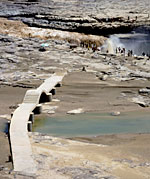
A few years ago, the American agronomist and environmentalist Lester Brown wrote a book called Who Will Feed China?: Wake Up Call for a Small Planet. It predicted just this. China can no longer feed itself largely because demand is rising sharply at a time when every last drop of water in the north of the country, its major breadbasket, is already taken. The Yellow River, which drains most of the region, now rarely reaches the sea, except for the short monsoon season.
Enlarge image
Yellow River
Fred Pearce
China's once-great Yellow River often no longer reaches the sea, as much of it is drawn off for power and agriculture.

Some press reports have recently suggested that China is being sucked dry to provide water for the Beijing Olympics. Would that it were so simple. The Olympics will require only trivial amounts of water. China’s water shortages are deep-seated, escalating, and tied to agriculture. Even hugely expensive plans to bring water from the wetter south to the arid north will only provide marginal relief.

The same is true of India, the world’s second most populous country. Forty years ago, India was a basket case. Millions died in famines. The green revolution then turned India into a food exporter. Its neighbor Bangladesh came to rely on India for rice. But Indian food production has stagnated recently, even as demand from richer residents has soared. And the main reason is water.
Enlarge image
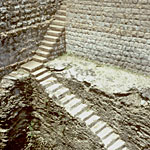
Hand dug well in India
Fred Pearce
Even this elaborate hand-dug well in the Indian state of Tamil Nadu is dry, a result of over-pumping the underground aquifers.

Enlarge image
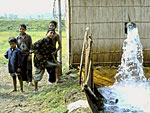
Pumping irrigation water in India
Fred Pearce
Underground water is pumped for irrigation in Bengal, India, a practice that is increasing as surface water dries up.

With river water fully used, Indian farmers have been trying to increase supplies by tapping underground reserves. In the last 15 years, they have bought a staggering 20 million Yamaha pumps to suck water from beneath their fields. Tushaar Shah, director of the International Water Management Institute’s groundwater research station in Gujarat, estimates those farmers are pumping annually to the surface 100 cubic kilometers more water than the monsoon rains replace. Water tables are plunging, and in many places water supplies are giving out.

“We are living hand-to-mouth,” says D.P. Singh, president of the All India Grain Exporters Association, who blames water shortages for faltering grain production. Last year India began to import rice, notably from Australia. This year, it stopped supplying its densely populated neighbor Bangladesh, triggering a crisis there too.

More and more countries are up against the limits of food production because they are up against the limits of water supply. Most of the Middle East reached this point years ago. In Egypt, where bread riots occurred this spring, the Nile River no longer reaches the sea because all its water is taken for irrigation.

A map of world food trade increasingly looks like a map of the water haves and have-nots, because in recent years the global food trade has become almost a proxy trade in water — or rather, the water needed to grow food. “Virtual water,” some economists call it. The trade has kept the hungry in dry lands fed. But now that system is breaking down, because there are too many buyers and not enough sellers.

According to estimates by UNESCO’s hydrology institute, the world’s largest net supplier of virtual water until recently was Australia. It exported a staggering 70 cubic kilometers of water a year in the form of crops, mainly food. With the Murray-Darling Basin, Australia’s main farming zone, virtually dry for the past two years, that figure has been cut in half.

The largest gross exporter of virtual water is the United States, but its exports have also slumped as corn is diverted to domestic biofuels, and because of continuing drought in the American West.

The current water shortages should not mark an absolute limit to food production around the world. But it should do three things. It should encourage a rethinking of biofuels, which are themselves major water guzzlers. It should prompt an expanding trade in food exported from countries that remain in water surplus, such as Brazil. And it should trigger much greater efforts everywhere to use water more efficiently.

On a trip to Australia in the midst of the 2006 drought, I was staggered to see that farmers even in the most arid areas still irrigate their fields mostly by flooding them. Until the water runs out, that is. Few have adopted much more efficient drip irrigation systems, where water is delivered down pipes and discharged close to roots. And, while many farmers are expert at collecting any rain that falls on their land, they sometimes allow half of that water to evaporate from the surfaces of their farm reservoirs.

For too long, we have seen water as a cheap and unlimited resource. Those days are coming to an end — not just in dry places, but everywhere. For if the current world food crisis shows anything, it is that in an era of global trade in “virtual water,” local water shortages can reverberate throughout the world — creating higher food prices and food shortages everywhere.


POSTED ON 03 Jun 2008 IN Climate Science & Technology Sustainability Water Africa Asia North America North America 

COMMENTS


This article ties very well with "What will Next
President Must do" by Elizabeth kolbert. Let's wish
the the next president do read this article too.

The final point is still "Energy". If we solve the
clean and unlimited energy problem, we shall be
able to desalt enough water to supply the water we
need. Of course, conservation and recycling is a
must first.

YU-tsang Hwang
Posted by yu-tsang Hwang on 03 Jun 2008


Water shortages, inept planning, poor utilization of existing resources, depletion of precious natural assets, all point to the effects, the external manifestations of the root cause of all these problems; man's egoism that is ever-increasing which accounts for the exacerbation of the current problems.

We blame politicians, they blame us and each other, countries squabble and confer to implement inept solutions. What has worked so far? Is global hunger, depletion of natural resouces, greed, famine a new thing? How long will these imbalances continue before we begin to look inside ourselves for the solution to these problems?

What about our egoism? We know we are selfish and we continue to look at the other guy, the other country to lay blame when the answer lies within us. We are steeped in egoism when all of nature requires altruism. Is the answer really this simple?

How do we make this change? There’s an interesting article at http://www.kabtoday.com/epaper_eng/content/view/epaper/7771/(page)/1/(article)/7773

Posted by fchristie on 05 Jul 2008


Comments have been closed on this feature.
fred pearceABOUT THE AUTHOR
Fred Pearce is a freelance author and journalist based in the UK. He is environment consultant for New Scientist magazine and author of recent books When The Rivers Run Dry and With Speed and Violence (Beacon Press). His next, Confessions of an Eco Sinner, is published in the fall. Pearce has also written for Yale e360 on defusing the population bomb and the limits of climate modeling.
MORE BY THIS AUTHOR


RELATED ARTICLES


The Clean Water Act at 40:
There’s Still Much Left to Do

The Clean Water Act of 1972, one of the boldest environmental laws ever enacted, turns 40 this year, with an impressive record of cleaning up America's waterways. But from New York Harbor to Alaska’s Bristol Bay, key challenges remain.
READ MORE

A Kenyan Woman Stands Up
Against Massive Dam Project

Ikal Angelei is helping lead a campaign to stop construction of a major dam in Ethiopia that threatens the water supply and way of life of tens of thousands of indigenous people. In an interview with Yale Environment 360, she explains what she believes is at stake in the fight against the Gibe III dam.
READ MORE

The New Story of Stuff:
Can We Consume Less?

A new study finds that Britons are consuming less than they did a decade ago, with similar patterns being seen across Europe. Could this be the beginning of a trend in developed countries? Might we be reaching “peak stuff”?
READ MORE

Colorado River: Running Near Empty
Photographer Pete McBride traveled along the Colorado River from its source high in the Rockies to its historic mouth at the Sea of Cortez. In a Yale Environment 360 video, he documents how increasing water demands have transformed the river that is the lifeblood for an arid Southwest.
READ MORE

What If Experts Are Wrong
On World Population Growth?

A central tenet of demography is that global population will peak at 9 to 10 billion this century and then gradually decline as poorer countries develop. But that assumption may be overly optimistic — and if it is, population will continue to rise, placing enormous strains on the environment.
READ MORE


MORE IN Analysis


The Vital Chain: Connecting
The Ecosystems of Land and Sea

by carl zimmer
A new study from a Pacific atoll reveals the links between native trees, bird guano, and the giant manta rays that live off the coast. In unraveling this intricate web, the researchers point to the often little-understood interconnectedness between terrestrial and marine ecosystems.
READ MORE

Could a Changing Climate
Set Off Volcanoes and Quakes?

by fred pearce
A British scientist argues that global warming could lead to a future of more intense volcanic eruptions and earthquakes. And while some dismiss his views as preposterous, he points to a body of recent research that shows a troubling link between climate change and the Earth’s most destructive geological events.
READ MORE

China’s Looming Conflict
Between Energy and Water

by christina larson
In its quest to find new sources of energy, China is increasingly looking to its western provinces. But the nation’s push to develop fossil fuel and alternative sources has so far ignored a basic fact — western China simply lacks the water resources needed to support major new energy development.
READ MORE

As Threats to Biodiversity Grow,
Can We Save World’s Species?

by lee hannah
With soaring human populations and rapid climate change putting unprecedented pressure on species, conservationists must look to innovative strategies — from creating migratory corridors to preserving biodiversity hotspots — if we are to prevent countless animals and plants from heading to extinction.
READ MORE

Linking Weird Weather to
Rapid Warming of the Arctic

by jennifer francis
The loss of Arctic summer sea ice and the rapid warming of the Far North are altering the jet stream over North America, Europe, and Russia. Scientists are now just beginning to understand how these profound shifts may be increasing the likelihood of more persistent and extreme weather.
READ MORE

Rethinking Carbon Dioxide:
From a Pollutant to an Asset

by marc gunther
Three startup companies led by prominent scientists are working on new technologies to remove carbon dioxide from the atmosphere. The scientific community is skeptical, but these entrepreneurs believe the process of CO2 removal can eventually be profitable and help cool an overheating planet.
READ MORE

Busting the Forest Myths:
People as Part of the Solution

by fred pearce
The long-held contention that rural forest communities are the prime culprits in tropical forest destruction is increasingly being discredited, as evidence mounts that the best way to protect rainforests is to involve local residents in sustainable management.
READ MORE

China’s Reforestation Programs:
Big Success or Just an Illusion?

by jon r. luoma
China has undertaken ambitious reforestation initiatives that have increased its forest cover dramatically in the last decade. But scientists are now raising questions about just how effective these grand projects will turn out to be.
READ MORE

As Coal Use Declines in U.S.,
Coal Companies Focus on China

by jonathan thompson
With aging coal-fired U.S. power plants shutting down, major American coal companies are exporting ever-larger amounts of coal to China. Now, plans to build two new coal-shipping terminals on the West Coast have set up a battle with environmentalists who want to steer the world away from fossil fuels.
READ MORE

The New Story of Stuff:
Can We Consume Less?

by fred pearce
A new study finds that Britons are consuming less than they did a decade ago, with similar patterns being seen across Europe. Could this be the beginning of a trend in developed countries? Might we be reaching “peak stuff”?
READ MORE


e360 digest
Yale
Yale Environment 360 is
a publication of the
Yale School of Forestry
& Environmental Studies
.

SEARCH e360


Donate to Yale Environment 360

CONNECT

Twitter: YaleE360
e360 on Facebook
Donate to e360
View mobile site
Bookmark
Share e360
Email newsletter
Subscribe to our feed:
rss


ABOUT

About e360
Contact
Submission Guidelines
Reprints

e360 VIDEO

Warriors of Qiugang
The Warriors of Qiugang, a Yale Environment 360 video that chronicles the story of a Chinese village’s fight against a polluting chemical plant, was nominated for a 2011 Academy Award for Best Documentary (Short Subject). Watch the video.


DEPARTMENTS

Opinion
Reports
Analysis
Interviews
e360 Digest
Video Reports

TOPICS

Biodiversity
Business & Innovation
Climate
Energy
Forests
Oceans
Policy & Politics
Pollution & Health
Science & Technology
Sustainability
Urbanization
Water

REGIONS

Antarctica and the Arctic
Africa
Asia
Australia
Central & South America
Europe
Middle East
North America

e360 VIDEO REPORT

When the Water Ends
As temperatures rise and water supplies dry up, tribes in East Africa increasingly are coming into conflict. A Yale Environment 360 video reports on a phenomenon that could become more common: how worsening drought will pit groups — and nations — against one another. Watch the video.

e360 MOBILE

Mobile
The latest
from Yale
Environment 360
is now available for mobile devices at e360.yale.edu/mobile.


header image
Top Image: aerial view of Iceland. © Google & TerraMetrics.

e360 VIDEO REPORT

Leveling Appalachia
Leveling Appalachia: The Legacy of Mountaintop Removal Mining, an e360 video examining the environmental and human impacts of this mining practice, won the award for best video in the 2010 National Magazine Awards for Digital Media. Watch the video.


OF INTEREST


Yale