A baby orangutan ambles across the grass at a rehabilitation center in Kalimantan, in the heart of Indonesian Borneo. The ape pauses, picks up a stick, and makes his way to a plastic log, lined with small holes. Breaking the stick in two, he pokes one end into a hole in an effort to extract honey that has been placed inside. His satisfied expression shows that the exercise — part of an elaborate training regime designed to teach the orangutan to ultimately live on his own in the forest — has been fruitful.
To his right, another baby orangutan has turned half a coconut shell into a helmet, two others wrestle on the lawn, and another scales a papaya tree. Just outside the compound, staff members teach dozens more young orangutans how to climb trees. Others feed milk to orangutans from baby bottles.
The orangutans at the Nyaru Menteng center, run by the Borneo Orangutan Survival Foundation (BOS), are mainly “oil palm orphans” whose forest habitats were destroyed — and parents killed — by the swiftly spreading oil palm industry in Indonesia. BOS hopes to eventually release all of these orangutans back into their natural habitat — the majestic rainforests and swampy peat lands of central Kalimantan.
But for many, this is a fate that may never be realized, and instead they may be relegated to a life in captivity. The reason? Suitable habitat in Borneo and Sumatra — the two islands that are home to the world’s entire population of wild orangutans — is being deforested so rapidly that it is becoming increasingly difficult to find locations for reintroduction.
Indeed, good habitat is becoming so scarce that scores of recently reintroduced orangutans have managed to win a taste of freedom only to be killed as their new homes are destroyed by loggers and oil palm
Photo Gallery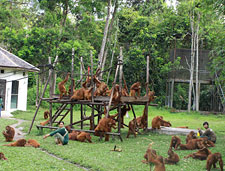
Orphaned orangutans play at the Nyaru Menteng rehabilitation center in the Indonesian Borneo.
developers. Economic returns from converting verdant rainforests into furniture, paper, and wood chips — and then using the land for oil palm plantations —have swiftly diminished the availability of sites for reintroduction, while dramatically boosting the number of orangutans in need of rescue.
So the orangutans must wait; more than 2,000 are currently in the rehabilitation system. But they are the lucky ones. For every orangutan housed in a center, half a dozen or more may have fallen victim to deforestation, been captured for the pet trade, or met their end at the blade of a machete or the blunt end of an iron bar. Estimates of orangutan deaths range from 1,500 to 5,000 per year, out of a population of only 54,000 in Borneo and 6,500 in Sumatra. (Borneo is divided between Indonesia and Malaysia; Sumatra is part of Indonesia.)
Meanwhile, their habitat continues to vanish as oil palm plantations metastasize across the Indonesian and Malaysian landscapes. In the past 17 years, prime orangutan habitat in Kalimantan has declined by more than 50 percent, falling from 55,000 square miles in 1992 to fewer than 27,000 square miles today. Since 1975, the extent of primary forest cover in Sumatra has decreased by more than 90 percent.
Orangutan rehabilitation centers originally emerged in the 1960s as a response to the pet trade that saw orangutans plucked from the forest to become circus performers, entertainers for TV shows, and occupants in zoos.
But while the flow of orangutan orphans from the pet trade was relatively manageable, the rise of palm oil has dramatically changed the situation, greatly increasing the number of orangutans in need of care.
Michelle Desilets, executive director of the Orangutan Land Trust, says she started to see the shift about five years ago. Relegated to ever smaller fragments of forest, wild orangutans began to face starvation as their food sources were depleted, forcing them to venture into newly established oil palm plantations where they feed on the young shoots of palms, destroying the tree before it produces any oil seeds.
Viewing the wild orangutans as pests, plantation managers started paying $10 to $20 for each dead orangutan — a strong incentive for a migrant worker.
“Our rescue teams began to be informed of wandering wild orangutans in human settlements,” said Desilets. “We have found orangutans beaten to death with wooden planks and iron bars, butchered by machetes, beaten unconscious and buried alive, and doused with petrol and set alight. Since 2004, more and more orangutans in our centers have been rescued from areas within or near oil palm plantations, and over 90 percent of the infants up to 3 years of age come from these areas.”
Indonesia and Malaysia are the world’s largest producers of palm oil, accounting for more than 85 percent of global output. Palm oil demand has risen sharply over the past two decades due to its wide use in foods, beauty products, and even as a feedstock for biodiesel. Accordingly, the area of land under cultivation in Indonesia and Malaysia has expanded exponentially, growing from less than 580 square miles in 1984 to more than 46,000 square miles today. Unlike logged forest, which has the capacity to support at least some orangutans, timber and oil palm plantations are not viable habitats for orangutans. If they can’t move to other areas — due to isolation or conflict with other orangutans — they will perish without human intervention.
But orangutan rehabilitation centers are ill equipped to handle this tide of oil palm orphans. It can cost more than $2,000 per year to feed and care for an orangutan, which, if raised from infancy, may be reared for eight to ten years, perhaps longer. Training a baby orangutan to live on its own in the wild is a painstaking process, as human caretakers must teach the young apes basic skills, such as how to climb, forage, build nests, and even avoid dangers like snakes. (Rubber snakes are used; the trainer acts frightened and makes loud noises when the rubber snake is uncovered from leaves.)
As the orangutans get older, they are given more time in the forest until they eventually are living on their own on an “orangutan island,” a forested island in the middle of a river. As their skills improve and they become more independent, the orangutans are moved to sites within natural forest areas.
Today, many issues complicate reintroduction. First and foremost is whether the habitat is secure. Finding safe forest is increasingly difficult, and there have been several recent instances where reintroduction sites have been cleared after the orangutans were returned, with tragic consequences.
Earlier this year, Globalindo Agung Lestari cleared a section of forest near Mawas, a reserve in Kalimantan where some 80 wild orangutans had been released. Hardi Baktiantoro of the Center for Orangutan Protection, an activist group in Kalimantan, says all the reintroduced orangutans likely perished.
Photo Gallery
In Sungai Wain, a protected forest in East Kalimantan, fires and logging by a coal mining company wiped out another reintroduction site last year. And in May, the Frankfurt Zoological Society warned that a plan by Asia Pulp & Paper (APP) and Sinar Mas Group to log thousands of acres of unprotected rainforest near Bukit Tigapuluh National Park on Sumatra could doom a portion of an introduction site for the critically endangered Sumatran orangutan.
“It took scientists decades to discover how to successfully reintroduce critically endangered orangutans from captivity into the wild,” said Peter Pratje of the Frankfurt Zoological Society. “It could take APP just months to destroy an important part of their new habitat. These lowland forests are excellent habitat for orangutans, which is why we got government permission to release them here beginning in 2002. The apes are thriving now, breeding and establishing new family groups.”
Some conservationists worry that developers may see reintroduction programs as an alternative to preserving orangutans in their natural habitat, thereby eliminating the need to preserve the animals’ habitat.
“I see 90 percent of the role of rehabilitation as animal welfare,” said Erik Meijaard, an ecologist working with The Nature Conservancy on orangutan conservation in Kalimantan. “But in the past, these programs have done nothing to address the root causes of orangutan decline. In fact, the opposite might happen when displaced orangutans are taken care of by the rehab centers, thereby giving the impression that the centers will help the plantations to solve a problem.”
Said Dave Dellatore, a primatologist with the Sumatran Orangutan Society/Orangutan Information Center, “Rehabilitation and reintroduction were never intended to be a stand-alone solution, but are rather reactions to the greater problem of shrinking habitat and displacement of individuals from the forest. It’s an example of treating the symptom rather than the cause.”
But concerns with reintroduction extend beyond land. Disease is a particular worry. Captive orangutans are more likely to carry disease and parasites due to their living in high density. Furthermore, ex-captives are prone to engage in behavior that puts them at risk, such as living in close proximity to humans when reintroduced into the wild. For example, mortality rates among baby orangutans visited by throngs of tourists in Sepilok and Bukit Lawang are more than 50 percent.
Genetic considerations, too, come into play in the reintroduction process. Due to genetic variation between populations — there are three sub-species of Bornean orangutan, and the Sumatran form is an independent species — orangutans cannot be haphazardly reintroduced to the wild without knowledge of the individual’s origin. Careless reintroduction can also lead to conflict with resident orangutan populations.
Finally, and most critically, reintroduction to areas where people are present doesn’t bode well for orangutans if the needs of locals are not met.
“For reintroduction it is equally important to create a safe political environment as it is a physical environment,” said Dellatore. “If a program is implemented from above with no care or attention given to the local community surrounding it, the project is likely doomed to fail.”
Unlike many Westerners, most rural people in Borneo and Sumatra don’t see orangutans as peers worthy of protection; they view them as pests that compete for food by ransacking crops and destroying livelihoods. Addressing this conflict is key, and various groups are working to show local populations how to reduce crop losses due to orangutans by using techniques such as avoiding planting near forest fringes and draping nets over fruit trees. The groups also highlight the ecological importance of the forests that support orangutans, such as supplying clean water.
Rehabilitation is an example of treating the symptom, rather than the cause.
Perhaps the most promising solution to the decimation of orangutans and their habitat is the emerging concept of paying local communities and companies to preserve forests rather than clearing them. This concept, known as REDD — Reducing Emissions from Deforestation and Degradation — can make local populations partners, rather than enemies, of conservation. Many conservationists working in Indonesia are hopeful that this December’s climate talks in Copenhagen will establish a REDD mechanism enabling governments, conservation groups, and companies to pay billions of dollars to begin protecting remaining areas of tropical forest.
“Many of us speak about balancing social, environmental, and economic values, but really we are in most cases talking about economics, economics, economics,” said The Nature Conservancy’s Meijaard. “If that’s the case, the demise of orangutans and other species is mostly due to the fact that no one is willing or able to pay the opportunity costs of development.”
Two studies, published recently in the journal Conservation Letters, showed that robust forest carbon offsets generated by REDD could be competitive with other forms of land use, including oil palm.
Given the vastness of Kalimantan and Sumatra, it’s going to take more than land acquisition to slow the influx of orphaned orangutans into rehabilitation centers. Improved governance and rooting out corruption will be critical in improving the plight of orangutans and the well-being of local communities. The USAID-backed Orangutan Conservation Services Project is working to do just this, focusing initially on improving law enforcement and identifying gaps in environmental regulations.
Finally, it’s important not to give up on rehabilitation efforts, which generate public awareness of conservation issues — this ultimately translates into political pressure to create protected areas and enforce environmental laws. And there is the issue of animal welfare. Conservationists cannot abandon the 2,000 orangutans currently in the rehabilitation system. After all, baby orangutans now in captivity should be able to enjoy a future where they can dig with tools in forest logs, rather than in plastic pipes.
Correction, July 1, 2009: An earlier version of this article incorrectly described the ownership of the company, Globalindo Agung Lestari. The company is not a subsidiary of the Musim Mas Group. Yale Environment 360 regrets the error.