Scientists say that a species of beetle has rapidly altered its life cycle to more efficiently devour the invasive tamarisk tree in the southern United States.
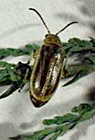 In a decade-long study, researchers from the University of California, Santa Barbara (UCSB) found that the tamarisk leaf beetle — itself an invasive species from Eurasia — was able to quickly establish itself in northern regions of the U.S., where the day lengths matched those in its native home of Kazakhstan and western China. But in the southern U.S., where day lengths in summer are shorter than in northern latitudes, the beetles initially took the reduced hours of daylight as a cue to enter hibernation. This premature hibernation used up the beetles’ metabolic reserves, leading to their deaths. But within seven years of their introduction to the U.S. south, scientists say, the beetles evolved to adapt to their new environment, delaying hibernation by two weeks or more and enabling the beetles to survive and consume the leaves of the tamarisk, also known as salt cedar. That evolutionary adjustment has helped boost efforts to control the shrub in region’s like Colorado’s Arkansas River valley. “This is one of the clearest cases of rapid evolution,” said Tom Dudley, a UCSB scientist and co-author of the study published in the journal Evolutionary Applications.
UCSB
Tamarisk leaf beetle