e360 digest
‘Unprecedented’ Elephant Massacre
Continues in Cameroon Park
28 Feb 2011
Poachers have killed nearly 500 elephants inside a Cameroon national park in the last six weeks, a highly organized slaughter that appears to be one of the worst elephant massacres in recent memory. Park
View images

IFAW
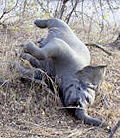
An elephant killed at Bouba Ndjida National Park.
officials have identified 458 elephant carcasses in Bouba Ndjida National Park, which is located in northern Cameroon near the Chad border, said park official Mathieu Fometa. But that number, he told Agence France-Presse, “may be an underestimate because the park covers 220,000 hectares [543,000 acres] and it isn’t easy to travel to get accurate information.” According to Fometa, the poachers, who reportedly are from Sudan and Chad, entered the park in January and are expected to remain there until the end of the dry season in April. Elephants are easier to spot during the dry season because the grass is shorter and the animals congregate at watering holes.
There are two sub-species of elephants in Cameroon: savannah elephants and forest elephants. Bas Huijbregts, regional field program manager for the World Wildlife Fund (WWF) in Cameroon, says that although the official number of dead elephants in the park is still unclear, “I wouldn’t be surprised if in the last six weeks that maybe more than half of the overall savannah elephant population in Cameroon has been killed.”
According to Huijbregts, news of the slaughter first began reaching WWF colleagues on Jan. 13, with an email message from a safari operator in the park who told of seven elephants being killed by a gang of Sudanese poachers on horseback. “This is the first time on such a massive scale that the poachers have come all the way from Sudan and maybe also Chad so deep into Cameroon,” Huijbregts says. The
MORE FROM YALE e360
Monitoring a Grim Rise
In the Illegal Ivory Trade
For two decades, TRAFFIC’s
Tom Milliken has tracked the ivory trade that has led to the continued slaughter of Africa’s elephants. In an interview with
Yale e360, he talks about the increase in ivory seizures and the criminal gangs that supply Asia’s black market for ivory.
READ MORE
poachers, who are after ivory, have been able to operate within the park because of a “sort of tacit agreement” with the local community; “The hunters pay them for shelter and food and give them free the elephant meat.” Ultimately, the tusks
will most likely make their way to China or Thailand where the demand for ivory continues to rise.
How many elephants exist in Cameroon is unknown. Estimates range from 1,000 to 5,000. Already elephants in the region are being poached at a massive rate. Stephanie Vergniault, the founder of SOS Elephants of Chad, claims that if the poaching trend does not reverse in that country, not a single elephant will remain in three years. In fact, Huijbregts believes that the kind of massacre taking place in Cameroon may not be an isolated incident: “We fear that similar situations are happening as we speak in the Congo Basin.”
The International Fund for Animal Welfare, an organization that has been monitoring the slaughter closely, is dispensing a team into the park area this week. The European Union has called for the Cameroon government to intervene. But so far, no effective intervention appears to be taking place.
— Christina M. Russo

Yale Environment 360 is
a publication of the
Yale School of Forestry
& Environmental Studies.
Twitter: YaleE360
e360 on Facebook
Donate to e360
View mobile site
Bookmark
Share e360
Email newsletter
Subscribe to our feed:
About e360
Contact
Submission Guidelines
Reprints

South African photojournalist Adam Welz documents the harrowing relocation of six white rhinos to a region that has lost all its rhinos to poaching.
View the gallery.
Opinion
Reports
Analysis
Interviews
e360 Digest
Podcasts
Video Reports
Biodiversity
Business & Innovation
Climate
Energy
Forests
Oceans
Policy & Politics
Pollution & Health
Science & Technology
Sustainability
Urbanization
Water
Antarctica and the Arctic
Africa
Asia
Australia
Central & South America
Europe
Middle East
North America

A
Yale Environment 360 video explores Ecuador’s threatened Yasuni Biosphere Reserve with scientists inventorying its stunning forests and wildlife.
Watch the video.
The latest
from
Yale
Environment 360 is now available for mobile devices at
e360.yale.edu/mobile.
In a
Yale Environment 360 video, photographer Pete McBride documents how increasing water demands have transformed the Colorado River, the lifeblood of the arid Southwest.
Watch the video.

Top Image: aerial view of
Iceland. © Google & TerraMetrics.
The Warriors of Qiugang, a
Yale Environment 360 video that chronicles the story of a Chinese village’s fight against a polluting chemical plant, was nominated for a 2011 Academy Award for Best Documentary (Short Subject).
Watch the video.