When he returned from Vietnam in 1968, Doug Peacock retreated to the Yellowstone backcountry to “get out of myself” and get beyond the war memories that haunted him. It was there he had his first encounter with a grizzly — a mother bear who came upon him as he sat naked in a hot springs, looked him over, and then let him be. That incident led to what was to become Peacock’s life’s work: documenting the grizzly on film and in books (including Grizzly Years and The Essential Grizzly) and fiercely advocating for its protection.

Now Peacock is warning against what he sees as the greatest threat yet to the grizzly’s future: the loss of white-bark pine, a major food source for the bear. Warming temperatures in the Rocky Mountains have led to a proliferation of the pine beetle, an insect that destroys the trees, wiping out vast swaths of white-bark pine. In an interview with Yale Environment 360 editor Roger Cohn, Peacock talks about why the demise of white-bark pine will lead to more contacts between grizzlies and people, why the grizzly needs to be protected under the Endangered Species Act, and how witnessing the bear in the wild helped restore his spirit after his tour as a Green Beret medic in Vietnam.
Peacock also describes his most memorable brush with a bear. “The grizzly had every right to take me out,” he recalls, “and he didn’t.”
Yale Environment 360: You’ve been an advocate for grizzlies for some four decades, and during that time, the Yellowstone grizzly in particular has faced numerous threats — from the killings that occurred in the ‘70s after they closed the trash dumps in Yellowstone and the bears ranged outside the park, to the more recent killings when the grizzlies were delisted and lost their Endangered Species Act protection. Yet you believe that the loss of the white bark pine forest might be the most serious long-term threat the grizzlies have faced yet. Why do you think that?
Doug Peacock: In the last five years, steady warming temperatures have allowed the mountain pine beetle to move up a life zone to where the white bark pine live. The mountain pine beetle has been around a long time. Until now, it’s mainly affected lodgepole pine up here, and lodgepole pine has evolved some defense to it. That same genetic material is present in white bark pine, but it has not evolved a defense. And that’s because it hadn’t been invaded before [by the pine beetle], because we had winter temperatures that reached 30, 35 below for four or five days in a row up in that high country and the larvae of the pine beetle cannot winter over. But since 2002 those temperatures have warmed to the point where the pine beetle can winter over. The last studies concluded that in the greater Yellowstone ecosystem, which is a much bigger area than the national park, 82 to 83 percent of the white bark pine trees were either dead or dying. And a lot have died since.
So what we’re talking about is probably the total loss of white bark pine in this ecosystem. We don’t know if we’re going to have any trees left in three or four years. And as far as the grizzly bear is concerned, that means the nut of the white bark pine cone is lost forever as a food source to grizzlies.
e360: And you don’t think that something can be done to bring the white bark pine back?
Peacock: Well, in short, no. Not in our lifetime. We don’t have a clue. We don’t seem to be finding many, if any, beetle-resistant pine trees. There are methods that have been talked about that would involve painting the tree with some kind of a substance. But you’re talking about a labor-intensive procedure that is not just impractical — it’s impossible.
e360: Some wildlife management officials are saying that the grizzlies will adapt and they’ll find other food sources to eat to replace the pine nuts.
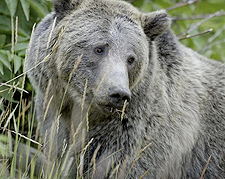
Peacock: Well, the grizzly is certainly going to try to do that all on its own. But that’s a very contentious area. White bark pine is incredibly nutritious. With the loss of the white bark pine as a food source, the carrying capacity — which is how rich the habitat is for bears — is going to be greatly diminished. And for bears to survive, basically they’re going to need a much larger area to forage in.
e360: So you see the loss of the pine nuts causing the Yellowstone’s bears to roam more widely to forage, and I assume that means ranging outside of public lands. Do you see that happening? And if so, do you think that’s going to precipitate more contacts between bears and humans?
Peacock: Absolutely. Absolutely. I mean Chuck Schwartz, who runs the [government’s] interagency study team in Yellowstone, predicted that in a paper back in 2006.
e360: I want to talk to you about the listing and the delisting of the grizzly. In 2007, I believe it was, the U.S. Fish and Wildlife Service delisted the grizzly from its threatened status under the Endangered Species Act. But then conservationists sued and got the courts to re-list the bear last year, and the federal government is now appealing that. You believe the grizzly should be listed and protected under the Endangered Species Act. Why do you believe that’s important, particularly given that the grizzly population right now is at a pretty good level? I think it’s something like a modern-day high. Isn’t that right?
Peacock: That’s what they believe. And I don’t have any hard evidence to contradict that opinion. But you know, that’s a soft number. Nobody knows for sure, even though counting grizzlies is kind of a cottage industry. People can make a good living doing that kind of estimation.
The grizzly, along with animals like polar bear and musk ox, has the lowest reproductive rate of any land mammal. And so they’re highly vulnerable — once mortality exceeds birth, a population can crash in a hurry. So I think they have to be protected. And I think that the Endangered Species Act and the recovery plan that’s been designed for it was absolutely unprepared for what has happened.
e360: You mean with what had happened with the white bark pine?
Peacock: Right. Nobody foresaw global warming in 1975 [when the grizzly was listed under the Endangered Species Act]. Nobody saw that it would knock out white bark pine. But now this insane insistence on delisting, technical delisting of the grizzly, it’s not rational, it’s not logical, and it’s not based on any science. I mean, global warming is a big wild card here… And you know, I tend to watch the grizzly just because it’s a metaphor for the way I think about the world. And if the bear can make it, I always assume maybe we’ve got a shot, too.
If the bear can make it, I always assume maybe we’ve got a shot, too.”
The bear is equally important to me because it’s the one animal out there that can kill and eat you about any time it chooses to, even though it seldom does. And it just stands as an instant lesson in humility. It stands in the face of human arrogance. And that lack of humility and human arrogance is what’s gotten us to where we are now — we’re seeing these incredible widespread effects on the very life-support system of the Earth, collectively manifested by this thing we call global warming. But we’ve done it and we seem not to want to notice it. Everyone wants to kind of think it’s happening somewhere else and it’s not going to hit home, but it has hit home. I’m looking up at my mountains right now, and they’re covered with this red blanket that’s kind of dripping down off the shoulders — and that’s dead white bark pine forest.
e360: You’ve mentioned that you became fascinated with grizzlies soon after you came back from Vietnam, where you’d served as a medic. Why did you start focusing on grizzlies then, and what was it about grizzlies that captivated you?
Peacock: Well I didn’t seek them out. What happened when I came back from Vietnam I was like a lot of other vets — quite out of sorts, no good around people. I couldn’t be around people. And the one place I’ve always been comfortable all my life was the wilderness. You know, started out in swamps in Michigan and ended up in the deserts and the mountains of the Rocky Mountains. So when I came back, I camped out. And when I was camping out in the Wind River Range, I had a malaria attack that propelled me to go into Yellowstone where the country was flat in comparison and the climate a little better.
But I ran into grizzlies. I wasn’t looking for them. I didn’t know anything about grizzlies when I started out. I was just recovering from a malaria attack in Yellowstone, soaking in a hot springs when a mother grizzly and two yearlings kind of walked up and looked at me. And so I learned about grizzlies by being alone in the woods — just living with them, basically. Self-indulgence is impossible in grizzly country because there’s an animal out there that’s far more dominant, more powerful, and you’ve got to pay attention. And that’s exactly what I needed. I needed to get out of myself, and step back in order to look back in. And there’s nothing like a grizzly bear to install that basic humility.
After Vietnam I was looking for a different kind of danger. Danger was still important in my life, but I was looking for something different, a different kind of peril that was free of the stench of killing and combat I’d seen in Vietnam. And the grizzly bear was a source of peril that was immensely helpful and healthy for me. And as the years went by, I started to support myself by working seasonal jobs for the Park Service backcountry rangers and climbing rangers in the North Cascades, and then I became a fire lookout and settled down to my true employment level, which is GS-3. Lowest rung on the ladder, and I was quite comfortable there.
But I was bearing witness, though I wasn’t aware of it, month by month, to the decline of Yellowstone grizzly. In a really important way, they had saved my life, I think. And you know, it was payback time — that’s what you do. The grizzlies were there when I needed them and so, since I was such a loner and outsider, I decided that I would document the last grizzlies of Yellowstone and Glacier [National Park] because I really expected the worst. So I started filming grizzlies… And you know, and I did that for almost 15 years.
e360: What was your most memorable encounter with a grizzly?
Peacock: Many of the encounters were kind of dangerous, where the grizzly had every right to take me out, and it didn’t. And one of those happened really early in Yellowstone. For the first three months I was in there I carried a weapon. I haven’t carried one since in grizzly country. You need them in bad places like [the Montana towns of] Livingston and Gardner, but you don’t need them in grizzly country.
In one early bear encounter, ‘I just felt my life had been touched by magic.’
In Yellowstone, the bears have a dominance hierarchy, and it’s really easy to read if you watch them every day. And at the top of this, there was an alpha male grizzly, a great big son of a gun. I bet you he weighed close to a thousand pounds. Anyway, one day I ran into him in a narrow defile in the middle of Yellowstone Park. There was a lodgepole forest and a meadow that was about 20 or 30 yards wide. And I was coming, and there was a big bear trail right down the middle of it. And I was going one way, and he came out the other way, and we ended up facing each other from about — it wasn’t very far away — probably 30 yards, max. And I got the old .357 out, and I was looking down the sight — and I knew after about half a second that I wasn’t going to use that thing…
e360: Because you wouldn’t have had the heart to kill it?
Peacock: I just knew that I would never use it on a bear. It would have been bad manners. I mean, it’s not my place — it’s their place. I’m the invader, you know — it’s not my moral option to do that. I was young and inexperienced, but I realized my shooting days were over.
The bear had his ears back, he had every sign of a charging grizzly — his head was lowered, ears flapped back, and usually the next thing you see is flying fur. But when I put the piece [gun] back in the holster, his ears popped back up, and he kind of turned his head off to the side, and then he looked at me again, took a couple steps forward, and just very slowly and powerfully took four or five dignified steps and disappeared into the forest. And I just felt that my life had been touched by magic.