07 Sep 2010: Opinion

A Symbolic Solar Road Trip
To Reignite a Climate Movement

An activist caravan to bring one of Jimmy Carter’s solar panels back to the White House symbolizes the time that the U.S. has lost in developing new energy technologies – and the urgent need for taking action on climate.

by bill mckibben

As I write this piece, we’re in the midst of a (biodiesel) road trip to Washington, D.C., towing behind us an unwieldy piece of history: a solar panel off the roof of the Carter White House. It’s decades old, though it still makes hot water just fine. In a sense, we’re traveling backward—which in another sense is what I think we’re going to have to do for a while in the U.S. climate movement.

The bad news everyone knows. The strongest attempt ever to pass climate legislation through the U.S. Congress came up short earlier this summer. The inside-the-Beltway green groups took what seemed to be the route of least resistance: a very tame piece of climate legislation larded with special prizes for special interests. They worked it as hard as it could have been worked—and in the end it didn’t even come close. The fossil fuel industry and their allies in D.C. barely had to break a sweat shooting it down.

So—barring some unforeseen development—we’re not going to see significant action on the federal level about climate for at least the next two years.

The solar panels need to be up on the roof, as visible as the White House garden.
And that means we’re far less likely to see significant international action on climate, since it’s hard for other governments to muster the political will to make tough choices when the U.S. is punting.

So what do we do with those two years? I think we use them to build a movement, which explains the solar panel we’re hauling south from Maine.

The story is painful even to consider. This panel went up on the White House roof in 1979, with then-president Jimmy Carter (in a wide tie, and with a bushy haircut) promising that it would still be there in the year 2000, producing hot water from the sun for whoever was then president. In fact, it didn’t make it through the next decade—it came down in the Reagan years, a symbol of our decision to turn away from the idea of limits and veer sharply down the path we’ve trod ever since.
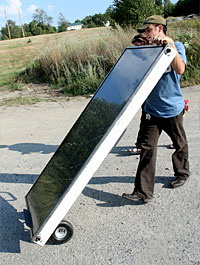
Solar panel
Mark Tardif
The Carter-era solar panel in Maine, being readied for the trip back to the White House.
But not everyone went along. Frugal folks at Unity College in Maine salvaged the panels, and put them up on the cafeteria, where they continued to produce hot water for the next three decades. Meanwhile, around the world other nations took the technology and went to work. Germany and Japan took over the lead in photovoltaic panels, but solar thermal technology like this became the special province of the Chinese.

I sat not long ago with Huang Ming, China’s leading solar entrepreneur, in his space-age Sun Moon Mansion in Shandong Province looking over the stats: his HiMin Solar Energy Group has put up 60 million such systems across China—he estimated that when 250 million Chinese take a shower, the hot water is coming off their roofs. In a biting symbol of that passed torch, he keeps one of the Carter panels in his private museum.

There’s no question what we should have spent the last few decades doing. But there’s no point now in crying about why we didn’t: the only job is to try to get back in the game, to start catching up.

Some of that means spending the money so that we can make the next technological discoveries. Many, including the Breakthrough Institute and Bill Gates, are calling for big increases in R and D funding, which might help us somehow claw our way back toward the front of the parade.

But catching up also means making use of the technology we already have, in ways both practical and symbolic.
President Obama is up against tough odds in Congress. But they can’t filibuster his roof.
We’re headed for the White House with this old panel, and with a promise from the U.S. company Sungevity that it will supply all the brand-new panels the president could ever want—as long as he puts them up on his roof where everyone can see them. George W. Bush, amazingly enough, actually put some solar back in the White House grounds—on the roof of a maintenance shed, and on, who knew, the Presidental Spa and Cabana. But since he didn’t tell anyone, they didn’t do much good. We want them up there on the roof, as visible as the White House garden, which helped boost seed sales 30 percent across the nation the year Michelle planted it.

So far, we haven’t heard a word from the White House about whether they’ll accept the gift and make the promise or not—which, frankly, surprises me. I can’t think of a clearer win for the president, a better reminder to the legions of young people who worked on his campaign that he is still focused on the future. He owes environmentalists more than he’s given them—by all accounts he decided not to push for the Senate legislation. He’s up against tough odds in Congress, of course, given the obstructionist GOP. But they can’t filibuster his roof.

What’s especially poignant is that we have gotten promises from other, much less likely, world leaders—Mohammed Nasheed, for instance, president of the entirely Muslim and quite poor Maldive Islands, the low-lying Indian Ocean nation that faces inundation from rising seas.
The point of the solar panels is to help build the movement that we allowed to wither away.
He took the Sungevity offer, and he’ll be putting solar panels on his roof on October 10 (10-10-10), the same day that thousands of groups around the world will be participating in a massive Global Work Party, putting up wind turbines and laying out bike paths. The same day we want Barack Obama, sleeves rolled up, out on his roof with a wrench.

The point of all these panels, of course, is not that we’re going to solve climate change one roof at a time. (Obama is doing lots of good practical things already—his “greening the government” effort is retrofitting federal buildings across the country with insulation, for instance). The point is that they help build the movement that we allowed to wither away.

Environmentalists lost sight of just how big a movement that would need to be. Too many groups convinced themselves that they could slide some legislation through Congress, make deals with industry, get things going without a fight. It was worth a try, but it didn’t work—the fossil fuel industry, the most profitable enterprise known to man, beat us. And they will beat us again and again until there’s a real, broad-based, popular, noisy movement underway in this country, a movement that can provide a currency (bodies, passion) equal to the currency the billionaire Koch Brothers can pony up to defeat climate legislation.

Some of that movement will go on at the local level, as we transform cities and towns and show what can be done. Some will be done on college campuses like Unity College, or Middlebury where I teach, which are showing the way forward. Some of it will be done in jails—I’d be very surprised if civil disobedience doesn’t become a bigger part of this battle in the years ahead, if only because it’s the tool we use to show our society how urgent, morally and practically, this crisis really is.

But some of it must be done symbolically. And there’s no more symbolic piece of real estate on this continent than the White House. Let’s hope that on the 10th of October it, at least, is transformed. It’s been a long, hot summer, in the capitol as in much of the northern hemisphere. Let’s make sure that next year that heat is put to some purpose—heating the Obamas’ bathtub, and helping power up a movement.

POSTED ON 07 Sep 2010 IN Business & Innovation Climate Climate Energy Policy & Politics Policy & Politics Sustainability North America North America 

COMMENTS


Perhaps when the climate activists stop talking about the fossil fuel industry like an enemy of the people and recognize that even they depend on fossil fuel for their very lives we can make progress. After all, I doubt solar energy was used in making the Carter solar panels.

PC
Posted by Paul C. on 07 Sep 2010


What terrific essay.

A single family home w/reasonable sun exposure and lacking solar DHW collectors on the roof is incomplete, like a home without a flush toilet.

"But catching up also means making use of the technology we already have, in ways both
practical and symbolic."

How true, the "perfect is the enemy of the good," sometimes. We're wedded to creating technologies suitable to the needs of venture capitalists, dreaming up ideas that can be harnessed by patents. The result is collective paralysis.

Even the solar DHW industry here in the U.S. is consigned to boutique status, a plaything of
people able to itemize their tax returns, largely thanks to pointless attempts to improve the
efficiency of systems using what is after an easily exploited and free resource. Solar DHW is just a couple of steps up in sophistication from a mud puddle sitting under a hot sun, too boring and mundane to attract the interest of capital. Meanwhile, the pragmatic Chinese build and massively deploy what is good and-- especially-- sufficient.

Posted by Doug Bostrom on 07 Sep 2010


Great article, it's a very laudable thing you are trying to do.

Here in the UK we are suddenly (finaly) startung to see rapid growth in the numbers of solar panels on roofs. This is thanks to the 'feed in tariff' launched in Feb 2010 which gaurntees electricity generated at home will be bought back by the national grid at an above market rate (worth about £900 to £1,450 a year).

Suddenly there are private companies springing up all over the country offering to install solar panels for free, and give you back enough power to knock about £200 a year off your bills.

Its a shame it has taken such a large financial incentive to make people come round to the idea of solar energy as a practical solution to energy generation. I wonder if that is what will have to happen in America too in the end?

www.easyepc.org
Posted by Guy Smith on 08 Sep 2010


Good luck, Bill, but remember that money is just a symbol as well. We need to open up the debate about how we fix the way we account for money so that we profit from nourishing the planet rather than destroying it.
Posted by Harold Forbes on 08 Sep 2010


It's good to bring back the Carter WH panels. You can re-invent the past, and this is a step toward doing it to advantage.

Americans only get going when they are challenged to do the impossible. Just at it has been the nation with the largest carbon footprint (and still is on a per capita basis), it can turn the coin over and do the opposite. It can become the nation with the lowest carbon footprint in the world. It can do this within 10 years time. Just like with putting a man on the moon. We rose to the challenge then, and we can rise to the challenge now.

Posted by TRB on 08 Sep 2010


Many other answers for sustainability may be found in the past as well, such as rail transport (streetcars and intercity), shipping by sailing ship and restoring millions of lost family farms. By the way, the photovoltaic effect was discovered twenty years before oil, in 1839, and silicon is the most abundant solid element on Eaarth.

Since the present has been corrupted and polluted, I say: FORWARD TO THE PAST (the best parts thereof). Now we "just" have to redefine eco-nomics away from plutocracy and global corporatism toward sustenance for the people.
Posted by James Newberry on 08 Sep 2010


Thank you, James Newberry. Your post is as wise as anything I could have expected to see.
Posted by Trevor Burrowes on 10 Sep 2010


And I read today that the White House is installing solar panels in response to 10/10/10!! BRAVO, 360.org!

Posted by Trevor Burrowes on 05 Oct 2010


Well, it is an interesting opinion, but he writes with an appalling lack of clarity, and what he says makes no sense whatsoever. To be clear, the panel he is talking about are water heating solar panels. Not solar PV. You can see the pipe entry point in the picture. These have been readily available for decades and are very low tech (you can use a black trashbag to warm water on a camp out). So the comment "the fossil fuel industry beat us" is just an irrelevant ad hominem. But I am glad you made that long drive to ensure low tech posterity. By the way, Bush has solar PV on his Central Texas home as well.

Posted by Henry Buttal on 04 Nov 2010


Comments have been closed on this feature.
bill mckibbenABOUT THE AUTHOR
Bill McKibben is the founder of 350.org, and author most recently of Eaarth: Making a Life on a Tough New Planet. You can follow the White House solar campaign at putsolaronit.org. McKibben has previously written for Yale Environment 360 on the failure of the Copenhagen climate summit and the challenges facing President Obama on climate policy. He has also spoken with Yale e360 on the urgency of building a popular movement to slow global warming.
MORE BY THIS AUTHOR


RELATED ARTICLES


For Africa’s Solar Sisters,
Off-Grid Electricity is Power

U.S. businesswoman Katherine Lucey is working with a network of women entrepreneurs in sub-Saharan Africa to sell inexpensive, household solar energy systems. In an interview with Yale Environment 360, Lucey explains how solar electricity can transform lives, particularly those of rural women and girls.
READ MORE

Harnessing Citizen Power to
Fund a U.S. Solar Revolution

Environmental activist Billy Parish believes the best way to fight climate change is to fund the renewable energy projects that will supplant fossil fuels. In an interview with Yale Environment 360, he discusses how “crowdfunding” can help lead to the widespread adoption of solar power.
READ MORE

Probing the Reasons Behind
The Changing Pace of Warming

A consensus is emerging among scientists that the rate of global warming has slowed over the last decade. While they are still examining why, many researchers believe this phenomenon is linked to the heat being absorbed by the world’s oceans.
READ MORE

Can a Divestment Campaign
Move the Fossil Fuel Industry?

U.S. climate activists have launched a movement to persuade universities, cities, and other groups to sell off their investments in fossil fuel companies. But while the financial impact of such divestment may be limited, the campaign could harm the companies in a critical sphere — public opinion.
READ MORE

An Advocate in Pursuit of
Environmental Justice at EPA

Matthew Tejada is taking over the EPA’s Office of Environmental Justice after helping low-income communities in Houston fight air pollution in their neighborhoods. He talks to Yale Environment 360 about how his work in Texas prepared him for the challenges of his new post.
READ MORE


MORE IN Opinion


As Final U.S. Decision Nears,
A Lively Debate on GM Salmon

In an online debate for Yale Environment 360, Elliot Entis, whose company has created a genetically modified salmon that may soon be for sale in the U.S., discusses the environmental and health impacts of this controversial technology with author Paul Greenberg, a critic of GM fish.
READ MORE

Should Polluting Nations Be
Liable for Climate Damages?

by fred pearce
An international agreement to study how to redress developing nations for damages from climate change illustrates how ineffective climate diplomacy has been over the last two decades. But this move may pave the way for future court suits against polluting countries and companies.
READ MORE

Hurricane Sandy Relief Bill
Fails to Face Coastal Realities

by rob young
As part of the sorely-needed aid package to help victims of Hurricane Sandy, Congress is also considering spending billions on ill-advised and environmentally damaging beach and coastal rebuilding projects that ignore the looming threats of rising seas and intensifying storms.
READ MORE

In U.S., the Lure of Export May
Further Fuel Natural Gas Boom

by shaun goho
As the United States experiences a glut of natural gas, a host of facilities are being proposed that would convert gas to a liquid and export it. But before embracing a gas export boom, the nation should carefully weigh the implications for both the economy and the environment.
READ MORE

Will President Obama Seize
Moment on Climate Change?

by william becker
Climate change received scant attention in the election campaign. But with public concern about global warming growing in the wake of Hurricane Sandy, President Obama has an unprecedented opportunity to take bold action on climate and clean energy.
READ MORE

Forget the Kyoto Accord
And Tax Carbon Consumption

by dieter helm
Given the failure of international climate negotiations, a tax on carbon consumption is the most effective way of lowering CO2 emissions. If nations are serious about addressing climate change, then they must pay for the carbon pollution caused by what they consume.
READ MORE

Why Are Environmentalists
Taking Anti-Science Positions?

by fred pearce
On issues ranging from genetically modified crops to nuclear power, environmentalists are increasingly refusing to listen to scientific arguments that challenge standard green positions. This approach risks weakening the environmental movement and empowering climate contrarians.
READ MORE

A Summer of Extremes
Signifies the New Normal

by bill mckibben
This summer has seen record heat waves and wildfires in the U.S, the worst flooding in Beijing’s modern history, and droughts that devastated the U.S. corn crop and led India to set up “refugee camps” for livestock. These extreme events were not freak occurrences — this is how the earth works now.
READ MORE

Natural Gas and Its Role
In the U.S. Energy Endgame

by kevin doran and adam reed
The boom in natural gas production has undeniable benefits for the United States. But two policy analysts argue that embracing a monolithic energy future dominated by gas will mean the loss of a golden opportunity: Leveraging cheap, abundant gas to create a sustainable future based on renewable power.
READ MORE

Fifty Years After Silent Spring,
Attacks on Science Continue

by frank graham jr.
When Silent Spring was published in 1962, author Rachel Carson was subjected to vicious personal assaults that had nothing do with the science or the merits of pesticide use. Those attacks find a troubling parallel today in the campaigns against climate scientists who point to evidence of a rapidly warming world.
READ MORE


e360 digest
Yale
Yale Environment 360 is
a publication of the
Yale School of Forestry
& Environmental Studies
.

SEARCH e360


Donate to Yale Environment 360

CONNECT

Twitter: YaleE360
e360 on Facebook
Donate to e360
View mobile site
Bookmark
Share e360
Email newsletter
Subscribe to our feed:
rss


ABOUT

About e360
Contact
Submission Guidelines
Reprints

e360 PHOTO GALLERY

To Catch a Rhino Welz
South African photojournalist Adam Welz documents the harrowing relocation of six white rhinos to a region that has lost all its rhinos to poaching. View the gallery.


DEPARTMENTS

Opinion
Reports
Analysis
Interviews
e360 Digest
Podcasts
Video Reports

TOPICS

Biodiversity
Business & Innovation
Climate
Energy
Forests
Oceans
Policy & Politics
Pollution & Health
Science & Technology
Sustainability
Urbanization
Water

REGIONS

Antarctica and the Arctic
Africa
Asia
Australia
Central & South America
Europe
Middle East
North America

e360 VIDEO

Into Heart of Ecuador Yasuni
A Yale Environment 360 video explores Ecuador’s threatened Yasuni Biosphere Reserve with scientists inventorying its stunning forests and wildlife. Watch the video.

e360 MOBILE

Mobile
The latest
from Yale
Environment 360
is now available for mobile devices at e360.yale.edu/mobile.

e360 VIDEO

Colorado River Video
In a Yale Environment 360 video, photographer Pete McBride documents how increasing water demands have transformed the Colorado River, the lifeblood of the arid Southwest. Watch the video.


header image
Top Image: aerial view of Iceland. © Google & TerraMetrics.

e360 VIDEO

Warriors of Qiugang
The Warriors of Qiugang, a Yale Environment 360 video that chronicles the story of a Chinese village’s fight against a polluting chemical plant, was nominated for a 2011 Academy Award for Best Documentary (Short Subject). Watch the video.


OF INTEREST


Yale