10 Sep 2012: Report

At Edge of Peruvian Andes,
Tracking Impacts of Warming

The Andes in eastern Peru, with steep slopes and remarkable biodiversity, are what one scientist calls a “perfect laboratory” for studying the effects of climate change. E360 contributor Elizabeth Kolbert trekked there with researchers seeking to determine if tree populations can move uphill fast enough to survive warming temperatures.

by elizabeth kolbert

“Trees are stunning,” Miles Silman was saying. “They’re beautiful. It’s true they take a little more appreciation. You walk into a forest, and the first thing you notice is, ‘That’s a big tree,’ or ‘That’s a tall tree,’ but when you start to think about their life history, about everything that goes into getting a tree to that spot, it’s really neat. It’s kind of like wine; once you start to understand it, it becomes more intriguing.”

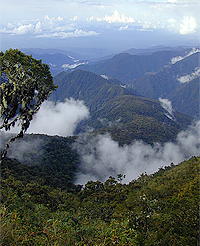
We were standing in eastern Peru, at the edge of the Andes, on top of a 12,000-foot mountain, where, in fact, there were no trees — just scrub and, somewhat incongruously, a dozen or so cows, eyeing us suspiciously. The sun was sinking, and with it the temperature, but the view, in the orange glow of evening, was extraordinary. To the east was the ribbon of the Alto Madre de Dios River, which flows into the Beni, which flows into the Madeira, which eventually meets the Amazon. Spread out before us was Manu National Park, one of the world’s great biodiversity “hot spots.”
View gallery
Manu National Park in Peru

Photo courtesy of Miles Silman
A view of Manu National Park in eastern Peru.
“In your field of vision is one out of every nine bird species on the planet,” Silman said. “Just in our plots alone, we have over a thousand species of trees.”

Silman, who teaches at Wake Forest University, calls himself a forest ecologist, though he also answers to the title of tropical ecologist, community ecologist, or conservation biologist. He began his career thinking about how forest communities are put together, and whether they tend to remain stable over time. This led him to look at the ways the climate in the tropics had changed in the past, which led him, naturally enough, to look into how it is projected to change in the future. What he learned inspired him to establish the network of tree plots that snakes down the mountain we were standing on.

In the popular imagination, global warming threatens cold-adapted species, like polar bears and Emperor penguins. However, Silman and many other ecologists have come to believe that climate change is likely to have just as great an impact, indeed probably an even greater impact, in the tropics.

The reasons for this are several. Temperatures in the tropics are a lot less variable than at higher latitudes, so tropical species tend to have a narrow range of “thermal tolerance.” Also in the tropics, temperature belts tend to be wider; thus, to track the temperature changes projected for the next
A researcher handed me a leaf the size of a dinner plate. ‘This is a new species,’ he said.
century, tropical species will have to move a lot farther (and therefore faster) than temperate species. Meanwhile, because the tropics are already the hottest places on earth, temperature increases there will create “novel climates” of a sort that probably haven’t been seen on earth in millions of years. Finally, and perhaps most significantly, the tropics are where most species actually live.

“When we think about climate change we often think that high latitudes are going to be the places that are affected the most,” Silman told me. “If you look at the absolute magnitude of change there, it’s high, though it’s surprisingly high in the low latitudes, too. But if we think about what’s important to organisms, it’s places on the planet where climates are going to disappear or climates are going to be so new that they’re going to present challenges to species that they’ve never seen. And if you look at either of those, what you find is that instead of the high latitudes being most affected, it’s the low latitudes, and more than that it’s the highest biodiversity areas of the low latitudes.”


The next morning, we got up early to watch the sun rise over the ridge. Then we packed up our gear and headed down to the first plot. “Pick out a leaf with an interesting shape,” Silman instructed me once we’d descended into the cloud forest. “You’ll see it for a few hundred meters and then it will be gone. That’s it. That’s the tree’s entire range.”

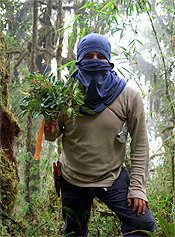
Silman was carrying a machete, which he used to hack away at the undergrowth. Occasionally he waved it in the air to point out something interesting — a spray of tiny white orchids; a parasitic plant with a bright orange flower; a bright red fuchsia that’s pollinated by a hummingbird whose bill is longer than its body. Several of Silman’s graduate students were also along on the trip. One of them, William Farfan Rios, handed me a leaf the size of a dinner plate. “This is a new species,” he said. Along the transect, the students have found 30 new species of tree, and one entirely new genus. (The new genus has yet to be named.)

“That’s not like finding another kind of oak or another kind of hickory. It's like finding ‘oak’ or ‘hickory,’” Silman observed. “That’s how poorly known these forests are.”
View gallery
Climate researcher Manu National Park

Photo courtesy of Miles Silman
Researcher William Farfan collects a species of Weinmannia near the treeline in the Andes.
Each of Silman’s tree plots is one hectare. Within each plot, every tree with a diameter of more than ten centimeters has been identified, tagged, and given a number. In plot 1, which sits at an altitude of 3,450 meters (11,320 feet) there are 569 trees 10 centimeters or wider, belonging to 38 different species. (This is greater than the number of tree species in all of Canada’s 290-million-hectare boreal forest.) In plot 4, at 2,750 meters (8,860 feet), there are 777 tagged trees from 60 species; more than 90 percent of these species are different from the species found at plot 1. In plot 8, at elevation 1,800 meters (5,905 feet) there are 1083 tagged trees from 117 different species. None of these species is the same as in plot 1.

Trees, of course, can’t move, but they can, in effect, migrate, by dispersing seeds that successfully grow into new trees. In the Andes, the temperature gradient is vertical, rather than horizontal; species can track the climate by migrating up the mountainside, instead of migrating latitudinally. The steep slope combined with the extraordinary diversity make the region, in Silman’s words, “a perfect laboratory” for studying the effects of climate change.

Currently, to track the climate, trees in the Andes should be migrating upslope at a rate of roughly 20 feet a year, and that rate will increase to 30 feet a year if carbon dioxide levels continue to climb. (Under a “business as usual” emissions scenario, temperatures in the eastern Andes are expected to rise by 9 degrees Fahrenheit by 2100.) While this is significantly less than the rate trees would need to move if they were going to track the climate by migrating to a higher latitude, it’s still very fast — quite possibly faster than trees in the region have ever migrated in the past. Among the questions Silman and his colleagues are hoping to answer with his plots are whether trees are in fact capable of moving rapidly enough to track climate change, and if not, what will happen.


Silman and his students first installed the plots in 2003. They re-censused them in 2007. Even after such a brief interval, one of Silman’s post-docs, Kenneth Feeley, found compelling evidence that some trees, were, in fact, on the move. Others, meanwhile, had remained stationary. Trees in the genus Schefflera, which includes the houseplant known as the umbrella tree, were moving the fastest; they had climbed upslope at the astonishing rate of nearly 100 feet a year. Trees in the coffee-family genus Ladenbergia, by contrast, had not migrated at all. For all the trees in the plots, Feeley, who now is on the faculty at Florida International University, calculated that the average migration rate was eight feet a year — significant, but not nearly enough for the trees to remain in equilibrium with the climate.

In a 2010 paper published in the journal Global Change Biology, Silman and Feeley looked at what differing “migration scenarios” would mean for Andean plants. Under what they called a “perfect migration” scenario, in
Trees in the genus Schefflera had climbed upslope at the astonishing rate of nearly 100 feet a year.
which all species are able to migrate fast enough to track the climate, some plant species will lose out, but many others will gain population as the climate warms. Under a “no migration” scenario, virtually all species becomes losers, with population declines of between 53 and 96 percent. And under an “observed migration” scenario, where plants move as fast as they have been observed to do in the tree plots, species will lose, on average, 40 percent of their population.

In addition to speed of migration, another key variable, Feeley and Silman found, was land use. In the Andes, the highlands are often cleared for grazing — hence the cows we encountered at the top of the mountain — so the tree line is artificially depressed. If this pattern doesn’t change (and there’s no particular reason to believe that it will), then virtually all species now found at high elevations will decline, no matter how quickly they’re able to migrate.

MORE FROM YALE e360

The World’s Tropical Forests
Are Already Feeling the Heat

The World’s Tropical Forests Are Already Feeling the Heat
Much attention has been paid to how global warming is affecting the world’s polar regions and glaciers. But William Laurance warns that rising temperatures could have an equally profound impact on rainforests and are already taking a toll on some tropical species.
READ MORE
“If the tree line stands still, it doesn’t matter what scenario you have,” Silman said.

That evening, we set up camp in a clearing near plot 4. Silman and Farfan went to get water, and when they came back, Farfan was carrying a spray of white berries interspersed with what looked like purple tassels. It was the infloresence of a tree in the Brassicaceae or mustard family. No one in the group had ever seen anything quite like it before, which led to speculation that it might belong to yet another new species. It was doused in alcohol for transport down the mountain, because especially now, with the future of the forest so uncertain, it seems important that every species be counted.

POSTED ON 10 Sep 2012 IN Climate Forests Policy & Politics Pollution & Health Science & Technology Central & South America Europe 

COMMENTS


For more information on Miles Silman's and his collaborator's work along the Andes transect, visit the ABERG (Andes Biodiversity and Ecosystem Research Group) website:

http://andesresearch.org/

Posted by Noah Yavit on 10 Sep 2012


Great article and a question...

Regarding the point that "Silman and many other ecologists have come to believe that climate change is likely to have just as great an impact, indeed probably an even greater impact, in the tropics", can someone answer how the tropical ecosystems at sea level will be affected? Specifically, I understand that low elevation species will move to higher elevations, however, where will the species come from to fill the void left by former tropical sea level species?

Posted by Terry Mock on 13 Sep 2012


Comments have been closed on this feature.
elizabeth kolbertABOUT THE AUTHOR
Elizabeth Kolbert has been a staff writer for the New Yorker since 1999. Her 2005 New Yorker series on global warming, “The Climate of Man,” won a National Magazine Award and was extended into a book, Field Notes from a Catastrophe, which was published in 2006. In previous articles for Yale Environment 360, she has written about a study that found the pace of global warming is outstripping projections and about the scientific debate over designating a new geological epoch to reflect the changes that humans have caused.
MORE BY THIS AUTHOR


RELATED ARTICLES


As Extreme Weather Increases,
Bangladesh Braces for the Worst

Scientists are predicting that warming conditions will bring more frequent and more intense extreme weather events. Their warnings hit home in densely populated Bangladesh, which historically has been hit by devastating sea surges and cyclones.
READ MORE

Probing the Reasons Behind
The Changing Pace of Warming

A consensus is emerging among scientists that the rate of global warming has slowed over the last decade. While they are still examining why, many researchers believe this phenomenon is linked to the heat being absorbed by the world’s oceans.
READ MORE

In Tibet, Change Comes to the
Once-Pristine Roof of the World

Renowned biologist George Schaller has been traveling to the Tibetan Plateau for nearly three decades, studying its unique wildlife. But with climate change and overgrazing taking a toll on the landscape, he reports, scientists and the Chinese government are working to preserve one of the planet’s wildest places.
READ MORE

Too Big to Flood? Megacities
Face Future of Major Storm Risk

As economic activity and populations continue to expand in coastal urban areas, particularly in Asia, hundreds of trillions of dollars of infrastructure, industrial and office buildings, and homes are increasingly at risk from intensifying storms and rising sea levels.
READ MORE

A Summer of Extremes
Signifies the New Normal

This summer has seen record heat waves and wildfires in the U.S, the worst flooding in Beijing’s modern history, and droughts that devastated the U.S. corn crop and led India to set up “refugee camps” for livestock. These extreme events were not freak occurrences — this is how the earth works now.
READ MORE


MORE IN Reports


An Economic Boom in Turkey
Takes a Toll on Marine Life

by sulmaan khan
The development-at-any-cost policies of Turkish Prime Minister Recip Tayyip Erdogan — a key factor behind the protests and clashes in Istanbul’s Taksim Square — are also playing a role in the steady decline of the nation’s porpoises, dolphins, and other marine life.
READ MORE

The Surprising Role of CO2 in
Changes on the African Savanna

by adam welz
Recent studies show that many of the world’s savannas, including famed southern African landscapes, are experiencing significant change as rising levels of carbon dioxide in the atmosphere favor the growth of trees over grasslands.
READ MORE

Green Highways: New Strategies
To Manage Roadsides as Habitat

by richard conniff
From northern Europe to Florida, highway planners are rethinking roadsides as potential habitat for native plants and wildlife. Scientists say this new approach could provide a useful tool in fostering biodiversity.
READ MORE

China’s New Arctic Presence
Signals Future Development

by ed struzik
China’s recent admission to the Arctic Council under observer status reflects a new reality: the world’s economic powers now regard development of natural resources and commerce in an increasingly ice-free Arctic as a top priority.
READ MORE

A Plague of Deforestation
Sweeps Across Southeast Asia

by daniel drollette
Illegal logging and unchecked economic development are taking a devastating toll on the forests of Vietnam and neighboring countries, threatening areas of biodiversity so rich that 1,700 species have been discovered in the last 15 years alone.
READ MORE

In Post-Tsunami Japan, A Push
To Rebuild Coast in Concrete

by winifred bird
In the wake of the 2011 tsunami, the Japanese government is forgoing an opportunity to sustainably protect its coastline and is instead building towering concrete seawalls and other defenses that environmentalists say will inflict serious damage on coastal ecosystems.
READ MORE

How Mussel Farming Could
Help to Clean Fouled Waters

by paul greenberg
Along the shores of New York Harbor, scientists are investigating whether this ubiquitous bivalve can be grown in urban areas as a way of cleansing coastal waters of sewage, fertilizers, and other pollutants.
READ MORE

Will Lead Bullets Finally
Kill Off the California Condor?

by ted williams
The California condor, the largest bird in North America, was saved from extinction by a captive breeding program that increased its numbers in the wild. But now the condor is facing a new and pernicious threat — the lead from bullets used by game hunters.
READ MORE

A Key Experiment to Probe the
Future of Our Acidifying Oceans

by peter friederici
In a Swedish fjord, European researchers are conducting an ambitious experiment aimed at better understanding how ocean acidification will affect marine life. Ultimately, these scientists hope to determine which species might win and which might lose in a more acidic ocean.
READ MORE

Declining Bee Populations Pose
A Threat to Global Agriculture

by elizabeth grossman
The danger that the decline of bees and other pollinators represents to the world’s food supply was highlighted this week when the European Commission decided to ban a class of pesticides suspected of playing a role in so-called “colony collapse disorder.”
READ MORE


e360 digest
Yale
Yale Environment 360 is
a publication of the
Yale School of Forestry
& Environmental Studies
.

SEARCH e360


Donate to Yale Environment 360

CONNECT

Twitter: YaleE360
e360 on Facebook
Donate to e360
View mobile site
Bookmark
Share e360
Email newsletter
Subscribe to our feed:
rss


ABOUT

About e360
Contact
Submission Guidelines
Reprints

e360 PHOTO GALLERY

To Catch a Rhino Welz
South African photojournalist Adam Welz documents the harrowing relocation of six white rhinos to a region that has lost all its rhinos to poaching. View the gallery.


DEPARTMENTS

Opinion
Reports
Analysis
Interviews
e360 Digest
Podcasts
Video Reports

TOPICS

Biodiversity
Business & Innovation
Climate
Energy
Forests
Oceans
Policy & Politics
Pollution & Health
Science & Technology
Sustainability
Urbanization
Water

REGIONS

Antarctica and the Arctic
Africa
Asia
Australia
Central & South America
Europe
Middle East
North America

e360 VIDEO

Into Heart of Ecuador Yasuni
A Yale Environment 360 video explores Ecuador’s threatened Yasuni Biosphere Reserve with scientists inventorying its stunning forests and wildlife. Watch the video.

e360 MOBILE

Mobile
The latest
from Yale
Environment 360
is now available for mobile devices at e360.yale.edu/mobile.

e360 VIDEO

Colorado River Video
In a Yale Environment 360 video, photographer Pete McBride documents how increasing water demands have transformed the Colorado River, the lifeblood of the arid Southwest. Watch the video.


header image
Top Image: aerial view of Iceland. © Google & TerraMetrics.

e360 VIDEO

Warriors of Qiugang
The Warriors of Qiugang, a Yale Environment 360 video that chronicles the story of a Chinese village’s fight against a polluting chemical plant, was nominated for a 2011 Academy Award for Best Documentary (Short Subject). Watch the video.


OF INTEREST


Yale