The Philadelphia Navy Yard sprawls over 1,200 acres on the banks of the Delaware River, a once-great shipyard now being transformed into a mix of research facilities, corporate offices, and manufacturing plants. In one remote, seven-acre corner — a nondescript plot of land with a highway bridge towering above it — the Navy Yard’s industrial past is palpable. Reeds and an occasional tree sprout among dilapidated buildings of corrugated iron. Crumbling cinder blocks are piled in a corner.
This forgotten corner of the city once served as a landfill and incinerator for the Navy Yard. Shipbuilding and other industrial activities, dating back to 1801, contaminated the site with heavy metals, among other things. Since the Navy built its last ship here in 1970, the area has sat largely unused.
But no longer: Soon these seven acres will be home to the largest solar photovoltaic installation in Philadelphia. Construction is scheduled to start this summer on the 1.3-megawatt, $5.6 million Navy Yard solar array, with a target completion date of early 2012. The facility will be capable of powering about 300 homes, and will create 50 construction jobs and 10 permanent jobs, according to developers.
Every solar project that rises from an industrial wasteland is one that won’t be built on pristine land.
The Navy Yard solar array is just one of a growing number of projects across the U.S. that fall into the small category of energy ideas that appear to have little to no downside: turning brownfields — or sites contaminated or disturbed by previous industrial activity — into green energy facilities. Among the successfully completed brown-to-green projects are a wind farm at the former Bethlehem Steel Mill in Lackawanna, New York; a concentrating solar photovoltaic array on the tailings pile of a former molybdenum mine in Questa, New Mexico; solar panels powering the cleanup systems at the Lawrence Livermore National Laboratory’s Superfund site in northern California; and the U.S. Army’s largest solar array atop a former landfill in Fort Carson, Colorado.
“It’s an untapped opportunity to not just deliver cleanup to some of these contaminated or previously contaminated sites, but to recycle our industrial legacy in making progress toward a cleaner energy future,” said Chase Huntley, a policy advisor on energy and climate change for the nonprofit Wilderness Society.
Huntley’s group is interested in preserving the country’s remaining wild lands, and every solar or wind project that rises from an industrial wasteland is one that won’t be built on a pristine ridgeline or tract of desert. Another plus is that public opposition to renewable energy projects on blighted land is highly unlikely.
Though practical considerations abound, the potential involved in taking contaminated land and putting it to use as solar or wind farms is enormous. The U.S. Environmental Protection Agency (EPA) estimates that more than 490,000 brownfields exist nationwide, largely concentrated in formerly industrialized regions.
Lura Matthews, team leader for the EPA’s Re-Powering America’s Land initiative — which aims to encourage and streamline the process of turning brown into green — said that about 11,000 of those sites, covering 15 million acres, have been at least preliminarily assessed for their renewable energy potential. The EPA has estimated that the total technical potential of energy sited on brownfields (not taking into account practical or monetary considerations) is nearly 1 million megawatts. That roughly equals the total existing U.S. electricity generating capacity.
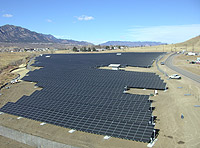
More practical estimates have also been done on smaller scales. One study by researchers at Michigan State University found that Michigan’s brownfields could eventually generate 5,855 megawatts of wind and solar power, enough to provide electricity to nearly half the state’s homes. Developing these Michigan sites would also attract $15 billion in investments and create more than 17,000 jobs, the Michigan State study found.
Converting brownfields to renewable energy sites faces no real opposition, although some developers caution that communities should make sure that a green energy project is the best long-term use of a former industrial site.
“In the short term, it makes great sense to take land that is otherwise not usable and put renewable energy on there,” said Jesse Silverstein, executive director of the Colorado Brownfields Foundation, which is working to put solar panels on a former landfill in Colorado Springs. But since solar arrays typically have a lease lasting 20 to 30 years, if the area around a proposed renewable energy site is projected to develop in other ways, then that spot may be better suited to different redevelopment options, Silverstein said.
The EPA has been working on its Re-Powering America’s Land initiative since September 2008. Matthews said there is widespread interest from communities that want to develop renewable energy projects but may not have a lot of space on which to locate them.
Generally, contaminated or disturbed sites could fall into one of two categories for renewable energy generation: either they could produce enough electricity to power the cleanup itself, or they could generate power for the grid. The extent of contamination and the site’s industrial history will determine which kind of renewable energy development would occur.
One of the most attractive aspects of brownfield sites is the existence of infrastructure.
Though small sites — capped landfills, abandoned factories, mine tailings piles — make up the majority of the half-million brownfields, larger sites and those that have been given Superfund designation could also be home to solar and wind power installations. Gail Mosey, with the National Renewable Energy Laboratory, has helped conduct assessments of several such locations, including the Stringfellow site in Riverside County in Southern California. Stringfellow was a hazardous waste dumping ground until 1972, with more than 34 million gallons of liquid industrial waste ending up on the site. Mosey said that this type of site, where cleanup is ongoing, is an ideal candidate for a renewable energy project.
“They were using power from the grid to power their pump-and-treat [cleanup process], and it was an expensive proposition for the state to pay for the power that was required,” Mosey said. “And they were looking for alternatives.” Mosey’s report on the site recommended a solar facility with a 250-kilowatt capacity, capable of providing nearly all the power for the cleanup.
One of the most attractive aspects of Stringfellow and similar sites is the existence of infrastructure, with roads and transmission lines — two of the biggest obstacles when it comes to developing wind and solar in more remote and pristine areas — already in place. At Stringfellow, it will largely be a matter of mounting the solar panels and plugging them in.
Mosey said that at some sites the options for reuse could be restricted because of the cleanup of contaminants, or a need to wait for those contaminants to disperse. “But in the meantime, maybe we’re talking about 10 or 15 years where power could be generated on that site,” she said. In her analysis, the cost of the solar installation would be recouped in less than 20 years when certain government incentives are included.
‘People realize that there is not a lot else that you can put on a property that’s in this condition,’ said one expert.
At the Philadelphia Navy Yard, Williams Agate, Jr., vice president of management and development at the Philadelphia Industrial Development Corporation, which is responsible for revitalizing the shipyard, said that the history of contamination at the solar site is not among the greatest challenges. The solar array will be built so that the cap on the landfill is not disturbed; Agate said the Pennsylvania Department of Environmental Protection made sure the project wouldn’t compromise the state of the site.
Agate said more serious challenges involved issues such as securing financing and the necessary city permits. Another challenge is liability: When toxic contaminants are involved, will renewable energy developers be responsible for the cleanup costs at a site? Some developers may be scared off by the prospect of paying for previous damage, but the EPA can issue “comfort letters” that aim to allay those fears and provide guidance for developers to protect against liability issues.
Huntley, of the Wilderness Society, said that while the EPA’s initiative to convert brownfields into renewable energy sites is a good start, further government incentives are needed. “What you’re doing is creating a market for reusing these places that until now have not seen interest,” he said.
Last year, U.S. Senator Frank Lautenberg (D—NJ) introduced both the Cleanfields Act and the Cleanfields Investment Act as ways to spur conversion of brownfields. The former bill would provide incentives to utilities to develop renewables on contaminated sites under a national renewable energy portfolio standard; the latter would allocate $50 million annually for developers planning to build on brownfield sites. Neither bill made it out of committee, however, and neither has been reintroduced in the current session of Congress.
In a further illustration of the idea’s widespread appeal, however, U.S. Senator James Inhofe (R—OK), an opponent of national renewable energy standards and one of the most vocal global warming skeptics in Washington, recommended expanding the legislation’s scope beyond strictly defined brownfields to virtually any type of contaminated site.
As Inhofe’s support shows, few, if any, people would argue that former industrial sites will somehow be ruined by a solar array or wind farm. “People realize,” said Agate, “that there is not a lot else that you can put on a property that’s in this kind of condition.”