Camera Traps Emerge as Key Tool in Wildlife Research
Scientists and conservationists are increasingly relying on heat- and motion-activated camera traps to study rare or reclusive species in remote habitats. And the striking images they provide are proving to be a boon for raising conservation awareness worldwide.
by jeremy hance
The humble camera trap — an automated digital device that takes a flash photo whenever an animal triggers an infrared sensor — has been coming into its own, playing an increasingly important role in wildlife conservation.
In recent years, the use of camera traps has led to major discoveries, including documenting an Amur leopard (Panthera pardus orientalis) in China for the first time in 62 years; proving that the world’s rarest rhino,
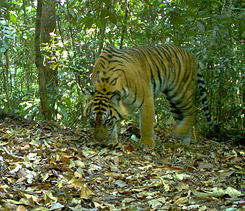
A Sumatran tiger photographed during a recent survey in Indonesia.
the Javan (Rhinoceros sondaicus), is breeding, by photographing a female with her calf; rediscovering the hairy-nosed otter (Lutra sumatrana) in the Malaysian state of Sabah; recording the first wolverine (Gulo gulo) in California since 1922; taking the first video of the rare Bornean bay cat (Pardofelis badia); documenting the elusive short-eared dog (Atelocynus microtis) preying on an amphibian in the Amazon; proving the extremely rare Siamese crocodile (Crocodylus siamensis) still inhabits Cambodia; and snapping the first-ever photographs of a number of species in the wild, including the Saharan cheetah (Acinonyx jubatus hecki) and the giant muntjac deer (Muntiacus vuquangensis) in Southeast Asia.
The technology has even been behind the discovery of a few new species: Both the Annamite striped rabbit (Nesolagus timminsi) of Southeast Asia and the grey-faced sengi (Rhynchocyon udzungwensis) of Tanzania, an elephant shrew, were first identified via camera trap photos. One measure of the camera trap’s rising importance was the release last February by the Smithsonian Institution of more than 200,000 camera trap photos online.
The camera trap has revolutionized wildlife research and conservation, enabling scientists to collect photographic evidence of rarely seen and often globally endangered species, with little expense, relative ease, and minimal disturbance to wildlife. Researchers are now using camera traps to document wildlife presence, abundance, and population changes, particularly in the face of deforestation and habitat destruction. And for the first time, camera traps are enabling researchers to collect baseline population data on tropical mammals and birds where only estimates — and often just guesses — were possible before.
Equally important, camera traps are increasingly being used to raise conservation awareness worldwide, with NGOs embracing the tool as a powerful way of reaching out to the public through You Tube, the Internet, and social networking sites. Groups such as WWF have found camera trap videos and photos to be an important part of campaigns to save threatened or endangered species.
In Sumatra, which has lost half of its forest cover since 1985, a conservation project called Eyes on Leuser is using camera trap videos and photos to publicize the threats to the Leuser forest’s diverse wildlife. To date the group has used camera traps to shoot video footage of 27 species, including the rare Sumatran tiger (Panthera tigris sumatrae), the colorful Argus pheasant (Argusianus argus), and the bright-eyed banded civet (Hemigalus derbyanus). “Until now, almost no videos existed of most of Leuser’s cryptic wildlife,” says Marten Slothouwer, a Dutch conservationist who runs Eyes on Leuser. “Our videos can make people realize that it’s worth it to save this forest.”
The first cameras to capture wildlife free from human presence were used in the late 1890s by photographic pioneer George Shiras, who employed trip wires and a flash bulb to catch animals on film; the photos were eventually published in National Geographic magazine. The first purely scientific use of camera traps was in the 1920s, when Frank M. Chapman surveyed the big species on Barro Colorado Island in Panama using a trip-wire camera trap.
But for decades, technological difficulties — including battery power, size of equipment, and unreliable trip mechanisms — left camera trapping for intrepid enthusiasts, rather than mainstream researchers. Not until the 1990s did a camera with an infrared trigger mechanism become available. Today, with the advent of digital cameras, the practice of studying wildlife through camera trapping has exploded.
Although the majority of camera trap photos are blurred or show only parts of an animal, some are on a par with the best in wildlife photography, capturing one thing that is truly difficult for photographers: a palpable sense of intimacy. More discoveries are expected as researchers undertake new and larger projects, including a study of tropical mammals in seven nations by The Tropical Ecology Assessment and Monitoring Network, which is documenting long-term wildlife population trends in order to identify conservation priorities.
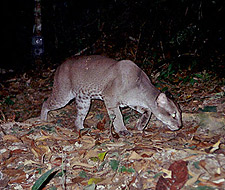
Camera traps in Gabon recently provided video of the African golden cat, the continent’s least-known feline.
There is no tool better for finding out “what’s out there” than the camera trap. Scientists usually place camera traps on trails or at watering holes or mud wallows (spots where animals or birds often appear), but also at locations where researchers can access the camera repeatedly to download photos and change batteries. Within a few months of setting up traps, scientists begin to gain a good sense of which large and medium-sized fauna reside in the area.
“Camera trapping provides a window into a world that was previously only accessible to researchers or individuals with intimate knowledge of that species or habitat,” says Brent Loken, president of Ethical Expeditions, which uses camera traps to collect data on the mammals of the Wehea Forest in the Indonesian state of Kalimantan. The traps have proven the existence of elusive mammals, such as the banded civet (Hemigalus derbyanus) and the Sunda clouded leopard (Neofelis diardi), one of the least known big cat species in the world.
In the Pantanal, Brazil’s great wetlands, Arnaud Desbiez of the Royal Zoological Society of Scotland has used camera traps to document the presence of the world’s largest armadillo (Priodontes maximus) — a rare, nocturnal species that spends much of its time underground. Using camera traps, he and his team have discovered that giant armadillo burrows play a bigger role in the ecosystem than anticipated, providing shelter to creatures such as collared peccaries.
In Africa, Ben Colleen of the Zoological Society of London and his colleagues have used camera traps to study rare pygmy hippos in West Africa’s dwindling rainforests. The species is so mysterious that researchers only took the first photo of a wild pygmy hippo in Liberia in 2008.
Camera traps could be used in rainforest canopies to study birds, reptiles, and monkeys.
rainforest, making it extremely difficult to spot, let alone study. University of KwaZulu-Natal graduate student Laila Bahaa-el-din captured footage of an African golden cat sitting directly in front of the camera and chasing a butterfly. On watching the videos for the first time, Bahaa-el-din says, “I felt, at last, like I was getting to know this elusive cat... The African golden cat has dominated my thoughts and energy for over a year-and-a-half now.”
Bahaa-el-din’s research is focused on understanding how the wild cat fares in pristine areas versus sustainably managed logging concessions and poorly managed logging tracts. Camera trap video footage taken in a logging concession in central Gabon that employs sound logging practices and aggressively pursues illegal hunters, indicates, says Bahaa-al-din, that “logging alone should not mean the depletion of wildlife.” The evidence from these camera traps will eventually be used to develop a conservation plan for the African golden cat, now getting its first global publicity thanks to the remote cameras.
Camera traps have some drawbacks. As Arnaud Desbiez puts it, “Camera traps are limited in space. They can only gather information in the tiny area where their sensors are positioned. Therefore animals can easily go undetected, and you need a lot of cameras to properly survey an area.”
An imaging system that uses a suite of airborne sensors is capable of providing detailed, three-dimensional pictures of tropical forests — including the species they contain and the amount of CO2 they store — at astonishing speed. These advances, Rhett Butler writes, could play a key role in preserving the world’s rainforests. READ MORE
The cost of camera traps also can be an issue, especially in developing countries. A single camera trap ranges from $150 to $600, not including extra batteries, battery chargers, and data cards. Camera traps also break; tigers, elephants, and other big mammals have been known to attack the traps. In addition, in areas where poachers are a problem, scientists occasionally lose camera traps to people who understandably don’t like their photo being taken.
Still, camera trapping is now on the cusp of a new round of expansion. Camera traps could be used in rainforest canopies to study birds, reptiles, and monkeys, and underwater cameras could document marine wildlife and the fauna of lakes and rivers. With further technological advances, it may even be possible to use tiny cameras to document the world’s micro-species, from stag beetles to brush-footed butterflies.
Indeed, proponents contend, the future of camera trapping may only be limited by our imagination.
Camera trap use for research has been on the rise in the US as well as the more exotic locales mentioned in this article. Here, camera traps often provide important presence information on endangered or troubled species that are increasingly coming into contact (or conflict) with humans and development.
I am currently working on a project at the University of Vermont that is using camera traps to detect carnivores in forest fragments in the Champlain Valley (the most developed and populated area of the state). Our hope is to reach some conclusions about what types of forest fragments (the little islands of core habitat that remain for carnivores within the larger landscape matrix of agricultural, residential and urban development) carnivores like to use in our state so that we better manage these forests.
Posted by
Sara Williams
on 11 Dec 2011
I had a Wyoming biologist tell me about a study they were doing about the decline in a ground nesting bird- I think the sage grouse. Setting up cameras around the nest sites they videoed a herd of elk eating every single egg. He commented that had a biologist without video ever come back to the office and claimed to have eye-witnessed the event - they would have been laughed out of the building.
Video seems a great tool for "proving" what we know can't be true- or if you will- a crutch for those averse to laughter.
Good luck with your research and wishing you much "imagination" using video to increase our
understanding.
Posted by
Patrick Moffitt
on 16 Dec 2011
I currently use trail cameras to study gopher tortoises and their burrow commensals in Florida. The pictures and videos I get are really insightful. It's my hope though that these cameras will soon be designed with the goal of using them for research, not hunting, and thus will be more user friendly for this use, and not their intended use. These cameras are a great tool and hopefully will be more widely used in the future.
Posted by
JP
on 04 Jan 2012
I am interested in trying this type of surveillance for willdlife, having read reviews of cameras some appear to be lacking in quality or trigger is a bit hit or miss, I was wondering what cameras were used in the video above. The picture quality seemed pretty good, also are they infrared, or would you be better getting a separate camera for that.
Cheers
Paul Edwards
http://www.wildlifereporter.co.uk
Posted by
Paul Edwards
on 14 Feb 2012
POST A COMMENT
Comments are moderated and will be reviewed before they are posted to ensure they are on topic, relevant, and not abusive. They may be edited for length and clarity. By filling out this form, you give Yale Environment 360 permission to publish this comment.
ABOUT THE AUTHOR Jeremy Hance is a senior writer for Mongabay.com, one of the leading sites on the Web covering tropical forests and biodiversity. He is the author of Life is Good: Conservation in an Age of Mass Extinction, which will be published in January. In an earlier article for Yale e360, Hance and Rhett Butler reported on the potential environmental implications of a proposed 148,000-acre palm oil plantation in West Africa. MORE BY THIS AUTHOR
Back on the Brink: Will the Lead In Bullets Finally Kill Off the Condor? The California condor, the largest bird in North America, was saved from extinction by a captive breeding program that increased its numbers in the wild. But now the condor is facing a new and pernicious threat — the lead from bullets used by game hunters. READ MORE
Into the Heart of Ecuador’s Yasuni Few places on earth harbor as much biodiversity as Ecuador’s Yasuni Biosphere Reserve, which sits atop vast deposits of oil and now faces intense development pressure. In a Yale Environment 360 video, filmmaker Ryan Killackey travels to the heart of Yasuni with scientists inventorying its stunning wildlife and plants. The researchers hope their work will bolster initiatives to preserve this threatened land. READ MORE
Counting Species: What It Says About Human Toll on Wildlife By analyzing mitochondrial DNA, scientists now can make more accurate estimates of the numbers of individual species that existed centuries ago. What does it tell us about our impact on the natural world and about our own future? READ MORE
To Catch a Rhino: Capturing Animals in Order to Save Them Six white rhinos were captured recently at a reserve in South Africa for eventual relocation to neighboring Botswana, which has lost its entire rhino population to poaching. E360 contributor Adam Welz joined the operation and produced a photo essay that documents the harrowing process. READ MORE
Will Bold Steps Be Needed to Save Beleaguered Polar Bears? In a new paper, the world’s leading polar bear scientists say the time has come to consider drastic measures to save these iconic animals, including supplemental feeding by humans during ice-free periods and relocating more southerly populations to the High Arctic. READ MORE
MORE IN Reports
In Post-Tsunami Japan, A Push To Rebuild Coast in Concrete by winifred bird In the wake of the 2011 tsunami, the Japanese government is forgoing an opportunity to sustainably protect its coastline and is instead building towering concrete seawalls and other defenses that environmentalists say will inflict serious damage on coastal ecosystems.
READ MORE
How Mussel Farming Could Help to Clean Fouled Waters by paul greenberg Along the shores of New York Harbor, scientists are investigating whether this ubiquitous bivalve can be grown in urban areas as a way of cleansing coastal waters of sewage, fertilizers, and other pollutants. READ MORE
A Key Experiment to Probe the Future of Our Acidifying Oceans by peter friederici In a Swedish fjord, European researchers are conducting an ambitious experiment aimed at better understanding how ocean acidification will affect marine life. Ultimately, these scientists hope to determine which species might win and which might lose in a more acidic ocean. READ MORE
Declining Bee Populations Pose A Threat to Global Agriculture by elizabeth grossman The danger that the decline of bees and other pollinators represents to the world’s food supply was highlighted this week when the European Commission decided to ban a class of pesticides suspected of playing a role in so-called “colony collapse disorder.” READ MORE
Fires Burn More Fiercely As Northern Forests Warm by dylan walsh From North America to Siberia, rising temperatures and drier woodlands are leading to a longer burning season and a significant increase in forest fires. Scientists warn that this trend is expected continue in the years ahead.
READ MORE
Will Electric Bicycles Get Americans to Start Pedaling? by marc gunther Electric bicycles are already popular in Europe and in China, which has more e-bikes than cars on its roads. Now, manufacturers are marketing e-bikes in the U.S., promoting them as a "green" alternative to driving. READ MORE
Copenhagen’s Ambitious Push To Be Carbon Neutral by 2025 by justin gerdes The Danish capital is moving rapidly toward a zero-carbon future, as it erects wind farms, transforms its citywide heating systems, promotes energy efficiency, and lures more people out of their cars and onto public transportation and bikes. READ MORE
How Ontario Is Putting an End To Coal-Burning Power Plants by keith schneider Ontario is on the verge of becoming the first industrial region in North America to eliminate all coal-fired electrical generation. Here’s how Canada’s most populous province did it — and what the U.S. and others can learn from it. READ MORE
Long Outlawed in the West, Lead Paint Sold in Poor Nations by rebecca kessler A new study finds that household lead paint — banned for years in the U.S. and Europe because of its health effects on children — is commonly sold in the African nation of Cameroon. Is lead paint the latest case of Western companies selling unsafe products in developing countries? READ MORE
Can a Divestment Campaign Move the Fossil Fuel Industry? by brooke jarvis U.S. climate activists have launched a movement to persuade universities, cities, and other groups to sell off their investments in fossil fuel companies. But while the financial impact of such divestment may be limited, the campaign could harm the companies in a critical sphere — public opinion. READ MORE
South African photojournalist Adam Welz documents the harrowing relocation of six white rhinos to a region that has lost all its rhinos to poaching. View the gallery.
A Yale Environment 360 video explores Ecuador’s threatened Yasuni Biosphere Reserve with scientists inventorying its stunning forests and wildlife.Watch the video.
e360 MOBILE
The latest from Yale
Environment 360 is now available for mobile devices at e360.yale.edu/mobile.
e360 VIDEO
In a Yale Environment 360 video, photographer Pete McBride documents how increasing water demands have transformed the Colorado River, the lifeblood of the arid Southwest.Watch the video.
The Warriors of Qiugang, a Yale Environment 360 video that chronicles the story of a Chinese village’s fight against a polluting chemical plant, was nominated for a 2011 Academy Award for Best Documentary (Short Subject).
Watch the video.
COMMENTS
Camera trap use for research has been on the rise in the US as well as the more exotic locales mentioned in this article. Here, camera traps often provide important presence information on endangered or troubled species that are increasingly coming into contact (or conflict) with humans and development.
I am currently working on a project at the University of Vermont that is using camera traps to detect carnivores in forest fragments in the Champlain Valley (the most developed and populated area of the state). Our hope is to reach some conclusions about what types of forest fragments (the little islands of core habitat that remain for carnivores within the larger landscape matrix of agricultural, residential and urban development) carnivores like to use in our state so that we better manage these forests.
I had a Wyoming biologist tell me about a study they were doing about the decline in a ground nesting bird- I think the sage grouse. Setting up cameras around the nest sites they videoed a herd of elk eating every single egg. He commented that had a biologist without video ever come back to the office and claimed to have eye-witnessed the event - they would have been laughed out of the building.
Video seems a great tool for "proving" what we know can't be true- or if you will- a crutch for those averse to laughter.
Good luck with your research and wishing you much "imagination" using video to increase our
understanding.
I currently use trail cameras to study gopher tortoises and their burrow commensals in Florida. The pictures and videos I get are really insightful. It's my hope though that these cameras will soon be designed with the goal of using them for research, not hunting, and thus will be more user friendly for this use, and not their intended use. These cameras are a great tool and hopefully will be more widely used in the future.
I am interested in trying this type of surveillance for willdlife, having read reviews of cameras some appear to be lacking in quality or trigger is a bit hit or miss, I was wondering what cameras were used in the video above. The picture quality seemed pretty good, also are they infrared, or would you be better getting a separate camera for that.
Cheers
Paul Edwards
http://www.wildlifereporter.co.uk
POST A COMMENT
Comments are moderated and will be reviewed before they are posted to ensure they are on topic, relevant, and not abusive. They may be edited for length and clarity. By filling out this form, you give Yale Environment 360 permission to publish this comment.