31 May 2012: Report

Can Environmentalists Learn
To Love a Texas Coal Plant?

A planned carbon capture and storage plant in West Texas is being billed as the “cleanest coal plant in the world.” But can the $3 billion project help move the global power industry toward the elusive goal of low-carbon electricity, or is it just another way of perpetuating fossil fuels?

by marc gunther

As mayor of Dallas from 2002 to 2007, Laura Miller helped lead the charge against a utility company called TXU that wanted to build 11 coal-fired power plants in Texas. Miller and her allies, including the Environmental Defense Fund and the Natural Resources Defense Council, stopped the coal plants, and in 2007 TXU was sold to two private-equity firms that promised to steer the company onto a greener path. Their story inspired a documentary film produced and narrated by Robert Redford that showcased Miller, as one magazine writer put it, as a “tough, smart and camera-friendly environmental heroine.”

Today, Miller, 53, who was a newspaper reporter before entering politics, again finds herself in the thick of a big Texas story about coal. This time, she’s trying to get a coal plant built — one that she says would be “the cleanest coal plant in the world.” As director of Texas projects for Summit Power, a Seattle-based energy firm, Miller has spent three years working on behalf of the Texas Clean Energy Project, an unusual $3 billion power facility that would capture carbon dioxide emissions and produce oil as well as coal.

e360 Podcast

Marc Gunther discusses the proposed carbon-capture-and-storage plant in Texas.

To listen to this content, you must have Javascript enabled in your browser preferences. You will also need to download the latest Flash Player.
You may also download the audio file.
Coal is, of course, the bane of climate-change activists. But Miller has secured the tacit support of environmentalists, including her old allies at the Natural Resources Defense Council (NRDC) and the Environmental Defense Fund (EDF), for the Texas coal plant. They say the plant could help move the global power industry toward a goal that has proven elusive: low-carbon electricity made from coal.

“With 300 years of coal in the ground, the United States needs to find out how to use it in a clean way,” Miller says. “This will raise the bar on all the other coal plants being built. It’s just a matter of spending the extra money to make something that was once dirty become clean.”

John Thompson, the director of fossil transition for the nonprofit Clean Air Task Force, agrees. “This is a globally significant project,” he says. “Carbon capture and storage is so important that I don’t think we can avert the worst aspects of climate change without its wide-scale adoption.”

That may well be true, but the prospects for clean coal remain uncertain at best. To understand why, it’s important to distinguish between carbon capture and storage (CCS) and what the coal industry and some electric utilities tout as “clean coal.” The industry uses the phrase to describe state-of-the-art pulverized-coal plants, which crush coal into a fine powder before it is burned; these plants emit fewer conventional pollutants (sulfur dioxide, particulates and mercury) than older plants, but they are big emitters of CO2. The average U.S. plant emits 2,249 pounds of CO2 for every megawatt hour (MWh) of electricity it generates, according to the U.S. Environmental Protection Agency. Capturing and storing CO2 could reduce those emissions dramatically, but it’s expensive.

Click to enlarge
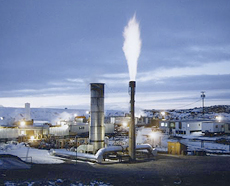
Coal Gasification Pilot Plant

Photo courtesy of llnlphotos.
The U.S. Department of Energy’s Rocky Mountain Test Facility, where coal gasification technologies being used in the Texas Clean Energy Project were demonstrated.
Summit Power’s Texas project is planned for a 600-acre plot of land in the ghost town of Penwell, near Midland-Odessa in west Texas. (The site was previously a finalist for the U.S. Department of Energy’s ill-fated FutureGen clean-coal plant.) The company intends to build a 400-megawatt power plant that would all but eliminate conventional pollutants and capture 90 percent of its CO2 emissions, according to Eric Redman, the company president. He says CO2 emissions would amount to about 200 pounds per MWh, making the Texas plant far more climate-friendly than even the best combined-cycle natural-gas plants, which emit about 850 to 1,000 pounds per MWh.

The technologies to accomplish this are well established. “There’s no breakthrough here,” Redman says. Coal can be “gasified” using a thermo-chemical process that strips it of pollutants including sulfur and mercury and separates virtually all of the CO2. This produces a flammable low-carbon synthetic gas, or syngas. (“A gasifier is like a refinery for coal,” Redman says.) The syngas is then burned to make electricity, and the captured CO2 is compressed into a semi-liquid. Compressed CO2 can be sold for enhanced oil recovery (EOR) in the oil-rich Permian Basin, where the project is located — just a mile from a 3,000-mile network of pipelines dedicated to CO2.

The potential transformation of CO2 from a greenhouse gas pollutant into an asset is one reason why the Department of Energy awarded the plant $450 million in grants. “If I’m venting CO2 from a plant, and I can use it as a product and not as a waste stream, I’m going to do it all day long,” says Charles McConnell, assistant secretary for fossil energy at the DOE. Texas has used CO2 to extract oil from hard-to-reach underground
Carbon capture and storage will require subsidies or carbon regulation to compete with conventional plants.
formations for decades, but most of it is piped in from elsewhere — Mississippi, New Mexico and Colorado — and natural supplies are limited.

What’s most innovative about the Texas plant, in fact, is a business model that depends on three major revenue streams, buttressed by the government grants and more than $1 billion in potential tax benefits realizable over a 10-year period. One source of income is the sale of CO2, for which demand is growing briskly in the oil patch. A second source of revenue, according to Summit, will be sales of urea fertilizer, which will be produced from syngas not burned for power.

Finally, the plant will sell electricity, although only about 200 MW of the plant’s 400MW capacity will flow into the grid; the rest will be used to power the project’s operations, including the urea plant and CO2 compressors. Summit has contracted to sell the electricity to the city of San Antonio, the CO2 to an oil company called Whiting Petroleum (among others), and the fertilizer to an unnamed buyer. It also intends to sell carbon credits, potentially in California’s regulated carbon market.

Click to enlarge
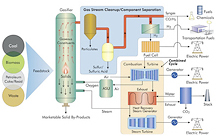
Gasification Process

U.S. Department of Energy
The gasification process breaks down coal into its basic chemical constituents that can be used for many commercial purposes.
Despite all this, the plant is not yet fully financed, and its prospects are uncertain. RBS Securities, a unit of the Royal Bank of Scotland, has been hired by Summit to raise money; its offering says that “an estimated $700 million of additional equity and $300 million of debt” will be needed to complete construction. Most of that is now lined up, Redman says, but the company still needs a lead equity investor. Construction is expected to take three to four years.

Howard Herzog, an expert on carbon capture at the Massachusetts Institute of Technology (MIT), says the Summit project could help move the industry closer to low-carbon coal. But, he says, carbon capture and storage will require either government subsidies or carbon regulation to compete with conventional coal or natural gas plants. “Ultimately, if you’re going to see CCS in the market, you're going to have to some kind regulatory forcing,” Herzog says.

Maybe the most remarkable thing about the Summit plan is that it sailed through the Texas regulatory process with no opposition, at a time when groups including the Sierra Club were running hard-hitting campaigns to shut down existing plants and stop new ones. To be sure, none of the
The U.S. needs to develop lower-carbon technology and sell it to China and India, an NRDC official says.
environmental groups has formally endorsed the plant. Bruce Nilles, director of the Sierra Club’s Beyond Coal initiative, said activists have more important battles to fight. “We’re not against demonstrating new technology,” he noted. More enthusiastic is David Frederick, an environmental lawyer who has worked for the Sierra Club and agreed to represent Summit Power in its effort to obtain an air permit. Why? By email, Frederick replied: “There is a Saudi Arabia of coal in the US, and, in the fullness of time, folks might use it. The Summit plant, if successful, would offer an incredibly low-CO2 way to use it.”

There’s another big reason why environmentalists favor efforts to develop carbon capture: China, and its vast reserves of coal. “If no other country in the world existed other than China, it would warrant the development of CCS [carbon capture and storage],” says David Hawkins, director of climate programs at NRDC. Jim Marston, who leads EDF’s Texas office and directs its national energy program, told me: “We probably don’t need coal plants in the U.S. But China and India are likely to build coal plants, and we need to demonstrate that there is much lower carbon technology out there at an affordable cost. In fact, we ought to develop that technology and sell it to them.”

Summit’s Texas project is one of three big coal plants under development in the U.S. that intend to capture carbon and use it to recover oil. Tenaska, a Nebraska-based energy company, wants to build a 600-MW plant near Sweetwater, Texas, that uses a post-combustion capture process to cut CO2 emissions by 85 to 90 percent. In Kemper,

MORE FROM YALE e360

Rethinking Carbon Dioxide:
From a Pollutant to an Asset

Rethinking Carbon Dioxide: From a Pollutant to an Asset
Three startup companies led by prominent scientists are working on new technologies to remove carbon dioxide from the atmosphere. The scientific community is skeptical, but, as Marc Gunther writes, these entrepreneurs believe the process of CO2 removal can eventually help cool an overheating planet.
READ MORE
Mississippi, construction has begun on the Southern Co.’s 582-MW plant that will use coal gasification to reduce its emissions by about 65 percent. The Sierra Club has opposed those plants, citing water issues in Texas and land use, cost and pollution issues in Mississippi. Meanwhile, China, Canada, the Netherlands and the UK are developing their own large-scale CCS-EOR projects, according to an MIT CCS database.

If all these projects pan out, carbon-capture proponents contend, “clean coal” could emerge as a climate-friendly source of base-load electric power. Meantime, vast reserves of domestic oil in places like the Permian Basin could be unlocked by the newly produced CO2, easing pressures to drill in pristine areas like Alaska.

“It’s the beginning of a new industry,” says John Thompson of the Clean Air Task Force. “As soon as these projects go online, everything that’s in operation seems obsolete. These are game-changers.”

POSTED ON 31 May 2012 IN Biodiversity Business & Innovation Climate Energy Oceans Science & Technology North America North America 

COMMENTS


What about the pollution caused by extracting the 300 years of coal left in the ground? Or the men who suffer from working the jobs to get it? Any one asking the communities with coal how the feel about this? Just another form of fracking.

My biggest question is how much are they paying the so called green expert?

Posted by Dena P on 31 May 2012


Let me get this straight — this coal-burning plant is supposed to be environmentally sound because the carbon dioxide it emits can be used to pump more oil out of the ground? What am I missing here?

Posted by John C. Berg on 31 May 2012


How about the other environmental groups you didn't mention here: like the ones most responsible for the 2007 fight against those TXU plants?

Namely Public Citizen, SEED Coalition, and Sierra Club?

How about others such as Greenpeace who have since joined the efforts against carbon-based energy in Texas? Perhaps in the future you might be well served to dig a little deeper on these stories.

http://www.citizen.org/Page.aspx?pid=694

There is no such thing as "clean" coal. Even if projects like this were even remotely economically feasible in comparison to renewables (without the massive subsidies) there are still many grave concerns with the entire premise of CCS that you haven't covered here.

Posted by Ryan R on 31 May 2012


One only has to look at the Duke Energy project in Edwardsport, Indiana to see the big lie that CCS perpetuates. Originally, Duke used the same hyperbole to sell the plant to Hoosier politicians and said that the 618 MW plant would be CCS ready and would cost only $1.2 billion. Today, the plant is ready to begin operating (time will tell if it even works or not) and there are no plans to do anything to control carbon emissions but yet the cost has risen to more than $3.3 billion.

Why? The answer is simple.

According to DOE, CCS adds about 50 percent to the capital cost of building such a plant, a cost that makes electricity generated from the plant the highest cost electricity in the nation.

Further, DOE and the Kentucky Center for Applied Energy Research, an ostensible supporter of new coal, says the "parasitic" energy consumption of capturing CO2 and sequestering it, uses from 25-40 percent of the energy produced by the plant, thereby reducing the overall efficiency of the plant greatly and costing the ultimate consumers of the energy even more.

Groups like the Clean Air Task Farce want to appear altruistic and concerned for the health of the planet but in fact, have sold their souls to supporters of coal in exchange for large donations from some very large pro-coal foundations. But hey, that is the American way, is it not?

Posted by John Blair on 31 May 2012


Re using CO2 to extract oil, unless CO2-EOR scales up hugely, it won't effect oil consumption or prices. If anything, it could replace imported oil and ease pressure to drill in sensitive areas.

Re other green groups, I reached out to Public Citizen which like the Sierra Club chose not to oppose the Texas projects.

Re Clean Air Task Force, I believe they are respected (as are EdF, NRDC and Sierra Club.) I'd be very interested in seeing evidence that they are funded by pro-coal foundations.

The other question that opponents of CCS need to ponder is: do you really believe the world's supply of coal will not be burned. I personally would like to see it left in the ground, but that seems highly unlikely to me.

Posted by Marc Gunther on 31 May 2012


It appears from your article that all the CO2 “captured” is injected into oil wells. This means that this CO2 will bubble out in short time frame. Thus is not really captured.

Please include this in any future articles as it is misleading without it. People assume the CO2 is locked away. Now if they pump to deep geological structures (& monitor them for 500 years) then that is different.

Posted by william Haaf on 01 Jun 2012


Thank you for your excellent article and for the insights offered regarding the need for sustaining revenue streams for 'clean coal' energy generating plants.

In Canada we have seen the collapse of a large scale Carbon Capture and Storage initiative in Alberta. Due in part to the lack of a viable market or a viable price for CO2 Transalta announced the Pioneer CCS Project linked to the Keephills 3 coal fired electricity plant west of Edmonton will not proceed.

This $1.4 billion scheme that would have piped emissions from that plant into oil wells to enhance petroleum production.

Clearly more is needed to make such projects viable, and new technologies as well as viable markets are key. Government subsidies are not enough.

Posted by Frank Came on 01 Jun 2012


Ultimately, there needs to be progress in the battle to support the world's energy needs and the efforts to protect and secure a healthy environment. So those that question the "clean coal" and "CCS" efforts towards securing this, need to be patient. Its an effort forward, not necessarily the answer. Steps in technology change are just that, steps, not silver bullets and new technologies indefinitely spur from their predecessors. Our advancements in the human race have quickly become "arguably" our own nemesis. That doesn't mean we just simply halt all efforts in the name of the environment. There has to be balance and I think the energy industry acknowledges this and is embracing it. A transitional phase is amongst us no doubt.

Posted by David Munn on 01 Jun 2012


Let me see if I understand this correctly.

You have a coal-fired power plant that will require more coal per electricity produced, is more expensive to run, will need to be at peak production all the time, and generates concentrated sulphur and mercury in one output, and marketable CO2 that will be sold to extract more fossil fuels?

How does that even make money, let alone sense?

Posted by ZA_SF on 01 Jun 2012


Marc - All the CCS and clean coal drama tend to overlook the emerging reality: multiple feedstock gasification, improved thermal recovery technology and distributed power generation offer real promise to transition from 200 million year-old coal to real-time biomass.

Swapping the relatively few jobs in underground coal for a much larger above-ground biomass economy is the future. Smart utilities, agroindustrial and chemical companies are forming new consortia to make this happen but innovation and investment has been hampered by the coal industries strangle hold on utility rate structures and commisions. Of course the foolish Federal subsidies into wind and solar (and complete exclusion of combined cycle biomass) ignored levelized energy cost reality making things worse and wasting time relearning the obvious.

The EU's overt commitment to phase coal out and biomass in through the Renewable Energy Directive and subsidized feed-in tarrifs offers a much more honest approach which has already given them a head start on these technologies and consortia. There are risks but many of the rewards have already accrued to the eastern US where wood pellet exports to the EU have doubled every year since 2008 and exceeded two million tons in 2011.

Most "green jobs" will be on forests and farms, not in solar manufacturing and certainly not down in the Medieval coal mines. It's time for biomass' day in the sun.

Posted by Dave Gibson on 02 Jun 2012


Mr. Gunther, For many years the CATF and NRDC have been supported with hundreds of thousands of dollars from CHicago based Joyce Foundation. You can look them up and verify their generous gifts designed to pursue there precious but elusive "clean coal" projects.

In Indiana the CATF and the Indiana Wildlife Federation (also funded by Joyce) actually
intervened in a regulatory proceeding on behalf of Duke Energy and against the coalition of actual environmental health and consumer groups as they fought to make sure that Duke ratepayers had to assume the risk for the Edwardsport lemon that is not even using the guise of CCS any longer.

Posted by John Blair on 02 Jun 2012


Sounds like black washing the issue to me. Even if they manage to use the coal in a cleaner way that does not take into account the environmental damage done removing it from the ground and cleaner does not mean clean. These kind of "solutions" do nothing to challenge our energy consumption or dependence.

Posted by Amy B Jolly on 04 Jun 2012


To address challenges in attaining operational excellence for clean energy plants with carbon capture, such as the Texas Clean Energy IGCC plant, the U.S. Department of Energy's (DOE) National Energy Technology Laboratory (NETL) has launched the world-class Advanced Virtual Energy Simulation Training and Research (AVESTAR) Center ( http://www.netl.doe.gov/avestar ).

The AVESTAR Center brings together state-of-the-art, real-time, high-fidelity dynamic simulators with operator training systems (OTS) and 3D virtual immersive training systems (ITS) into an integrated energy plant and control room environment.

NETL launched the AVESTAR Center in March 2011 with the deployment of a real-time dynamic simulator and OTS for an integrated gasification combined cycle (IGCC) power plant with 90\% pre-combustion CO2 capture. A 3D virtual ITS is scheduled to be deployed next month.

The IGCC OTS/ITS simulation technology is used to deliver comprehensive workforce training, enhanced engineering education, and collaborative, innovative, internationally-recognized R&D on the operation and control of IGCC plants with carbon capture.

Posted by Stephen E. Zitney on 21 Jun 2012


POST A COMMENT

Comments are moderated and will be reviewed before they are posted to ensure they are on topic, relevant, and not abusive. They may be edited for length and clarity. By filling out this form, you give Yale Environment 360 permission to publish this comment.

Name 
Email address 
Comment 
 

marc guntherABOUT THE AUTHOR
Marc Gunther is a contributing editor at Fortune, a senior writer at Greenbiz.com and a blogger at www.marcgunther.com. His book, Suck It Up: How Capturing Carbon From the Air Can Help Solve the Climate Crisis, is available as an Amazon Kindle Single. In a previous article for Yale Environment 360, he wrote about emerging technologies to remove carbon dioxide from the atmosphere.
MORE BY THIS AUTHOR


RELATED ARTICLES


Will Global Coal Boom Go Bust
As Climate Concerns Increase?

The surge in global coal consumption, driven largely by China and India, has climate scientists deeply worried. But environmentalists and a growing number of financial experts say that alarm over global warming may halt the seemingly inevitable rise of the coal industry.
READ MORE

How Ontario Is Putting an End
To Coal-Burning Power Plants

Ontario is on the verge of becoming the first industrial region in North America to eliminate all coal-fired electrical generation. Here’s how Canada’s most populous province did it — and what the U.S. and others can learn from it.
READ MORE

How Data and Social Pressure
Can Reduce Home Energy Use

With the relationship between utilities and their customers changing in unprecedented ways, new companies are deploying vast amounts of data and social psychology techniques to try to persuade people to use less electricity in their homes.
READ MORE

Green Crude: The Quest to
Unlock Algae’s Energy Potential

A host of startup companies are pursuing new technologies that they claim will soon lead to large-scale commercialization of biofuels made from algae. But questions remain about the viability and environmental benefits of what some of its developers are calling “green crude.”
READ MORE

High-Altitude Wind Energy:
Huge Potential — And Hurdles

A host of start-up companies are exploring ways to harness the enormous amount of wind energy flowing around the earth, especially at high altitudes. But as these innovators are discovering, the engineering and regulatory challenges of what is known as airborne wind power are daunting.
READ MORE


MORE IN Reports


A Plague of Deforestation
Sweeps Across Southeast Asia

by daniel drollette
Illegal logging and unchecked economic development are taking a devastating toll on the forests of Vietnam and neighboring countries, threatening areas of biodiversity so rich that 1,700 species have been discovered in the last 15 years alone.
READ MORE

In Post-Tsunami Japan, A Push
To Rebuild Coast in Concrete

by winifred bird
In the wake of the 2011 tsunami, the Japanese government is forgoing an opportunity to sustainably protect its coastline and is instead building towering concrete seawalls and other defenses that environmentalists say will inflict serious damage on coastal ecosystems.
READ MORE

How Mussel Farming Could
Help to Clean Fouled Waters

by paul greenberg
Along the shores of New York Harbor, scientists are investigating whether this ubiquitous bivalve can be grown in urban areas as a way of cleansing coastal waters of sewage, fertilizers, and other pollutants.
READ MORE

A Key Experiment to Probe the
Future of Our Acidifying Oceans

by peter friederici
In a Swedish fjord, European researchers are conducting an ambitious experiment aimed at better understanding how ocean acidification will affect marine life. Ultimately, these scientists hope to determine which species might win and which might lose in a more acidic ocean.
READ MORE

Declining Bee Populations Pose
A Threat to Global Agriculture

by elizabeth grossman
The danger that the decline of bees and other pollinators represents to the world’s food supply was highlighted this week when the European Commission decided to ban a class of pesticides suspected of playing a role in so-called “colony collapse disorder.”
READ MORE

Fires Burn More Fiercely
As Northern Forests Warm

by dylan walsh
From North America to Siberia, rising temperatures and drier woodlands are leading to a longer burning season and a significant increase in forest fires. Scientists warn that this trend is expected continue in the years ahead.
READ MORE

Will Electric Bicycles Get
Americans to Start Pedaling?

by marc gunther
Electric bicycles are already popular in Europe and in China, which has more e-bikes than cars on its roads. Now, manufacturers are marketing e-bikes in the U.S., promoting them as a "green" alternative to driving.
READ MORE

Copenhagen’s Ambitious Push
To Be Carbon Neutral by 2025

by justin gerdes
The Danish capital is moving rapidly toward a zero-carbon future, as it erects wind farms, transforms its citywide heating systems, promotes energy efficiency, and lures more people out of their cars and onto public transportation and bikes.
READ MORE

How Ontario Is Putting an End
To Coal-Burning Power Plants

by keith schneider
Ontario is on the verge of becoming the first industrial region in North America to eliminate all coal-fired electrical generation. Here’s how Canada’s most populous province did it — and what the U.S. and others can learn from it.
READ MORE

Long Outlawed in the West,
Lead Paint Sold in Poor Nations

by rebecca kessler
A new study finds that household lead paint — banned for years in the U.S. and Europe because of its health effects on children — is commonly sold in the African nation of Cameroon. Is lead paint the latest case of Western companies selling unsafe products in developing countries?
READ MORE


e360 digest
Yale
Yale Environment 360 is
a publication of the
Yale School of Forestry
& Environmental Studies
.

SEARCH e360


Donate to Yale Environment 360

CONNECT

Twitter: YaleE360
e360 on Facebook
Donate to e360
View mobile site
Bookmark
Share e360
Email newsletter
Subscribe to our feed:
rss


ABOUT

About e360
Contact
Submission Guidelines
Reprints

e360 PHOTO GALLERY

To Catch a Rhino Welz
South African photojournalist Adam Welz documents the harrowing relocation of six white rhinos to a region that has lost all its rhinos to poaching. View the gallery.


DEPARTMENTS

Opinion
Reports
Analysis
Interviews
e360 Digest
Podcasts
Video Reports

TOPICS

Biodiversity
Business & Innovation
Climate
Energy
Forests
Oceans
Policy & Politics
Pollution & Health
Science & Technology
Sustainability
Urbanization
Water

REGIONS

Antarctica and the Arctic
Africa
Asia
Australia
Central & South America
Europe
Middle East
North America

e360 VIDEO

Into Heart of Ecuador Yasuni
A Yale Environment 360 video explores Ecuador’s threatened Yasuni Biosphere Reserve with scientists inventorying its stunning forests and wildlife. Watch the video.

e360 MOBILE

Mobile
The latest
from Yale
Environment 360
is now available for mobile devices at e360.yale.edu/mobile.

e360 VIDEO

Colorado River Video
In a Yale Environment 360 video, photographer Pete McBride documents how increasing water demands have transformed the Colorado River, the lifeblood of the arid Southwest. Watch the video.


header image
Top Image: aerial view of Iceland. © Google & TerraMetrics.

e360 VIDEO

Warriors of Qiugang
The Warriors of Qiugang, a Yale Environment 360 video that chronicles the story of a Chinese village’s fight against a polluting chemical plant, was nominated for a 2011 Academy Award for Best Documentary (Short Subject). Watch the video.


OF INTEREST


Yale