17 Nov 2011: Analysis

China’s Appetite for Wood
Takes a Heavy Toll on Forests

More than half of the timber now shipped globally is destined for China. But unscrupulous Chinese companies are importing huge amounts of illegally harvested wood, prompting conservation groups to step up boycotts against rapacious timber interests.

by william laurance

In Chinese folklore, a dragon symbolizes strength. It is an apt icon for a nation whose rise as an economic superpower has been nothing short of meteoric.

While China’s stunning economic advances have come at significant environmental cost, the boom has been a plus in a few realms. The country is investing avidly in green technologies, such as solar energy and high-tech car batteries. It has also undertaken an ambitious national reforestation program, while cracking down on illegal forest clearing and logging inside its borders. According to the UN Food and Agricultural Organization, forest cover in China, including large areas of timber plantations, increased from 157 million hectares in 1990 to 197 million hectares in 2005.

Counter-intuitively, the expansion of Chinese forests has occurred at the same time the country has been developing an immense export industry for
In its fervor to secure timber, China is increasingly seen as a predator on the world’s forests.
wood and paper products. China is now the “wood workshop for the world,” according to Forest Trends, a Washington, D.C.-based think tank, consuming more than 400 million cubic meters of timber annually to feed both its burgeoning exports and growing domestic demands. Production of paper products has also grown dramatically in China, doubling from 2002 to 2007.

But the rise of the Chinese dragon has a darker side. As much as half of the timber and much of the paper pulp consumed by China is imported, primarily from tropical nations or nearby Siberia. In and of itself, there is nothing wrong with this — China has every right to grow economically and seek the kind of prosperity that industrial nations have long enjoyed. However, in its fervor to secure timber, minerals, and other natural resources, China is increasingly seen as a predator on the world’s forests.


China is now overwhelmingly the biggest global consumer of tropical timber, importing around 40 to 45 million cubic meters of timber annually. Today, more than half of all timber being shipped anywhere in the world is destined for China. Many nations in the Asia-Pacific region and Africa export the lion’s share of their timber to China.

China faces three criticisms by those worried about the health and biodiversity of the world’s forests. First, the country and its hundreds of wood-products corporations and middlemen have been remarkably aggressive in pursuing timber supplies globally, while generally being little concerned with social equity or environmental sustainability. For instance, China has helped fund and promote an array of ambitious new road or rail projects that are opening up remote forested regions in the Amazon, Congo Basin, and Asia-Pacific to exploitation. Such frontier roads can unleash a Pandora’s Box of activities — including illegal colonization, hunting, mining, and land speculation — that are often highly destructive to forests.

View photos
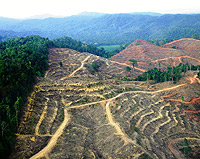
Sumatra Deforestation

Courtesy of William Laurance
Vast expanses of Sumatran rainforest are being turned into paper pulp.
China is also a major consumer of wood pulp, which is helping to drive large-scale deforestation in places like Sumatra and Borneo. During a recent visit to Sumatra, I witnessed the felling of large expanses of native rainforests, which are being chopped up and fed into the world’s largest wood-pulp plant, located nearby, and replaced by monocultures of exotic acacia trees.

Second, China, in its relentless pursuit of timber, almost exclusively seeks raw logs. Raw logs are the least economically beneficial way for developing nations to exploit their timber resources, as they provide only limited royalties and little employment, workforce training, and industrial development. As a result, most of the profits from logging are realized by foreign timber-cutters, shippers, and wood-products manufacturers. A cubic meter of the valuable timber merbau (Intsia bijuga), for instance, yields only around $11 to local communities in Indonesian Papua but around $240 when delivered as raw logs to wood-products manufacturers in China, who profit further by converting it into prized wood flooring.

Finally, China has done little to combat the scourge of illegal logging, which is an enormous problem in many developing nations. A 2011 report on illegal logging by Interpol and the World Bank concluded that, among 15 of the major timber-producing countries in the tropics, two-thirds had half or more of their timber harvested illegally. Globally, economic losses and tax and royalty evasion from illegal logging are thought to cost around $15 billion annually — a large economic burden for developing nations. Forest ecosystems suffer serious impacts as well, because illegal loggers frequently ignore environmental controls on cutting operations.

According to a 2010 analysis by Chatham House, a respected UK think tank, illegal logging is slowly declining globally but this is despite, rather than because of, China’s influence. The report concluded that, from 2000 to 2008, China imported 16 to 24 million cubic meters of illegal timber each
One report said that China imports 16 to 24 million cubic meters of illegal timber each year.
year. This is an incredible figure — twice the total amount imported annually by leading industrial nations.

Around a third of Chinese timber imports are ultimately exported, as furniture, plywood, flooring, disposable chopsticks, and other wood products. European countries, the U.S, and Japan are the biggest importers, with consumers there often unaware of the illicit origin of many wood products from China.

When it comes to illegal or predatory logging, it has not been easy to get China’s attention. Stories about illegal logging rarely penetrate the Chinese news media. For example, in 2006 the Association for Tropical Biology and Conservation (ATBC), an international scientific organization, held its annual conference in Kunming, China. At the time I was president of the ATBC, and I spoke at length to Chinese journalists about the problem of illegal logging and the risks it posed for Chinese exporters. To my knowledge, not a single story about my concerns was reported in China, even though I emailed the journalists a summary of my comments translated into Mandarin Chinese.

Outside China, the story is different. Awareness of the rapacious nature of Chinese timber interests is growing, especially since a 2005 report by a green group, the Environmental Investigation Agency, that detailed massive illegal logging and timber theft in the Indonesian state of Papua. Smuggled timber from Papua arrived in mainland China via international criminal syndicates involving corrupt Indonesian insiders, Malaysian loggers, and Singaporean shippers. Other groups, such as the World Resources Institute, Forest Trends, WWF, and Greenpeace, have laid similar claims against China. With mainstream organizations such as the World Bank, Interpol, and Chatham House joining in, what began as murmurs of concern is becoming a loud clamor for change.

This is a dangerous situation for Chinese businesses and exporters. Influential environmental organizations in Europe and North America have their eye on China. For example, the Rainforest Action Network (RAN) has waged a campaign urging corporate customers to avoid paper and pulp products originating from two of Indonesia’s largest corporations, Asian
Efforts to combat illicit timber imports are finally beginning to gain some traction in China.
Pulp & Paper (APP) and APRIL, which are felling large expanses of native rainforest for wood pulp. The pulp and paper have been used by Chinese manufacturers to make branded products for scores of well-known companies around the world. Some of those companies — including Gucci, Scholastic, Hachette, and Tiffany & Co. — have switched to recycled and sustainably certified paper products. As of this year, other companies — including Prada, American Greetings, Marc Jacobs, and the Rupert Murdoch-owned HarperCollins publishing — are continuing to use APP or APRIL paper products supplied by Chinese manufacturers, according to RAN.

Such actions could have a big impact on Chinese exports. Boycotts initiated by green groups can have a major influence on consumer preferences and have forced some of the largest retail chains in North America and Europe, such as Walmart and Ikea, to limit products sourced from old-growth forests. Meanwhile, eco-certified timber products accounted for $7.4 billion in sales in the U.S. alone in 2005, and were expected to grow to $38 billion there by 2010. At some point, Chinese companies will buck the trend toward sustainable logging at their peril.

Adding teeth to such consumer actions are tougher laws and initiatives in industrial nations. In particular, new provisions to the Lacey Act in the U.S., and the European Union Timber Action Plan in Europe are increasingly holding corporations that import illicit timber products responsible for their actions.

One senses that efforts to combat illicit timber imports are finally beginning to gain some traction in China. The relevant government agencies are now engaged, and the country has commissioned an analysis of its role as an importer of illegal timber and released draft guidelines to improve sustainability of its timber-importing corporations. It also recently hosted the Asia Forest Partnership Dialogue 2011, in Beijing, designed to assess progress in efforts to combat illegal logging in Asia over the last decade.

MORE FROM YALE e360

A Revolutionary Technology is
Unlocking Secrets of the Forest

A Revolutionary Technology is<br /> 
Unlocking Secrets of the Forest
A new imaging system is capable of providing detailed, three-dimensional pictures of tropical forests — including the species they contain and the amount of CO2 they store — at astonishing speed. These advances, Rhett Butler writes, could play a key role in preserving the world’s beleaguered rainforests.
READ MORE
However, China still has no national action plan or legislation to prevent the import of illegally sourced timber, and no formal trade arrangements with major timber-producing countries designed to improve enforcement. Despite dominating the global timber market, Chinese wood-products corporations feel little pressure from buyers to improve the legality of their timber products and consider it largely unimportant to their future competitiveness, according to the Chatham House report.

The bottom line: China’s efforts to limit the environmental impacts of its burgeoning timber imports are still mostly lip-service, with little practical impact.

Check the labels when you shop for any wood or paper products. If it says, “Made in China,” be wary of the dragon, and think twice before buying.

POSTED ON 17 Nov 2011 IN Forests Forests Policy & Politics Pollution & Health Sustainability Asia Central & South America 

COMMENTS


The article raises an important issue of PRC being a major importer of illegal tropical timber, and the need for the country to implement policies that prevent it. Such a move would greatly reduce demand for illagal timber so supporting the efforts to reduce unplanned deforestation and degradation in the source countries. The article also provides a warning to producers in PRC of the potential consumer boycotts of their products in those countries where civil society groups have a strong influence. However, those key messages are undermined by the delivery of the article which I feel makes the warning sound like a threat to PRC rather than an attempt to engage and encourage, and mixes analysis with opinion.

The article is listed as an analysis but the concluding sentences are the opinion of the author unsubstantiated by the analysis (i.e. PRC's lack of sincerity), and rather than just making the observation that a consumer boycott could result if there was not an improvement the author crosses the line to actually advocate a boycott now. Even if the University of Queensland wanted to support the process of preventing tropical timber entering PRC, I think you would now find the door firmly closed. But that's just my opinion.

Posted by Philip Wells on 18 Nov 2011


PLEASE STOP cutting down the trees. This is destroying our forests for someone else to profit
from. This is NOT right. Something NEEDS to be done NOW before it is too late.

Posted by Terri Hughes on 18 Nov 2011


Things always change slowly in the land of the dragon. Certainly there are some good business practices that are natural to the Chinese way of doing business. Their willingness to educate and employ the locals to work in their enterprises; their willingness to pay a percentage of their profits into the native government coffers; their willingness to help local governments build the necessary infrastructure are all sound and beneficial practices that Big Western Oil doesn't do. Tibet for example is controlled by China. Tibet has arge forests; heavy and precious metals and rare earth deposits; not to mention that it also controls the headwaters of five of the major world rivers. This is the only reason that the US government; the CIA and the NGOs support the Dalai Lama. The monks regime was sexually brutal and invasive if the truth be known.

On the other hand Chinese consumption of illegal products sanctioned under global law comes to mind. The purchase of illegal lumber from Indonesia; Sumatra; the Amazon and India is one example.

If the the Three Gorges Dam were ever to break it would cause such an environmental disaster that would affect China, Russia and a great deal of South East Asia. China needs to improve its environmental footprint and rapidly.

Then of course there is the amount of pollution caused by the non regulation of China's factories and automobiles coupled with its labor practices and human rights. China also has such a significant portion of its population that cooks openly with fossil fuels. Things in China are changing but change in China is slow. It needs to improve its track record but it needs to do it properly at the expense of PROFIT.

Posted by Michael Kirkby on 19 Nov 2011


I hope to see much greater efforts to salvage wood from demolition, as well as projects to build without the use of wood. More cob and adobe where it's feasible, recylcled metal for studs, etc. Earth so badly needs to restore and preserve its forestry that it is becoming intolerable how much of it is being cut for building.

Posted by TRB on 19 Nov 2011


The export value of China's exports during 2010 of timber and paper products to the USA and EU - which prohibit the import of illegal wood-based products - amounted to roughly US$8bi and US$5 bi (timber) and US$1.5bi each (paper) respectively.

It is likely that on average 20%-30% of that timber was illegal and the proportion of that paper which was made at least partly from illegal Indonesian pulp exceded 10%.

If (and this a big IF) the Lacey Act and its equivalent in the EU are implemented robustly, they should improve some US$4 billion of China's exports. This is small relative to China's overall exports.

Many Chinese exporters would prefer not to base their business on crime, but it takes two to tango - they need a level playing field in their export markets.

Posted by James Hewitt on 21 Nov 2011


Reduce importing goods from China can help this. Many Americans (and others in other countries alike) always enjoy cheap goods even they are not necessary - change your purchase behaviors today and it may change the world tomorrow.

Posted by Mandy on 21 Nov 2011


It has become more and more obvious that it is impossible to build industrial economies without
massive quantities of wood being fed into their maw. Given the rate of deforestation, and the overall state of the forest China may be the last place in the world that actually thinks it has a chance to join the middle class because there will be no resources to build the next industrial giant.

Posted by greg Gerritt on 23 Nov 2011


It cannot reach a conclusion without involving politics.

Posted by Luyi on 25 Nov 2011


Why not we think of banning importing of specific products made of tropical wood and campaign against its use when is is not possible to do anything at producer end, something need to be done at the consumer's end for the shake of conservation which is at stake as revealed in the article.

Posted by Asesh Lahiri on 07 Dec 2011


In China this past January, I stayed in private apartments in Harbin and Beijing. The floors of each of these was comprised of hardwood - likely the Indonesian merbau of this article. Multiply this by the millions of apartments having been or now being constructed all over the country and you have the result of decimation of the world's tropical forests. Should this come as a surprise? Hardly. Why has China been investing in roads across the tropical world?

The fundamental issue is finding the key to change the mindset of the Chinese, one that enables the country to enact protection of its own forests (because of the devastating impact of floods and landslides - a very practical reason, of course) while felling them across the rest of the planet. I doubt that consumer boycotts will prompt change.

Posted by Len Milich on 06 Feb 2012


POST A COMMENT

Comments are moderated and will be reviewed before they are posted to ensure they are on topic, relevant, and not abusive. They may be edited for length and clarity. By filling out this form, you give Yale Environment 360 permission to publish this comment.

Name 
Email address 
Comment 
 

william lauranceABOUT THE AUTHOR
William Laurance is Distinguished Research Professor and an Australian Laureate at James Cook University in Queensland, Australia. He is also the Prince Bernhard Chair in International Nature Conservation at Utrecht University, Netherlands. His research on the impacts of intense land use on tropical forests and species has ranged from the Amazon to Africa to tropical Australia. In an earlier article for Yale Environment 360, he wrote that rising temperatures are already taking a toll on tropical species.
MORE BY THIS AUTHOR


RELATED ARTICLES


China’s Looming Conflict
Between Energy and Water

In its quest to find new sources of energy, China is increasingly looking to its western provinces. But the nation’s push to develop fossil fuel and alternative sources has so far ignored a basic fact — western China simply lacks the water resources needed to support major new energy development.
READ MORE

China’s Ma Jun on the Fight
To Clean Up Beijing’s Dirty Air

Chinese environmentalist Ma Jun played an important role in a recent successful effort to force the government to more strictly monitor air pollution in Beijing. In an interview with Yale Environment 360, he talks about the daunting challenges of China’s anti-pollution battle and how social media is helping lead the fight to improve the nation’s air.
READ MORE

Digital Defenders: Tribal People
Use GPS to Protect Their Lands

From the rainforests of central Africa to the Australian outback, indigenous people armed with GPS devices are surveying their territories and producing maps they can use to protect them from logging and other outside development.
READ MORE

Busting the Forest Myths:
People as Part of the Solution

The long-held contention that rural forest communities are the prime culprits in tropical forest destruction is increasingly being discredited, as evidence mounts that the best way to protect rainforests is to involve local residents in sustainable management.
READ MORE

Can Smarter Growth Guide
China’s Urban Building Boom?

The world has never seen anything like China’s dizzying urbanization boom, which has taken a heavy environmental toll. But efforts are now underway to start using principles of green design and smart growth to guide the nation’s future development.
READ MORE


MORE IN Analysis


The Vital Chain: Connecting
The Ecosystems of Land and Sea

by carl zimmer
A new study from a Pacific atoll reveals the links between native trees, bird guano, and the giant manta rays that live off the coast. In unraveling this intricate web, the researchers point to the often little-understood interconnectedness between terrestrial and marine ecosystems.
READ MORE

Could a Changing Climate
Set Off Volcanoes and Quakes?

by fred pearce
A British scientist argues that global warming could lead to a future of more intense volcanic eruptions and earthquakes. And while some dismiss his views as preposterous, he points to a body of recent research that shows a troubling link between climate change and the Earth’s most destructive geological events.
READ MORE

China’s Looming Conflict
Between Energy and Water

by christina larson
In its quest to find new sources of energy, China is increasingly looking to its western provinces. But the nation’s push to develop fossil fuel and alternative sources has so far ignored a basic fact — western China simply lacks the water resources needed to support major new energy development.
READ MORE

As Threats to Biodiversity Grow,
Can We Save World’s Species?

by lee hannah
With soaring human populations and rapid climate change putting unprecedented pressure on species, conservationists must look to innovative strategies — from creating migratory corridors to preserving biodiversity hotspots — if we are to prevent countless animals and plants from heading to extinction.
READ MORE

Linking Weird Weather to
Rapid Warming of the Arctic

by jennifer francis
The loss of Arctic summer sea ice and the rapid warming of the Far North are altering the jet stream over North America, Europe, and Russia. Scientists are now just beginning to understand how these profound shifts may be increasing the likelihood of more persistent and extreme weather.
READ MORE

Rethinking Carbon Dioxide:
From a Pollutant to an Asset

by marc gunther
Three startup companies led by prominent scientists are working on new technologies to remove carbon dioxide from the atmosphere. The scientific community is skeptical, but these entrepreneurs believe the process of CO2 removal can eventually be profitable and help cool an overheating planet.
READ MORE

Busting the Forest Myths:
People as Part of the Solution

by fred pearce
The long-held contention that rural forest communities are the prime culprits in tropical forest destruction is increasingly being discredited, as evidence mounts that the best way to protect rainforests is to involve local residents in sustainable management.
READ MORE

China’s Reforestation Programs:
Big Success or Just an Illusion?

by jon r. luoma
China has undertaken ambitious reforestation initiatives that have increased its forest cover dramatically in the last decade. But scientists are now raising questions about just how effective these grand projects will turn out to be.
READ MORE

As Coal Use Declines in U.S.,
Coal Companies Focus on China

by jonathan thompson
With aging coal-fired U.S. power plants shutting down, major American coal companies are exporting ever-larger amounts of coal to China. Now, plans to build two new coal-shipping terminals on the West Coast have set up a battle with environmentalists who want to steer the world away from fossil fuels.
READ MORE

The New Story of Stuff:
Can We Consume Less?

by fred pearce
A new study finds that Britons are consuming less than they did a decade ago, with similar patterns being seen across Europe. Could this be the beginning of a trend in developed countries? Might we be reaching “peak stuff”?
READ MORE


e360 digest
Yale
Yale Environment 360 is
a publication of the
Yale School of Forestry
& Environmental Studies
.

SEARCH e360


Donate to Yale Environment 360

CONNECT

Twitter: YaleE360
e360 on Facebook
Donate to e360
View mobile site
Bookmark
Share e360
Email newsletter
Subscribe to our feed:
rss


ABOUT

About e360
Contact
Submission Guidelines
Reprints

e360 VIDEO

Warriors of Qiugang
The Warriors of Qiugang, a Yale Environment 360 video that chronicles the story of a Chinese village’s fight against a polluting chemical plant, was nominated for a 2011 Academy Award for Best Documentary (Short Subject). Watch the video.


DEPARTMENTS

Opinion
Reports
Analysis
Interviews
e360 Digest
Video Reports

TOPICS

Biodiversity
Business & Innovation
Climate
Energy
Forests
Oceans
Policy & Politics
Pollution & Health
Science & Technology
Sustainability
Urbanization
Water

REGIONS

Antarctica and the Arctic
Africa
Asia
Australia
Central & South America
Europe
Middle East
North America

e360 VIDEO REPORT

When the Water Ends
As temperatures rise and water supplies dry up, tribes in East Africa increasingly are coming into conflict. A Yale Environment 360 video reports on a phenomenon that could become more common: how worsening drought will pit groups — and nations — against one another. Watch the video.

e360 MOBILE

Mobile
The latest
from Yale
Environment 360
is now available for mobile devices at e360.yale.edu/mobile.


header image
Top Image: aerial view of Iceland. © Google & TerraMetrics.

e360 VIDEO REPORT

Leveling Appalachia
Leveling Appalachia: The Legacy of Mountaintop Removal Mining, an e360 video examining the environmental and human impacts of this mining practice, won the award for best video in the 2010 National Magazine Awards for Digital Media. Watch the video.


OF INTEREST


Yale