06 Feb 2012: Report

In Fast-Track Technology, Hope
For a Second Green Revolution

With advances in a technique known as fast-track breeding, researchers are developing crops that can produce more and healthier food and can adapt and thrive as the climate shifts.

by richard conniff

In Zambia during the current planting season, a corn crop will go into the fields that begins the process of rapidly boosting vitamin A content by as much ten-fold — helping to address a nutritional deficiency that causes 250,000-500,000 children to go blind annually, most of them in Africa and Asia. In China, Kenya, and Madagascar, also this planting season, farmers will put out a crop of Artemisia annua that yields 20 to 30 percent more of the chemical compound artemisinin, the basis for what is now the world’s standard treatment for malaria.

Both improvements are happening because of fast-track breeding technology that promises to produce a 21st-century green revolution. It is already putting more food on tables — though it’s unclear whether it can add enough food to keep pace as the world’s human population booms to 9 billion people by 2050.

Fast-track breeding is also giving agronomists a remarkable tool for quickly adapting crops to climate change and the increasing challenges of drought, flooding, emerging diseases, and shifting agricultural zones. And it can help save lives: In the absence of prevention, half those victims of vitamin A deficiency now die shortly after going blind, according to the World Health
Fast-track breeding is a faster and more efficient way of doing what nature and farmers have always done.
Organization; and in 2010, lack of adequate treatment — meaning artemisinin — contributed to the deaths of 655,000 children from malaria.

The fast-track technology, called marker-assisted selection (MAS), or molecular breeding, takes advantage of rapid improvements in genetic sequencing, but avoids all the regulatory and political baggage of genetic engineering. Bill Freese, a science policy analyst with the Center for Food Safety, a nonprofit advocacy group, calls it “a perfectly acceptable tool. I don’t see any food safety issue. It can be a very useful technique if it’s used by breeders who are working in the public interest.”

Molecular breeding isn’t genetic engineering, a technology that has long alarmed critics on two counts. Its methods seem outlandish — taking genes from spiders and putting them in goats, or borrowing insect resistance from soil bacteria and transferring it into corn — and it has also seemed to benefit a handful of agribusiness giants armed with patents, at the expense of public interest.

By contrast, molecular breeding is merely a much faster and more efficient way of doing what nature and farmers have always done, by natural selection and artificial selection respectively: It takes existing genes that happen to be advantageous in a given situation and increases their frequency in a population.

In the past, farmers and breeders did it by walking around their fields and looking at individual plants or animals that seemed to have desirable traits, like greater productivity, or resistance to a particular disease. Then they went to work cross-breeding to see if they could tease out that trait and get it to appear reliably in subsequent generations. It could take decades, and success at breeding in one trait often meant bringing along some deleterious fellow traveler, or inadvertently breeding out some other essential trait.
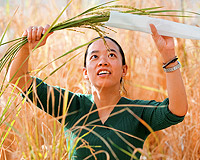
Cornell Molecular Breeding
Cornell University Photography Photo/Lindsay France.
A Cornell researcher bags rice plant panicles to prevent cross pollination.
Molecular breeding enables growers to get the improvements they want far more precisely, by zeroing in on the genes responsible for a given trait. If genetic engineering is a tool for “bludgeoning the genome,” as Cornell University researcher Susan McCouch puts it, what molecular breeding does instead is to “open a window” into how the genome works, enabling researchers to collaborate with it.

Sequencing the entire genome of a species is the first step, and this process, which cost millions of dollars a decade ago, is down now to the low thousands. Next, researchers sort out which genes are responsible for a given function, the bottleneck in the process so far, though McCouch says it becomes faster and cheaper with each new species that gets sequenced, because nature tends to employ the same mechanisms from one species to another. Finally, researchers map out markers — bits of genetic material that are linked to those genes, to flag whether or not the desired genes are present in a given individual.

“It’s not uncommon for a company to want to combine 10 or 20 traits in a variety,” says Harry Klee, a specialist in tomato breeding at the University of Florida in Gainesville. In the past, to get the perfect combination of traits using conventional methods, “you would have to put out millions of plants in the field.” Instead, breeders typically simplified, narrowing down their wish list to a few key traits.

With tomatoes, for instance, as many as 30 or 40 different genes influence taste — too many variables to juggle. So shelf life and appearance inevitably trumped taste. “But this is where molecular breeding really pays off,” says Klee. Breeders now use genetic markers to automatically screen one-inch-tall seedlings and immediately weed out the 99 percent they don’t want, cutting years off the breeding timetable. That makes it easier to get to desirable cross-breed quickly — and also stack up a complex array of traits in a single strain. As a result, says Klee, even mass-produced supermarket tomatoes should actually taste good five years from now.

In the two decades since researchers first proposed molecular breeding in 1989, high costs and the difficult work of discovery have largely confined the technology to big companies working in commodity crops like corn and
These methods have the potential to make breeding aim at enhancing biological and agricultural diversity.
soybeans. But as costs fall even faster than Moore’s Law would predict and genetic methods become routine, researchers are now also applying them to the so-called orphan crops on which much of the developing world depends. Molecular breeding is not as effective so far for crops that propagate clonally, including such tropical staples as cassava, sweet potato, yams, bananas and plantains. But for rice and many other crops, it enables breeders to quickly tailor a plant to a particular environment or taste.

“Every village has its own favorite rice,” says Ian Graham, director of the University of York’s Centre for Novel Agricultural Products. “The challenge is if you come up with a great trait, how on earth do you put that trait into all these local varieties easily, economically, and quickly? Sequencing gives you the tool to do it. That’s the secret of really making molecular breeding work for the developing world.” There are still economic barriers, he says, but equipment to set up a basic laboratory in a developing country “is on the order of $100,000 instead of millions.” Thus genetic methods have the potential to make breeding more local, more democratic, and aimed at enhancing biological and agricultural diversity, instead of stripping it away.

The Green Revolution of the 1960s largely achieved its huge leap in productivity by streamlining plants and farming methods to work across hundreds of millions of hectares, regardless of local tastes or environments. It re-designed plants for high-input industrial agriculture, so they could respond to an intensive regimen of fertilizers, water, and pesticides, regardless of the environment. But the molecular Green Revolution will work, says McCouch, by fine-tuning crops to perform in a particular environment, minus additional input. Farmers are backing off growing rice in water, for instance, “because they can’t afford the water, there isn’t enough water in the world.”

Molecular breeding will also build crops, McCouch says, to “respond constructively to changes in the environment that we cannot predict,” like flooding and drought. “A really big challenge in discovery genetics right now,” she says, “is to understand how plants sense environments: How do they count number of days? How do they count the number hours of daylight? How do they know when to grow and when to hold their breath if they’re underwater? Once we make the discovery of which genes allow the

MORE FROM YALE e360

Can ‘Climate-Smart’ Agriculture
Help Africa and the Planet?

Climate Smart Agriculture Africa
An idea promoted at the recent Durban talks is “climate-smart agriculture,” which could make crops less vulnerable to heat and drought and turn depleted soils into carbon sinks. The World Bank and African leaders back this approach, Fred Pearce writes, but some critics are skeptical that it will benefit small-scale African farmers.
READ MORE
plants to sense these things, then we can do marker-assisted selection” and move those genes into local varieties that already have the other traits farmers want.

The potential for molecular breeding to help farmers adapt to a rapidly changing world became evident last month when Nature Biotechnology published an article about rice breeding in Japan. Geneticists at the Iwate Biotechnology Research Center 130 miles north of Fukushima were already using molecular breeding to improve the cold-tolerant rice variety preferred by farmers there, when last year’s earthquake hit. The subsequent tsunami left a huge swath of rice paddies — 58,000 acres, representing almost a fifth of the nation’s rice supply — contaminated with too much salt for conventional farming. The researchers promptly switched their focus to salt-tolerant genes. Instead of taking five years to produce a suitable crossbreed by conventional methods, they now hope to deliver those seeds to affected farmers in just two years, for the 2014 growing season.

POSTED ON 06 Feb 2012 IN Business & Innovation Climate Policy & Politics Policy & Politics Africa Asia Europe North America 

COMMENTS


Japanese efforts in developing salt tolerance varieties for 2014, and molecular level breeding definitely will be turning point in green revolution. However, biodiversity and argroecological concerns are other challenges.

Posted by SANJEEV ADHIKARI on 06 Feb 2012


Molecular-breeding sure seems like the right thing to do, to help all concerned. Are the seeds available for USA-use, NOW, in our drier areas, like my state of Arizona? If so, how do I obtain some? My collegues talk of an EMP-attack from Iran/other, and if war occurs with Iran/Syria, Russia & Red China may decide we should be struck--at best only the "Command & Control & Military, and at worse, a general strike that kills 40 million from blast, outright, china then occupying. Are important projects like those mentioned, dispersed, in case of either scenario? I wonder if Yale could develop Purselane, which is an excellent, high-nutrient plant that can grow as well as a weed, in the Southwest?

Posted by Jack Dale on 07 Feb 2012


With climatic changes and increasing population the need of the hour is improved varieties of crops and high yielding ones.

Dr.A.Jagadeesh Nellore (AP),India
E-mail: anumakonda.jagadeesh@gmail.com

Posted by Dr.A.Jagadeesh on 07 Feb 2012


So, the question is whether this technology will improve food security or just allow for our world population to continue to grow? If this second green revolution allows the world population to grow to 9 billion people, do we have a solution when it needs to grow to 10 billion? 11 billion?

The first green revolution was so successful that it tripled the world population without solving hunger. I can't wait to see what happens with round two.

Posted by John Dyer on 07 Feb 2012


Indeed, a glowing report of "Molecular breeding isn’t genetic engineering". However, I find it very hard to believe that the GMO/Monsanto/Chemical industries would not be involved in "owing" this technology as they are with patenting their gm seeds.

Could you comment please? In other words, is this just a trojan horse to push more modification of our food dependent on pesticides, chemicals, destruction of biodiversity, soils and ecosystems?

Thank you.

Posted by Pam Jacob on 07 Feb 2012


I am awed - nay, completely gobsmacked - by the comment from Jack Dale, the farmer from Arizona.

Quote: “My collegues talk of an EMP-attack from Iran/other, and if war occurs with Iran/Syria,
Russia & Red China may decide we should be struck--at best only the "Command & Control & Military, and at worse, a general strike that kills 40 million from blast, outright, china then occupying.”

Just as a matter of interest, is such mind-blowing paranoia confined merely to bucolic denizens of Arizona, or is this analysis of potential world affairs a commonly-held belief among US voters?

If the latter, then all I can say is, God help us all.

Posted by Nick Downie on 18 Feb 2012


POST A COMMENT

Comments are moderated and will be reviewed before they are posted to ensure they are on topic, relevant, and not abusive. They may be edited for length and clarity. By filling out this form, you give Yale Environment 360 permission to publish this comment.

Name 
Email address 
Comment 
 

richard conniff ABOUT THE AUTHOR
Richard Conniff, a 2012 Alicia Patterson Journalism Fellow, is a National Magazine Award-winning writer whose articles have appeared in Time, Smithsonian, The Atlantic, The New York Times Magazine, National Geographic, and other publications. He is the author of several books, including The Species Seekers: Heroes, Fools, and the Mad Pursuit of Life on Earth. In previous articles for Yale Environment 360, he has written about the decline of wildlife in Africa and about Namibia’s community-based wildlife management system.
MORE BY THIS AUTHOR


RELATED ARTICLES


Africa’s Ambitious Experiment
To Preserve Threatened Wildlife

Five nations in southern Africa are joining together to create a huge conservation area that will extend across their borders and expand critical territory for elephants. But can these new protections reverse decades of decline for area wildlife while also benefiting the people who live there?
READ MORE

Solar Windows: Transforming
Buildings Into Energy Producers

The vast amount of glass in skyscrapers and office buildings represents enormous potential for an emerging technology that turns windows into solar panels. But major questions remain as to whether solar windows can be sufficiently inexpensive and efficient to be widely adopted.
READ MORE

A Kenyan Woman Stands Up
Against Massive Dam Project

Ikal Angelei is helping lead a campaign to stop construction of a major dam in Ethiopia that threatens the water supply and way of life of tens of thousands of indigenous people. In an interview with Yale Environment 360, she explains what she believes is at stake in the fight against the Gibe III dam.
READ MORE

Hopes Fade for Cleanup
In Nigeria’s Oil-Rich Delta

The Ogoniland region of Nigeria has long been badly polluted by decades of oil production that has fouled the delta and contaminated drinking water. A United Nations report has recommended a massive recovery initiative, but so far the Nigerian government has shown few signs it will agree to the cleanup project.
READ MORE

The Folly of Big Agriculture:
Why Nature Always Wins

Large-scale industrial agriculture depends on engineering the land to ensure the absence of natural diversity. But as the recent emergence of herbicide-tolerant weeds on U.S. farms has shown, nature ultimately finds a way to subvert uniformity and assert itself.
READ MORE


MORE IN Reports


Africa’s Ambitious Experiment
To Preserve Threatened Wildlife

by caroline fraser
Five nations in southern Africa are joining together to create a huge conservation area that will extend across their borders and expand critical territory for elephants. But can these new protections reverse decades of decline for area wildlife while also benefiting the people who live there?
READ MORE

Melting Sea Ice Could Lead
To Pressure on Arctic Fishery

by ed struzik
With melting sea ice opening up previously inaccessible parts of the Arctic Ocean, the fishing industry sees a potential bonanza. But some scientists and government officials have begun calling for a moratorium on fishing in the region until the true state of the Arctic fishery is assessed.
READ MORE

Solar Windows: Transforming
Buildings Into Energy Producers

by dave levitan
The vast amount of glass in skyscrapers and office buildings represents enormous potential for an emerging technology that turns windows into solar panels. But major questions remain as to whether solar windows can be sufficiently inexpensive and efficient to be widely adopted.
READ MORE

Fighting A Last-Ditch Battle
To Save the Rare Javan Rhino

by rhett butler
Rhinoceroses worldwide are under siege as their habitat shrinks and poachers slaughter hundreds annually for their valuable horns. Now, in Indonesia, conservation groups are engaged in a desperate struggle to save the last 40 Javan rhinos on earth.
READ MORE

Insurance Companies Face
Increased Risks from Warming

by ben schiller
If the damages related to climate change mount in the coming decades, insurance companies may face the prospect of paying larger disaster claims and being dragged into global warming lawsuits. But many firms, especially in the U.S., have barely begun to confront the risks.
READ MORE

Hopes Fade for Cleanup
In Nigeria’s Oil-Rich Delta

by fred pearce
The Ogoniland region of Nigeria has long been badly polluted by decades of oil production that has fouled the delta and contaminated drinking water. A United Nations report has recommended a massive recovery initiative, but so far the Nigerian government has shown few signs it will agree to the cleanup project.
READ MORE

Betting on Technology to
Help Turn Consumers Green

by marc gunther
U.S. consumers tell researchers they want to buy environmentally friendly products, but so far they haven’t been doing that on a large scale. Now a host of companies and nonprofits are trying to use new technology — from smartphones to social networking — to make it easier for buyers to make the green choice.
READ MORE

U.S. Fossil Fuel Boom
Dims Glow of Clean Energy

by keith schneider
A surge in gas and oil drilling in the U.S. is helping drive the economic recovery and is enhancing energy security. But as the situation in Ohio shows, cheaper energy prices and the focus on fossil fuels has been bad news for the renewable energy industry.
READ MORE

Can Reforming the Farm Bill
Help Change U.S. Agriculture?

by jim robbins
For decades, farm bills in the U.S. Congress have supported large-scale agriculture. But with the 2012 Farm Bill now up for debate, advocates say seismic shifts in the way the nation views food production may lead to new policies that tilt more toward local, sustainable agriculture.
READ MORE

Scientists Warn of Low-Dose
Risks of Chemical Exposure

by elizabeth grossman
A new study finds that even low doses of hormone-disrupting chemicals — used in everything from plastics to pesticides – can have serious effects on human health. These findings, the researchers say, point to the need for basic changes in how chemical safety testing is conducted.
READ MORE


e360 digest
Yale
Yale Environment 360 is
a publication of the
Yale School of Forestry
& Environmental Studies
.

SEARCH e360


Donate to Yale Environment 360

CONNECT

Twitter: YaleE360
e360 on Facebook
Donate to e360
View mobile site
Bookmark
Share e360
Email newsletter
Subscribe to our feed:
rss


ABOUT

About e360
Contact
Submission Guidelines
Reprints

e360 VIDEO

Warriors of Qiugang
The Warriors of Qiugang, a Yale Environment 360 video that chronicles the story of a Chinese village’s fight against a polluting chemical plant, was nominated for a 2011 Academy Award for Best Documentary (Short Subject). Watch the video.


DEPARTMENTS

Opinion
Reports
Analysis
Interviews
e360 Digest
Video Reports

TOPICS

Biodiversity
Business & Innovation
Climate
Energy
Forests
Oceans
Policy & Politics
Pollution & Health
Science & Technology
Sustainability
Urbanization
Water

REGIONS

Antarctica and the Arctic
Africa
Asia
Australia
Central & South America
Europe
Middle East
North America

e360 VIDEO REPORT

When the Water Ends
As temperatures rise and water supplies dry up, tribes in East Africa increasingly are coming into conflict. A Yale Environment 360 video reports on a phenomenon that could become more common: how worsening drought will pit groups — and nations — against one another. Watch the video.

e360 MOBILE

Mobile
The latest
from Yale
Environment 360
is now available for mobile devices at e360.yale.edu/mobile.


header image
Top Image: aerial view of Iceland. © Google & TerraMetrics.

e360 VIDEO REPORT

Leveling Appalachia
Leveling Appalachia: The Legacy of Mountaintop Removal Mining, an e360 video examining the environmental and human impacts of this mining practice, won the award for best video in the 2010 National Magazine Awards for Digital Media. Watch the video.


OF INTEREST


Yale