15 Oct 2012: Report

Green Crude: The Quest to
Unlock Algae’s Energy Potential

A host of startup companies are pursuing new technologies that they claim will soon lead to large-scale commercialization of biofuels made from algae. But questions remain about the viability and environmental benefits of what some of its developers are calling “green crude.”

by marc gunther

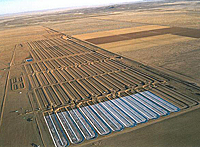
Tiny Columbus, New Mexico (population, 1,678) is hot, flat and uncrowded — an ideal place to launch a new green revolution in agriculture. That, in essence, is what a well-funded startup company called Sapphire Energy wants to do: It is turning a 300-acre expanse of desert scrub into the world’s largest algae farm designed to produce crude oil. Sapphire began making oil there in May, and its goal is to produce about 100 barrels a day, or 1.5 million gallons a year, of oil, once construction of the “green crude farm” is completed next year.

“We take algae, CO2, water and sunlight, and then we refine it,” says Cynthia Warner, the chief executive of Sapphire, who joined the company after working for more than 20 years at oil-company giants Amoco and BP. Algae, she says, has the potential to change the world, by reducing carbon dioxide emissions and enabling almost any country to make its own oil. “This technology is so compelling — and it will make such a big difference — that, once it gets out of the gate, it will ramp up very quickly,” Warner says.

Sapphire is one of scores of companies worldwide that today are making biofuels from microalgae, albeit on a small scale, according to the Algae Biomass Organization, a trade group. Solazyme, which is arguably the industry leader, last year sold an algae-derived jet fuel to United Airlines, which used it to fly a Boeing 737-800 from Houston to Chicago — the first
Scientists have been trying to unlock the energy potential of algae for decades, but they don’t yet agree on how to go about it.
time a commercial jet flew using a biofuel made using algae. Synthetic Genomics, a company founded by geneticist J. Craig Venter and financed by ExxonMobil, is building an algae farm in the Imperial Valley of southern California. Other algae farms are under development in Hawaii, by Phycal, and in Karratha, Australia, by Aurora Algae, and in Florida, by Algenol. In Europe, the Swedish energy company Vattenfall and Italy’s Enel Group have been using algae, which is then made into fuel or food, to absorb greenhouse gas emissions from power plants, and Algae-Tec, an Australia-based company, has agreed to operate an algae-based biofuel plant in Europe to supply Lufthansa with jet fuel.

Although scientists and entrepreneurs have been trying to unlock the energy potential of algae for more than three decades, they don’t yet agree on how to go about it. Some companies grow algae in ponds, others grow them in clear plastic containers, and others keep their algae away from sunlight, feeding them sugars instead. To improve the productivity of the algae, some scientists use conventional breeding and others turn to genetic engineering. “Algae is the most promising source of renewable transportation fuel that we have today,” says Steve Kay, a distinguished professor of biology at the University of California, San Diego, and co-founder of the San Diego Center for Algae Biotechnology, a partnership of research institutions, business, and government.
View gallery
Sapphire Energy

Sapphire Energy
Sapphire Energy’s 300-acre “green crude farm” in Columbus, New Mexico.
And yet there’s plenty of reason for skepticism about algae. Scientists and entrepreneurs have been trying for decades to unlock algae’s energy potential, with mixed results. After the 1970s oil shocks, the U.S. government created an algae research program that analyzed more than 3,000 strains of the tiny organisms; the program was shut down in 1996, after the Department of Energy concluded that algal biofuels would cost too much money to compete with fossil fuels. A decade later, after President George W. Bush declared that the U.S. is “addicted to oil,” government research into algae was restarted, and venture capital flowed into dozens of algae startups. Oil companies ExxonMobil and Chevron placed bets, too.

But algae companies haven’t made much oil yet: Sapphire’s annual production target of 1.5 million gallons for 2014 compares to U.S. daily oil consumption of 18.8 million barrels. Even algae’s most enthusiastic advocates say that commercialization of algal biofuels, on a scale that that would matter to the environment or the energy industry, is at least five to 10 years away.

High costs remain the big obstacle to commercial production. The algae business has suffered from “fantastic promotions, bizarre cultivation systems, and absurd productivity projections.” says John Benemann, an industry consultant and Ph.D. biochemist who has spent more than 30
Government researchers maintain that the environmental benefits of algae remain unproven.
years working on algae. Even if the capital costs and operating costs of algae farms are low, and the productivity of the algae is improved, Benemann says that “algae biofuels cannot compete with fossil energy based on simple economics… The real issue is that an oil field will deplete eventually, while an algae pond would be sustainable indefinitely.” In a thorough 2010 technology assessment, researchers at the Lawrence Berkeley National Laboratory estimated that producing oil from algae grown in ponds at scale would cost between $240 and $332 a barrel, far higher than current petroleum prices.

Perhaps more worrisome, government scientists say the environmental benefits of algae remain unproven. Writing in American Scientist, Philip T. Pienkos, Lieve Laurens and Andy Aden, all of the National Renewable Energy Laboratory, say that the few life-cycle assesements of algae done so far have shown “unpromising energy returns and weak greenhouse gas benefits.” By phone, Pienkos acknowledged that, in theory, algae should produce low-carbon fuels because the CO2 emitted when the fuels are burned is absorbed from the air when algae grow. But, he says, calculating the true sustainability benefits of algae requires doing a detailed study of inputs and outputs and “that will be difficult until big algae farms are built.”

Sapphire Energy

Sapphire Energy
Refined “green crude” oil.
So why continue to pursue the algae dream? Because algae, even skeptics say, are remarkable little creatures that could someday realize their potential as energy producers. Algae are easy to grow, as any owner of a background swimming pool knows (and as does the U.S. National Park Service, which this month began draining the Lincoln Memorial reflecting pool to remove a sea of green). Algae grow rapidly, reaching maturity in days. They absorb carbon dioxide, a greenhouse gas. They thrive in fresh, saline or brackish water. And they don’t compete with food crops for land. According to the National Renewable Energy Laboratory, algae yield more lipids, or oil, than other biomass feedstock — as much as 30 times more per unit of land when compared to terrestrial oilseed crops like palm and soy.

What’s needed now are concentrated efforts to deploy all the tools of modern agriculture to bring down the costs of growing algae, harvesting the crop, and extracting its oil. That’s the focus of all the algae startups. In New Mexico, for example, Sapphire is trying to drive extraneous costs out of its ponds (do they need plastic liners, or will dirt do?), out of the process of removing algae and returning water to the ponds, and out of the thermo-chemical process used to separate oil from the algae. “Each step requires multi-disciplinary, multi-year R&D,” Warner says.

None of this comes cheap: Sapphire has raised $300 million from investors including venture capitalists Arch Venture Partners and Venrock, British charity The Wellcome Trust, and Cascade Investment, which manages the personal fortune of Bill Gates. The U.S. Department of Energy awarded Sapphire a $50 million grant in 2009, and the company has secured a
Companies are using conventional breeding and genetic modification to develop strains of algae to grow faster, yield more oil, and repel pests.
$54.4 million loan guarantee from the U.S. Department of Agriculture.

Solazyme experimented with open-pond technology in the late 2000s before deciding to abandon the sun (though it kept the “sola” in its name). The company now grows its algae indoors, in big industrial fermenters in a factory in Peoria, Ill., and feeds them biomass such as sugarcane or corn stover. In an email interview, Solzayme’s CEO, Jonathan Wolfson, said, “The economics for producing oil via open ponds was simply not viable in a time frame that would work for our commercialization plans. While algae is a prolific oil producer, it is far from the most economic way to convert carbon dioxide and sunlight into sugars, which is the first step in making oils.”

By engineering its algae to perform whatever task is at hand, Solazyme says it has developed for the first time in history “the ability to design oil rather than simply use what’s available in nature.” The company makes not just transportation fuels, but oils for food products including cakes, cookies and ice cream; personal care products like soaps and detergents; and chemical products like lubricants and surfactants. Serving a variety of markets enabled Solazyme to attract investment from the likes of Chevron, British entrepreneur Richard Branson, and Unilever, and to generate enough revenue so the company could go public last year. (Its current market value is about $650 million.) More important, Solazyme plans to grow its production capacity faster than its rivals — it says it will produce about 142 million gallons a year of renewable oil by 2015.

By far the biggest opportunity to reduce the costs of algal fuels lies within the algae. Just as crop scientists have bred corn and wheat to improve yields, with spectacular results, the algae companies are using conventional breeding and genetic modification to develop strains of algae to grow faster, yield more oil, and repel pests.

Venter’s Synthetic Genomics is going a step further, studying natural algae in order to design, from scratch, a plant of its own. Venter was not available for an interview but he told Scientific American last year: “Everybody is looking for a naturally occurring algae that is going to be a miracle cell to save the world and, after a century of looking, people still haven’t found it. We hope we’re different.” Venter noted that genetic tools “give us a new approach: being able to rewrite the genetic code and get cells to do what we want them to do.”

MORE FROM YALE e360

For Greening Aviation,
Are Biofuels the Right Stuff?

For Greening Aviation, Are Biofuels the Right Stuff?
Biofuels — made from algae and non-food plants — are emerging as a potentially viable alternative to conventional jet fuels. Although big challenges remain, the reductions in greenhouse gas emissions could be major.
READ MORE
For now, Synthetic Genomes is growing algae in a greenhouse in La Jolla, Calif. The company recently acquired 81 acres of land in the California desert, near a power plant that is expected to be a source of cheap CO2. Like the other algae companies, Venter’s venture is well financed. ExxonMobil has promised the company $300 million over the next decade, provided that its research and development milestones are met; other backers include BP and venture capital firm Draper Fisher Jurvetson.

Venter admits that success is by no means guaranteed, and that patience will be required to see the benefits of algae. Algae plants may grow in days, but a real algae industry will need years, if not decades, to reach maturity.

Correction, October 15, 2012: An earlier version of this article incorrectly stated U.S. daily oil consumption. The correct figure is 18.8 million barrels.

POSTED ON 15 Oct 2012 IN Business & Innovation Energy Energy Science & Technology Europe North America 

COMMENTS


Yes. Biofuel from algae is a promising option for alternative energy..

There is biofuel from plants like agave which is a care-free growth plant. Mexico is pioneer in this. Also biogas from opuntia and subsequent power generation. Biogas generators are available from China. These plants can be grown on a massive scale in vacant lands in developing countries.

Another advantage:

Crassulacean acid metabolism, also known as CAM photosynthesis, is a carbon fixation pathway that evolved in some plants as an adaptation to arid conditions In a plant using full CAM, the stomata in the leaves remain shut during the day to reduce evapotranspiration, but open at night to collect carbon dioxide (CO2). The CO2 is stored as the four-carbon acidmalate, and then used during photosynthesis during the day. The pre-collected CO2 is concentrated around the enzyme RuBisCO, increasing photosynthetic efficiency. Agave and Opuntia are the best CAM Plants.

Dr. A. Jagadeesh Nellore(AP), India
E-mail: anumakonda.jagadeesh@gmail.com

Posted by Dr.A.Jagadeesh on 15 Oct 2012


I think algae are indeed the way to go, but I disagree on focusing most research on biofuel, as there are more pressing problems at the moment, such as alimentary sovereignty.

In my view, some algae can already be used for feeding both humans and animals.

Human consumption would pose some problems linked to taste and culinary traditions (just as insect consumption does, for instance, in the West). However, substituting corn with algae as an animal feed would free million of tons of cereals now used in the meat industry.

I guess Solazyme approach, focusing on different sectors, will prove a winning one, but using sugars to feed the algae poses serious doubts about its sustainability.

Posted by Olmo Forni on 16 Oct 2012


SO PROMISING!! Now, if we can grow a biofuel algae on our sewage treatment, there would been endless supply of renewable fuel!! I hope this works...one step in the right direction and every step counts!

Posted by Shannon Warwick on 15 Nov 2012


I LOVE ALGAE!

Posted by Angel Lacroix on 01 Dec 2012


Chemically, are most seawater algae "closely related" to seaweeds? In the southern parts of the UK, particularly in the Channel Islands, farmers in the 18th century used to gather their local "vraic" from beaches, and use as natural fertiliser. Small-scale experiments ongoing today. In Cornwall and East Anglia, samphire is prized by chefs and versatile cooks as a delicious, nutritious vegetable, with "larvae bread" prized in Wales.

Posted by Jack on 04 Jan 2013


"In New Mexico, for example, Sapphire is trying to drive extraneous costs out of its ponds (do they need plastic liners, or will dirt do?), out of the process of removing algae and returning water to the ponds, and out of the thermo-chemical process used to separate oil from the algae. “Each step requires multi-disciplinary, multi-year R&D,” Warner says." --Have they not heard of OriginOil's technology to separate oil and algae? It uses electromagnetic pulses to crack the cell well and release the oil. The oil then floats to the top of the solution and is harvested. It has an extremely low kwh/gal which is magnitudes more efficient than anyone else...

Posted by Janine on 08 Jan 2013


Thank you for this article. Alas, I am no scientist but I have been trying to find a way to use the
experience and contact network I have after 25 years in sea urchin and lobster and sea vegetables here in Maine. I wish there was a way to parlay that into an algae business. Any suggestion would be welcome.

Jim at urchins@tds.net

Posted by Jim Wadsworth on 25 Jan 2013


POST A COMMENT

Comments are moderated and will be reviewed before they are posted to ensure they are on topic, relevant, and not abusive. They may be edited for length and clarity. By filling out this form, you give Yale Environment 360 permission to publish this comment.

Name 
Email address 
Comment 
 

marc guntherABOUT THE AUTHOR
Marc Gunther is a contributing editor at Fortune, a senior writer at Greenbiz.com and a blogger at www.marcgunther.com. His book, Suck It Up: How Capturing Carbon From the Air Can Help Solve the Climate Crisis, is available as an Amazon Kindle Single. In previous articles for Yale Environment 360, he has reported on systems being developed to remove carbon dioxide from the atmosphere and on how technology can help consumers make greener choices.
MORE BY THIS AUTHOR


RELATED ARTICLES


Harnessing Citizen Power to
Fund a U.S. Solar Revolution

Environmental activist Billy Parish believes the best way to fight climate change is to fund the renewable energy projects that will supplant fossil fuels. In an interview with Yale Environment 360, he discusses how “crowdfunding” can help lead to the widespread adoption of solar power.
READ MORE

Copenhagen’s Ambitious Push
To Be Carbon Neutral by 2025

The Danish capital is moving rapidly toward a zero-carbon future, as it erects wind farms, transforms its citywide heating systems, promotes energy efficiency, and lures more people out of their cars and onto public transportation and bikes.
READ MORE

To Tackle Runoff, Cities
Turn to Green Initiatives

Urban stormwater runoff is a serious problem, overloading sewage treatment plants and polluting waterways. Now, various U.S. cities are creating innovative green infrastructure — such as rain gardens and roadside plantings — that mimics the way nature collects and cleanses water.
READ MORE

High-Altitude Wind Energy:
Huge Potential — And Hurdles

A host of start-up companies are exploring ways to harness the enormous amount of wind energy flowing around the earth, especially at high altitudes. But as these innovators are discovering, the engineering and regulatory challenges of what is known as airborne wind power are daunting.
READ MORE

For Electric Car Batteries,
The Race for a Rapid Charge

The amount of time it takes to recharge lithium-ion batteries has been a major impediment to consumer acceptance of electric vehicles. But a host of companies and researchers are working intensively to develop a battery that can recharge in 10 minutes and power a car for hundreds of miles.
READ MORE


MORE IN Reports


A Plague of Deforestation
Sweeps Across Southeast Asia

by daniel drollette
Illegal logging and unchecked economic development are taking a devastating toll on the forests of Vietnam and neighboring countries, threatening areas of biodiversity so rich that 1,700 species have been discovered in the last 15 years alone.
READ MORE

In Post-Tsunami Japan, A Push
To Rebuild Coast in Concrete

by winifred bird
In the wake of the 2011 tsunami, the Japanese government is forgoing an opportunity to sustainably protect its coastline and is instead building towering concrete seawalls and other defenses that environmentalists say will inflict serious damage on coastal ecosystems.
READ MORE

How Mussel Farming Could
Help to Clean Fouled Waters

by paul greenberg
Along the shores of New York Harbor, scientists are investigating whether this ubiquitous bivalve can be grown in urban areas as a way of cleansing coastal waters of sewage, fertilizers, and other pollutants.
READ MORE

A Key Experiment to Probe the
Future of Our Acidifying Oceans

by peter friederici
In a Swedish fjord, European researchers are conducting an ambitious experiment aimed at better understanding how ocean acidification will affect marine life. Ultimately, these scientists hope to determine which species might win and which might lose in a more acidic ocean.
READ MORE

Declining Bee Populations Pose
A Threat to Global Agriculture

by elizabeth grossman
The danger that the decline of bees and other pollinators represents to the world’s food supply was highlighted this week when the European Commission decided to ban a class of pesticides suspected of playing a role in so-called “colony collapse disorder.”
READ MORE

Fires Burn More Fiercely
As Northern Forests Warm

by dylan walsh
From North America to Siberia, rising temperatures and drier woodlands are leading to a longer burning season and a significant increase in forest fires. Scientists warn that this trend is expected continue in the years ahead.
READ MORE

Will Electric Bicycles Get
Americans to Start Pedaling?

by marc gunther
Electric bicycles are already popular in Europe and in China, which has more e-bikes than cars on its roads. Now, manufacturers are marketing e-bikes in the U.S., promoting them as a "green" alternative to driving.
READ MORE

Copenhagen’s Ambitious Push
To Be Carbon Neutral by 2025

by justin gerdes
The Danish capital is moving rapidly toward a zero-carbon future, as it erects wind farms, transforms its citywide heating systems, promotes energy efficiency, and lures more people out of their cars and onto public transportation and bikes.
READ MORE

How Ontario Is Putting an End
To Coal-Burning Power Plants

by keith schneider
Ontario is on the verge of becoming the first industrial region in North America to eliminate all coal-fired electrical generation. Here’s how Canada’s most populous province did it — and what the U.S. and others can learn from it.
READ MORE

Long Outlawed in the West,
Lead Paint Sold in Poor Nations

by rebecca kessler
A new study finds that household lead paint — banned for years in the U.S. and Europe because of its health effects on children — is commonly sold in the African nation of Cameroon. Is lead paint the latest case of Western companies selling unsafe products in developing countries?
READ MORE


e360 digest
Yale
Yale Environment 360 is
a publication of the
Yale School of Forestry
& Environmental Studies
.

SEARCH e360


Donate to Yale Environment 360

CONNECT

Twitter: YaleE360
e360 on Facebook
Donate to e360
View mobile site
Bookmark
Share e360
Email newsletter
Subscribe to our feed:
rss


ABOUT

About e360
Contact
Submission Guidelines
Reprints

e360 PHOTO GALLERY

To Catch a Rhino Welz
South African photojournalist Adam Welz documents the harrowing relocation of six white rhinos to a region that has lost all its rhinos to poaching. View the gallery.


DEPARTMENTS

Opinion
Reports
Analysis
Interviews
e360 Digest
Podcasts
Video Reports

TOPICS

Biodiversity
Business & Innovation
Climate
Energy
Forests
Oceans
Policy & Politics
Pollution & Health
Science & Technology
Sustainability
Urbanization
Water

REGIONS

Antarctica and the Arctic
Africa
Asia
Australia
Central & South America
Europe
Middle East
North America

e360 VIDEO

Into Heart of Ecuador Yasuni
A Yale Environment 360 video explores Ecuador’s threatened Yasuni Biosphere Reserve with scientists inventorying its stunning forests and wildlife. Watch the video.

e360 MOBILE

Mobile
The latest
from Yale
Environment 360
is now available for mobile devices at e360.yale.edu/mobile.

e360 VIDEO

Colorado River Video
In a Yale Environment 360 video, photographer Pete McBride documents how increasing water demands have transformed the Colorado River, the lifeblood of the arid Southwest. Watch the video.


header image
Top Image: aerial view of Iceland. © Google & TerraMetrics.

e360 VIDEO

Warriors of Qiugang
The Warriors of Qiugang, a Yale Environment 360 video that chronicles the story of a Chinese village’s fight against a polluting chemical plant, was nominated for a 2011 Academy Award for Best Documentary (Short Subject). Watch the video.


OF INTEREST


Yale