07 Oct 2010: Opinion

How One Small Business
Cut Its Energy Use and Costs

How significant would it be if America’s 29 million small businesses increased their energy efficiency and reduced their emissions? Judging from the example of one California entrepreneur, the impact could be far greater than you might expect.

by tom bowman

Would enlisting millions of small companies in a national response to climate change be worth the effort? Their prominence in political rhetoric suggests that it might. Small business owners are attractive political icons — entrepreneurs personify American ideals of free enterprise, innovation and self-reliance. But their individual contributions to greenhouse gas emissions are small, and in practice, getting millions of entrepreneurs to agree about anything is like herding cats; we are a diverse, independent, and competitive group. This leaves the value of a small business response to climate change unclear.

Actual evidence is scarce. New technologies and LEED-certified buildings dominate the news, but the majority of small companies are neither clean-tech start-ups, nor likely to build new facilities. Experiments with my own company, which fits this common profile, suggest that we can reduce greenhouse-gas emissions rapidly and cost-effectively, and that some of the barriers to action are misunderstood.

I own a design firm, and my work on climate change exhibitions for the Marian Koshland Science Museum of the National Academy of Sciences
Green business plans that set impossible targets force people to look at problems in new ways.
and the Birch Aquarium at Scripps Institution of Oceanography earned me the nickname “the closet climatologist” and provided an education about the potential consequences of unchecked global warming. These experiences engendered a sense of urgency about finding practical ways to mitigate greenhouse gas emissions. Like many Americans, I felt compelled to act and, because I am a business owner, I had the opportunity to try.

My company’s frustrating search for effective, affordable opportunities eventually led to a surprising discovery: Cost-saving opportunities to reduce carbon emissions are ever-present in the normal course of business operations.

My test bed is a small creative services company located in Southern California. Our 10 employees occupy a two-story, 2,000-square-foot, commercially-zoned residence that was built in the 1930s and upgraded during the mid-90s. Our facility has fairly good natural light and ventilation, but suffers from enormous heat gain. Owning this facility provided the flexibility to consider making long-term investments in the property, but we have not actually implemented them yet. Our experiment indicates that smaller, less-expensive steps can be extremely effective.

I began with an observation from Daniel Esty and Andrew Winston’s Green to Gold that successful sustainability programs are usually built upon extraordinarily ambitious goals. Green business plans that set impossible targets force people to look at problems in new ways. I found a suitably improbable goal in California’s landmark Global Warming Solutions Act (AB 32). AB 32 requires California to reduce emissions to 1990 levels by 2020, and to 80 percent below 1990 levels by 2050. Since our company does not employ long-lived capital equipment, I reasoned that we should try to accelerate this timeline.

We joined the California Climate Action Registry in early 2008 to take advantage of its low-cost emissions verification program, and we
One employee asked if I was crazy, but our conversations helped establish a green-conscious culture.
submitted our 2006 data to establish an emissions baseline. We set aggressive emissions targets: a reduction of 10 percent by 2010, 20 percent by 2013, and 80 percent by 2020, with similar goals for water use and landfill waste. One employee asked whether I was crazy, but our frequent conversations helped establish a green-conscious culture within a few months.

I traded the company’s small SUV for a Prius because it offered the highest mileage available at the time, and because the merits of biodiesel were in dispute. Next, we took our electric utility company’s advice and called them for an energy audit. In a pattern that is typical for service businesses, our air conditioning, computers, and other office equipment dominate our energy usage. The utility re-lamped our building — a $300 savings. We signed up for a program that lets the utility cycle our air conditioning during peak demand events, and we eliminated “vampire power” by turning power strips off at night. Unfortunately, the utility could not offer incentive programs for solar PV, cool roofs, weatherization, or low-E windows to businesses of our size, so we were left to rely on our own research and financial resources.

In setting a budget, an energy consultant told me that many companies invest three times their annual utility costs in efficiency upgrades. While this number is fairly arbitrary, it suggested that we might spend about $10,000 on carbon abatement. As a point of reference, a solar PV array, plus a carport structure we would need to build in order to aim solar panels southward, would have cost nine times that amount.

Unfortunately, government incentives on solar power were small in 2008, and our type of corporate structure disqualified us anyway. These barriers have since been lowered, but our experience suggests that we can benefit
By the end of 2008, we had reduced emissions by 65 percent and cut electricity costs by 40 percent.
from improving energy efficiency, as a first step toward going solar. In fact, an architect recommended that we improve the passive efficiency of our building so that we might eventually invest in smaller, less expensive air conditioning and solar energy systems based on reduced demand. He recommended a highly reflective metal roof with additional insulation, which would have cost a prohibitive $40,000. Finding heat-gain data for less expensive roofing options proved to be impossible, so we were back to square one.

Then events took us by surprise: The lease on our copier expired, and we chose an energy-efficient, multi-function machine that allowed us to decommission two other laser printers, a laser fax, and a scanner. The print quality is so good that we reduced our large-format plotting by 75 percent.

Over the summer, our air conditioner broke down. We replaced it with the most energy efficient model we could afford, and took the opportunity to improve airflow through some of our ductwork. The total cost was $7,000.

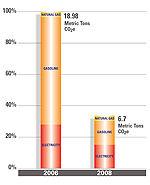
The results of these simple steps have been extraordinary. By the end of 2008, we had reduced greenhouse-gas emissions by 65 percent, gasoline use by 63 percent, landfill waste by 45 percent, and water use by 18 percent. We cut costs for electricity by 40 percent, gasoline by 59 percent, and water by 20 percent. But the net savings are even more impressive: When vehicle and equipment maintenance, paper and toner, and other related costs and savings are considered, the company saves about $9,000 annually, which we can apply to further energy-efficiency upgrades.

In addition, we are experimenting with telecommuting, and we rescheduled supplier visits to coincide with commuting. We continue to learn lessons about maintaining teamwork in this process, and we have reduced employee driving by 43 percent, and reimbursed mileage costs by 29 percent.

The implications could not be clearer: There is a strong business case for slashing carbon emissions through simple, low-cost energy efficiency improvements. Energy efficiency upgrades look expensive when the payback comes entirely from energy cost savings, but we found additional savings on maintenance, supplies, and more. This finding is important because it belies the myth that reducing emissions necessarily requires investing in systems with high up-front costs and very slow payback. We are now approaching the threshold where solar PV will make sense for us, but we cut our emissions by nearly two-thirds before reaching that threshold.

Neither building ownership nor financing for expensive upgrades was a prerequisite for success in our case. But the scarcity of information about which actions work was an almost prohibitive barrier. Small business owners cannot afford to hire energy consultants, and it is unrealistic to think that many business owners will duplicate our research efforts. Even with all of our success, my company is not sure which efficiency upgrades to pursue next.

We will continue to reduce electricity demand by replacing older computer equipment that is obsolete anyway. Thereafter, we must turn to our building itself, and we will probably need help to be successful with that. Like every other small company, we would benefit from information that helps us prioritize options. Which of the following investments is likely to provide the best balance of up-front costs, fast payback, and emissions reductions: cooler roofing, window and wall shading, better natural ventilation, water-conserving landscaping, flash water heating, or solar water or PV? We simply do not know, and finding answers is beyond challenging.

Regulators have told me that they are confounded by the sheer diversity of small businesses and their circumstances, which may be why current information resources merely report anecdotal achievements. But our experiment suggests that they could do better with further analysis. Developing information that is genuinely useful to small business owners should be a top priority for government agencies.

MORE FROM YALE e360

Energy Sleuths in Pursuit
Of the Truly Green Building

Energy Sleuths in Pursuit of the Truly Green Building
The practice of “commissioning,” in which an engineer monitors the efficiency of a building from its design through its initial operation, just may be the most effective strategy for reducing long-term energy usage, costs, and greenhouse gas emissions from buildings, Richard Conniff writes. So why is it so seldom used?
READ MORE
Reducing energy demand and carbon emissions is everyone’s business, and we have shown that it is good business, too. Our 12.3 metric tons reduction in emissions is not significant compared to total U.S. emissions of nearly 7 billion metric tons, but this comparison misses the point. In the end, these reductions were absurdly easy to achieve, and they pay dividends. Duplicating them across the nation’s 29.6 million small businesses would yield significant gains.

More importantly, people create new behavioral norms when they tackle problems together. Small businesses employ half of the private-sector workforce, so engaging the nation’s small businesses can create a new culture of energy efficiency quickly, if the proverbial cats can be harnessed in this challenge.

The contributions that small businesses can make to America’s energy and climate future are being squandered through inattention. The time has come to energize the workforce that we employ and get it working on the problem. Moving quickly to save money is what small businesses do best. With better information and encouragement, small businesses can become humanity’s first responders in the climate crisis.

POSTED ON 07 Oct 2010 IN Business & Innovation Energy Forests Policy & Politics Urbanization North America North America 

COMMENTS


Thank you for putting this post together, Tom. Your story is an inspiration to small businesses across America and your call for actively engaging the small business community in energy efficiency and carbon reduction initiatives is dead on.

I work for The Council of Smaller Enterprises (COSE) in Cleveland; we are a small business support organization with more than 16,000 members. I am focused on energy and sustainability issues for our members, and you point out exactly the challenges that we face on a daily basis in trying to promote these issues. The diversity of our membership makes focusing on any one issue extremely difficult. Encouraging members to undergo a comprehensive lighting retrofit may be applicable for one business, but not necessarily for another. Furthermore, many small businesses are held back by their concern that the barriers to energy efficiency (knowledge, cost, time, research, etc.) will be too great to bear much fruit through the effort. However, as your case study points out, small steps, conservation measures, and responding to circumstances in a proactive way can reap considerable dividends.

This type of widespread engagement to grab the low-hanging fruit on energy efficiency is exactly what we are trying to encourage here. We are releasing an Energy Efficiency Resource Guide later this month that we hope will be a piece that small business owners throughout the country can use to find easy steps to cut use and costs. We are also holding an Energy Efficiency Challenge to highlight and reward our members who have taken on this effort.

Ultimately, as you point out, small businesses make up the bulk of the workforce in this country. There are more than 29 million of them, and they account for more than 99% of employer firms. Until we all get on the same page and realize that we need to bring them into the fray and actively tackle their hurdles to energy efficiency, we cannot expect to engrain sustainability into the mindset of business culture, nor is it likely we can reach emission reduction goals.

Cutting emissions 17% by 2020 and 80% by 2050 may seem like a daunting task, but it's one the science says we need to meet. And it's something we can't hope to achieve without small businesses taking part.

- Tim Kovach
Product Coordinator, Energy at COSE
www.cose.org/blog
www.twitter.com/COSEenergy

Posted by Tim Kovach on 07 Oct 2010


The California Jobs Initiative (CJI) is an oil corporation farce and fraud. There is no connection, whatsoever, between greenhouse gas emission reduction and the jobs. This notion is an to the intelligence people of California. In fact, there is job growth in the clean, renewable enegy industry. Chevron employs 65,000 worldwide and CJI is not going to change this. The only jobs created by the oil industry are clean-up jobs after oil spills and deep water, blow-outs and pump-handler jobs. CJI will make fantastic profits for the oil industry, increase air pollution, especially in communities around their refineries and there will not be lower gas prices. Koch Industries, Valero and Tesoro are super Enrons. Since when did the oil companies start to show any concern for the unemployed and their families and for small businesses?

Posted by Earl Richards on 07 Oct 2010


I am a member of a local nonprofit that is focusing on addressing the impacts of climate change and preparing for a future with less abundant fossil fuels. Energy efficiency is one the main presentations that we give around the community.

We have found that each person, residence, business, etc. has to go a journey similar to what you've described. We've also found that the answer is different for each person.

I noted that you mentioned you have high air conditioning usage. Have you looked into putting up solar screens on your windows? They can block 90% of the sunlight before it gets to your windows. It drastically cuts down on the AC usage.

We have also developed a worksheet that quantifies how much money can be saved by taking various energy/water conservation measures (primarily aimed at residences). If you are interested, I am happy to share the work sheet and audit checklist with you.

Thanks for a great article.

Posted by Eric Shen on 08 Oct 2010


Inspiring article. The way I'm thinking now, there could be no more importanty initiative. I base my thinking on the following:

"Green business plans that set impossible targets force people to look at problems in new ways."

So here's my impossible initiative: As with Kennedy's call to put a man on the moon in 10 years, issue a call for America to become the nation with the smallest carbon footprint by the year 2020.

Posted by Trevor Burrowes on 09 Oct 2010


Nice article. There's a lot more information and successful strategies for the built environment available via real estate industry groups, like IREM and BOMA. Contact a professional in your area. Cheers!!

Posted by Paul Dimeo on 15 Oct 2010


Mr. Bowman, this is a great article. Besides being well-written -- I teach university writing and am a writer myself -- you provide many specific details that any reader can take away to help readers think about what might work for them. Sure, you're business has many factors that set it apart from another small business, but with the details you provide, a reader has some sort of sample framework as a rough guide.

Further, this article is inspiring. I don't own a small business nor work in one (I'm retired), but if I did and if I hadn't thought about these matters, I would feel inspired to sit down and put on my thinking cap. Maybe some other business owners out there who read your piece will decide to analyze their own situations -- and to act. Your mention of your company's downright extraordinary savings surely will cause readers to sit up and take notice.

I live alone in a smallish apartment measuring about 530 square feet, in central Bangkok. While the climate is tropical, it doesn't get *that* hot, even during the hot season (typically February through May), rarely going over 100 degrees. About a year ago, one of my two air-conditioners ran out of gas and the other one's motor went out almost simultaneously. I had already taken a few small steps to reduce my energy and water consumption, and decided to see how I might fare depending on just my two ceiling fans and two floor fans (and natural breezes). I've never looked back, especially in light of the fact that my electricity bill has dropped by about 2/3rd's, as my water bill had already done. I also am conscientious about turning off lights, etc. when I don't need them.

While what you, if anything, you've done at home is beyond the scope of this article, Mr. Bowman, I was left supposing that you likely took a look at options there as well. Imagine the impact if most of your fellow business owners not only took steps to reduce their energy and water consumption in their businesses but in their homes as well.

One of your experiences that really surprised me was having difficulty in finding information. Maybe that will improve as more people take an active interest in discovering such information.

Thanks for a very good article.

Posted by Mekhong Kurt on 02 Nov 2010


An well written article that illuminates how pragmatism and basic steps often offer the best solutions, while grandiose rhetoric and fanaticism can detract from large benefits achieved simply.

Most impressive is how you achieved your business goals without excessive capital investment unrelated to your business.

Over the years, without excessive regulatory oversight or penalties, the U.S. has continued to achieve improved efficiencies in energy use of 2% or more per year. This has been achieved, for the most part, by free market drivers such as customer demand and cost reductions.

Posted by Henry Buttal on 08 Nov 2010


Comments have been closed on this feature.
tom bowmanABOUT THE AUTHOR
Tom Bowman is founder and president of Bowman Design Group, a California-based company that creates exhibitions for corporations, museums, and event organizers. In 2009, the company received a Small Business of the Year award from the California Air Resources Board. He also established Bowman Global Change, which helps organizations develop sustainable strategies.


RELATED ARTICLES


Copenhagen’s Ambitious Push
To Be Carbon Neutral by 2025

The Danish capital is moving rapidly toward a zero-carbon future, as it erects wind farms, transforms its citywide heating systems, promotes energy efficiency, and lures more people out of their cars and onto public transportation and bikes.
READ MORE

To Tackle Runoff, Cities
Turn to Green Initiatives

Urban stormwater runoff is a serious problem, overloading sewage treatment plants and polluting waterways. Now, various U.S. cities are creating innovative green infrastructure — such as rain gardens and roadside plantings — that mimics the way nature collects and cleanses water.
READ MORE

Designing the Urban Landscape
To Meet 21st Century Challenges

Martha Schwartz, a professor at Harvard’s Graduate School of Design, explains in a Yale Environment 360 interview how creative landscape architecture can help cities become models of sustainability in a world facing daunting environmental challenges.
READ MORE

Green Crude: The Quest to
Unlock Algae’s Energy Potential

A host of startup companies are pursuing new technologies that they claim will soon lead to large-scale commercialization of biofuels made from algae. But questions remain about the viability and environmental benefits of what some of its developers are calling “green crude.”
READ MORE

High-Altitude Wind Energy:
Huge Potential — And Hurdles

A host of start-up companies are exploring ways to harness the enormous amount of wind energy flowing around the earth, especially at high altitudes. But as these innovators are discovering, the engineering and regulatory challenges of what is known as airborne wind power are daunting.
READ MORE


MORE IN Opinion


As Final U.S. Decision Nears,
A Lively Debate on GM Salmon

In an online debate for Yale Environment 360, Elliot Entis, whose company has created a genetically modified salmon that may soon be for sale in the U.S., discusses the environmental and health impacts of this controversial technology with author Paul Greenberg, a critic of GM fish.
READ MORE

Should Polluting Nations Be
Liable for Climate Damages?

by fred pearce
An international agreement to study how to redress developing nations for damages from climate change illustrates how ineffective climate diplomacy has been over the last two decades. But this move may pave the way for future court suits against polluting countries and companies.
READ MORE

Hurricane Sandy Relief Bill
Fails to Face Coastal Realities

by rob young
As part of the sorely-needed aid package to help victims of Hurricane Sandy, Congress is also considering spending billions on ill-advised and environmentally damaging beach and coastal rebuilding projects that ignore the looming threats of rising seas and intensifying storms.
READ MORE

In U.S., the Lure of Export May
Further Fuel Natural Gas Boom

by shaun goho
As the United States experiences a glut of natural gas, a host of facilities are being proposed that would convert gas to a liquid and export it. But before embracing a gas export boom, the nation should carefully weigh the implications for both the economy and the environment.
READ MORE

Will President Obama Seize
Moment on Climate Change?

by william becker
Climate change received scant attention in the election campaign. But with public concern about global warming growing in the wake of Hurricane Sandy, President Obama has an unprecedented opportunity to take bold action on climate and clean energy.
READ MORE

Forget the Kyoto Accord
And Tax Carbon Consumption

by dieter helm
Given the failure of international climate negotiations, a tax on carbon consumption is the most effective way of lowering CO2 emissions. If nations are serious about addressing climate change, then they must pay for the carbon pollution caused by what they consume.
READ MORE

Why Are Environmentalists
Taking Anti-Science Positions?

by fred pearce
On issues ranging from genetically modified crops to nuclear power, environmentalists are increasingly refusing to listen to scientific arguments that challenge standard green positions. This approach risks weakening the environmental movement and empowering climate contrarians.
READ MORE

A Summer of Extremes
Signifies the New Normal

by bill mckibben
This summer has seen record heat waves and wildfires in the U.S, the worst flooding in Beijing’s modern history, and droughts that devastated the U.S. corn crop and led India to set up “refugee camps” for livestock. These extreme events were not freak occurrences — this is how the earth works now.
READ MORE

Natural Gas and Its Role
In the U.S. Energy Endgame

by kevin doran and adam reed
The boom in natural gas production has undeniable benefits for the United States. But two policy analysts argue that embracing a monolithic energy future dominated by gas will mean the loss of a golden opportunity: Leveraging cheap, abundant gas to create a sustainable future based on renewable power.
READ MORE

Fifty Years After Silent Spring,
Attacks on Science Continue

by frank graham jr.
When Silent Spring was published in 1962, author Rachel Carson was subjected to vicious personal assaults that had nothing do with the science or the merits of pesticide use. Those attacks find a troubling parallel today in the campaigns against climate scientists who point to evidence of a rapidly warming world.
READ MORE


e360 digest
Yale
Yale Environment 360 is
a publication of the
Yale School of Forestry
& Environmental Studies
.

SEARCH e360


Donate to Yale Environment 360

CONNECT

Twitter: YaleE360
e360 on Facebook
Donate to e360
View mobile site
Bookmark
Share e360
Email newsletter
Subscribe to our feed:
rss


ABOUT

About e360
Contact
Submission Guidelines
Reprints

e360 PHOTO GALLERY

To Catch a Rhino Welz
South African photojournalist Adam Welz documents the harrowing relocation of six white rhinos to a region that has lost all its rhinos to poaching. View the gallery.


DEPARTMENTS

Opinion
Reports
Analysis
Interviews
e360 Digest
Podcasts
Video Reports

TOPICS

Biodiversity
Business & Innovation
Climate
Energy
Forests
Oceans
Policy & Politics
Pollution & Health
Science & Technology
Sustainability
Urbanization
Water

REGIONS

Antarctica and the Arctic
Africa
Asia
Australia
Central & South America
Europe
Middle East
North America

e360 VIDEO

Into Heart of Ecuador Yasuni
A Yale Environment 360 video explores Ecuador’s threatened Yasuni Biosphere Reserve with scientists inventorying its stunning forests and wildlife. Watch the video.

e360 MOBILE

Mobile
The latest
from Yale
Environment 360
is now available for mobile devices at e360.yale.edu/mobile.

e360 VIDEO

Colorado River Video
In a Yale Environment 360 video, photographer Pete McBride documents how increasing water demands have transformed the Colorado River, the lifeblood of the arid Southwest. Watch the video.


header image
Top Image: aerial view of Iceland. © Google & TerraMetrics.

e360 VIDEO

Warriors of Qiugang
The Warriors of Qiugang, a Yale Environment 360 video that chronicles the story of a Chinese village’s fight against a polluting chemical plant, was nominated for a 2011 Academy Award for Best Documentary (Short Subject). Watch the video.


OF INTEREST


Yale