24 Mar 2011: Report

In Aeolus Cave, A Search for the
Vanishing Bats of the Northeast

When wildlife biologists ventured into a Vermont cave this month, they found disturbing evidence that white-nose syndrome was continuing to take its toll on once-abundant bat populations. But the question remains: What can be done to halt the spread of this still-mysterious ailment?

by elizabeth kolbert

Aeolus Cave runs into the side of a mountain in Dorset, Vermont, like a tunnel. At its mouth, there’s a large chamber with a vaulted ceiling, which has been nicknamed Guano Hall. Further along, the cave narrows into a network of passageways so tight that no one knows how far they extend. In the 1960s, a team of biologists estimated that a quarter of a million bats gathered each winter in the passageways of Aeolus to hibernate. Many doubted this estimate, but later studies confirmed it.

View photos
White Nose Syndrome Bats

Photo courtesy of The Nature Conservancy
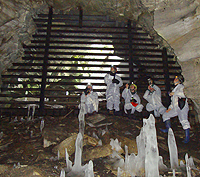
Researchers inside Aeolus Cave in March, 2010.
One day earlier this month, Scott Darling, of the Vermont Fish and Wildlife Department, Susi von Oettingen of the U.S. Fish and Wildlife Service, and David McDevitt of the Nature Conservancy, snowshoed up to Aeolus Cave to count up how many bats remain there. It was a bright blue day and a recent storm had coated the trees with a thick layer of ice. Near the entrance to the cave, the group stopped to have lunch; it was observed that after the count, no one would really feel like eating. Darling handed out helmets and Tyvek suits, which he’d been carrying in his backpack.

As is the case with most hibernacula in New England, the bat population at Aeolus has been hard-hit by white-nose syndrome, the still somewhat mysterious ailment first detected in upstate New York in the winter of 2007. In the winter of 2008, Darling arrived at Aeolus and found the cave littered with dead bats. The following winter, there were so many dead bats on the floor of the cave that they formed a sort of a carpet. By last winter, the dead bats had decomposed, and the ground was covered in tiny bat bones.

In a normal year, there used to be between 1,000 and 3,000 bats hanging from the ceiling in Guano Hall. Last winter, the count in the hall was down to 112. Assuming that the hall is representative of the cave as a whole, this means the bat population at Aeolus had plummeted by at least 88 percent.

Here’s what is now known about white-nose syndrome: the powdery white substance that gives the syndrome its name is fungus from the genus Geomyces. (For its destructive power, it’s been named Geomyces destructans.) Geomyces destructans grows only in cold conditions — when
Some evidence suggests the fungus was brought to the U.S. from Europe, perhaps from an unwary spelunker.
bats hibernate, their body temperature drops to the level of their surroundings — and it sends out hyphae, or filaments, that enter the bats’ skin through their glands and hair follicles. It’s able to break down bat tissue – a recent paper described it as “digesting, eroding and invading the skin of hibernating bats” — which, as Darling observed, “is a very unusual behavior, if you can use that term, for a fungus.” White-nose syndrome can be spread from bat to bat, and experiments performed in Vermont have shown that bats can also contract it from the environment.

Still, it’s not clear exactly how white-nose kills bats, or if in fact it does. One hypothesis is that the fungus kills them directly. Another is that it irritates the bats, which causes them to wake from their torpor and use up the fat reserves they need to survive the winter. A third is that white-nose is an opportunistic infection that reflects some deeper, immunological problem. It’s not clear how Geomyces destructans was introduced into caves in the Northeast, though some evidence suggests that it was brought in from Europe, perhaps by an unwary spelunker.

Once everyone had suited up, the group made its way to the mouth of the cave. Even before white-nose hit, the Nature Conservancy, which owns Aeolus Cave, had installed a gate across the entrance to protect the bats from disturbance. McDevitt fished out a key and, after several tries, managed to remove one of the slats from the gate; this created an opening just big enough for a person to crawl through.

Inside Guano Hall, icicles hung down from the ceiling, and knobs of ice rose up from the ground, like columns. The floor was still covered in tiny bat bones, but the ceiling, which just a few winters ago was covered with
The floor of the cave was still covered in tiny bat bones, but the ceiling was nearly empty.
clusters of hibernating bats, was nearly empty. Darling gestured toward a hollow in the cave wall. “That area used to be covered in bats,” he said. “This is damn near dead.” The group searched for an hour, and managed to locate just 35 live bats — 33 little brown bats (Myotis lucifugus) and 2 northern long-eareds (Myotis septentrionalis). One of the bats was awake and grooming itself, probably a sign, von Oettingen observed, that it was suffering from white-nose.

“I guess the question is: What’s going to be the bottom here?” she said. “We do have sites with none.”

Darling said that in hibernacula that have been monitored in Vermont, populations are down between 85 and 100 percent compared with just five years ago. Other states — white-nose has now been detected in 13 states, from New Hampshire to Tennessee — have reported similar mortality rates. It’s been estimated that since the syndrome was first observed, at least a million bats have died, which, as one recent publication put it, “far exceeds the rate and magnitude of any previously known natural or anthropogenic mortality events in bats, and possibly in any mammalian group.”

View photos
White Nose Syndrome Bats

USFWS/Wikimedia
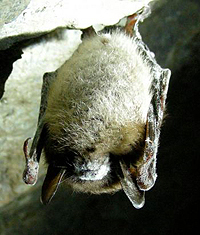
The powdery white substance that gives white-nose syndrome its name is fungus from the genus Geomyces.
On the way back down the mountain, Darling discussed efforts to find a cure for white-nose. In the lab, Geomyces destructans can be killed by a variety of anti-fungal agents, including athlete’s foot medications. But when wildlife biologists in New York tried to treat hibernating bats with an anti-fungal agent, all of the treated bats died — though whether from white-nose or from being handled is not clear.

Vermont is now in the process of adding little brown bats and northern long-eared bats to the state’s list of endangered species. The proposed listing of the little brown is particularly shocking, as the bat was, at least until recently, the most common in New England — so much so that no one paid much attention to it.

“Five years ago, if you had asked me, ‘Well, can you imagine anything that would make your little brown bat go to one of your rarest species,’ I probably would have laughed and said, ‘No that’s not even possible,’” Darling said. “Even if it’s an invasive fungus, to think that it could have a regional impact that fast would be really surprising.”

“The difficult thing is, well what do you do about it?” he continued. “And I wish I had answers for that.”

POSTED ON 24 Mar 2011 IN Biodiversity Climate Policy & Politics Science & Technology North America 

COMMENTS


A well written and dramatic article! This is truly a major environmental disaster!

We too are working to save bats at my Lab and continue to be thoroughly astonished at the rapid demise of individuals within a cave or region.

Posted by Dr. Andrew N. Barrass on 25 Mar 2011


Thank you for the article. However, I find it in very poor form to place in the insert that "spelunkers perhaps were the cause ..." when the St. Lawrence Seaway is just a few miles north of ground zero. and there are several documented occurances of bats crossing the Atlantic on ships. Include that in your next article. U.S. Fish and Wildlife have a theory, blame people. Ask them to provide you the study showing this.

Thanks again for the article.

Posted by Ray Keeler on 25 Mar 2011


Here a video piece I did on Aeolus Cave several years ago when white-nose first hit. If you want to see what the cave floor looked like when bats were dying inn hug numbers have a look:

http://www.youtube.com/watch?v=a0JoPbSBnqo&feature=player_embedded

Posted by Gerrit on 27 Mar 2011


I also dislike your comment, as did Ray Keeler, that "It’s not clear how Geomyces destructans was introduced into caves in the Northeast, though some evidence suggests that it was brought in from Europe, perhaps by an unwary spelunker."

The first recorded occurrence of white nose syndrome, in 2006, was in the downstream section beyond the commercial show cave Howe Caverns, in Schoharie County, New York. Well over 100,000 persons visit Howe Caverns annually, as opposed to a much smaller number of "spelunkers" visiting northeastern caves. It is much more likely to have been introduced by a visitor to Howe Caverns who had been in Europe.

Posted by Chuck Porter on 29 Mar 2011


Would it be possible, or even feasible, to treat infected bats with a vaporisor of known medications that work instead of handling them directly?

Posted by Robert Savannah on 29 Mar 2011


Well it is a torpor issue that causes the bats to die off during the winter torpor. They do not have a sufficent supply of energy, for them to go back into torpor, after getting awoke by the fungus. They have a limited supply of energy for the torpor season, and would not be able to feed since it is winter...no insects available. The major cost for torpor is when you begin to come out, so if a bat is disturbed when in torpor and it awakes, a huge energy cost is incurred. If this happens 2 or 3 times during torpor season, then the bat eventually runs out of energy, and cannot go back into torpor.

Posted by C. J. on 30 Mar 2011


It may be a problem with torpor, but it's more likely that the fungi attacking their systems mess up the electrolyte balance. In the rainforest, the same things happen to tree frogs and they die of heart attacks. Probiotics solve the problem, but how do we treat them in the field?

http://news.nationalgeographic.com/news/2008/04/080401-frog-fungus.html

Posted by Beth Martell on 05 Apr 2011


Comments have been closed on this feature.
elizabeth kolbert ABOUT THE AUTHOR
Elizabeth Kolbert has been a staff writer for the New Yorker since 1999. Her 2005 New Yorker series on global warming, “The Climate of Man,” won a National Magazine Award and was extended into a book, Field Notes from a Catastrophe, which was published in 2006. She is a regular contributor to Yale Environment 360. In previous articles for e360, she has reported on a study that found the pace of global warming is outstripping projections and about the scientific debate over whether to designate a new geological epoch to reflect the changes caused by human activity.
MORE BY THIS AUTHOR


RELATED ARTICLES


An Economic Boom in Turkey
Takes a Toll on Marine Life

The development-at-any-cost policies of Turkish Prime Minister Recip Tayyip Erdogan — a key factor behind the protests and clashes in Istanbul’s Taksim Square — are also playing a role in the steady decline of the nation’s porpoises, dolphins, and other marine life.
READ MORE

Research on Microbes Points
To New Tools for Conservation

Improvements in DNA technology now make it possible for biologists to identify every living organism in and around a species. Scientists say this could have profound implications for everything from protecting amphibians from a deadly fungus to reintroducing species into the wild.
READ MORE

Will Lead Bullets Finally
Kill Off the California Condor?

The California condor, the largest bird in North America, was saved from extinction by a captive breeding program that increased its numbers in the wild. But now the condor is facing a new and pernicious threat — the lead from bullets used by game hunters.
READ MORE

Into the Heart of Ecuador’s Yasuni
Few places on earth harbor as much biodiversity as Ecuador’s Yasuni Biosphere Reserve, which sits atop vast deposits of oil and now faces intense development pressure. In a Yale Environment 360 video, filmmaker Ryan Killackey travels to the heart of Yasuni with scientists inventorying its stunning wildlife and plants. The researchers hope their work will bolster initiatives to preserve this threatened land.
READ MORE

Counting Species: What It Says
About Human Toll on Wildlife

By analyzing mitochondrial DNA, scientists now can make more accurate estimates of the numbers of individual species that existed centuries ago. What does it tell us about our impact on the natural world and about our own future?
READ MORE


MORE IN Reports


An Economic Boom in Turkey
Takes a Toll on Marine Life

by sulmaan khan
The development-at-any-cost policies of Turkish Prime Minister Recip Tayyip Erdogan — a key factor behind the protests and clashes in Istanbul’s Taksim Square — are also playing a role in the steady decline of the nation’s porpoises, dolphins, and other marine life.
READ MORE

The Surprising Role of CO2 in
Changes on the African Savanna

by adam welz
Recent studies show that many of the world’s savannas, including famed southern African landscapes, are experiencing significant change as rising levels of carbon dioxide in the atmosphere favor the growth of trees over grasslands.
READ MORE

Green Highways: New Strategies
To Manage Roadsides as Habitat

by richard conniff
From northern Europe to Florida, highway planners are rethinking roadsides as potential habitat for native plants and wildlife. Scientists say this new approach could provide a useful tool in fostering biodiversity.
READ MORE

China’s New Arctic Presence
Signals Future Development

by ed struzik
China’s recent admission to the Arctic Council under observer status reflects a new reality: the world’s economic powers now regard development of natural resources and commerce in an increasingly ice-free Arctic as a top priority.
READ MORE

A Plague of Deforestation
Sweeps Across Southeast Asia

by daniel drollette
Illegal logging and unchecked economic development are taking a devastating toll on the forests of Vietnam and neighboring countries, threatening areas of biodiversity so rich that 1,700 species have been discovered in the last 15 years alone.
READ MORE

In Post-Tsunami Japan, A Push
To Rebuild Coast in Concrete

by winifred bird
In the wake of the 2011 tsunami, the Japanese government is forgoing an opportunity to sustainably protect its coastline and is instead building towering concrete seawalls and other defenses that environmentalists say will inflict serious damage on coastal ecosystems.
READ MORE

How Mussel Farming Could
Help to Clean Fouled Waters

by paul greenberg
Along the shores of New York Harbor, scientists are investigating whether this ubiquitous bivalve can be grown in urban areas as a way of cleansing coastal waters of sewage, fertilizers, and other pollutants.
READ MORE

Will Lead Bullets Finally
Kill Off the California Condor?

by ted williams
The California condor, the largest bird in North America, was saved from extinction by a captive breeding program that increased its numbers in the wild. But now the condor is facing a new and pernicious threat — the lead from bullets used by game hunters.
READ MORE

A Key Experiment to Probe the
Future of Our Acidifying Oceans

by peter friederici
In a Swedish fjord, European researchers are conducting an ambitious experiment aimed at better understanding how ocean acidification will affect marine life. Ultimately, these scientists hope to determine which species might win and which might lose in a more acidic ocean.
READ MORE

Declining Bee Populations Pose
A Threat to Global Agriculture

by elizabeth grossman
The danger that the decline of bees and other pollinators represents to the world’s food supply was highlighted this week when the European Commission decided to ban a class of pesticides suspected of playing a role in so-called “colony collapse disorder.”
READ MORE


e360 digest
Yale
Yale Environment 360 is
a publication of the
Yale School of Forestry
& Environmental Studies
.

SEARCH e360


Donate to Yale Environment 360

CONNECT

Twitter: YaleE360
e360 on Facebook
Donate to e360
View mobile site
Bookmark
Share e360
Email newsletter
Subscribe to our feed:
rss


ABOUT

About e360
Contact
Submission Guidelines
Reprints

e360 PHOTO GALLERY

To Catch a Rhino Welz
South African photojournalist Adam Welz documents the harrowing relocation of six white rhinos to a region that has lost all its rhinos to poaching. View the gallery.


DEPARTMENTS

Opinion
Reports
Analysis
Interviews
e360 Digest
Podcasts
Video Reports

TOPICS

Biodiversity
Business & Innovation
Climate
Energy
Forests
Oceans
Policy & Politics
Pollution & Health
Science & Technology
Sustainability
Urbanization
Water

REGIONS

Antarctica and the Arctic
Africa
Asia
Australia
Central & South America
Europe
Middle East
North America

e360 VIDEO

Into Heart of Ecuador Yasuni
A Yale Environment 360 video explores Ecuador’s threatened Yasuni Biosphere Reserve with scientists inventorying its stunning forests and wildlife. Watch the video.

e360 MOBILE

Mobile
The latest
from Yale
Environment 360
is now available for mobile devices at e360.yale.edu/mobile.

e360 VIDEO

Colorado River Video
In a Yale Environment 360 video, photographer Pete McBride documents how increasing water demands have transformed the Colorado River, the lifeblood of the arid Southwest. Watch the video.


header image
Top Image: aerial view of Iceland. © Google & TerraMetrics.

e360 VIDEO

Warriors of Qiugang
The Warriors of Qiugang, a Yale Environment 360 video that chronicles the story of a Chinese village’s fight against a polluting chemical plant, was nominated for a 2011 Academy Award for Best Documentary (Short Subject). Watch the video.


OF INTEREST


Yale