12 Dec 2011: Opinion

In Australia’s New Carbon Tax,
A Host of Missed Opportunities

The Australian government will begin imposing a tax on carbon emissions in mid-2012. But large giveaways to industry mean Australia’s scheme doesn’t go nearly far enough in reducing the nation’s CO2 emissions or providing economic stimulus.

by richard denniss

Another global climate conference has come and gone with little action to reduce carbon dioxide emissions, which makes efforts to combat climate change at the national or local level all the more important. After years of bitter debate and haggling, we in Australia last month finally decided to follow Europe in putting a price on carbon. Unfortunately, Australia’s plan, like Europe’s, gave away far too much to major emitters of CO2 and does far too little to reduce emissions, aiming for a 5 percent cut in carbon by 2020, with uncertainty as to how deep the cuts may be beyond then.

Countries that wish to use market-based mechanisms to tackle climate change can learn much from Australia’s example. Unfortunately, most of the lessons relate to what not to do. The final incarnation of Australia’s scheme could have been both economically and environmentally superior had the politics not been so poorly handled. A review of the blunders and miscalculations is instructive.

While the Labor government was initially highly ambitious about the scope of its scheme and the depth of the emission reductions, the longer the debate dragged on, the more watered-down the scheme became. In the end, entire sectors of business, industry, or agriculture were either largely or
The price on carbon is too low to transform the way Australia produces or consumes energy.
entirely exempted from needing CO2 emissions permits in the coming eight years. The plan — a hybrid between a carbon tax and an emissions trading scheme — sets the price of CO2 emissions at a fixed level of $23 Australian per ton for the first three years, too low to drive substantial transformation of the way that Australia produces and consumes energy. Prime Minister Julia Gillard says CO2 emissions will be cut by 160 million tons over the next eight years, but that remains to be seen.

After the three-year fixed-price period ends in 2015, market forces will set the cost of pollution permits. However, price caps and ceilings will exist for an additional five years to provide some degree of ongoing price stability. Only about 500 big polluters — those responsible for releasing more than 25,000 tons of carbon dioxide equivalent per year — will be required to purchase pollution permits under the scheme. That sounds fair enough, until you realize that many major CO2 polluters were largely let off the hook for the near future.

For example, agricultural emissions were exempted entirely from the scheme. Big sectors like passenger transport were effectively removed. And Australian exporters were given a huge break, after fervently arguing that the introduction of a carbon price would make them uncompetitive and result in jobs being transferred offshore. Despite the evidence that these concerns were largely exaggerated, the so-called “emissions-intensive trade-exposed” industries succeeded in winning their demands that they be largely exempted from the carbon price. Indeed, these big polluters will not have to pay the carbon price on 94.5 percent of their emissions for the first three years. While the carbon price legislation includes provisions for future review of these generous entitlements to free permits, in practice it will take at least five years to make any real reductions.

Click to enlarge
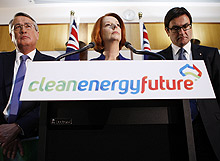
Australia Carbon Tax

Getty Images
Australian Prime Minister Julia Gillard during the government’s announcement of the carbon tax plan on July 10.
This highlights a key lesson from the Australian debate. The giveaway of so many CO2 emissions permits should have been presented to the public for what it is: lost revenue and a gift to the biggest polluters. Instead, export industries framed the debate as an essential step to protect domestic industry. The tens of billions of dollars in lost revenue associated with the provision of large amounts of free permits is money that the government could have been spent on investing in renewable energy, giving tax cuts to employees, funding targeted cuts in corporate taxes, or providing investment allowances to targeted industries. Such use of carbon tax revenues would have helped create stronger support among segments of business.

As it was, most businesses that were not big polluters were relatively silent about both the desirability of introducing a carbon price and the enormous cost of providing the free emissions permits. Unfortunately, the consequences of providing so many free permits were not usually discussed in such terms — a major mistake.

While there is an economic argument for providing some compensation for some industries, there were no strong economic arguments for providing anything like the level of free permits given to the biggest polluters in Australia. The generosity of the assistance appears to be wildly out of step with the meager compromises made by the polluters. Put simply, if compensation is the price you are willing to pay to get what you want, the Australian taxpayer was willing to pay a lot to achieve very little.

Australia’s carbon scheme will also provide generous compensation to low- and middle- income households; the lowest income earners will receive more than 100 percent compensation for the likely impact of higher energy prices on their household budgets. That said, despite the enormous political outcry about putting a price on carbon, the price impact is likely to be less than one percent, or $9.00 per week, for an average household. Only the highest-income earners will miss out on compensation, but again the price impact is likely to be modest; a household earning $100,000 is likely to experience energy and other price rises of less than $1,000 per year.

Critics derided the idea of taking money away from Australian households with one hand, in the form of a price on carbon, and giving it back to them
Never underestimate the ease with which opponents can attack the details in any scheme.
with another, labeling it a “great big money-go-round.” But this is one aspect of the carbon legislation that makes sense. With a price on carbon, those who can change their behavior and use fewer fossil fuels will be better off when they receive compensation from the government. Those who can't change their behavior need be no worse off.

Another valuable lesson from Australia is to never underestimate the ease with which opponents can attack the details of any scheme — the more complex, the harder it is to sell. When proponents start putting effort into explaining a specific scheme, then by definition they must put less energy into talking about the gravity of the problem it is designed to solve.

Both the Australian government and the Australian environmental movement spent nearly four years talking about the details of an incredibly complex piece of policy, and in so doing virtually stopped talking about the scientific and economic cases for tackling climate change. The abandonment of this terrain enabled the climate and economic skeptics to promote a wide range of entirely misleading — but highly effective — messages, many focused on overstated claims of economic disaster. (A similar tactic was used to kill climate legislation in the U.S. Senate.) Opponents also frequently shifted ground, at first denying there was evidence of global warming, then accepting that there might be warming but repudiating the link to human activity. Some finally accepted that humans might be causing the planet to heat up, but then maintained that Australia is too small to make a difference.

To other countries contemplating a carbon tax or a cap-and-trade scheme, I would offer the following advice: Be less ambitious at the beginning of the project and more determined at the end. Don’t try to take on all the polluters simultaneously, but approach different sectors in different ways at different times. They should be played off against each other on specific issues, rather than united in their hostility toward a general principle.

MORE FROM YALE e360

Europe’s CO2 Trading Scheme:
Is it Time for a Major Overhaul?

Europe’s CO2 Trading Scheme: Is it Time for a Major Overhaul?
When it was launched in 2005, the EU’s carbon emissions trading system was hailed as a major step forward in the fight against climate change. But, journalist Ben Schiller writes, critics contend it has done little to slow the release of CO2 and argue that it should be significantly reformed — or scrapped.
READ MORE
So where do things stand? The design of the legislation and the determination of the government to provide certainty to industry means it is highly unlikely that there will be any chance to broaden the scope of the scheme — and give it real teeth — before 2020. The debate about the scientific need to tackle climate change has been removed from the political agenda, replaced with economic arguments about whether the compensation is adequate or not.

Meanwhile, as Australia moves ahead with a watered-down plan that ignores scientific evidence about the depth of cuts required to help prevent global warming, the nation’s coal industry — the world’s largest exporter of coal — is experiencing a boom. Australia’s coal exports are expected to double in the coming decade, much of it heading to China, where the emissions will further foul the air of Beijing and Shanghai and add to the heat-trapping gases rapidly accumulating in the Earth’s atmosphere.

POSTED ON 12 Dec 2011 IN Biodiversity Climate Climate Energy Policy & Politics Australia 

COMMENTS


Thank you for your analysis of Australia's carbon tax. It is interesting to see what has worked and what hasn't because I hope that Canada will get their butt in gear and put a price on carbon. Two elections ago, our Liberal government ran on the idea of a "revenue neutral" carbon tax. Unfortunately, they did a horrible job of explaining it, justifying it and detailing why it is so important to put a price on carbon. That and the Conservative party (you Republicans) did a great job of scaring people into thinking the tax would ruin the economy.

Posted by Jocelyn Plourde on 12 Dec 2011


A carbon tax was implemented in the province of British Columbia. It is a total waste of time as the funds go into general government coffers and none is spent on anything other than the governments pet projects (ie, getting re-elected). A carbon tax is an utterly watseful and deceptive idea.

The Ozzies will soon be finding out how stupid it is and will be cutting their arms off to get out of it shortly. At least Canada had the guts to call foul on the whole concept of MMGW and leave Kyoto.

Posted by Shoshin on 15 Dec 2011


As Richard says, getting back the the core issue - is climate change something we can affect? Answer is, no, so we should stop wasting time and trillions of dollars and deal with change as it occurs. More CO2 means greater cropping potential, just whn we need it most. Next question is - how does humanity deal with global cooling of 8-10 degrees C, and maintain productivity to feed the growing populous? Chew on that Richard.

Posted by Pete in Christchurch on 01 Jan 2012


Australia made exactly the same mistakes that Europe made with its ETS.

And for the same reasons. No country can change its economy overnight and none can afford to loose economic growth overseas for no real carbon dioxide reduction. Nor can you preserve a stable democracy without paying off losers.

Australia also doesn't have a nuclear industry or the water for hydroelectricity. Nor can it import nuclear and hydroelectricity from France and Sweden like much of Europe is doing.

Posted by Pertinax on 10 Jan 2012


POST A COMMENT

Comments are moderated and will be reviewed before they are posted to ensure they are on topic, relevant, and not abusive. They may be edited for length and clarity. By filling out this form, you give Yale Environment 360 permission to publish this comment.

Name 
Email address 
Comment 
 

richard dennissABOUT THE AUTHOR
Richard Denniss is an economist and executive director of The Australia Institute, a Canberra-based think tank. A former associate professor at the Crawford School of Economics and Government at the Australian National University, his writing has been published in numerous academic journals. He was the co-author of An Introduction to Australian Public Policy: Theory and Practices.


RELATED ARTICLES


On the Road Back to Rio,
Green Direction Has Been Lost

Twenty years ago, an historic environmental summit in Rio de Janeiro produced groundbreaking treaties and high hopes that pressing issues would be addressed. But as organizers prepare for the Rio+20 conference in June, there is little on the agenda to suggest any substantive action will be taken.
READ MORE

A Veteran of the Climate Wars
Reflects On U.S. Failure to Act

One of the many casualties of the recent U.S. elections was Congressman Rick Boucher, a Virginia Democrat who played a key role in passage of cap-and-trade legislation by the House of Representatives. In an interview with Yale Environment 360, Boucher discusses the bitter failure of the Senate to pass a climate bill and future prospects for tackling global warming.
READ MORE

In Wreckage of Climate Bill,
Some Clues for Moving Forward

Ample blame exists for the demise of climate legislation in the U.S. Senate, from President Obama’s lack of political courage, to the environmental community’s overly ambitious strategy, to Republican intransigence. A way forward exists, however, to build on the rubble of the Senate’s failure to cap carbon emissions.
READ MORE

Putting a Price on Carbon:
An Emissions Cap or a Tax?

The days of freely dumping greenhouse gases into the atmosphere are coming to an end, but how best to price carbon emissions remains in dispute. As the U.S. Congress debates the issue, Yale Environment 360 asked eight experts to discuss the merits of a cap-and-trade system versus a carbon tax.
READ MORE

Warming Takes Center Stage
as Australian Drought Worsens

With record-setting heat waves, bush fires and drought, Australians are increasingly convinced they are facing the early impacts of global warming. Their growing concern about climate change has led to a consensus that the nation must now act boldly to stave off the crisis.
READ MORE


MORE IN Opinion


On the Road Back to Rio,
Green Direction Has Been Lost

by fred pearce
Twenty years ago, an historic environmental summit in Rio de Janeiro produced groundbreaking treaties and high hopes that pressing issues would be addressed. But as organizers prepare for the Rio+20 conference in June, there is little on the agenda to suggest any substantive action will be taken.
READ MORE

As Roads Spread in Rainforests,
The Environmental Toll Grows

by william laurance
From Brazil to Borneo, new roads are being built into tropical forests at a dizzying pace, putting previously intact wilderness at risk. If we hope to preserve rainforests, a leading researcher says, new strategies must be adopted to limit the number of roads and reduce their impacts.
READ MORE

Solar Power Off the Grid:
Energy Access for World’s Poor

by carl pope
More than a billion people worldwide lack access to electricity. The best way to bring it to them — while reducing greenhouse gas emissions — is to launch a global initiative to provide solar panels and other forms of distributed renewable power to poor villages and neighborhoods.
READ MORE

Making the Case for the
Value of Environmental Rules

by gernot wagner
Some U.S. politicians have been attacking environmental regulations, arguing that they hurt the economy and that the costs outweigh the benefits. But four decades of data refute that claim and show we need not choose between a clean environment and economic growth.
READ MORE

The Ethical Dimension of
Tackling Climate Change

by stephen gardiner
The global challenge of climate change poses a perfect moral storm — by failing to take action to rein in carbon emissions, the current generation is spreading the costs of its behavior far into the future. Why should people in the future pay to clean up our mess?
READ MORE

With the Keystone Pipeline,
Drawing a Line in the Tar Sands

by bill mckibben
For environmentalists protesting the Keystone XL pipeline, the battle is about more than just transporting tar sands oil from Alberta. It’s about whether the United States — and the rest of the world — will finally come to its senses about global warming.
READ MORE

A Planetary Crisis Is
A Terrible Thing to Waste

by christian schwägerl
There are striking similarities between the current economic and ecological crises — both involve indulgent over-consumption and a failure to consider the impacts on future generations. But it’s not too late to look to new economic and environmental models and to dramatically change course.
READ MORE

Forum: Assessing Obama’s
Record on the Environment

When Barack Obama won the presidency in 2008, environmentalists were optimistic that their issues would finally become a priority at the White House. So how is Obama doing? Yale Environment 360 asked a group of environmentalists and energy experts for their verdicts on the president's performance.
READ MORE

The World at 7 Billion:
Can We Stop Growing Now?

by robert engelman
With global population expected to surpass 7 billion people this year, the staggering impact on an overtaxed planet is becoming more and more evident. A two-pronged response is imperative: empower women to make their own decisions on childbearing and rein in our excessive consumption of resources.
READ MORE

On Biking, Why Can’t the U.S.
Learn Lessons from Europe?

by elisabeth rosenthal
Building bike paths alone will not get people out of their cars in the U.S. and onto bicycles. To create a thriving bike culture in America’s cities, people must begin to view bicycling as Europeans do — not just as a way of exercising, but as a serious form of urban mass transportation.
READ MORE


e360 digest
Yale
Yale Environment 360 is
a publication of the
Yale School of Forestry
& Environmental Studies
.

SEARCH e360


Donate to Yale Environment 360

CONNECT

Twitter: YaleE360
e360 on Facebook
Donate to e360
View mobile site
Bookmark
Share e360
Email newsletter
Subscribe to our feed:
rss


ABOUT

About e360
Contact
Submission Guidelines
Reprints

e360 VIDEO

Warriors of Qiugang
The Warriors of Qiugang, a Yale Environment 360 video that chronicles the story of a Chinese village’s fight against a polluting chemical plant, was nominated for a 2011 Academy Award for Best Documentary (Short Subject). Watch the video.


DEPARTMENTS

Opinion
Reports
Analysis
Interviews
e360 Digest
Video Reports

TOPICS

Biodiversity
Business & Innovation
Climate
Energy
Forests
Oceans
Policy & Politics
Pollution & Health
Science & Technology
Sustainability
Urbanization
Water

REGIONS

Antarctica and the Arctic
Africa
Asia
Australia
Central & South America
Europe
Middle East
North America

e360 VIDEO REPORT

When the Water Ends
As temperatures rise and water supplies dry up, tribes in East Africa increasingly are coming into conflict. A Yale Environment 360 video reports on a phenomenon that could become more common: how worsening drought will pit groups — and nations — against one another. Watch the video.

e360 MOBILE

Mobile
The latest
from Yale
Environment 360
is now available for mobile devices at e360.yale.edu/mobile.


header image
Top Image: aerial view of Iceland. © Google & TerraMetrics.

e360 VIDEO REPORT

Leveling Appalachia
Leveling Appalachia: The Legacy of Mountaintop Removal Mining, an e360 video examining the environmental and human impacts of this mining practice, won the award for best video in the 2010 National Magazine Awards for Digital Media. Watch the video.


OF INTEREST


RESOURCES


Yale