21 Sep 2009: Report

Korea’s Four Rivers Project:
Economic Boost or Boondoggle?

The natural landscape of South Korea has been largely re-engineered, with nearly every river damned or forced into concrete channels. Now the government is reviving plans for a mammoth water project that would dredge and develop hundreds more miles of waterways and put added stress on the country's remaining wildlife.

by james card

The Korean peninsula was once called geum-su-gang-san, “a land of embroidered rivers and mountains.” Before South Korea industrialized in the postwar years, the rivers were wild-running freestone streams barreling down the mountains and turning into sandy shallow rivers edged by wetlands as they reached the sea. In her 1898 book Korea and Her Neighbors, 19th-century travel writer Isabella Bird described the upper Namhan River as “where pure emerald water laps gently upon crags festooned with roses and honeysuckle, or in fairy bays on pebbly beaches and white sand.”

That world is long gone now, as the Namhan and nearly every other South Korean river has been dammed, forced into concrete channels, or otherwise re-engineered by successive governments that have funneled billions of dollars to the powerful construction industry to fund countless public works projects designed to tame the country’s rivers. Today, besides a handful of creeks deep in the mountains or protected in national parks, only one major river, the Dong, exists in a natural meandering and un-dammed state.

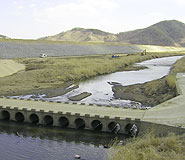
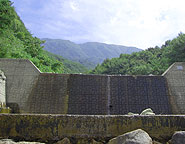
Now, in part to boost the fortunes of the construction cartel in a global recession, there is a new public works offensive: the Four Rivers Restoration Project. The $18 billion plan will further develop Korea’s four major river systems — the Han, Nakdong, Geum, and Youngsan — with the stated goals of preventing water shortages, improving water quality, bolstering flood control, and creating “eco-friendly culture spaces” for tourism. The work would require building 16 new dams on those rivers, rebuilding 87 old dams, reinforcing 209 miles of riverbanks, and dredging 570 million cubic meters of sediment from 428 river miles. On 14 tributaries there will be five new dams and nine more will be rebuilt, and 151 miles of riverbank will be buttressed with concrete.

The four rivers targeted in the project no longer exist in a natural state as many stretches have been straightened and channelized. But for the large numbers of migratory birds that still pass through South Korea, the ceaseless work will further erode dwindling habitat. The Geum River, for example, still has a massive flock of Baikal teal, but many of those birds will have to find new roosting territories as the river’s remaining shallow, reed-filled areas are excavated and deepened. One researcher at the state-funded Korea Institute of Construction Technology called the Four Rivers Project a “grand disaster that any expert can clearly foresee with common sense.”

South Korea has over 18,000 dams that create man-made reservoirs. By comparison, China has a world-record 87,000 dammed water reservoirs, but China has roughly 100 times the land area and nearly 30 times as many people. South Korea is roughly the size of Indiana, which means that almost every creek, stream and river in the country is dammed or has water barriers — such as weirs or drop structures — that impede fish migration. Floodplains are now rice paddies safely behind the levees and excavators plow into the streambeds and flatten them out for flood control.

One of the most recent riverine “restoration” schemes was the Saemangeum reclamation project on the west coast. South Korea’s largest public works project, the Saemangeum wiped out the estuaries of two rivers and an expansive tidal flat of critical importance to the migratory birds of the Australasian flyway. Bureaucrats are still wrangling about what to do with the newly created landfill area that is six times the size of Manhattan.

Korean environmentalists opposed the Saemangeum, to no avail. They are aware that other countries are restoring streams and rivers by removing dams and taking down concrete walls and that South Korea’s river restoration projects are diametrically opposed to internationally accepted principles for the ecological restoration of aquatic resources.

Despite the fractured riparian habitat, wildlife do their best to survive and abound in some places. Korean water deer, leopard cats, and raccoon dogs skulk along the shoreline, their tracks easily seen in the mud. Korean anglers cast lures for river tarpon and largemouth bass that must continually adapt to disturbances in river systems.

Environmentalists have had a few victories, primarily their successful fight in 2000 to preserve the Dong River — Korea’s last, large, undammed waterway — from a giant dam that would have drowned the entire Dong River valley ecosystem.

The environmental movement also played a part in torpedoing one of the most grandiose public works schemes in recent decade, the Pan Korea Grand Waterway. Proposed in December 2007 by President Lee Myung-bak — the former Hyundai Construction CEO nicknamed the “Bulldozer” — the waterway was to have been a super canal system with the 336-mile-long main canal connecting Seoul to Busan. Cargo freighters would have gone up Korea’s longest river, the Nakdong, floating through flooded mountain tunnels to connect to the Han River, which eventually winds through Seoul. South Korea’s four main rivers, the Han, Nakdong, Guem and the Youngsan, were to be heavily dredged, channelized and fitted with locks and dams. Seventeen other smaller canals were added to the plan for a total of 1,926 miles of rivers to be transformed into slow-water canals.

The canal scheme was too much, even for Korea. The president’s proposal was met with a groundswell of opposition from critics who said it would be an environmental catastrophe and a massive boondoggle.

President Lee’s popularity plummeted in the summer of 2008 because of his decision to allow the importation of American beef, resulting in violent demonstrations on the streets of Seoul. To regain the public’s favor, he promised to drop the canal project. At a mid-June press conference he said, “I made a pledge to construct the Pan-Korea Grand Waterway. However, if the people object to it, I will not push it.” Stocks of construction companies across the nation immediately fell.

But President Lee’s plan is now back, in more modest form, in the guise of the Four Rivers project. Under a so-called “Green New Deal” to create an estimated 960,000 new jobs, Lee proposed development of solar, wind, and tidal power; stepped-up production of hybrid vehicles; introduced a tree-planting program; and expanded railways. But the item receiving the largest allocation of money was the previously unheard-of Four Rivers Restoration Project. They are the same four rivers that were the lynchpin of the Pan Korean Waterway.

“President Lee said nothing about greening Korea during his election that I remember,” said Mark D. Whitaker, a professor of environmental sociology at Ewha Womans University in Seoul. “He is attempting to rebrand himself, and [the] same policies, as ecological modernization.”

The Four Rivers project, which is moving forward, will rival the Saemangeum reclamation project in budget, and already mission creep has set in. In March, an additional 50 smaller rivers were targeted to be dredged and embanked. In June, the government announced that one of South Korea’s cleanest major rivers, the Seomjim, would be included. The budget for the Four Rivers project was increased by 60 percent and in July, the Land Ministry announced it had started drafting a master plan to develop 43 more rivers. “It is a plan to renovate virtually every river in the country,” Kim Dong-yeon, an official at the Land Ministry told the JoongAng Daily.

More from Yale e360

The Damming of the Mekong:
Major Blow to an Epic River

The Mekong has long flowed freely, supporting one of the world’s great inland fisheries. But China is now building a series of dams on the 2,800-mile river that will restrict its natural flow and threaten the sustenance of tens of millions of Southeast Asians.


The Great Paradox of China:
Green Energy and Black Skies

China is on its way to becoming the world’s largest producer of renewable energy, yet it remains one of the most polluted countries on earth. Economic and political forces are combining to make China simultaneously a leader in alternative energy — and in dirty water and air.
As with the Saemangeum project, the government has provided little information on how the scheme will affect the environment. Scientists and environmentalists accuse the government of hastily preparing an Environmental Impact Statement so construction can begin next month.

“It is not a proper process for such a large development project which will cause a big impact on the riverine environment of the country,” Ma Yong-un, the top wetland expert of the Korean Federation for the Environmental Movement, said in an e-mail.

Nial Moores, co-founder of Birds Korea and one of the top field ornithologists in East Asia, noted that South Korea still has large numbers of birds, many of them migratory. But surviving has become a game of musical habitat for the country’s bird population, and when the sound of the construction stops and starts for the Four Rivers project, the birds must fly to new roosting areas. He predicted that Baikal teal from the new Geum River project “will shift to the Saemangeum reclamation area until that, too, becomes unusable.”

The government has repeatedly stated that the Four Rivers project is completely unrelated to the canal project, but critics think otherwise and the public doesn’t seem to buy that argument either.

Kim I-tae decided to speak out. The 48-year-old researcher at the state-funded Korea Institute of Construction Technology was part of a team assigned to come up with a blueprint for the Four Rivers project for the Ministry of Land, Transport and Maritime Affairs. Kim posted his opinion on Agora, the country’s most popular discussion board. Entitled “A Researcher Participating in the Grand Korean Waterway,” Kim claimed the Four Rivers project was nothing more than the Grand Canal project in disguise and termed it a “grand disaster.”

Ye was suspended from his job for three months.

POSTED ON 21 Sep 2009 IN Climate Policy & Politics Policy & Politics Water Asia 

COMMENTS


hello, i am a student studying in seattle. i am extremely grieved by this project. if you have any interest in further studying the project and its effects on the korean ecosystem, please please let me know. this is a serious problem to me, and i am looking for anyone to help me further investigate the situation.

Posted by yunyoung on 17 Jun 2010


As a volunteer activist in KFEM (mentioned in the article) and a student studying natural resources, I am saddened to say that this project is still ongoing stronger than ever. The president has no intention to stop or even adjust the plan accordingly. Let it be known that even the UN has denied this monstrocity CDM (clean development mechanism) status and, well, there are going to a lot of grieving Koreans 10 years down the road.

Posted by peterkwon on 29 Jul 2010


You fail to note the military angle. North Korea has dammed rivers that could be used to flood the south. This project appears aimed in part to deflect that threat.

Posted by mossdale on 30 Jul 2010


I returned from Korea before about two weeks and saw this on my own eyes. I study landscape ecology and I also made some scientific research in Korea at Nagdong river. I´m absolutely against the project but I have to say one thing about the introduction in this article. It´s not true in my opinion that nearly all Korean rivers have been re-modelated. They have definitely much more natural rivers than for example we in our country;) I´m from Czech Republic.

Posted by Lairelossë on 12 Nov 2010


Comments have been closed on this feature.
james cardABOUT THE AUTHOR
James Card is an American journalist living in South Korea. His work has appeared in Foreign Policy, The New York Times, The Wall Street Journal, National Geographic News, Travel + Leisure, Salon, The Christian Science Monitor, Field & Stream, Outside’s Go, and other publications.


RELATED ARTICLES


As Coal Use Declines in U.S.,
Coal Companies Focus on China

With aging coal-fired U.S. power plants shutting down, major American coal companies are exporting ever-larger amounts of coal to China. Now, plans to build two new coal-shipping terminals on the West Coast have set up a battle with environmentalists who want to steer the world away from fossil fuels.
READ MORE

Africa’s Flourishing Niger Delta
Threatened by Libya Water Plan

The inland Niger delta of Mali is a unique wetland ecosystem that supports a million farmers, fishermen, and herders and a rich diversity of wildlife. But now, the country’s president and Libyan leader Moammar Gaddafi have begun a major agricultural project that will divert much of the river’s water and put the delta’s future at risk.
READ MORE

In War-Scarred Landscape,
Vietnam Replants Its Forests

With large swaths of forest destroyed by wartime defoliants, and even larger areas lost to post-war logging, Vietnam has set an ambitious goal for regenerating its woodlands. But proponents of reintroducing native tree species face resistance from a timber industry that favors fast-growing exotics like acacia.
READ MORE

Growing Shortages of Water
Threaten China’s Development

With 20 percent of the world’s population but just 7 percent of its available freshwater, China faces serious water shortages as its economy booms and urbanization increases. The government is planning massive water diversion projects, but environmentalists say conservation — especially in the wasteful agricultural sector — is the key.
READ MORE

Does Egypt Own The Nile?
A Battle Over Precious Water

A dispute between Egypt and upstream African nations has brought to the fore a long-standing controversy over who has rights to the waters of the Nile. The outcome could have profound consequences for the ecological health of the river and for one of the world’s largest tropical wetlands.
READ MORE


MORE IN Reports


Africa’s Ambitious Experiment
To Preserve Threatened Wildlife

by caroline fraser
Five nations in southern Africa are joining together to create a huge conservation area that will extend across their borders and expand critical territory for elephants. But can these new protections reverse decades of decline for area wildlife while also benefiting the people who live there?
READ MORE

Melting Sea Ice Could Lead
To Pressure on Arctic Fishery

by ed struzik
With melting sea ice opening up previously inaccessible parts of the Arctic Ocean, the fishing industry sees a potential bonanza. But some scientists and government officials have begun calling for a moratorium on fishing in the region until the true state of the Arctic fishery is assessed.
READ MORE

Solar Windows: Transforming
Buildings Into Energy Producers

by dave levitan
The vast amount of glass in skyscrapers and office buildings represents enormous potential for an emerging technology that turns windows into solar panels. But major questions remain as to whether solar windows can be sufficiently inexpensive and efficient to be widely adopted.
READ MORE

Fighting A Last-Ditch Battle
To Save the Rare Javan Rhino

by rhett butler
Rhinoceroses worldwide are under siege as their habitat shrinks and poachers slaughter hundreds annually for their valuable horns. Now, in Indonesia, conservation groups are engaged in a desperate struggle to save the last 40 Javan rhinos on earth.
READ MORE

Insurance Companies Face
Increased Risks from Warming

by ben schiller
If the damages related to climate change mount in the coming decades, insurance companies may face the prospect of paying larger disaster claims and being dragged into global warming lawsuits. But many firms, especially in the U.S., have barely begun to confront the risks.
READ MORE

Hopes Fade for Cleanup
In Nigeria’s Oil-Rich Delta

by fred pearce
The Ogoniland region of Nigeria has long been badly polluted by decades of oil production that has fouled the delta and contaminated drinking water. A United Nations report has recommended a massive recovery initiative, but so far the Nigerian government has shown few signs it will agree to the cleanup project.
READ MORE

Betting on Technology to
Help Turn Consumers Green

by marc gunther
U.S. consumers tell researchers they want to buy environmentally friendly products, but so far they haven’t been doing that on a large scale. Now a host of companies and nonprofits are trying to use new technology — from smartphones to social networking — to make it easier for buyers to make the green choice.
READ MORE

U.S. Fossil Fuel Boom
Dims Glow of Clean Energy

by keith schneider
A surge in gas and oil drilling in the U.S. is helping drive the economic recovery and is enhancing energy security. But as the situation in Ohio shows, cheaper energy prices and the focus on fossil fuels has been bad news for the renewable energy industry.
READ MORE

Can Reforming the Farm Bill
Help Change U.S. Agriculture?

by jim robbins
For decades, farm bills in the U.S. Congress have supported large-scale agriculture. But with the 2012 Farm Bill now up for debate, advocates say seismic shifts in the way the nation views food production may lead to new policies that tilt more toward local, sustainable agriculture.
READ MORE

Scientists Warn of Low-Dose
Risks of Chemical Exposure

by elizabeth grossman
A new study finds that even low doses of hormone-disrupting chemicals — used in everything from plastics to pesticides – can have serious effects on human health. These findings, the researchers say, point to the need for basic changes in how chemical safety testing is conducted.
READ MORE


e360 digest
Yale
Yale Environment 360 is
a publication of the
Yale School of Forestry
& Environmental Studies
.

SEARCH e360


Donate to Yale Environment 360

CONNECT

Twitter: YaleE360
e360 on Facebook
Donate to e360
View mobile site
Bookmark
Share e360
Email newsletter
Subscribe to our feed:
rss


ABOUT

About e360
Contact
Submission Guidelines
Reprints

e360 VIDEO

Warriors of Qiugang
The Warriors of Qiugang, a Yale Environment 360 video that chronicles the story of a Chinese village’s fight against a polluting chemical plant, was nominated for a 2011 Academy Award for Best Documentary (Short Subject). Watch the video.


DEPARTMENTS

Opinion
Reports
Analysis
Interviews
e360 Digest
Video Reports

TOPICS

Biodiversity
Business & Innovation
Climate
Energy
Forests
Oceans
Policy & Politics
Pollution & Health
Science & Technology
Sustainability
Urbanization
Water

REGIONS

Antarctica and the Arctic
Africa
Asia
Australia
Central & South America
Europe
Middle East
North America

e360 VIDEO REPORT

When the Water Ends
As temperatures rise and water supplies dry up, tribes in East Africa increasingly are coming into conflict. A Yale Environment 360 video reports on a phenomenon that could become more common: how worsening drought will pit groups — and nations — against one another. Watch the video.

e360 MOBILE

Mobile
The latest
from Yale
Environment 360
is now available for mobile devices at e360.yale.edu/mobile.


header image
Top Image: aerial view of Iceland. © Google & TerraMetrics.

e360 VIDEO REPORT

Leveling Appalachia
Leveling Appalachia: The Legacy of Mountaintop Removal Mining, an e360 video examining the environmental and human impacts of this mining practice, won the award for best video in the 2010 National Magazine Awards for Digital Media. Watch the video.


OF INTEREST


Yale