Only 10 years ago, Madagascar — the California-sized island off the eastern coast of southern Africa — was notorious for its environmental degradation and deforestation; astronauts orbiting the Earth remarked that the red color of Madagascar’s rivers suggested the country was bleeding to death as its denuded mountainsides hemorrhaged topsoil into its waterways.
But that began to change earlier this decade when President Mark Ravalomanana, working with international conservation organizations and local groups, set aside 10 percent of the country as parks and nurtured a thriving ecotourism business, all of which slowed deforestation and safeguarded more of the nation’s legendary biodiversity. Madagascar’s park system mandated that half of park entrance fees flow back to local communities, ensuring that at least some benefits of ecotourism — two-thirds of visitors come to Madagascar for nature-related activities — reached people who might otherwise be disadvantaged by conservation initiatives. Indeed the emergence of ecotourism helped make local people partners — rather than adversaries — in conservation. In short order, Madagascar went from being a pariah of the conservation world to a model.
All of which makes the spasm of forest destruction that has swept the country since a coup last March even more tragic. After President Ravalomanana was chased into exile at gunpoint, the civil service and park management system collapsed, and donor funds, which provide half the government’s annual budget, dried up. In the absence of governance, organized gangs ransacked the island’s protected rainforests for biological treasures — including precious hardwoods and endangered lemurs — and frightened away tourists, who provide a critical economic incentive for conservation.
Now with the prospect of political stability returning, the question is whether Madagascar’s once highly regarded conservation system can be restored and maintained. One heartening sign, evident during a recent visit, is that locals who have benefited from ecotourism are now pressuring the government to end the widespread destruction that has been a hallmark of this dark year.
Isolated from other land masses for at least 80 million years, Madagascar is home to a remarkable and eclectic collection of plants and animals, more than 80 percent of which are found nowhere else in the world. From its
Photo Gallery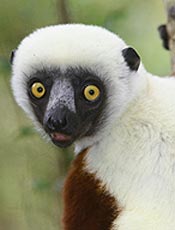
mountain moorlands to tropical lowland rainforests, the island boasts such evolutionary oddities as the fossa, a carnivorous mammal that looks like a cross between a puma and a dog but is closely related to the mongoose; the indri, a cat-sized lemur that sings haunting, whale-like songs; brilliantly colored chameleons; and leaf-tailed geckos that are nearly impossible to distinguish from bark or moss. It has baobab trees, which look like they’ve been planted upside down; the rosy periwinkle, a delicate flower used to cure pediatric leukemia and Hogkin’s disease; and an entire desert ecosystem consisting of just spiny plants, none of which are cacti.
Scientists are continuing to discover species. The number of lemurs has risen from 50 in 1994 to more than 100 today, while scientists earlier this year announced a near-doubling of the number of frog species known to occur on the island. All but one are endemic. For all these reasons, scientists have made the island — dubbed the Eighth Continent — a top conservation priority.
In the past half-century, however, this rich biodiversity came under tremendous pressure. Forests that once blanketed the eastern third of the island were degraded and fragmented, while endemic spiny forests have been diminished by subsistence agriculture, cattle grazing, and charcoal production. The central highlands have mostly been cleared for pasture, rice paddies, and eucalyptus and pine plantations. Each year as much as a third of the country burns, the result of fires set by farmers and cattle herders clearing land for subsistence agriculture. Meanwhile industrial miners from developed countries are tearing away at some of Madagascar’s last remaining forest tracts.
This destruction left Madagascar with pockets of extraordinary biodiversity, which President Ravalomanana set out to preserve. Lured by its spectacular landscapes, unmatched wildlife, and cultural richness, tourism grew steadily, reaching $390 million in 2008.
Without government or international support after the coup, little could be done to stop rampant logging.
But these gains were all but erased by the political crisis in March. The democratically-elected Ravalomanana had become increasingly autocratic in his second term, shutting down opposition media outlets, using his political power to further his sprawling business interests, and signing controversial deals, including one that reportedly would have turned over half of Madagascar’s arable land to Daewoo, a South Korean conglomerate, for export-only crop production. After a series of demonstrations turned violent under questionable circumstances, a faction of army officers allied with Andry Rajoelina, the mayor of the capital city of Antananarivo, overthrew Ravalomanana, who fled to South Africa.
In the aftermath of the coup, Madagascar’s reserves — especially in the northern part of the country — were ravaged by illegal loggers. Without backing from the central government or support from the international agencies that withdrew aid following the coup, there was little that could be done to stop the carnage. Armed bands, financed by foreign timber traders and at times in collusion with local officials, went into Marojejy and Masoala national parks, harvesting valuable hardwoods, including rosewood and ebonies.
In Marojejy, a forested mountain that is among Madagascar’s most biodiverse parks, armed marauders invaded the reserve, cutting trails, hunting wildlife, and extracting timber. The chaos forced authorities to close Marojejy to tourists — its lifeblood — for the first time, effectively blocking outsiders from bearing witness to the plunder.
Loggers soon moved into Masoala National Park, a UNESCO World Heritage site that is considered one of the jewels of Madagascar’s protected areas. The Masoala Peninsula — the site where the bulk of recent rosewood logging has occurred — is a place of spectacular beauty, with lush tropical rainforest extending down relatively steep terrain to sand beaches fringed by clear seas and coral reefs. The forests of Masoala and the neighboring Makira are estimated to house 50 percent of Madagascar’s biodiversity, despite making up less than 2 percent of its land mass.
Logging was so intense in Masoala that the supply of cargo boats in the neighboring town of Maroantstra was fully employed to haul rosewood out of the forest — none was available for conventional shipping. All told, logging affected 27,000 to 40,000 acres of protected rainforest, according to estimates from Peter H. Raven and his colleagues at the Missouri Botanical Gardens. More than $100 million of timber was cut. Much of it went to China to make wood products that will eventually be sold in Europe and the United States.
What was particularly galling for conservationists was that logging was principally for commercial gain by well-connected traffickers, rather than subsistence harvesting by poor Malagasy.
The downturn in tourism has made some Malagasy aware of how important visitors are to their well-being.
“Harvesting these extremely heavy and valuable hardwoods is a labor-intensive activity requiring coordination between local residents who manually cut the trees, but receive little profit, and a criminal network of exporters, domestic transporters, and corrupt officials who initiate the process and reap most of the enormous profits,” said Erik Patel, a researcher from Cornell University who studies the Silky Sifaka in Marojejy. “Local people benefit very little from rosewood logging. In most cases, rosewood logging is harmful to local people because of loss of tourism and violation of local taboos.”
At the same time that northern rainforests were being pillaged for their timber, a disturbing new trade emerged: commercial bushmeat hunting of lemurs. In August, Conservation International (CI), an NGO that has been particularly active in Madagascar, released photos showing piles of dead lemurs that had been confiscated from traders and restaurants in northern towns.
“What is happening to the biodiversity of Madagascar is truly appalling, and the slaughter for these delightful, gentle, and unique animals is simply unacceptable,” CI’s president, Russ Mittermeier — an expert on Madagascar’s lemurs — said at the time. “And it is not for subsistence, but rather to serve what is certainly a ‘luxury’ market in restaurants of larger towns… These poachers are killing the goose that laid the golden egg, wiping out the very animals that people most want to see, and undercutting the country and especially local communities by robbing them of future ecotourism revenue.”
Tourist arrivals dropped 50 to 60 percent for the year, badly affecting workers employed in the tourism industry. During a September visit to Perinet Special Reserve, the home of the famous singing Indri lemur, nature guides idled in front of lodges, waiting for tourists, and loitered along the road to a mining area, hoping to pick up work as day laborers. The lucky ones had managed months ago to line up temporary work at a $3.8 billion nickel mine run by Sherritt, a Canadian mining firm. The project will eventually send millions of tons of mining sluice to the coastal port of Tamatave via an 85-mile-long pipeline that runs between two protected areas.
In Ranomafana, arguably Madagascar’s best-managed park, tourist arrivals are down by more than 40 percent. Before the coup, in 2008, 24,000 tourists visited the park, generating $1.72 million in revenue, according to an analysis by Patricia Wright, executive director of the Institute for the Conservation of Tropical Environments at Stony Brook University.
The downturn has had one salutary effect, however: It has made some Malagasy aware of just how important visitors are to their well-being.
“Many people didn’t believe that bringing vazaha [the local term for foreigners] to the forest helped them,” said Claudio, a nature guide in Masoala National Park. “But the crisis has shown them that tourism does bring benefits. Everyone is feeling it now — the political crisis has become an economic crisis.”
The fall in tourist revenue has been exacerbated by the loss of donor support. US AID, a major source of finance for conservation projects, and other organizations have frozen funding, while the Peace Corps pulled its volunteers out of the country for months. NGOs have been pleading for governments to restore aid. There are worries that the suspension of projects has eroded confidence among local communities that conservationists are committed to Madagasar for the long haul.
But in the past few months, there have been some encouraging signs as calls from conservation groups and media attention have put pressure on the government to take action. Gendarmerie have been sent back into some vulnerable areas, and several local officials have been sacked following investigations that have tied them to illicit wood shipments. While the current government has temporarily authorized the export of timber, officials have said that the trade will be more closely monitored.
Tourists also appear to be returning to the island. Operators such as Cortez Travel and Rainbow Tours reported an increase in interest and bookings this past fall. And foreign governments are taking steps to stem the trade in illegal timber. The U.S. Fish and Wildlife Service has invoked the Lacey Act — a provision that requires companies in the U.S. to obey environmental laws in other countries — to take action against domestic buyers of illegally sourced rosewood.
But Madagascar will need more than admonishments from rich countries and stricter enforcement of trade regulations to restore its once-admired protected areas management system. It needs international support and domestic political will to ensure a future for ecotourism and its spectacular wildlife.