As the first non-Japanese head of a Japanese automaker, Carlos Ghosn shook up the Nissan Motor Co. with his blunt, aggressive style. Now he’s made perhaps his boldest move yet: committing his company’s future — and his own considerable reputation — to the success of the new all-electric Leaf.
The Leaf, which last month was named 2011 World Car of the Year, is now being sold in the U.S. and Japan, with plans to expand to other global markets next year, and Nissan has invested $5 billion — more than half of its 2007-2012 research budget — in the development of electric vehicles. But Ghosn says he has no doubt that the electric car’s moment has arrived.

“For people who are really interested in zero-emission mobility, with a reasonable performance, the electric car is the best solution,” he says, noting that after years of false starts, “the necessary technology is now ready.”
In an interview with Yale Environment 360 editor Roger Cohn, Ghosn discussed why he believes electric cars will represent 10 percent of the world market by 2020; how private businesses, not governments, will provide the necessary network of public charging stations; and how China will soon become the biggest new market for electric vehicles.
“The first cars in the industry were electric cars,” Ghosn said. “So when people say you’re pioneering electric cars, we’re going to say that electric cars always existed. What we’re pioneering is affordable electric cars — that’s where the revolution is taking place.”
Yale Environment 360: In the new film, Revenge of the Electric Car, Dan Neil of the Wall Street Journal says you’re putting your career and Nissan’s future on the line by going for the electric car and the Leaf. You’re known as a strong-willed and bottom line-oriented executive. What made you decide to make the leap to the Leaf?
Carlos Ghosn: I think obviously the media exaggerated a little bit the risk and the stakes and everything, which is normal. But one of the reasons that we are undertaking this investment is the fact that it makes a lot of sense. We have the technology ready not only to develop the products but all the components that lead to the products — like the battery, the motor, the inverter, et cetera. We have this technology, and we think that the performance that we reach is the performance that makes the product attractive to the consumer.
We have an analysis as a corporation that zero-emission cars are part of the future, no matter what. We can discuss about when and how much, but nobody today can seriously say there is no place for zero-emission mobility in the panorama of the car industry. So all of this led to an obvious decision, that if we have the technology and we can produce an affordable car that will have good performance, well, we’re going to need to launch a product.
e360: Why the decision to go to an electric car instead of a hybrid?
Ghosn: These are two completely different products, it’s not either/or. We have hybrids and we are marketing hybrids in our lineup, and we have electric cars. I don’t think it’s either/or. I think there are some uses for hybrids that make a lot of sense, and there are some uses for zero-emission mobility that make perfect sense. And I think the challenge that many car manufacturers are facing is to make sure that they have a long list of technologies being implemented in different products and for different uses that are absolutely tailored for the need of the consumer. And the electric car is one of them.
e360: Psychologically, Americans, in particular, who are used to the freedom of their wheels, are going to think about the Leaf’s range of 100 miles or less, and are going to think, ‘Is that going to be enough for me?’
“Obviously, for a lot of consumers, the range of 100 miles is not enough.”
Ghosn: Obviously, for a lot of consumers, the range of 100 miles is not enough. It’s obvious. That’s why we’re not saying the electric car is going to represent 50 percent of the marketplace. We’re talking about 10 percent of the marketplace in 10 years. Even 10 percent of the global marketplace is about 7 million cars. Coming out of 20,000, which were sold last year, that is a tremendous margin of progress. I don’t dispute the fact that for many people in the public, the range for electric cars may represent a reason for hesitating or saying, ‘It’s not for me now.’ But for all the people who are really interested in zero-emission mobility, with a reasonable performance, the electric car is the best solution. And my opinion is this represents more than 10 percent of the market. That’s our first step. Within the next 10 years, 10 percent of the marketplace will be made by electric cars. And this will increase as a function of the performance of the electric car.
e360: And so, 10 years, 10 percent. What about in 25 years? Do you see electric cars making up a larger share of the market?
Ghosn: Without any doubt. But it doesn’t make sense to make forecast 25 years down the road, knowing that the performance of the product is going to change a lot. The range is going to get bigger, the battery is going to get smaller, cheaper, the car is going to have much better performance. So I think trying to guess today what’s going to be the performance of the car three or four years down the road is useless. I think we will revise the forecast with the revision of the performance of the car. But there is no doubt for me that the bottom line now is 10 percent of the global market 10 years down the road.
e360: It was interesting to me what you said this morning, which I hadn’t expected you to say, about not being that concerned about cities and governments doing the infrastructure for charging stations, and looking more to the marketplace to do that. Could you explain that a little?
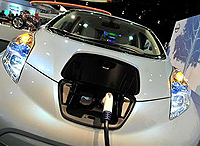
Ghosn: The government’s responsibility is to create the condition for the market to perform — to initiate technology, or to offer the basic conditions for this technology to flourish, or to serve as a catalyst for something to happen. That’s where I see government cannot be replaced. But then after this, the faster you move to market forces, the better it is. That’s what needs to happen in terms of infrastructure. That’s what I meant by saying the faster we move toward private enterprises and market forces, where the electric car is considered an opportunity, where businesses can bring people to their store or people to their business or people to their fuel station. The faster we get there the better.
e360: Are there models for that now that are doing that, or prototypes or places that are doing that? Are there private businesses in the marketplace that have built recharging stations?
Ghosn: It is too early, but what I can tell you is that we have a partnership in Germany with a utility company, RWE. And the CEO of RWE told me that he is very interested in making investment in some cities in terms of infrastructure in order to be able to sell his electricity. So this is a great example about how markets and entrepreneurship are going to do the job.
e360: It takes right now to charge the Leaf, how long? I guess it depends on the charging station itself?
Ghosn: Yes, if you are on a slow normal charge, it takes eight hours.
e360: That would be for home use?
Ghosn: Yes, but if you go for a fast-charging device, 30 minutes.
e360: And that’s what you would envision for the supermarket or the movie theater that might put in a charging station?
Ghosn: Exactly. The fast-charging station should develop in many areas because it will make sense for malls or fuel stations or trading places to have the user of the electric car stopping by, fast charge their car, shop your shop, or buy whatever they want.
e360: Which could also be an image builder for some companies that want to present themselves as green businesses. You were saying that about rental companies, but would also be an image builder for retail operations.
Ghosn: Exactly. On top of the business that you’re driving, you have also a question of image.
e360: You mentioned this morning hydrogen fuel cell cars. Nissan has some in development?
Ghosn: We have prototype. We are testing fuel cell cars today. We are developing fuel cell cars.
e360: Do you have any projections about when you would have one?
“ Fuel cell technology is probably five years behind electric cars.”
Ghosn: No, today, no. Today we don’t have any projection. But the fuel cell technology is probably five years behind electric cars. Five years behind not in terms of technological knowledge, but in terms of cost reduction and affordability.
e360: You mentioned this morning you’ve been getting good feedback on the Leaf from users. Is the U.S. the first place you’re introducing it?
Ghosn: No. Japan and the U.S. are the two places.
e360: I think it was mentioned 5,000 are on order in the U.S. How many in Japan? Do you think you’ll be able to fill those orders for the Leaf this year.
Ghosn: Yes. This year, yes.
e360: In Japan, they’re on order as well, or they’re actually on the road now?
Ghosn: There are a lot of cars on the road. Production is going up. As you know, in the U.S. we reopened order-taking for the Leaf after closing it for a while.
e360: For the consumer, what do you see the prime selling point or attractiveness? Is it the green aspect or saving money?
Ghosn: Objectively, you have plenty of advantages for the consumer. Depending on the consumer, he’ll weigh some aspects more than others. There is an economic advantage. When you make your calculation about the cost of the car, plus the cost of electricity, plus the cost of gasoline, et cetera, today it’s a great buy. Particularly with the price of oil moving on, and the price of gasoline being more than four dollars on the gallon. So it’s a great buy. Second, it’s a good environmental decision. A lot of people want to be driving or be driven in a car that is neutral to the environment. No emission, no gasoline, no noise, nothing. That’s number two.
And then number three, is the driving pleasure of the electric car, which is unique. You get into this car, there is no vibration, there is no noise, there is no smell, it’s great acceleration, so the driving performance of the car itself can be also a reason why some consumers would say, ‘I like this car.’
It’s a great buy, it’s a unique driving experience, and at the same time for those people who are conscious about the environment, it’s a good thing to do. Some consumers are more attuned to consider the environment, others more attuned to consider the economy. But objectively, the zero-emission technology and the electric car offer a lot of advantages.
e360: You’ve noted that you were surprised and somewhat embarrassed to be considered a pioneer in all this, because it seemed like such an obvious thing that should have been done already. Can you explain that a little bit?
Ghosn: Well, the first cars in the industry were electric. So when people say you’re pioneering electric cars, we’re going to say electric cars always existed. What we’re pioneering is affordable electric cars. This is where the revolution is taking place…
e360: Why do you think it took this long?
Ghosn: Because at a certain point in time, when the necessary technology is ready, and you make your own analysis, and you know that you need to move into this direction, someone’s going to have to say, ‘OK, we’re going to bite the bullet, and we’re going to move forward.’ In every technology, somebody’s going to have to move first. It’s us, and we’re proud of moving first because we think it’s going to bring a lot of benefit. It’s going to be a great investment. But on top of that it’s going to bring a lot to the image of the company and to the image of the brand.
e360: Do you see China as your number one market in terms of size?
Ghosn: For the future, without any doubt. I think it’s going to be between China and the United States. It’s difficult to give you any information because we don’t know yet what is the official policy that the Chinese government wants for electric cars. When we get that policy, then we can make a much clearer statement. But it looks like they’re going to be extremely forceful in promoting electric car technology.