08 Jan 2009: Report

On Chinese Water Project,
A Struggle Over Sound Science

Geologist Yong Yang has serious concerns about plans for a massive Yangtze River diversion project. When he went public with them, he found out how difficult it can be to challenge a government decision in China. The third in a series on Chinese environmentalists.

by christina larson

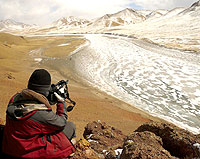
In January 2007, an independent geologist named Yong Yang set out from his home in China’s western Sichuan Province with a small team of researchers packed into two SUVs to find the unmarked place on the Tibetan plateau from which the Yangtze River springs. They drove over 16,000 miles through China’s still-wild western frontier – vast hinterlands where no roads cross, with mountainous terrain known only to local herders, antelope and wolves.

Yong is a bit of an outdoors adventure junkie (he was previously among the first kayakers to navigate the treacherous upper reaches of the Yangtze), but on this trip his mission was more profound: to investigate the geological and hydrological conditions of the Yangtze River basin – and to evaluate whether a colossal three-part water-diversion project planned by the government, called the “South-to-North Water Transfer Project,” could live up to its incredible billing.

The aim is to alleviate water shortages in parched northern China. But critics, both inside and outside the government, worry that it will be a giant boondoggle – wasting billions of dollars, forcing the relocation of thousands of people, and causing irreparable damage to unique and fragile ecosystems.

China is facing severe water shortages. Both Chinese and Western experts predict that in the next 15 years, China’s shortage of clean water will create up to 30 million “environmental refugees.”
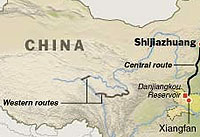
This problem is particularly acute in northern China, where climate and geology have always made water a limited resource. No one seriously disputes that bold steps must be taken to forestall a crisis. But the question is whether Beijing’s ambition – to build a $62 billion series of canals to divert water from the Yangtze River in the south to the Yellow River in the north – will actually work.

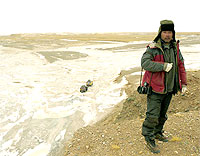
Yong’s research has focused on the western leg, which is perhaps the most controversial. When I first met him in his offices in Sichuan in the spring of 2007, he had just returned from his midwinter expedition. The 49-year-old geologist, wearing a dark sweater and black jacket, looked thin and worn, as you might expect from someone who had just survived for two months on canned foods, occasional fresh-killed meat, and cigarettes. When I saw him again that October, for an update on his research, his cheeks were rosier and rounder. In a Beijing hotel room we huddled over his laptop to examine spreadsheets of data compiled from his trip.

Based on his research, he believes the government’s blueprints for the western leg of the water-diversion project are based on inaccurate estimates of the volume of water in the upper Yangtze. If the diversion plan fails, the consequences of faulty engineering could be disastrous for downstream communities, including Shanghai, that depend on the Yangtze for agriculture, industry, and hydropower. Reduced river flow could shutter downstream hydropower stations, inflicting blackouts on millions.

The Chinese government has in the past unleashed disastrous plans with the best of intentions. Mao Zedong’s Great Leap Forward, for instance, set targets for enhanced steel and grain production based on fantasy, rather than science. Unable to meet unrealistic goals, local cadres felt compelled to fudge performance numbers, ensuring that inaccurate data and corruption would doom the effort. More recently, the government’s Three Gorges Dam hydropower project – an attempt to address the country’s rapidly growing energy needs that was completed this fall – has run into trouble. Even government officials acknowledged, after the fact, that faulty geological planning along the dam’s route had caused massive landslides and created the potential for an “environmental catastrophe.”
In recent years, a small but growing number of Chinese scientists, including former government scientists such as Yong, have joined the country’s fledgling environmental movement – not for ideological reasons, but because they worry about how decisions regarding environmental challenges, such as water shortages, are being made.

Another concerned scientist is Dr. Yu Xiaogang, a prominent Chinese environmentalist and winner of the prestigious international “Goldman Environmental Prize” in 2006. He began his career in a government ministry in Yunnan province, but became frustrated with the way science was conducted within his bureau. “I find that inside the system, you can do only so-called ‘decision-making supporting research,’” he told me. “That means the government has already made the decision. You do research to support the decision. You never do something that changes the decision.”

For his part, Yong told me his goal now is better public policy. “I am not against the government,” he says. “What I want is to get the facts.”

Research versus policy

Yong learned his rugged respect for the outdoors – a mix of awe and trepidation – from his father, a Red Army officer who had been posted in western China. Yong studied geology at the China Mining Industry University, then went to work for the Ministry of Coal’s mining bureau, where he did research to assess geological and environmental risks. At one point, Yong tried to caution that a plan to ship coal down a river on barges was untenable because massive erosion had made the surrounding hillsides prone to landslides. But his superiors didn’t want to hear the bad news.

Yong later explained to me how science was conducted within his bureau. “The government, they will make a goal. Then their researchers think their job is just to say it works. Everybody will just say the good word, and try to find data to support it,” he said. “It’s not a very scientific way of doing research.”

What prompted Yong to think about conducting research independently was his participation in a series of boat trips down the Yangtze River in 1986, in conjunction with teams of international scientists and
I am not against the government,' says Yong. 'What I want is to get the facts.'
environmentalists. The “adventure,” as he calls it, steeled his nerves (before his team’s trip, five people had died trying to navigate the same course), reinforced his regard for nature’s splendor and danger, and introduced him to the international scientific community and global environmental literature. Soon after, he quit his government job to work full-time as an independent geologist, focusing on environmental risk assessment and collaborating with international organizations including Arizona State University and the UK Great Nature Society.

His scientific research has spanned many regions of China, but always Yong has returned to the Yangtze. On his recent winter expedition, Yong's team traced every bend in the western reaches of the river. The previous summer they had traveled roughly the same route, so they could compare water levels in different seasons. On both trips they collected data on rainfall, geology, receding glaciers, and other trends that affect the volume of water in the river.

Based on his analysis of the available data – from his own research, and from 30 years’ worth of reports from hydrology monitoring stations – Yong believes that the planned western route of the South-to-North Water Transfer Project won’t work. Through friends who still work for the government, he obtained copies of two official government plans for the project. These blueprints, he says, are based upon data he calls “completely unreasonable.”
As Yong explained, along this section of the upper Yangtze, the government’s plans call for diverting between 8 and 9 billion cubic meters of water north each year. However, his research indicates that the average annual water flow for that section of the river includes a low estimate of 7 billion cubic meters per year. This would mean that when the river flow is low, the government would be hoping to divert an amount of water greater than the total annual volume in the river.

Yong is surely not alone in doubting the feasibility of the final section of the water-diversion project. More than 50 scientists in Sichuan contributed to a 2006 book, South-to-North Water Transfer Project Western Route Memorandums. The collection of scientific articles and reports raises serious concerns about construction at high altitudes, seismic stability, pollution in the Yangtze, climate change (the river's volume is expected to diminish as Tibet's glaciers melt), and the potential for reduced river flow to shutter hundreds of downstream hydropower stations.

No matter whose figures are correct, what worries Yong most is that there is no open, independent system in place to determine whether such a
What worries Yong most is that there is no independent system to determine whether such a colossal undertaking will work.
colossal and disruptive undertaking will work. For now, discussion of the project, handled by the government’s Yellow River Conservancy Commission, continues to take place behind closed doors. Last year, Yong tried to open a channel of communication to ask how officials had arrived at their figures, but the commission’s staffers refused to respond. “They just emphasize that there won't be much problem,” he said.

With its authoritarian government, China has both advantages and disadvantages in confronting its massive environmental challenges. “On the one hand, ambitious projects can be more quickly implemented, and when they work, can do so on an astonishing scale,” says Dr. Zhao Jianping, sector coordinator for energy in the World Bank's China Office. “On the other hand, there’s no system of checks and balances. So if you make a mistake, it might not become apparent for several years, after which it’s very difficult to change course and avert disastrous consequences.”

For now, Yong is reaching out to environmentalists like Yu and others whom he hopes can help transmit his concerns to the authorities. Whether or not independent scientists, or even government scientists who question official plans, will be permitted to have any influence over future public policy remains to be seen. As Yong says, “Science is the most damning kind of criticism.”

POSTED ON 08 Jan 2009 IN Biodiversity Climate Science & Technology Water Asia Europe 

COMMENTS


What is the danger that Yong will be imprisoned for embarrassing the government?
Posted by Don on 08 Jan 2009


Thanks for your concern, Don. All Chinese environmentalists walk a delicate line in voicing concerns about public projects and polluting factories. On the one hand, the government has given them much more freedom to operate than in the past, in part because Beijing wishes to engage the public in environmental clean-up efforts. On the other hand, the definition of permissible action is subtle and ever shifting, and varies province by province.

For his part, Yong has been engaged in work like this for over a decade and made a decision that this is what he wishes to do. His courageousness and willingness to share his research definitely earned the respect of this reporter. His aim -- it’s worth reinforcing -- is not to embarrass anyone, but to provide a scientific assessment; his critiques focus on particular quantifiable concerns.

Posted by Christina Larson on 08 Jan 2009


Would another potential problem with the diversion be clogging of the channels by the large volume of silt that is in the Yangtze? What will the impact be on farming and agriculture along the Yangtze river basin with up to 1/3 of the water diverted away?
Posted by Gregory Majersky on 11 Jan 2009


I am from HuBei, I felt upset by the Beijing's single action. My beautiful hometown will die for north desert.
Posted by lu on 20 Oct 2009


State media said on Sunday that close to 330,000 people in central China are to be evicted from their homes due to a reservoir being built that will form part of a massive water diversion project.

Zhang Jiyao, head of the project, said that over two-thirds of the people in Hubei and Henan provinces would be relocated to 50 nearby counties and cities.

It was not said where the remaining 100,000 would be placed to make way for the Danjiangkou Reservoir, which is part of the multi-billion-dollar North-South Water Diversion Project.

The project's goal is to bring water from the Yangtze, the nation's largest river, to the parched north of the country, which is plagued by droughts.

Previously, Xinhua said that by 2010, up to one billion cubic meters of water will be diverted to Beijing annually. And I´ve read that the relocation of the 330,000 people is expected to be completed only by the end of 2013.

Posted by Transportadora on 15 Dec 2009


We should bear in mind the fact that these "independent" researchers are being funded by the West.

Posted by MmMm on 02 Nov 2010


Comments have been closed on this feature.
christina larsonABOUT THE AUTHOR
Christina Larson is a journalist focusing on international environmental issues, based in Beijing and Washington, D.C. Her reporting has brought her to seven provinces across China, as well to Cambodia, Vietnam, Thailand, and Greece, and her writing has appeared in The New York Times, The New Republic, and The Washington Monthly, where she is a contributing editor. In previous articles in this series for Yale e360, she wrote about a Chinese environmentalist's fight to save the Yellow River and a Beijing-based legal aid center for pollution victims.
MORE BY THIS AUTHOR


RELATED ARTICLES


The Clean Water Act at 40:
There’s Still Much Left to Do

The Clean Water Act of 1972, one of the boldest environmental laws ever enacted, turns 40 this year, with an impressive record of cleaning up America's waterways. But from New York Harbor to Alaska’s Bristol Bay, key challenges remain.
READ MORE

Taking Green Chemistry Out
Of The Lab and into Products

Paul Anastas pioneered the concept of green chemistry and has led the effort to rethink the way we design and make the products we use. In an interview with Yale Environment 360, he talks about the challenges of bringing this approach to policy making and the frustrations of tackling environmental issues in a politically polarized era.
READ MORE

China’s Looming Conflict
Between Energy and Water

In its quest to find new sources of energy, China is increasingly looking to its western provinces. But the nation’s push to develop fossil fuel and alternative sources has so far ignored a basic fact — western China simply lacks the water resources needed to support major new energy development.
READ MORE

Insurance Companies Face
Increased Risks from Warming

If the damages related to climate change mount in the coming decades, insurance companies may face the prospect of paying larger disaster claims and being dragged into global warming lawsuits. But many firms, especially in the U.S., have barely begun to confront the risks.
READ MORE

Besieged by Climate Deniers,
A Scientist Decides to Fight Back

Climate scientist Michael Mann, who has faced years of attacks from climate-change skeptics, explains why he believes bad-faith assaults on science have no place in a functioning democracy and why the truth about global warming will inevitably gain wide acceptance.
READ MORE


MORE IN Reports


Africa’s Ambitious Experiment
To Preserve Threatened Wildlife

by caroline fraser
Five nations in southern Africa are joining together to create a huge conservation area that will extend across their borders and expand critical territory for elephants. But can these new protections reverse decades of decline for area wildlife while also benefiting the people who live there?
READ MORE

Melting Sea Ice Could Lead
To Pressure on Arctic Fishery

by ed struzik
With melting sea ice opening up previously inaccessible parts of the Arctic Ocean, the fishing industry sees a potential bonanza. But some scientists and government officials have begun calling for a moratorium on fishing in the region until the true state of the Arctic fishery is assessed.
READ MORE

Solar Windows: Transforming
Buildings Into Energy Producers

by dave levitan
The vast amount of glass in skyscrapers and office buildings represents enormous potential for an emerging technology that turns windows into solar panels. But major questions remain as to whether solar windows can be sufficiently inexpensive and efficient to be widely adopted.
READ MORE

Fighting A Last-Ditch Battle
To Save the Rare Javan Rhino

by rhett butler
Rhinoceroses worldwide are under siege as their habitat shrinks and poachers slaughter hundreds annually for their valuable horns. Now, in Indonesia, conservation groups are engaged in a desperate struggle to save the last 40 Javan rhinos on earth.
READ MORE

Insurance Companies Face
Increased Risks from Warming

by ben schiller
If the damages related to climate change mount in the coming decades, insurance companies may face the prospect of paying larger disaster claims and being dragged into global warming lawsuits. But many firms, especially in the U.S., have barely begun to confront the risks.
READ MORE

Hopes Fade for Cleanup
In Nigeria’s Oil-Rich Delta

by fred pearce
The Ogoniland region of Nigeria has long been badly polluted by decades of oil production that has fouled the delta and contaminated drinking water. A United Nations report has recommended a massive recovery initiative, but so far the Nigerian government has shown few signs it will agree to the cleanup project.
READ MORE

Betting on Technology to
Help Turn Consumers Green

by marc gunther
U.S. consumers tell researchers they want to buy environmentally friendly products, but so far they haven’t been doing that on a large scale. Now a host of companies and nonprofits are trying to use new technology — from smartphones to social networking — to make it easier for buyers to make the green choice.
READ MORE

U.S. Fossil Fuel Boom
Dims Glow of Clean Energy

by keith schneider
A surge in gas and oil drilling in the U.S. is helping drive the economic recovery and is enhancing energy security. But as the situation in Ohio shows, cheaper energy prices and the focus on fossil fuels has been bad news for the renewable energy industry.
READ MORE

Can Reforming the Farm Bill
Help Change U.S. Agriculture?

by jim robbins
For decades, farm bills in the U.S. Congress have supported large-scale agriculture. But with the 2012 Farm Bill now up for debate, advocates say seismic shifts in the way the nation views food production may lead to new policies that tilt more toward local, sustainable agriculture.
READ MORE

Scientists Warn of Low-Dose
Risks of Chemical Exposure

by elizabeth grossman
A new study finds that even low doses of hormone-disrupting chemicals — used in everything from plastics to pesticides – can have serious effects on human health. These findings, the researchers say, point to the need for basic changes in how chemical safety testing is conducted.
READ MORE


e360 digest
Yale
Yale Environment 360 is
a publication of the
Yale School of Forestry
& Environmental Studies
.

SEARCH e360


Donate to Yale Environment 360

CONNECT

Twitter: YaleE360
e360 on Facebook
Donate to e360
View mobile site
Bookmark
Share e360
Email newsletter
Subscribe to our feed:
rss


ABOUT

About e360
Contact
Submission Guidelines
Reprints

e360 VIDEO

Warriors of Qiugang
The Warriors of Qiugang, a Yale Environment 360 video that chronicles the story of a Chinese village’s fight against a polluting chemical plant, was nominated for a 2011 Academy Award for Best Documentary (Short Subject). Watch the video.


DEPARTMENTS

Opinion
Reports
Analysis
Interviews
e360 Digest
Video Reports

TOPICS

Biodiversity
Business & Innovation
Climate
Energy
Forests
Oceans
Policy & Politics
Pollution & Health
Science & Technology
Sustainability
Urbanization
Water

REGIONS

Antarctica and the Arctic
Africa
Asia
Australia
Central & South America
Europe
Middle East
North America

e360 VIDEO REPORT

When the Water Ends
As temperatures rise and water supplies dry up, tribes in East Africa increasingly are coming into conflict. A Yale Environment 360 video reports on a phenomenon that could become more common: how worsening drought will pit groups — and nations — against one another. Watch the video.

e360 MOBILE

Mobile
The latest
from Yale
Environment 360
is now available for mobile devices at e360.yale.edu/mobile.


header image
Top Image: aerial view of Iceland. © Google & TerraMetrics.

e360 VIDEO REPORT

Leveling Appalachia
Leveling Appalachia: The Legacy of Mountaintop Removal Mining, an e360 video examining the environmental and human impacts of this mining practice, won the award for best video in the 2010 National Magazine Awards for Digital Media. Watch the video.


OF INTEREST


Yale