Stephen R. Kellert, a social ecologist, has spent much of his career thinking and writing about biophilia, the innate human affinity for nature. His most recent book (with co-editors Judith H. Heerwagen and Martin L. Mador) is Biophilic Design: The Theory, Science, and Practice of Bringing Buildings to Life. It’s an exploration of how we cut ourselves off from nature in the way we design the buildings and neighborhoods where we live and work. And it’s an argument for re-connecting these spaces to the natural world, with plenty of windows, daylight, fresh air, plants and green spaces, natural materials, and decorative motifs from the natural world.
Kellert and his co-authors believe that people learn better, work more comfortably, and recuperate more successfully in buildings that echo the
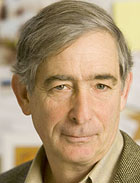 Stephen R. Kellert
environment in which the human species evolved. The new volume brings together the evidence, which is strongest in health care. In one study, for instance, spinal surgery patients in rooms with bright sunlight needed 22 percent less pain medication than patients in darker recovery rooms. But firm evidence of improvements in workplace productivity, absenteeism, employee retention and other bottom-line criteria is still too patchy for most companies to make the commitment to rethinking design.
Kellert himself recently put his biophilic ideas to the test at the Yale School of Forestry & Environmental Studies, where he’s the Tweedy/Ordway Professor of Social Ecology. As one of the driving thinkers in the design of the school’s new headquarters, opened early this year, he pushed successfully for use of wood surfaces from the school’s own forests, green courtyards, and many other biophilic features. Kellert has also served as an advisor to such prominent green building projects as Bank of America’s new office tower in midtown Manhattan, Goldman Sachs’ Jersey City campus, and the new Sidwell Friends Middle School campus in Washington, D.C.
After 30 years in academia, Kellert recently cut back on his teaching to join Environmental Capital Partners, a newly formed private equity firm, investing in companies offering green products and services. But, in an interview with Yale Environment 360, he admits that persuading his partners to invest in biophilic design is just a dream, for now.
Yale Environment 360: So let’s start with the status quo, can you talk about one building that really epitomizes what we’re doing wrong, that cuts people off from nature instead of connecting them to it?
Steven Kellert: One simple statistic is that the majority of people who work in office buildings in the United States work in a windowless environment. And look at the way we decorate or don’t decorate hospital rooms, for example. A good many of them are windowless, especially the older kinds. They’re barren. There’s not much attempt to incorporate any kind of organic — even simulated organic — characteristics. There’s a great recent study by Roger Ulrich. There are identical emergency room rooms. One is this windowless, barren environment, with nothing on the wall, and the barest, meanest of furnishings. And it’s a room that is characterized by hostility, anxiety, and even acting-out behavior. And then they transform the room — it’s the same room, still windowless, but they put décor in there that had natural materials, it had patterns on the couches that mimicked natural forms; they had pictures on the wall. I have a picture of the two side by side — and you only have to see it to recognize in yourself which place would you rather be, and the empirical data was dramatic. Less hostility, less aggression, less acting-out behavior, and this is not just amenity value, it’s actual performance and productivity.
The same thing occurs in the workplace. Why do people experience flagging morale and fatigue and higher absenteeism in these windowless environments? Why are they far far more likely to try to incorporate some kind of — usually fairly pathetic — but to incorporate some kind of expression of organic quality — they’ll have a Sierra Club calendar, they’ll have a potted plant, much more likely than say somebody working in a perimeter in a windowed environment. The problem is that that’s really superficial, there’s not really an experiential engagement, and so after a while even though you’ve got a beautiful Sierra Club calendar you barely see it anymore, it’s like your screensaver, which saves you for a little while and then it’s just background Muzak, or whatever.
e360: So what are two or three of the main things that buildings need to be doing to get people connected to nature, and that work well?
Kellert: Well the lowest hanging fruit, I like to say, because it’s the easiest thing do, is natural light and — to the extent that you can — natural ventilation helps. Certainly décor. A lot of what we’ve done from time immemorial in buildings is to contextualize our experience of nature in ways that we hardly even realize. When you go into a cathedral, which often has many biophilic elements in the way in which it manipulates light and space and air, and material and shape and form, and color sometimes as well, you know people don’t say “ah, nature,” it’s not obvious, it’s not a direct experiential contact with self-sustaining nature. It’s what I call vicarious or representational nature. A lot of this is retrieving things that we’ve done in the past, intuitively and instinctually, and I use the word advisedly, because I think these are biological tendencies, inclinations. As we became more machine-oriented and thought of the world as a human-engineered world, I think we’ve kind of lost sight of those needs.
e360: You’ve said at some point that we have laws to protect zoo animals from being kept in hostile environments. I wonder if we have laws that do the opposite for humans, that force us into unnatural and hostile environments?
Kellert: We have laws to protect animals from environments that we regard as psychologically degrading or depraved or debilitating. And the irony, those were humane laws, they were promulgated by organizations like the Humane Society of the United States, and now we try to create naturalistic habitats for these animals, because they’re animals, right, and we describe the conditions as inhumane, which to me is the ultimate irony. And yet we can put ourselves into a windowless environment, something that would have been considered like a Skinner box not too long ago, with very little stimulation, very little color, very little variability, very little that is organic in its simulation or form, and yet we don’t regard that as inhumane, which I think says volumes about how we don’t really see ourselves as like the animal in the cage, we are something different from an animal.
e360: In the book much of what you present as evidence is not about aesthetics, it’s about neurology and physiology. I’m thinking of the healthcare studies where patients in surgery had a 22 percent reduction in the use of painkillers when they were in more naturalistic recovery rooms.
Kellert: Why do people bring flowers to the hospital all the time? What good is it? It’s not a pill, it’s not—these flowers aren’t selected for their medicinal values, they haven’t been systematically examined for their pharmacological effects, and yet people do it. Is it just superficial? Is it just a nice gesture, nice but not important? I would suggest that it is a much deeper recognition of the healing effects associated with affirming life. I don’t think there’s a person on earth who doesn’t respond to a sunset, or to a beautiful flowering rose, or to a conical shape of a mountain.
And when you begin to look, you begin to see all sorts of adaptive and functional tendencies that can come out of that experiential response to aesthetics. Modern medicine sees ourselves as transcending and conquering nature, and all we needed was a machine that could intervene and make us well again, conquer, suppress, eliminate disease, and certainly we’ve done marvelous things with these machines. But we’ve also lost sight of some very fundamental aspects of health and healing, and consequently create these hospitals that are very often mechanistic to the point that they’re debilitating, and the evidence in this particular sphere is beginning to change some minds.
e360: The one thing missing in the evidence and that really matters most to builders and developers is, whether biophilic design affects cost and benefits, profit and loss”¦
Kellert: Right. There’s some evidence—it’s not completely absent. We’re doing a study right now for the eastern headquarters for Bank of America at Bryant Park [in mid-town Manhattan], and the builders, one of the authors in our biophilic design book”¦Bob Fox”¦he did incorporate some elements of biophilic design, in terms of fresh air, and natural light, and all kinds of experiential elements and materials used and so forth.
e360: The trading pit in that building is the only one, I think, that has daylight.
Kellert: Right, right, and we’re collecting data across a wide range of parameters from physical data to social data to psychological data. And we’re going to be able to measure whether there have been bottom line effects, absenteeism, health and symptomatology, productivity, retention — retention is a really important thing for a company like Bank of America, because it costs a lot to train people — and so we’ll have some of those indicators. My colleague on the Bank of American study did an office and factory study associated with the Herman Miller company, which is a furniture manufacturer, in which they were able to find significant productivity gains, less absenteeism, less health problems, a better sense of well-being as reported by the individuals that participated. And ultimately all of this translates to the bottom line.
I would prefer that we had even more subtle measures — critical thinking, problem solving, creativity, solidarity, if you will. Ultimately, those are the real tests of whether a company succeeds or not. Genzyme, which employs a lot of expensive Ph.D. types to do biotech work, built a new building, which doesn’t look much different from the outside, but when you go inside it’s got light and space, it’s got these little mini parks. They find people are working together more, and they’re working longer — only 20 minutes on average, but that’s a big factor from their point of view.
e360: Have you had a builder or a developer say “you’ve talked me into it”?
Kellert: I think that if the consumer of the product starts demanding it, that will drive change. If we depend on enlightened developers, that’s going to be very difficult. First of all, most of our development in the United States is kind of hit and run. It’s money coming from afar, that wants return on investment very quickly, and where the people who are investing the money and getting back returns on that money don’t really care about the productivity of those who are leasing the space. That sounds kind of callous, but they don’t care very much because they don’t reap the benefits.
e360: So the customer…
Kellert: So the customer has to believe that this is a better work environment, and that is a slow process. On the other hand, the first law of social life is contagion, and if you can get to that critical threshold where enough people believe this is the case, even if they think it’s just the fashion of the day, it can start to accelerate. And I believe that will occur.
e360: So let’s talk about architects. The book is pretty harsh, at times, on architects, even though you have architects among your authors. So how are your architects reacting to this?
Kellert: I think most are indifferent rather than hostile.
e360: Well, how do you get their attention?
Kellert: I know that when we did our session on biophilic design at the “Greenbuild Conference,” I thought we had been given a room that was too big, and that it was going to be embarrassing, because we’re going to have this room for seven or eight hundred people and there’d be a hundred there”¦ We filled the place up, and were turning people away.
e360: One of your authors has proposed a way to get architects thinking more along the biophilic design lines, and that is to have a biologist at the table. Architects already have to deal with so many people at the table when they’re building, what would one voice add?
Kellert: Part of our problem today is kind of promiscuous specialization, the engineer or contractor or architect or whatever the specialization is, focuses on their particular brand of knowledge and develops it to the nth degree without reference to other areas, and consequently it’s fragmented and we accomplish certain goals in that specialization, but it usually causes problems because it’s not integrated. And I think architecture is beginning to recognize that that model is broken and needs to be more interdisciplinary and there needs to be more collaboration and teamwork across different disciplines. So for example, a couple of architects in the book — Stephen Kieran with KieranTimberlake Associates, Bert Gregory with Mithun — have hired graduates of the [Yale] School of Forestry & Environmental Studies, without architecture degrees but who have a strong interest in design.
e360: You’ve recently started an investment firm with an environmental orientation. Are there companies that you have just shunned because they don’t get biophilia and biophilic design, and are there other companies that you embrace?
Kellert: I wish it were so. Our firm has a focus on environment and a focus on investment, on environmental investment. I’ve found out that the investment side has a capital letter and the environmental side is a lower case letter. I think we’ve partially done it, but not as much as I would like.
e360: So you sound like if we’re talking about the outlook for biophilic design for the next five or 10 years, maybe cautiously optimistic?
Kellert: I do think that we’re going to moving more and more in that direction, especially as the evidence becomes more demonstrative that this is not just an amenity value — pretty but not important. Everyone’s looking for an edge, everyone’s looking for a gain, that’s one thing that I’ve found in my foray into the economic world, is that competitive advantage in distinguishing your firm is so critical. And I think as it becomes clear that this gives you a competitive edge, you’ll see an accelerating implementation.
e360: You moved into a building [at the Yale School of Forestry and Environmental Studies] just recently that was designed and built with nature in mind. Has it changed things for you?
Kellert: Definitely, and I’ll give you an example. We had a conference up in the third floor, and it was celebrating the legacy of Aldo Leopold who is one of the iconic figures in the environmental field, and it was a dark stormy day, heavy rainfall, and people loved being in that room. You had the refuge of the room, but you had the prospect and enjoyment of looking out at nature. You felt like there was this dialogue between inside and outside that was so stimulating, affirmative. Certainly for the occupants of the building, the users of the building, there appears to be a tremendously positive reception, not just because it’s more energy efficient, but because people really like to be there. And to me that will be the motivation to sustain the building, because the technology comes and goes in terms of how efficient it is. Ten years from now, technology we put in there to make it energy efficient will be eclipsed by far more sophisticated technology. But whether people will maintain that building and modernize the building and restore it will be because they really love the space.
e360: Because the connection to nature is there.
Kellert: I’m convinced of it.