25 Sep 2008: Report

Revenge of the Electric Car

After years of false starts and failures, the electric car may finally be poised to go big-time. With automakers from GM to Chrysler to Nissan preparing to roll out new plug-in hybrids or all-electric models, it looks like the transition from gasoline to electricity is now irreversible.

by jeff goodell

The recent high-profile unveiling of the Chevrolet Volt, the hybrid electric car that General Motors hopes will roll into dealer showrooms in late 2010 and rescue the automaker from near-bankruptcy, felt like the opening credits of a movie we’ve seen before.

After all, there’s nothing new about electric cars, hybrid or otherwise – 100 years ago, there were more electric cars on the road than gas-powered ones. Henry Ford even bought an electric car for his wife, Clara.

But the story of the 20th century (or one chapter of it, anyway) is the story of the triumph of the internal combustion engine. Periodic attempts to revive the plug-in cars have met with failure, or have been willfully squashed (check out Chris Paine’s excellent 2006 documentary Who Killed the Electric Car?).
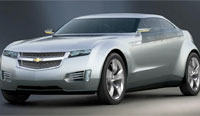
Chevy Volt
Chevrolet
The Chevrolet Volt, the hybrid electric car that General Motors hopes will roll into dealer showrooms in late 2010.
Shortly after the Volt was introduced, GM executive Bob Lutz nearly killed GM’s born-again mojo when he admitted in a TV interview that when it comes to global warming, “I don’t believe in the CO2 theory.” So much for enlightened corporate leadership. But does that mean the Volt is just a repeat of the same old movie?

No. For one thing, GM – which lost $15 billion in a single quarter this year – isn’t the only company betting its future on electric cars. Virtually every carmaker in the world, from Chrysler to Nissan to Chery, the upstart Chinese automaker, has announced plans to shift away from internal combustion engines toward electric drives.

Today’s hybrids follow the model of the Toyota Prius, which uses batteries and an electric motor to assist the gas engine. Tomorrow’s plug-in hybrids – starting with the Volt – will flip this around, using the electric motor as the primary drive, with the gas engine on board simply as a range-extending generator to charge up the battery. If you drive less than about 40 miles a day, you’ll never need the engine – the gas station will be replaced by the outlet in your garage.

Some carmakers, including big players like Nissan and Silicon Valley start-ups like Tesla Motors, are moving straight to all-electric cars. Within the industry, there is much debate about the virtues of plug-in hybrids vs. all-electric cars, but either way, says Willett Kempton, who has been studying electric cars for more than a decade at the University of Delaware, “the transition from gasoline to electricity is now irreversible.”

In the world today, electrons are easier to come by than hydrocarbons. To get oil, you have to drill thousands of feet below the surface of the earth – often in a hostile nation – pump it up, refine it, ship it (via pipeline or tanker), then store it until somebody comes along with a thirsty SUV. All in all, an expensive and rigid system. Electrons, on the other hand, come from many places: wind turbines, solar panels, hydroelectric dams, nukes and even burning coal. This simple fact upends everything. With electric cars, we’re not dependent on sheiks in the Middle East. We’re dependent on our own ingenuity.

A secondary virtue of the shift from atoms to electrons is that an electric motor is three to four times better at converting energy into motion than an internal combustion engine. In fact, the amount of electricity it takes to push an electric car down the road is surprisingly small.

“In a typical day, an electric car uses about as much electricity as four plasma TVs,” says Mark Duvall, the head of the electric car program at the Electric Power Research Institute in Palo Alto, California.
In a typical day, an electric car uses about as much electricity as four plasma TVs.


This means that, for the foreseeable future, we don’t need to add a lot of generating capacity to the grid in order to meet the demand for electric cars. (Mike Morris, the chairman and CEO of American Electric Power, believes that up to 20 percent of the U.S. vehicle fleet could be switched over to plug-in hybrids without overtaxing the existing grid.) And higher efficiencies all along the energy supply chain mean that switching from gas to electric cars does not simply shift pollution from the tailpipe to a distant power plant.

Even on a grid that’s 100 percent coal-fired, overall CO2 emissions – that is, including pollution from mining and burning coal – with a plug-in car would be lower than overall emissions from a similar-sized car with an internal combustion engine.

According to a recent study by the Electric Power Research Institute and the Natural Resources Defense Council, widespread adoption of plug-in hybrids could reduce annual emissions of greenhouse gases by more than 450 million tons by 2050, the equivalent of taking more than one-third of today’s cars and light-duty trucks off the road.

Of course, the cleaner the grid, the lower the emissions. But electric cars can help here, too.

One of the big problems with renewables is intermittency: The sun doesn’t always shine, the wind blows at the wrong time. For electric cars, this is not a problem.

In Texas, for example, the wind blows most strongly at night – exactly when the power isn’t needed. But what if that power could be used to charge electric cars sitting in the garage?

“Plug-in vehicles are a way of changing from Middle Eastern oil to west Texas wind as a transportation fuel,” says Austan Librach, director of emerging transportation technologies at Austin Energy, a large utility in Austin, Texas, that has long promoted the use of electric vehicles.

In Denmark, 20 percent of the electricity is generated by wind – “it is a perfect match for electric cars,” says Torben Holm, a consultant at DONG Energy, the country’s largest electric power provider. DONG recently announced a deal with Renault and Better Place, a Silicon Valley start-up, to bring electric cars to Denmark. According to Holm, a single 2-megawatt wind turbine generates enough electricity to power 3,000 cars.

In the near term, however, the most important benefit of electric cars is that they will accelerate the deployment of the so-called “smart grid.” In fact, plug-in vehicles may be to the smart grid what Halo was to the Xbox: the killer app that drives everybody to want one.

The problem with our electric grid today is not just that it is big and dirty, but that it is big and dirty and dumb. We burn energy and have no idea where it is coming from.

“The most revolutionary thing about the Prius,” says Dan Dudek, chief economist for Environmental Defense Fund, “is not the hybrid engine. It’s the monitor on the dash that shows you your energy consumption in real time. It turns us all into savvy consumers, because we see the reaction in real time to our driving. Imagine if we had that for the rest of our energy consumption?”

If electric cars are going to work, the grid has to evolve into something that looks more like the Internet, with two-way communication and lots of data and context. For car owners, a smart grid will help them track exactly how much electricity they’re consuming and what it costs (just like at a gas pump). For utilities, a smart grid will help manage demand – preventing big power surges at 6 p.m., when everyone comes home and plugs their car in, is a major concern – as well as open the door to a variety of new services, from innovative pricing packages to energy management programs for your home and business.

But the real promise of a smart grid is the ability to turn electric cars into a rolling fleet of batteries that can be tapped on demand, feeding power back into the grid.
A smart grid could have the ability to turn electric cars into a rolling fleet of batteries that can be tapped on demand.


“For utilities, the economics of vehicle-to-grid are incredibly compelling,” says Willett Kempton.

According to Kempton, the richest market is in frequency regulation of the grid – that is, feeding in small amounts of power to keep the balance between electricity production and demand steady – which he estimates could amount to a market of $10 billion a year in the United States alone.

There is also money to be made in supplying power for peak-load demands on hot summer days, when everyone cranks the A/C.

“In Sacramento, we have 400 megawatts of power that we use four days a year,” says Bill Boyce, the transportation supervisor at Sacramento Municipal Utility District in California. “Instead of keeping these power plants around, what if we could draw that 400 megawatts from parked cars? This is an idea we’re very interested in pursuing.”

So are plenty of other progressive power companies. Southern California Edison, Austin Energy, Duke Energy, Wisconsin Power, Excel Energy, and Pacific Gas & Electric – to name just a few – all have pilot programs to learn more about how to integrate plug-in vehicles with the grid.

Of course, all this is still a long way off.

“It’s hard to overestimate the inertia of the old system, and how resistant many people are to change,” says Tom Turrentine, head of the Plug-in Hybrid Electric Vehicle Research Center at the University of California at Davis. A recent MIT study on the future of the car suggested plug-in vehicles might capture, at best, 15 percent of the light-duty vehicle market (passenger cars and SUVs) by 2035.

One big uncertainty, obviously, is the price of oil – how high will it rise, and how fast? Another is the cost and reliability of batteries. Much of the optimism about electric cars is based on assumptions that batteries will evolve like microprocessors, with rapidly declining costs and rising performance.

But what if that turns out to be a false analogy? The revolution could also be derailed by a VHS-vs.-Betamax-type battle over plug and battery standards.

And in the long run, the happy vision of an OPEC-free world could be tarnished by the monopolistic impulses of electric power companies.

Clearly, dealing with the twin challenges of peak oil and global warming will require far deeper, more radical changes in our lives than simply jumping from gas cars to electric. As for GM’s Volt, despite all the hype it’s getting today, it could look like yesterday’s news by the time it finally rolls into dealer showrooms. But Chris Paine, director of Who Killed the Electric Car?, isn’t betting against it. In fact, he’s already working on a sequel. It’s called Revenge of the Electric Car.

POSTED ON 25 Sep 2008 IN Business & Innovation Climate Energy Oceans Antarctica and the Arctic North America North America 

COMMENTS


This article gives us yet another reason to hope that oil prices stay high and keep on rising. As Mr. Goodell rightly points out, the necessary new technologies will only come about if the market provides the incentives to develop them.
Posted by Alan Freund on 25 Sep 2008


Great article. Actually, I learned a lot about the recent developments in electric auto development that I didn't know (though I can trade the buzz-words with the best of 'em!), so many thanks.

This wasn't the point of the article, but one problem I foresee with general acceptance of electric cars is the design issues. It IS possible to create a damn good looking electric car (tesla) but I think a lot of people are still thinking along the lines of "Pruis" aesthetics (the recent uproar over the Volt's design change is a good indicator of this).

But, with recent gas prices EVERYONE is thinking in terms of MPG. And online gadgets such as Mini-cooper's carfunfootprint.com site give issues like fuel efficiency and carbon emissions (simplified as "green" scores) a flair and portability that the EPA lacks (though it's hard to criticize them on those grounds). In short, electric cars and hybrids are not quite hippie-mobiles anymore. If we really want to change things we need to start giving electric technology a kind of "sex appeal," if you will.
Posted by dan stanton on 26 Sep 2008


To achieve meaningful GHG benefits from this technology, it will be essential to increase the rate of market penetration. To make these vehicles accessible to more than the current market of Pruis buyers, the industry will need support in offsetting the incremental cost of the battery technology. This could be accomplished by shifting the current tax scheme for funding the national transportation network from taxes on liquid fuels to taxes on carbon emissions. The tex should be set at a level that replaces the current federal gasoline tax with a tax on carbon emitted to provide a meaningful fuel tax benefit for users of the grid as a fuel source. Tax savings would reduce 10-year operating costs by about $1200 to provide a partial operating cost incentive along with the lower electric power cost savings of $2.00 per gallon avoided for a driver who operates solely off the battery. A climate impact fee could be added to the purchase cost of new liguid fueled vehicles to buy old GHG emitters from current owners to increase demand for the new hybrids. Without these kinds of incentives, a 15% penetration rate by 2035 will provide no meaningful GHG benefit.
Posted by Bob Yuhnke on 27 Sep 2008


One of the best essays on the subject to date, and
I've read them all. Good work, Jeff Goodell, I'll
send this one wide.

Posted by Paul Scott on 01 Oct 2008


“It’s hard to overestimate the inertia of the old
system, and how resistant many people are to
change,” says Tom Turrentine, head of the Plug-in
Hybrid Electric Vehicle Research Center at the
University of California at Davis."


Jeff: Do you have this quote right? Did Tom mean
"underestimate" or you are implying that the MIT
study is too conservative?
Posted by APB on 07 Oct 2008


The quote is correct (I double-checked). The
implication is that the MIT study may accurately
reflect the difficulty of shifting our existing fleet
over to plug-in hybrids. In other words, this is
not the iPhone revolution writ large.
Posted by Jeff Goodell on 08 Oct 2008


Very informative and hopeful article. I'd like to see more emphasis on conversion as we have millions and millions of quite serviceable cars on the road (including mine) and if the best ones could be converted, I think it would prevent megatons of waste.

For tips and info about saving money & energy in your home and lifestyle, see my Project HOUSE website (Household Opportunity to Upgrade & Save the Environment).
Posted by Marjorie Campaigne on 29 Oct 2008


If the electric car is really successful and reduces the demand for petroleum the price of petroleum is likely to drop. President Gerald Ford first recognized that dropping petroleum prices could damage the domestic energy industry and proposed various forms of taxes and fees to prevent this.

The supply-demand vs. price curve for petroleum is very steep. Recently, as small reduction in consumption has resulted in a large reduction in oil price. Gerald Ford proposed that any additional tax on oil be revenue neutral, i.e. returned to taxpayers in the form of other tax reductions.

We need to reconsider these issues because any program that significantly reduces oil consumption could reduce prices to the point that the alternative programs are priced out of business. This happened in the 80's to the shale oil industry, which was driven into bankruptcy.
Posted by David Rubin on 29 Oct 2008


Comments have been closed on this feature.
jeff goodellABOUT THE AUTHOR
Jeff Goodell's latest book, Big Coal: The Dirty Secret Behind America's Energy Future, was chosen as one of the best nonfiction books of 2006 by Kirkus Reviews. He is the author of three previous books, including Sunnyvale, a memoir about growing up in Silicon Valley, and Our Story, an account of nine miners trapped in a Pennsylvania coal mine. A contributing editor at Rolling Stone, his work has appeared in The New Republic, The Washington Post, The New York Times Magazine, and Wired. His most recent article for Yale e360 was about new coal technologies.
MORE BY THIS AUTHOR


RELATED ARTICLES


Solar Windows: Transforming
Buildings Into Energy Producers

The vast amount of glass in skyscrapers and office buildings represents enormous potential for an emerging technology that turns windows into solar panels. But major questions remain as to whether solar windows can be sufficiently inexpensive and efficient to be widely adopted.
READ MORE

In Fast-Track Technology, Hope
For a Second Green Revolution

With advances in a technique known as fast-track breeding, researchers are developing crops that can produce more and healthier food and can adapt and thrive as the climate shifts.
READ MORE

For the Electric Car,
A Slow Road to Success

The big electric car launches of 2011 failed to generate the consumer excitement that some had predicted. But as new battery technologies emerge and tougher mileage standards kick in, automakers and analysts still believe that electric vehicles have a bright future.
READ MORE

Building a Better Bulb:
Lighting Revolution Advances

With the industry’s support and despite political opposition, new U.S. lighting efficiency standards went into effect this month. This move, along with similar actions in Europe and China, is helping spur new technologies that will change the way the world's homes and businesses are illuminated.
READ MORE

A Revolutionary Technology is
Unlocking Secrets of the Forest

A new imaging system that uses a suite of airborne sensors is capable of providing detailed, three-dimensional pictures of tropical forests — including the species they contain and the amount of CO2 they store — at astonishing speed. These advances could play a key role in preserving the world’s beleaguered rainforests.
READ MORE


MORE IN Reports


Africa’s Ambitious Experiment
To Preserve Threatened Wildlife

by caroline fraser
Five nations in southern Africa are joining together to create a huge conservation area that will extend across their borders and expand critical territory for elephants. But can these new protections reverse decades of decline for area wildlife while also benefiting the people who live there?
READ MORE

Melting Sea Ice Could Lead
To Pressure on Arctic Fishery

by ed struzik
With melting sea ice opening up previously inaccessible parts of the Arctic Ocean, the fishing industry sees a potential bonanza. But some scientists and government officials have begun calling for a moratorium on fishing in the region until the true state of the Arctic fishery is assessed.
READ MORE

Solar Windows: Transforming
Buildings Into Energy Producers

by dave levitan
The vast amount of glass in skyscrapers and office buildings represents enormous potential for an emerging technology that turns windows into solar panels. But major questions remain as to whether solar windows can be sufficiently inexpensive and efficient to be widely adopted.
READ MORE

Fighting A Last-Ditch Battle
To Save the Rare Javan Rhino

by rhett butler
Rhinoceroses worldwide are under siege as their habitat shrinks and poachers slaughter hundreds annually for their valuable horns. Now, in Indonesia, conservation groups are engaged in a desperate struggle to save the last 40 Javan rhinos on earth.
READ MORE

Insurance Companies Face
Increased Risks from Warming

by ben schiller
If the damages related to climate change mount in the coming decades, insurance companies may face the prospect of paying larger disaster claims and being dragged into global warming lawsuits. But many firms, especially in the U.S., have barely begun to confront the risks.
READ MORE

Hopes Fade for Cleanup
In Nigeria’s Oil-Rich Delta

by fred pearce
The Ogoniland region of Nigeria has long been badly polluted by decades of oil production that has fouled the delta and contaminated drinking water. A United Nations report has recommended a massive recovery initiative, but so far the Nigerian government has shown few signs it will agree to the cleanup project.
READ MORE

Betting on Technology to
Help Turn Consumers Green

by marc gunther
U.S. consumers tell researchers they want to buy environmentally friendly products, but so far they haven’t been doing that on a large scale. Now a host of companies and nonprofits are trying to use new technology — from smartphones to social networking — to make it easier for buyers to make the green choice.
READ MORE

U.S. Fossil Fuel Boom
Dims Glow of Clean Energy

by keith schneider
A surge in gas and oil drilling in the U.S. is helping drive the economic recovery and is enhancing energy security. But as the situation in Ohio shows, cheaper energy prices and the focus on fossil fuels has been bad news for the renewable energy industry.
READ MORE

Can Reforming the Farm Bill
Help Change U.S. Agriculture?

by jim robbins
For decades, farm bills in the U.S. Congress have supported large-scale agriculture. But with the 2012 Farm Bill now up for debate, advocates say seismic shifts in the way the nation views food production may lead to new policies that tilt more toward local, sustainable agriculture.
READ MORE

Scientists Warn of Low-Dose
Risks of Chemical Exposure

by elizabeth grossman
A new study finds that even low doses of hormone-disrupting chemicals — used in everything from plastics to pesticides – can have serious effects on human health. These findings, the researchers say, point to the need for basic changes in how chemical safety testing is conducted.
READ MORE


e360 digest
Yale
Yale Environment 360 is
a publication of the
Yale School of Forestry
& Environmental Studies
.

SEARCH e360


Donate to Yale Environment 360

CONNECT

Twitter: YaleE360
e360 on Facebook
Donate to e360
View mobile site
Bookmark
Share e360
Email newsletter
Subscribe to our feed:
rss


ABOUT

About e360
Contact
Submission Guidelines
Reprints

e360 VIDEO

Warriors of Qiugang
The Warriors of Qiugang, a Yale Environment 360 video that chronicles the story of a Chinese village’s fight against a polluting chemical plant, was nominated for a 2011 Academy Award for Best Documentary (Short Subject). Watch the video.


DEPARTMENTS

Opinion
Reports
Analysis
Interviews
e360 Digest
Video Reports

TOPICS

Biodiversity
Business & Innovation
Climate
Energy
Forests
Oceans
Policy & Politics
Pollution & Health
Science & Technology
Sustainability
Urbanization
Water

REGIONS

Antarctica and the Arctic
Africa
Asia
Australia
Central & South America
Europe
Middle East
North America

e360 VIDEO REPORT

When the Water Ends
As temperatures rise and water supplies dry up, tribes in East Africa increasingly are coming into conflict. A Yale Environment 360 video reports on a phenomenon that could become more common: how worsening drought will pit groups — and nations — against one another. Watch the video.

e360 MOBILE

Mobile
The latest
from Yale
Environment 360
is now available for mobile devices at e360.yale.edu/mobile.


header image
Top Image: aerial view of Iceland. © Google & TerraMetrics.

e360 VIDEO REPORT

Leveling Appalachia
Leveling Appalachia: The Legacy of Mountaintop Removal Mining, an e360 video examining the environmental and human impacts of this mining practice, won the award for best video in the 2010 National Magazine Awards for Digital Media. Watch the video.


OF INTEREST


Yale