26 Aug 2010: Report

Spurred by Warming Climate,
Beetles Threaten Coffee Crops

Coffee production has long been vulnerable to drought or excess rains. But recently, a tiny insect that thrives in warmer temperatures — the coffee berry borer — has been spreading steadily, devastating coffee plants in Africa, Latin America, and around the world.

by erica westly

The highlands of southwestern Ethiopia should be ideal for growing coffee. After all, this is the region where coffee first originated hundreds of years ago. But although coffee remains Ethiopia’s number one export, the nation’s coffee farmers have been struggling.

The Arabica coffee grown in Ethiopia and Latin America is an especially climate-sensitive crop. It requires just the right amount of rain and an average annual temperature between 64 degrees Fahrenheit and 70 degrees Fahrenheit to prosper. As temperatures rise — Ethiopia’s average low temperature has increased by about .66 degrees F every decade since 1951, according to the country’s National Meteorological Agency — and rains become more variable, Ethiopian coffee farmers have suffered increasingly poor yields. Last year was especially bad, with exports dropping by 33 percent. Some have moved their coffee trees to higher elevations, while others have been forced to switch to livestock and more heat-tolerant crops, such as enset, a starchy root vegetable similar to the plantain.
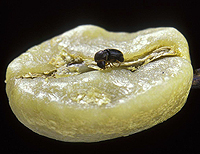
Now, there is evidence that a warming climate may be linked to one of the major threats facing the coffee industry in Ethiopia and elsewhere: A tiny insect known as the coffee berry borer beetle has been devastating coffee plants around the world, and new research suggests even slight temperature increases promote the spread of the pest.

The beetle is a relatively recent problem in Ethiopia and Latin America, where most Arabica coffee is grown. A field survey of Ethiopia’s coffee-growing regions conducted in the late 1960s found no trace of the beetle, but in 2003 researchers reported that the pest was widespread. Drought and heavy rains during harvest time may be the prevailing problems for coffee growers in Ethiopia and other countries; but the lack of an effective treatment for the coffee berry borer is cause for concern, especially given new research findings tying the spread of the beetle to rising temperatures.

Coffee may not be a basic food crop, such as wheat, but it is arguably one of the most important agricultural products. Valued as high as $90 billion a year, coffee, which is grown in more than 70 countries, is one of the most heavily traded commodities in terms of monetary value. Seventy percent of the world’s coffee comes from small, family-owned farms and more than 100 million people are dependent on the crop for their livelihood. Researchers estimate that the coffee berry borer causes more than $500 million in damages each year, making it the most costly pest affecting coffee today. Coffee growers have tried various tactics to stop the beetle, but to little avail. Pesticides don’t help, and even if they did, they are an unfavorable option, given their negative effects on coffee quality.

Until recently, the coffee berry borer was confined to just a few regions in Central Africa. But since the 1980s, the beetle has gradually spread to every
Since the 1980s, the beetle has spread to every coffee-growing region except Hawaii, Nepal, and Papua New Guinea.
coffee-growing region except Hawaii, Nepal, and Papua New Guinea. Juliana Jaramillo, a biologist at Kenya’s International Center of Insect Physiology and Ecology, suspects temperature increases are to blame. She and her collaborators recently identified the temperature range in which the beetle can survive. They found that the average minimum temperature the borer requires to reproduce is about 68 degrees F, and the mountainous regions of Ethiopia did not reach that temperature until 1984.

The borer did not appear in Colombia, Jaramillo’s native country, until 1988, but it has since become a persistent problem. Twenty years ago, Colombia was the second-largest coffee exporter in the world, and regularly sent abroad more than 12 million bags of Arabica coffee each year. But production has not reached that level since 1994, and 2009 was the country’s worst year ever. At an International Coffee Organization meeting in February, a Colombian coffee representative revealed that the country’s coffee exports had dipped to 7.9 million bags last year and that infestation by the borer — along with excessive rainfall and reduced application of fertilizer — was partly to blame.

Eliminating the coffee berry borer has become Jaramillo’s mission. She grew up in the picturesque Caldas region — the heart of Colombia’s coffee country — and her family still maintains a small coffee farm there. “It’s really a personal problem for me,” she said.

After establishing the temperature limits of the borer, Jaramillo and her colleagues used climate data to estimate the number of reproductive cycles the beetle could complete annually in four coffee-growing regions. While Ethiopia was on the low end, with only one to two generations per year,
For every 1.8 degree F increase, Colombian coffee growers will have to move up 550 feet in altitude.
Colombia was one of the highest, supporting up to 4.7 generations of the borer in one year. Jaramillo believes the discrepancy is largely due to Colombia’s year-long growing season. Coffee plants are most susceptible to pests when they’re flowering, so regions that receive rain all year, such as Colombia, are more vulnerable to the borer than those with distinct dry and rainy periods, such as Ethiopia and Kenya. Female borers kill coffee plants by burrowing into coffee berries to lay their eggs. (Each female can lay up to 200.) The resulting damage attracts herbivores and pathogens. In Latin America, the pest is known simply as la broca, which means “the drill.”

In their research, Jaramillo and her collaborators found that for every 1.8 degrees F increase in temperature, the coffee berry borer became 8.5 percent more infectious on average. Not only did the female beetles lay more eggs at higher temperatures, but they also drilled deeper into coffee berries, causing more physical damage. A follow up study, published this year in the Journal of Economic Entomology, found that higher temperatures also caused the female beetles to travel from berry to berry earlier.
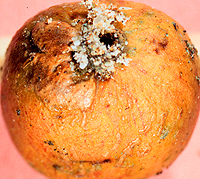
Even more troubling, Jaramillo’s data indicate that the beetle can survive in a dormant state in sub-tropical conditions. That means farmers will not be able to escape the pest by moving to higher altitudes. Indeed, researchers in Uganda and Indonesia have already started finding the borer as high as 6,115 feet above sea level; the beetle is typically only found at 4,000 to 5,000 feet above sea level.

“Coffee is migrating,” said Dean Cycon, owner of Dean’s Beans, a Massachusetts-based specialty coffee company that works with farmers around the world. “As it’s getting hotter at the lower altitudes, the lower plants are dying off, so it marches the coffee forest up the slopes.” Jaramillo’s research indicates that the borers are migrating with the coffee plants.

Jaramillo’s father, Alvaro Jaramillo — a climatologist at the National Coffee Research Center in Manizales, Colombia — has calculated that for every 1.8 degrees F increase in temperature, Colombian coffee growers will have to move their plants up about 550 feet in altitude to maintain current levels of quality and quantity.

The coffee berry borer could also be more difficult to control at higher altitudes since moving a pest into a new ecosystem makes its behavior
Coffee growers need new strategies to combat threats such as the borer, and that requires research.
harder to predict. For example, insects that could serve as natural enemies to the coffee berry borer may not interact with the beetle in the same way at higher elevations. “Natural enemies can be very useful in pest control, but their cycle has to be in sync with the pest’s,” said Curtis Petzoldt, a researcher at Cornell University’s Integrated Pest Management Program.

Traditionally, the cooling effects of shade trees have provided some of the best protection from coffee pests, including the coffee berry borer. Studies have shown shade trees can reduce the temperature around coffee leaves by 3 degrees F to 7 degrees F, depending on the environment. There is also evidence that shade-grown coffee plants produce higher-quality coffee. But many coffee growers have cut down the trees around their coffee plants in order to increase sun access.

“There is a dogma that sun-grown coffee produces higher yields than shade-grown coffee,” explained Fernando Vega, a coffee researcher at the U.S. Department of Agriculture and Jaramillo’s main collaborator. And consistently dwindling supplies can make farmers desperate. “If you’re getting a lesser crop — and in many of the countries they are — there’s more fear that you have to grab every percentage you can,” said Cycon.

MORE FROM YALE e360

What’s Killing the Great
Forests of the American West?

What’s Killing the Great Forests of the American West?
Across western North America, huge tracts of forest are dying off at an extraordinary rate, mostly because of outbreaks of insects. Scientists are now seeing such forest die-offs around the world and are linking them to changes in climate, science journalist Jim Robbins reports.
READ MORE
But shade trees can take years to grow, and while some coffee retailers, including Starbucks, have started promoting shade-grown coffee, it’s still the exception rather than the rule. The notion of sustainable growing practices has also become popular with coffee importers, but these forward-looking efforts, which focus largely on conserving water and reducing carbon emissions, do little to address the climate-related problems that coffee growers are now facing.

Coffee farmers need new strategies to combat threats such as the coffee berry borer, Jaramillo said, and that requires research. “I think the coffee industry has two options,” she said. “Either they start investing in climate research, or they educate the consumers to drink something else.”

POSTED ON 26 Aug 2010 IN Climate Policy & Politics Science & Technology Africa Central & South America Central & South America 

COMMENTS


A very important story, and beautifully written. You
might like to see some of the issues also arising of
late at the intersection of energy and agriculture.
see www.gregor.us

Your story suggests certain thresholds have been
crossed. The notion of temperate bands, or other
delicate zones or ledges suffering dislocation is
becoming more common and not just from
temperature change.

G
Posted by Gregor Macdonald on 05 Sep 2010


Had my attention until it turned into an infomercial for AGW fund raising. I see the new eco-fascist mantra is "Grab them by the lattes and their hearts and minds will follow".

Posted by Shoshin on 30 Sep 2010


Just for the record. The coffee berry borer is now in Hawaii. Kona in particular.

Posted by Barry on 04 Nov 2010


The coffee berry borer is simmerly related to the pine beetle and other similar tree borers and it has been found that when the trees are properly sprayed with environmentally friendly products and fed with local products raising the "Brix" level in the trees, the beetles will not endanger the trees and the trees will prosper. Also other products can be used on the trees which will convince the borers that the trees are healthy and also some available products will disable the beetles.

Posted by James F. Holland on 08 Nov 2010


POST A COMMENT

Comments are moderated and will be reviewed before they are posted to ensure they are on topic, relevant, and not abusive. They may be edited for length and clarity. By filling out this form, you give Yale Environment 360 permission to publish this comment.

Name 
Email address 
Comment 
 

erica westlyABOUT THE AUTHOR
Erica Westly is a freelance science writer based in Brooklyn, New York. Her work has appeared in numerous publications, including Scientific American, Slate, and the New York Times.
MORE BY THIS AUTHOR


RELATED ARTICLES


In Fast-Track Technology, Hope
For a Second Green Revolution

With advances in a technique known as fast-track breeding, researchers are developing crops that can produce more and healthier food and can adapt and thrive as the climate shifts.
READ MORE

Monitoring A Grim Rise
In the Illegal Ivory Trade

For two decades, TRAFFIC’s Tom Milliken has tracked the illicit ivory trade that has led to the continued slaughter of Africa’s elephants. In an interview with Yale Environment 360, Milliken talks about the recent increase in ivory seizures and the criminal gangs that supply Asia’s black market for ivory.
READ MORE

As Roads Spread in Rainforests,
The Environmental Toll Grows

From Brazil to Borneo, new roads are being built into tropical forests at a dizzying pace, putting previously intact wilderness at risk. If we hope to preserve rainforests, a leading researcher says, new strategies must be adopted to limit the number of roads and reduce their impacts.
READ MORE

A Development Expert Relies
On the Resilience of Villagers

Geographer Edward Carr has worked extensively in sub-Saharan Africa, where climate change and other environmental threats present a growing challenge. In an interview with Yale Environment 360, Carr talks about why any outside aid to the developing world must build on the inherent capability of the local residents.
READ MORE

What Rising Temperatures May
Mean for World’s Wine Industry

Warming temperatures associated with climate change are already affecting vineyards from France to Chile, often in beneficial ways. But as the world continues to warm, some traditional winemaking regions are scrambling to adapt, while other areas see themselves as new wine frontiers.
READ MORE


MORE IN Reports


In Fast-Track Technology, Hope
For a Second Green Revolution

by richard conniff
With advances in a technique known as fast-track breeding, researchers are developing crops that can produce more and healthier food and can adapt and thrive as the climate shifts.
READ MORE

A Vast Canadian Wilderness
Poised for a Uranium Boom

by ed struzik
Canada’s Nunavut Territory is the largest undisturbed wilderness in the Northern Hemisphere. It also contains large deposits of uranium, generating intense interest from mining companies and raising concerns that a mining boom could harm the caribou at the center of Inuit life.
READ MORE

For the Electric Car,
A Slow Road to Success

by jim motavalli
The big electric car launches of 2011 failed to generate the consumer excitement that some had predicted. But as new battery technologies emerge and tougher mileage standards kick in, automakers and analysts still believe that electric vehicles have a bright future.
READ MORE

Building a Better Bulb:
Lighting Revolution Advances

by dave levitan
With the industry’s support and despite political opposition, new U.S. lighting efficiency standards went into effect this month. This move, along with similar actions in Europe and China, is helping spur new technologies that will change the way the world's homes and businesses are illuminated.
READ MORE

Florida Counties Band Together
To Ready for Warming’s Effects

by michael d. lemonick
While U.S. action on climate change remains stalled, four south Florida counties have joined forces to plan for how to deal with the impacts — some of which are already being felt — of rising seas, higher temperatures, and more torrential rains.
READ MORE

As Fukushima Cleanup Begins,
Long-term Impacts are Weighed

by winifred bird
The Japanese government is launching a large-scale cleanup of the fields, forests, and villages contaminated by the Fukushima nuclear disaster. But some experts caution that an overly aggressive remediation program could create a host of other environmental problems.
READ MORE

What Rising Temperatures May
Mean for World’s Wine Industry

by john mcquaid
Warming temperatures associated with climate change are already affecting vineyards from France to Chile, often in beneficial ways. But as the world continues to warm, some traditional winemaking regions are scrambling to adapt, while other areas see themselves as new wine frontiers.
READ MORE

Can ‘Climate-Smart’ Agriculture
Help Both Africa and the Planet?

by fred pearce
One idea promoted at the Durban talks was “climate-smart agriculture," which could make crops less vulnerable to heat and drought and turn depleted soils into carbon sinks. The World Bank and African leaders are backing this new approach, but some critics are skeptical that it will benefit small-scale African farmers.
READ MORE

Camera Traps Emerge as
Key Tool in Wildlife Research

by jeremy hance
Scientists and conservationists are increasingly relying on heat- and motion-activated camera traps to study rare or reclusive species in remote habitats. And the striking images they provide are proving to be a boon for raising conservation awareness worldwide.
READ MORE

Sweden’s Green Veneer Hides
Unsustainable Logging Practices

by erik hoffner
Sweden has a reputation as being one of the world’s most environmentally progressive nations. But its surprisingly lax forestry laws often leave decisions about logging to the timber companies — and as a result, large swaths of biologically-rich boreal forest are being lost.
READ MORE


e360 digest
Yale
Yale Environment 360 is
a publication of the
Yale School of Forestry
& Environmental Studies
.

SEARCH e360


Donate to Yale Environment 360

CONNECT

Twitter: YaleE360
e360 on Facebook
Donate to e360
View mobile site
Bookmark
Share e360
Email newsletter
Subscribe to our feed:
rss


ABOUT

About e360
Contact
Submission Guidelines
Reprints

e360 VIDEO

Warriors of Qiugang
The Warriors of Qiugang, a Yale Environment 360 video that chronicles the story of a Chinese village’s fight against a polluting chemical plant, was nominated for a 2011 Academy Award for Best Documentary (Short Subject). Watch the video.


DEPARTMENTS

Opinion
Reports
Analysis
Interviews
e360 Digest
Video Reports

TOPICS

Biodiversity
Business & Innovation
Climate
Energy
Forests
Oceans
Policy & Politics
Pollution & Health
Science & Technology
Sustainability
Urbanization
Water

REGIONS

Antarctica and the Arctic
Africa
Asia
Australia
Central & South America
Europe
Middle East
North America

e360 VIDEO REPORT

When the Water Ends
As temperatures rise and water supplies dry up, tribes in East Africa increasingly are coming into conflict. A Yale Environment 360 video reports on a phenomenon that could become more common: how worsening drought will pit groups — and nations — against one another. Watch the video.

e360 MOBILE

Mobile
The latest
from Yale
Environment 360
is now available for mobile devices at e360.yale.edu/mobile.


header image
Top Image: aerial view of Iceland. © Google & TerraMetrics.

e360 VIDEO REPORT

Leveling Appalachia
Leveling Appalachia: The Legacy of Mountaintop Removal Mining, an e360 video examining the environmental and human impacts of this mining practice, won the award for best video in the 2010 National Magazine Awards for Digital Media. Watch the video.


OF INTEREST


RESOURCES


Yale