03 Jun 2008: Opinion

States Take the Lead on Climate

With the Bush Administration and Congress failing to act, many states are devising sweeping climate and energy policies that could be a blueprint for a future national climate policy.

by michael northrop and david sassoon

The federal government in the Bush era has done little to tackle our most pressing environmental problem — climate change. Yet there is one bright side amid Washington’s inaction: Many states have been stepping into the void and adopting comprehensive climate change policies that can be a model for the coming federal legislation to slow global warming.

The leadership of states such as California, Arizona, Connecticut, New Jersey, and Florida is crucial not only because it provides a template for federal climate legislation that will no doubt be adopted under the next presidential administration. State action is also vital because among the top 75 emitters of greenhouse gases worldwide, half are U.S. states.

Individually, the size of many of these state economies rivals those of most countries. State climate policy initiatives — though not yet implemented on a national scale — are collectively among the most advanced anywhere in the world. They provide a profound but largely unrecognized platform for national action, and for a potential reassertion of global environmental leadership by the United States. Indeed, state climate initiatives have provided hope to those in the global community who have waited patiently for the United States to engage meaningfully in international climate efforts.

The decisive action of many states — 27 currently have or are developing comprehensive climate action plans — is taking on added importance for another reason: Innovative state climate and energy policies are showing skeptics in this country and in Congress that, rather than being a burden, ground-breaking energy conservation and renewable energy programs can create economic opportunity. Many of the more than 300 climate policies and mechanisms devised by various states will provide new business opportunities, as all sectors of society — housing, industry, commerce, energy, agriculture, forestry, transportation, waste management — adopt greater energy efficiencies and move to alternative sources of energy.

Against the backdrop of inaction by the Bush administration and Congress, the states have moved farther and more rapidly than most people realize. Indeed, this September, ten mid-Atlantic and Northeastern states will begin implementing a cornerstone of effective national or global climate policy: A so-called “cap-and-trade” system under which emitters of greenhouse gases — in this case, power plants — must begin steadily reducing carbon emissions and can sell a portion of their emissions allotment once they begin implementing efficiencies. Power plants that fail to meet their emissions targets could buy allotments from more efficient utilities.

As heartening as such moves are, the fact remains that the United States still needs a comprehensive national climate policy that will set national carbon reduction targets, put a national price on greenhouse gas emissions — either through a cap-and-trade system or a tax — and eliminate uneven standards among states. Proof that some federal action is needed can be seen in Texas, which is currently the sixth largest emitter of greenhouse gases worldwide, yet has not adopted a climate policy to reduce those emissions.

Make no mistake, climate legislation is coming, though almost certainly not until a new presidential administration takes office. Climate change will be the subject of loud political debate on Capitol Hill this summer when the Senate considers America’s Climate Security Act — also known as Lieberman-Warner. But this will only be a dress rehearsal; few are under any illusion that final climate law will emerge from this initial exercise.

In less than a year, however, this situation could easily be reversed. The new president will likely be a game-changing force, as all three top presidential contenders have committed themselves to tackling global warming. Also decisive might be the new movement of US governors who are publicly demanding a state-federal partnership to proactively address climate and energy issues. These demands were aired last month when 18 states signed such a declaration, issued at the Governors’ Conference on Climate Change at Yale University.

The states’ record of fostering groundbreaking environmental policies that ultimately evolve into national law is well established. State innovation was, for example, at the heart of the battle against acid rain. State laws served as models for the federal Clean Air Act, Clean Water Act, and legislation creating Superfund sites.

In addition to the cap-and-trade program that will be launched in September by the ten Eastern states in the Regional Greenhouse Gas Initiative (RGGI), two other regional groupings of states are working to establish carbon trading — the Western Climate Initiative and the Midwestern Governors Association. They have rolled up their sleeves, convened key stakeholders, and are hammering out the actual details of how to establish and implement an effective cap-and-trade mechanism.

This is wisdom that would go a long way in Washington as lawmakers debate Lieberman-Warner, which would create a national cap-and-trade program. One important element of the debate on Capitol Hill concerns the formula for allocating or auctioning carbon credits, and a number of states have developed valuable expertise on this issue. A RGGI expert working group, for instance, conducted an in-depth analysis on the subject, and many states have already made the crucial choice to auction 100% of carbon credits under RGGI trading. Under this system, northeastern utilities would purchase credits, or allowances, permitting them to emit CO2 at current levels, with requirements for steady reductions. As the utilities lower CO2 emissions, they can sell the credits to utilities that have made slower cutbacks. The RGGI auction proceeds would be used to help vulnerable citizens defray higher energy costs, to support energy efficiency programs, and to invest in renewable energy projects — all preferable to offering free emission allocations to major polluters. As it now stands, Lieberman-Warner calls for doling out a significant percentage of free emissions permits to major emitters of greenhouse gases.
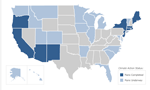
View interactive map
Climate Policies
Center for Climate Strategies
Climate policy by state

But the states have far more to offer. They also have approved a host of energy-efficiency measures affecting all sectors of the economy. For example, one set of policies provides both emissions reductions and substantial economic savings from the building sector through improved building codes, insulation and weatherization programs, and lighting retrofits. From the waste management sector, waste reduction and recycling programs yield similar two-pronged benefits.

These policies go hand-in-hand with others mandating that an increasing percentage of a state’s energy come from renewable sources, such as solar and wind power. Many states — chief among them California — have shown similar national leadership by significantly toughening auto emissions standards, leading Congress to increase national vehicle standards last December and the Environmental Protection Agency (EPA) to challenge the states in court.

The fact that so many states are acting with a similar impetus begs an important question: What would happen if you aggregated these policies and applied them on a national scale?

One study conducted by the Center for Climate Strategies (CCS) — a non-partisan group that has worked on climate policymaking and analysis with many of these states — indicates that the adoption of a comprehensive, nationwide climate and energy policy would have substantial economic benefits. Using data from 12 states that are leaders in the field of climate change and energy, CSS calculated that were all 50 states to adopt similar rules and legislation, the aggregate economic savings would be $25 billion. The nation could achieve a 33% reduction in projected greenhouse gas emissions by 2020 — a common interim target — and save money doing so.

Overall, the 27 states that have either adopted or are working on climate plans have targeted greenhouse gas reductions of 50 to 85 percent between 2040 and 2100, and their shorter term projections place them on this path.

The states’ experiences also can be incorporated into a national cap-and-trade scheme. For example, in the first phase of the European Union’s Emissions Trading Scheme, the cap-and-trade mechanism increased costs without reducing emissions. Carbon credits had been over-allocated, so there was little pressure to make reductions; emitters, however, realized profits by passing on the cost of carbon credits to consumers, even though the credits had been given to them for free. Although a recalibration has since occurred and the lessons learned are being incorporated, it seems reasonable to expect that a US cap-and-trade system will encounter similar trials.

The crafting of climate plans at the state level has been based upon a model of bipartisan consensus-building. Utility executives, trucking interests, builders, business leaders, and others have worked face-to-face with environmentalists and non-profit public interest groups to develop policy solutions that were in most cases adopted unanimously. One reason for that is simple: There is mounting evidence that these policies will create new jobs and promote broad economic development.

As a result, back in the home districts of Congressional representatives, governors have created an informed network of stakeholders committed to responsible climate action and ready to support a needed national response. Federal partnership with state governments opens a new political possibility as well — the forging of a genuinely bipartisan national consensus to secure passage of crucial federal climate legislation.


POSTED ON 03 Jun 2008 IN Climate Energy Energy Policy & Politics Policy & Politics Australia North America North America 

COMMENTS


Nice story. Let's add transportation to the discussion which, after all, represents 33% of domestic GHG emissions and over 70% of domestic oil consumption. However, other than adding between 25 to 50 cents to the cost of a gallon of gasoline and funding some transit, transportation is still the orphan of the climate bill. The transportation law is up for renewal in Senator Boxer's committee in 2009 as well. Let's bolt the two bills together and use auction revenues to reinvest in new transit options that provide the transportation infrastructure needed to serve the New Energy Economy of the 21st Century.
Posted by David Gates Burwell on 03 Jun 2008


What do the authors have to say in response to the sustained industry campaign to preempt state and local initiatives? Powerful legislators like John Dingell (D-MI) have declared preemption the "price" of industry cooperation in getting climate legislation passed. My group, the Center for Progressive Reform, just wrote the first comprehensive analysis of the adverse legal and policy results that would occur if such initiatives are preempted. It is posted at www.progressivereform.org.
Posted by Rena Steinzor on 03 Jun 2008


Mr. Burwell

I couldn't agree with you more, but I'm not sure Congress is equipped to do as you suggest. Keep in mind climate issues also impinge on the territory of the energy and farm bills, but the lawmaking happens in silos. The states have shown how to develop comprehensive climate plans that cut across all economic sectors -- another reason why it would be wise for the feds to partner with state governments on climate policy.
Posted by David Sassoon on 03 Jun 2008


Rena, we will all be hearing a lot about the "patchwork of state and local regulations" and why economic necessity says we ought to be sure to preempt them. Like you I worry about generalized preemption. State and local government in fact have the best purchase on many key regulatory approaches, including green building and land use. The proper formulation should emphasize the important of a federal state locality partnership on climate change. We need to be far more specific about where the feds and where the states and localities ought to be designing policy, and we need to be very sure that the each has the necessary authority to act where they should. General preemption is the wrong approach.
Posted by Michael Northrop on 03 Jun 2008


David Burwell, point well taken. If we're going to succeed on climate we will need to integrate several pieces of federal legislation, including transportation, energy, and agriculture into an overarching federal approach to climate. Keeping these all siloed and separate will be inefficient and a waste of money.
Posted by Michael Northrop on 03 Jun 2008


Very good discussion re: transportation and the threat of preemption.

As to the latter, I think that the threat of a "patchwork" of state climate regulations is more myth than reality.

In reality, states wanting to do clean cars legislation have simply adopted the CA Pavley standards. 14 states wish to do so, but that doesn't mean there are 14 different state standards. In fact, there is only one.

Further, when it comes to cap and trade will there be 50 different cap and trade programs? Hardly. It is far more likely that RGGI will integrate with WCI which will integrate with MGA, and so on. It's better than even odds that before the federal government even begins a cap and trade program, a majority of U.S. states representing a majority of emissions will have agreed to similar rules on cap and trade.

And let's not forget--41 different states feel it's important to register carbon emissions from sources within their jurisdictions. Does this mean 41 different state protocols? Actually, no. It's just one protocol, all organized under the state Climate Registry.

Now of course there are areas where states have and will differ in their regulatory regimes. These differences involve certain building codes, appliance standards, and the like. But consider that real estate developers and construction companies don't seem to find themselves unable to build in more than one state, even with building codes that differ at a state (and local) level. As well, appliances are sold in many different states without undue effect on corporate interests.

Beyond climate and energy issues, banking systems vary state to state and this doesn't seem to have raised obstacles to a growing concentration of U.S. banks doing business across state lines. Ditto for pharmaceutical companies that seem to be able to keep up with differing state standards. And then there's beer.

Since the end of Prohibition, beer sales have (for better or worse) been regulated as with other alcohol at a subfederal (and in many cases substate) level. At a county level, rules governing the sale of beer, wine, and hard liquor will vary greatly. Same for state level regulation.

Does this appear to have put a dent into major U.S. companies doing business in different state, county, and local jurisdictions? Again, hardly.

But as it happens this dreaded circumstance is not what is playing out in the real world. States, in their own interests, are more interested in adopting other state approaches when those approaches make sense (and they often do).

So the "patchwork" quilt needs to be put into storage. It is not a real threat, and serves mostly to justify a blanket preemption (pardon the uncontrolled analogy) of leadership state efforts on climate.

And used in that way, the quilt also becomes a tool by which some corporate sectors argue for preemption of the states and the adoption of one single national standard--often one that is set far lower than those already in place at a state level.

While there are some legitimate reasons to adopt a single standard (including administrative efficiency), it is not wise to do so if it undermines the overall effectiveness of a comprehensive state and federal partnership on climate.

As such, I fear the blanket more than the quilt.
Posted by stewart hudson on 05 Jun 2008


Mr. Hudson, you have nailed it exactly. Thank you.
Posted by michael northrop on 06 Jun 2008


Where is Mr. Northrop's disclosure that his employer, the Rockefeller Brothers Fund, is funding the vast majority (at least 80 percent, if not more) of the work by Center for Climate Strategies in the states?

In contrast to the authors' claims of "economic savings" and "benefits," see these alternative analyses here as commissioned by my colleagues at the John Locke Foundation and others:

http://www.johnlocke.org/press_releases/display_story.html?id=370
http://www.johnlocke.org/press_releases/display_story.html?id=372
http://www.i2i.org/main/author.php?author_id=271

The economic assumptions made by CCS for the states' climate commissions are not credible.
Posted by Paul Chesser on 16 Jun 2008


Ah, the John Locke Foundation and Paul Chesser, both well-know denizens of the denialist fringe with documented ties to Exxon money. Please keep that disclosure in mind when consulting their so-called economic studies. (And indeed, please do be aware that the Rockefeller Brothers Fund does provide funding to the Center for Climate Strategies, though Mr. Chesser is misinformed as to the degree.)

Please also keep in mind that Mr. Chesser and John Locke are the authors of a persistent but ineffectual national communications campaign designed specifically to derail and discredit state climate action (documentation below). They attack donors like RBF and target CCS with fabricated studies because they don't have the courage to go after the true authors of state climate action -- 30 governors, at last count, elected officials all.

You can see these state climate leaders in action for yourself in a short documentary film called “Ahead of the Curve 2: States Lead on Climate Change.” It features Governors Pawlenty and Crist, Napolitano and O'Malley, and can be viewed online at www.seastudios.org/ahead2.

The Rockefeller Brothers Fund was also one of the funders of the film, which tells the story – in the governors own words -- of the bipartisan cooperation on climate policy that is yielding both emissions reductions and economic benefits.

For more on the John Locke Foundation and Paul Chesser, please note the following:

“Noise machine: Independence Institute leveraged public media to promote global warming critic Chesser and misinformation” Feb 20, 2008. http://colorado.mediamatters.org/items/200802200004

“SPECIAL INVESTIGATION: Who's behind the attack on state climate policy?” November 13, 2007. http://southernstudies.org/facingsouth/2007/11/hostile-climate-whos-behind-attack-on_13.asp

“Report details John Locke climate pundit's Exxon ties,” January 4, 2007. http://www.raleigheconews.com/2007/01/report-details-john-locke-climate.html

Disclosure is a wonderful thing.

Posted by David Sassoon on 18 Jun 2008


Comments have been closed on this feature.
ABOUT THE AUTHORS
Michael Northrop is Program Director for Sustainable Development at the Rockefeller Brothers Fund. David Sassoon runs SolveClimate.com, a Web site dedicated to debating and advancing solutions to global warming.
MORE BY THE AUTHORS


RELATED ARTICLES


The Clean Water Act at 40:
There’s Still Much Left to Do

The Clean Water Act of 1972, one of the boldest environmental laws ever enacted, turns 40 this year, with an impressive record of cleaning up America's waterways. But from New York Harbor to Alaska’s Bristol Bay, key challenges remain.
READ MORE

Taking Green Chemistry Out
Of The Lab and into Products

Paul Anastas pioneered the concept of green chemistry and has led the effort to rethink the way we design and make the products we use. In an interview with Yale Environment 360, he talks about the challenges of bringing this approach to policy making and the frustrations of tackling environmental issues in a politically polarized era.
READ MORE

Insurance Companies Face
Increased Risks from Warming

If the damages related to climate change mount in the coming decades, insurance companies may face the prospect of paying larger disaster claims and being dragged into global warming lawsuits. But many firms, especially in the U.S., have barely begun to confront the risks.
READ MORE

Besieged by Climate Deniers,
A Scientist Decides to Fight Back

Climate scientist Michael Mann, who has faced years of attacks from climate-change skeptics, explains why he believes bad-faith assaults on science have no place in a functioning democracy and why the truth about global warming will inevitably gain wide acceptance.
READ MORE

U.S. Fossil Fuel Boom
Dims Glow of Clean Energy

A surge in gas and oil drilling in the U.S. is helping drive the economic recovery and is enhancing energy security. But as the situation in Ohio shows, cheaper energy prices and the focus on fossil fuels has been bad news for the renewable energy industry.
READ MORE


MORE IN Opinion


The Clean Water Act at 40:
There’s Still Much Left to Do

by paul greenberg
The Clean Water Act of 1972, one of the boldest environmental laws ever enacted, turns 40 this year, with an impressive record of cleaning up America's waterways. But from New York Harbor to Alaska’s Bristol Bay, key challenges remain.
READ MORE

Besieged by Climate Deniers,
A Scientist Decides to Fight Back

by michael e. mann
Climate scientist Michael Mann, who has faced years of attacks from climate-change skeptics, explains why he believes bad-faith assaults on science have no place in a functioning democracy and why the truth about global warming will inevitably gain wide acceptance.
READ MORE

The Folly of Big Agriculture:
Why Nature Always Wins

by verlyn klinkenborg
Large-scale industrial agriculture depends on engineering the land to ensure the absence of natural diversity. But as the recent emergence of herbicide-tolerant weeds on U.S. farms has shown, nature ultimately finds a way to subvert uniformity and assert itself.
READ MORE

Shunning Nuclear Power
Will Lead to a Warmer World

by spencer r. weart
A physicist argues that if we allow our overblown and often irrational fears of nuclear energy to block the building of a significant number of new nuclear plants, we will be choosing a far more perilous option: the intensified burning of planet-warming fossil fuels.
READ MORE

Innovation is Not Enough:
Why Polluters Must Pay

by gernot wagner
Innovative energy technologies are certainly essential if the world is to curb carbon emissions. But in response to a recent e360 article by the co-founders of the Breakthrough Institute, an economist argues we must also cap emissions or put a price on carbon in order to avoid the worst impacts of climate change.
READ MORE

Beyond Cap and Trade,
A New Path to Clean Energy

by ted nordhaus and michael shellenberger
Putting a price and a binding cap on carbon is not the panacea that many thought it to be. The real road to cutting U.S. emissions, two iconoclastic environmentalists argue, is for the government to help fund the development of cleaner alternatives that are better and cheaper than natural gas.
READ MORE

On the Road Back to Rio,
Green Direction Has Been Lost

by fred pearce
Twenty years ago, an historic environmental summit in Rio de Janeiro produced groundbreaking treaties and high hopes that pressing issues would be addressed. But as organizers prepare for the Rio+20 conference in June, there is little on the agenda to suggest any substantive action will be taken.
READ MORE

As Roads Spread in Rainforests,
The Environmental Toll Grows

by william laurance
From Brazil to Borneo, new roads are being built into tropical forests at a dizzying pace, putting previously intact wilderness at risk. If we hope to preserve rainforests, a leading researcher says, new strategies must be adopted to limit the number of roads and reduce their impacts.
READ MORE

Solar Power Off the Grid:
Energy Access for World’s Poor

by carl pope
More than a billion people worldwide lack access to electricity. The best way to bring it to them — while reducing greenhouse gas emissions — is to launch a global initiative to provide solar panels and other forms of distributed renewable power to poor villages and neighborhoods.
READ MORE

In Australia’s New Carbon Tax,
A Host of Missed Opportunities

by richard denniss
The Australian government will begin imposing a tax on carbon emissions in mid-2012. But large giveaways to industry mean Australia’s scheme doesn’t go nearly far enough in reducing the nation’s CO2 emissions or providing economic stimulus.
READ MORE


e360 digest
Yale
Yale Environment 360 is
a publication of the
Yale School of Forestry
& Environmental Studies
.

SEARCH e360


Donate to Yale Environment 360

CONNECT

Twitter: YaleE360
e360 on Facebook
Donate to e360
View mobile site
Bookmark
Share e360
Email newsletter
Subscribe to our feed:
rss


ABOUT

About e360
Contact
Submission Guidelines
Reprints

e360 VIDEO

Warriors of Qiugang
The Warriors of Qiugang, a Yale Environment 360 video that chronicles the story of a Chinese village’s fight against a polluting chemical plant, was nominated for a 2011 Academy Award for Best Documentary (Short Subject). Watch the video.


DEPARTMENTS

Opinion
Reports
Analysis
Interviews
e360 Digest
Video Reports

TOPICS

Biodiversity
Business & Innovation
Climate
Energy
Forests
Oceans
Policy & Politics
Pollution & Health
Science & Technology
Sustainability
Urbanization
Water

REGIONS

Antarctica and the Arctic
Africa
Asia
Australia
Central & South America
Europe
Middle East
North America

e360 VIDEO REPORT

When the Water Ends
As temperatures rise and water supplies dry up, tribes in East Africa increasingly are coming into conflict. A Yale Environment 360 video reports on a phenomenon that could become more common: how worsening drought will pit groups — and nations — against one another. Watch the video.

e360 MOBILE

Mobile
The latest
from Yale
Environment 360
is now available for mobile devices at e360.yale.edu/mobile.


header image
Top Image: aerial view of Iceland. © Google & TerraMetrics.

e360 VIDEO REPORT

Leveling Appalachia
Leveling Appalachia: The Legacy of Mountaintop Removal Mining, an e360 video examining the environmental and human impacts of this mining practice, won the award for best video in the 2010 National Magazine Awards for Digital Media. Watch the video.


OF INTEREST


Yale