01 Dec 2011: Report

Sweden’s Green Veneer Hides
Unsustainable Logging Practices

Sweden has a reputation as being one of the world’s most environmentally progressive nations. But its surprisingly lax forestry laws often leave decisions about logging to the timber companies — and as a result, large swaths of biologically-rich boreal forest are being lost.

by erik hoffner

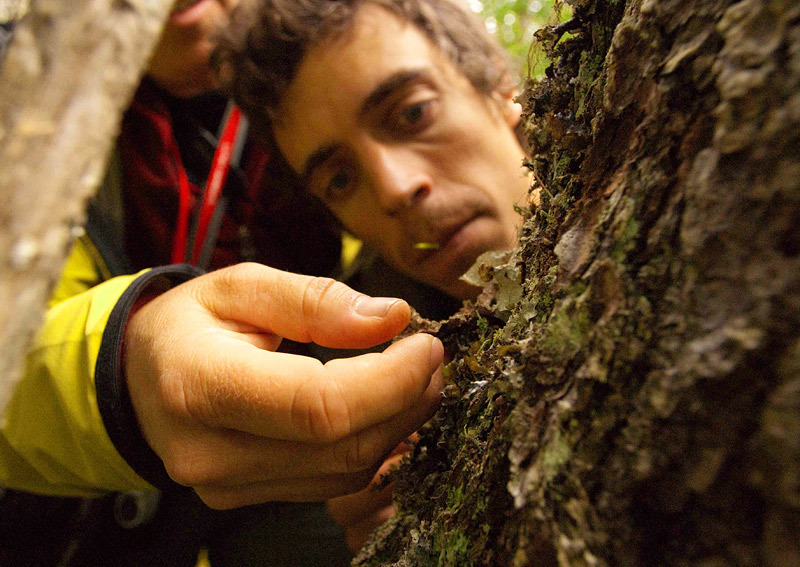
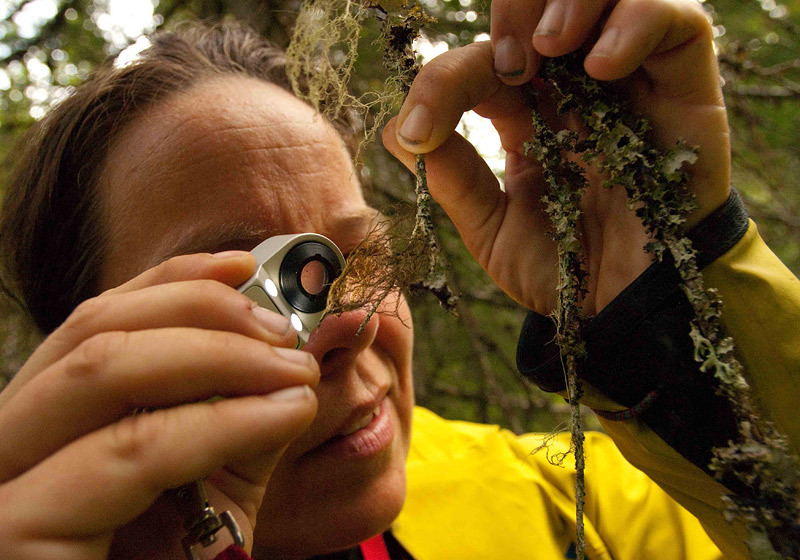
On a misty August morning in northern Sweden, a team of conservationists was combing an old spruce forest for rare species of lichen and fungi. The woodland was thick with trees towering over a mossy forest floor tracked up by moose, and it contained rare species of lichen, such as Platismatia norvegica, which is on Sweden’s Red List of Threatened Species. A GIS map carried by Mahlin Sahlin, a forest campaigner for the Swedish Society for Nature Conservation (SSNC), put the tract at 57 hectares (141 acres). The map also showed that this patch of forest was surrounded on all sides by recent clear-cuts.

The northern county of Jämtland, where we tripped, slid, and sloshed on a late-summer day, is under intense pressure from logging companies. It is also the area of Sweden where biodiversity is the least documented. So activists like Daniel Rutschman, with the Swedish nonprofit Protect the Forest, take part in surveys organized by SSNC. “At first I was bored by lichen and fungi, until I heard that you can save a forest like this if you find rare ones,” said Rutschman. “It’s become a treasure hunt.”

Sweden has long been viewed as one of the world’s most environmentally progressive nations, possessing comprehensive laws to protect nature, including its extensive boreal forest. But as a recent trip to Sweden showed, the country’s supposedly sustainable forestry practices are little more than a green veneer. Large areas of forest, particularly the oldest tracts in the north, are being felled with little regard for the biodiversity they harbor, according to both conservationists and government regulators.
View gallery
Sweden Forest

Photo courtesy of Erik Hoffner
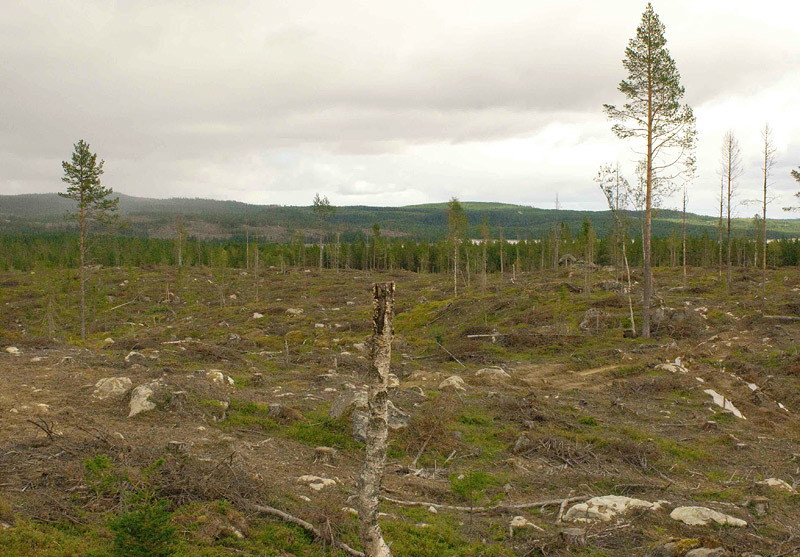
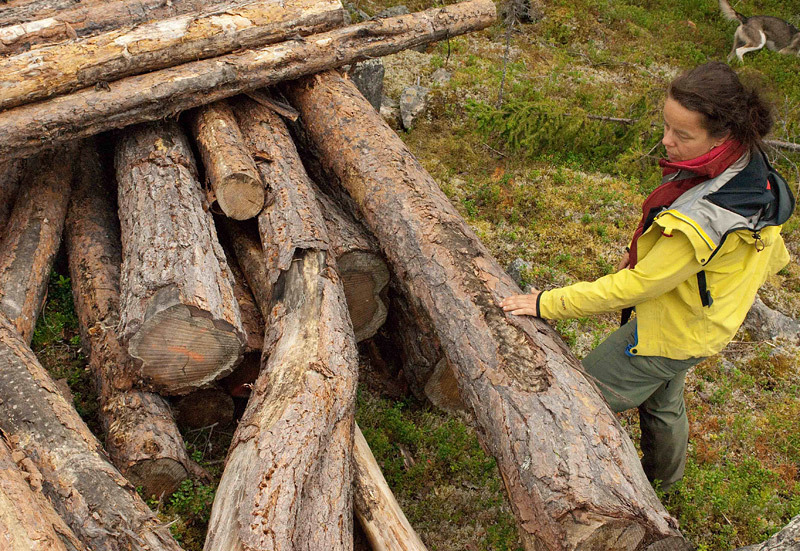
In Sweden, most clear-cuts are replanted in monocultures of spruce and pine.
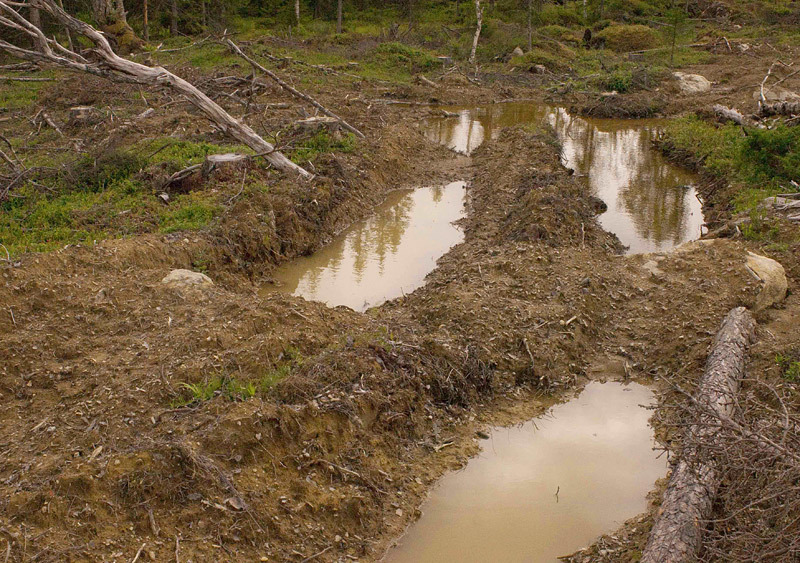
At the same time, the Swedish Forestry Model, as it is called, is widely promoted by the forestry industry and the government, which like to claim that it is the most sustainable in the world, even suggesting in promotional materials that other countries adopt similar policies. Around 45 percent of Sweden’s forested area — 10 million of 23 million hectares (24 million to 57 million acres) — is certified as being managed sustainably. But as I discovered, what that looks like on the ground can be sobering: clear-cuts that remove up to 95 percent of the trees, deep tire tracks, and buffer zones around waterways that can be as little as 2 meters wide. Most clear-cuts are replanted in monocultures of spruce and pine, or, increasingly in northern Sweden, a fast-growing import from North America, lodgepole pine.

The root of Sweden’s current forestry problems can be traced to the law that was supposed to solve them: a 1993 act requiring that every logging operation balance production with conservation, including the protection of trees in areas of high biodiversity. But logging is not strictly regulated under the act, the main tenet of which is “freedom with responsibility.” The Swedish Forest Agency (SFA) is supposed to monitor compliance with the rules, but because the agency is understaffed, forestry companies and landowners are left to make most of the decisions about how to manage their forests.

Conservationists and officials at the Swedish Forest Agency agree that this largely voluntary aspect of the policy has failed to adequately protect the
Officials at the Swedish Forestry Agency agree that the largely voluntary policy has failed to protect forests.
country’s forests.

In Stockholm, I asked Jan Terstad, who worked for the Ministry of the Environment and for the Swedish Environmental Protection Agency (SEPA) for 20 years, whether Sweden’s is a forestry model that the rest of the world should adopt. “Not at all,” replied Terstad, who heads the Biodiversity and Forest Department at SSNC. “Its overall approach is correct, but since its inception, nature conservation has declined, and its voluntary system has not worked.”

Olle Höjer, a senior advisor for SEPA concurred. “It could work, in a theoretical sense,” he said of the voluntary system. “In reality, it’s very naïve.”

Johanna From, chief forester of the country’s southern Svea Region for the Swedish Forest Agency (SFA), agrees with the critics. “We have to fix the model to make it work better,” she said in an interview. “We want to show the world that we can use our forests in innovative ways while keeping social and environmental values in place. But Sweden’s forestry is not yet sustainable.” Her agency is charged with implementing the 1993 Forestry Act, and one particular item on its to-do list is huge: 70,000 forest plots are proposed annually for logging, but the SFA has just six weeks to respond to each “notification.” If her staff does not respond in time, cutting is allowed to commence.


Sweden is the third-largest country in the European Union and among the most forested, its boreal woodlands dominated by pine and spruce and heavily logged by an industry working to convert its “green gold” (besides iron ore, timber is the country’s most valuable natural resource) into products for sale in Europe, Japan, and the United States. Much of the annual harvest is pulped for paper and the rest is converted into lumber or burned by power plants. In the post-World War II era, clearcutting became the most common logging method, and the impact on the landscape and biodiversity alarmed conservationists, leading to the 1993 Forestry Act.

Shortly before my arrival in Sweden, the Swedish Forestry Agency held a press conference to discuss its new report, which found that 37 percent of logging in the country was prioritizing production over conservation, in
A rise in threatened and endangered species is the predictable result of this logging trend.
violation of the Forestry Act. It surprised and dismayed many, especially industry representatives, some of whom disputed the findings. Much of that 37 percent consists of logging within old, diverse forests. The overall age of Sweden’s forest is getting progressively younger, and nearly half of the country’s woodlands are currently too young to harvest. This fact is what underpins the recent trend of logging operations pushing into old, diversity-rich forests, especially in the north, where regeneration is slow due to the Arctic climate.

While few of these remaining old forests qualify as actual old growth (most have been selectively cut over the last several centuries), they maintain vitally important characteristics, like massive amounts of dead wood and landscapes that are key for rare species survival. Species of fungi exist there that only grow on standing trees that have been dead for more than 300 years, and other species specialize in parasitizing such fungi. More common species such as reindeer rely on the lush carpets of lichen found within such old forests for winter forage. It is these forests that NGO representatives feel most passionately about.

“The country needs the forestry industry and the jobs,” said the SSNC's Mahlin Sahlin. “But let’s stop cutting the old forests down.”
View gallery
Sweden Forest

Photo courtesy of Erik Hoffner
Conservationist Malin Sahlin identifies a species of lichen during a recent survey.
A rise in the country’s Red List of threatened and endangered species — more than 2,100 threatened creatures native to Sweden depend directly on mature forests for survival — is the predictable result of this recent logging trend, according to scientists. Species like the white-backed and lesser-spotted woodpeckers, as well as fungi and vascular plants like fairy slipper and ghost orchids, are found in few places and in small numbers. Only ten white-backed woodpeckers are believed to remain in the entire country. This is a problem for Sweden’s official objectives under the UN Convention on Biodiversity. In Nagoya, Japan last year, Swedish negotiators agreed to protect 17 percent of the country’s productive land areas in order to preserve diversity.

That target is closely aligned with the demands of 170 Swedish scientists who, independent of Nagoya, last year signed an appeal calling for protection of 20 percent of Sweden’s productive forests, especially those harboring the oldest trees. One of the petition signers is Dr. Ulf Swenson, senior research scientist at the Swedish Museum of Natural History. “We have permanently protected less than 5 percent of the natural vegetation, and only around 3 percent of the productive forests,” he told me. “I personally find it embarrassing, since many countries poorer than mine have protected 20 or even 30 percent.” He’s noticed the sharp increase in logging in the northern part of the country, and a recent visit there left him “terrified by how little forest was left.”

The Forest Stewardship Council (FSC), organized in Sweden in 1997, is attempting to tackle the problem. FSC-Sweden manages the country’s implementation of this international sustainable forestry scheme, and its members can use its logo to market their forest products at a premium
A recent visit to northern Sweden left one scientist ‘terrified by how little forest was left.’
price to green-minded buyers. FSC members are expected to set aside a certain percentage of their lands for conservation and to protect high-diversity zones.

FSC is widely credited with increasing overall awareness of environmental considerations within Sweden’s logging industry. All of the biggest forestry companies are certified, including Sveaskog, the state-owned company that manages a variety of public forestlands, and Svenska Cellulosa Aktiebolaget (SCA), which employs 45,000 workers.

But the Swedish Society for Nature Conservation issued a report this year saying that, despite efforts like FSC, timber companies continue to cut older forests and erode Sweden’s biodiversity. Worse, according to SSNC, is that the FSC-certified companies often cut in the key habitats they are required to set aside to harbor rare species.

“So how many times can you violate FSC rules without losing your certification?” wondered SSNC’s Terstad. Daniel Rutschman of Protect the Forest said of Sweden’s program, “You shouldn’t trust the FSC label, it’s not a guarantee of sustainability. It’s greenwash, and creates a market for old forest destruction.”

SCA’s sustainability director, Hans Djurberg, said that while he didn’t think that his company should lose its FSC certification, he agreed with the

MORE FROM YALE e360

China’s Appetite for Wood
Takes a Heavy Toll on Forests

China’s Appetite for Wood Takes a Heavy Toll on Forests
More than half of the timber now shipped globally is destined for China. But unscrupulous Chinese companies are importing huge amounts of illegally harvested wood, William Laurance writes, prompting conservation groups to step up boycotts against rapacious timber interests.
READ MORE
critique of the industry. “It’s unacceptable for a company to make recurring mistakes with no effort to correct them,” he said. “They should not be allowed to keep their certificate.” He admitted that his company has made such mistakes, and also that they are overcutting old trees, but asserted that “we cannot set aside every area where we find rare species, because that would leave us with nowhere to cut.” Like many in the industry, he challenges the relevance of the Red List, contending that some of these species have always been rare regardless of current conditions, as they rely on very particular forest niches to survive.

While it seems highly unlikely that any company would be stripped of its certification by FSC-Sweden, the level of criticism has put its director Lina Bergström in a pensive mood. “I wish we could have more backbone,” she said. “But big companies make mistakes. We are not a monitoring system, we are an improving system. It’s a slow process, but we’re getting there.”


POSTED ON 01 Dec 2011 IN Forests Oceans Policy & Politics Science & Technology Sustainability Europe North America 

COMMENTS


We just have to get past industrial logging for the mass global markets. It is wiping out standing forests (the lungs of he planet) at an alarming rate. What are the alternatives? Use more salvaged wood? Replace wlood with other materials? Build less and reorganize and reuse existing spaces?

Posted by Trevor Burrowes on 01 Dec 2011


In the 'FREE MARKET' World, CORPORATES, be they LOCAL, National or MULTINATIONAL CANNOT BE TRUSTED TO ACT PRUDENTLY and adhere STRICTLY to 'GREEN SUSTAINABILITY PROGRAMS' as they have to MAXIMISE productivity and lavish their INVESTORS with HEFTY, HANDSOME DIVIDENDS on a regular basis. GOVERNMENTS, even in NORDIC COUNTRIES generally respected when it comes to Environmental Issues, MUST LEGISLATE AND POLICE to ensure 'CORRECT' practices that meet 'GOLD STANDARDS' !are adhered to ! Sweden therefore should not leave to 'Corporate Consciences' of Multi-Nationals !!

Posted by d'Albert Matlhoko on 02 Dec 2011


This comes as quite a shock to me. The forestry/logging companies are very slick at promoting themselves (like oil companies elsewhere). I will more actively participate in moves to remove the muck from Sweden's green face!

Posted by Ric Fisher on 04 Dec 2011


As a longtime resident and admirer of Sweden, I found this quite shocking. Like oil companies in other parts of the world, the associations of forest owners and PR by the logging companies present a rosy picture. I'll do that I can to remove the smudges from Sweden's green veneer!

Posted by Ric Fisher on 04 Dec 2011


Wow, what a nice article about the Swedish forestry which in fact is not sustainable.
I really hope a huge crowd of people do read this report and consider maybe writing to FSC Sweden, the different forest companies and why not to Swedish politicians in the parliament.
It is only they who can change the situation. But the NGO:s can deliver the facts.

Check out this too:

http://www.youtube.com/watch?v=am1xKGQ3YHc

This is the same type of forestry as in Sweden and actually it is the Swedish forestry model which they are using in Latvia and many other east European countries. For example IKEA is clear cutting primeval taiga forests in Russia.

Posted by Sebastian Kirppu on 04 Dec 2011


Interesting article--thanks for your research. You mention that certain fungi only grow on "standing trees that have been dead for more than 300 years." Doesn't a dead tree rot and turn to compost in fewer than 300 years?

Posted by Steve Kelton on 13 Dec 2011


Good question, Steve. The conditions in Sweden's boreal forest are such that trees can indeed stand that long before toppling. And once they do, I was told by a mycologist, they can take another 300 years to rot, providing habitat for a host of lichen, fungi, and more. The removal of trees like these from the forest floor during and after logging is therefore a big concern for conservationists.

Posted by Erik Hoffner on 14 Dec 2011


Hello Erik!

Thanks for a very describing article in N.G. How the “The Swedish model” as well as FSC is acting / (not) working –is very important to bring out in the daylight.

I`m know working full scale to change the forestry worldwide.

Since childhood I´m been living next to the forest, and always felt pain when clear-cutting has bin made. For some years ago I came across a forestry-method called “The Lübeckmodell” that whas told to be a forestry model that could combine Ecology, Economy and Social aspects. Sins that day i´we been working full time, first to learn, then to introduce this model in large scale. Thou I find it the most un-harmful way to harvest timber.

I´m active in southern Sweden, but our vision is to influence the forestry worldwide.

I´ll be happy to talk to you about this.

Best regards – Mikael Mikael@silvaskog.se

Posted by Mikael Karlsson on 05 Jan 2012


Eric,

It´s interesting to see how our forestry is viewd thruogh the eyes of a foreigner. I´m a third generation forest owner and can give you some credit in your research. But your conclusion that we need more of Goverment control and regulation is in my eyes to ask the "wolf to protect the sheep". 25% of the productive forest landbase is crownland, here have the most intensive industrial forestry taken place. The goverment now confiscating private land in order to protect rare species. A quick summary of govermental policies since the 40s.
2nd world war: vedkommisionen forced farmers to cut wood for heating in the cities. 1950s: select logging gets replaced by clear cut logging. Promited by the goverment. 1960s horses are replaced by skidders and forwarders, select logging (blädning) is banned. 1970s decidious forests are sprayed by herbicides, even here did the Goverment take an active role. But the most shameful act from the Goverment was the law that was in place during the 1980s. The law of mandatory logging for passive land owners. None has destroyed so many valuble forests as the Goverment. For 60 years we´ve been told how to manage our forest properly, a policy that has changed for every decade. If you decide to follow up this article, Talk to the woodlot owners and their organizations. You my get another picture then.

Posted by Mikael Edman on 16 Jan 2012


"Like many in the industry, he challenges the relevance of the Red List, contending that some of these species have always been rare regardless of current conditions, as they rely on very particular forest niches to survive."

Facepalm. This is the very reason why these forest niches need to be protected.

Posted by John Alden on 22 Jan 2012


I was interviewed by the author during his visit in Sweden, as one of the representatives of the industry. The article presents a biased view of Swedish forestry embracing the perspective of environmental NGOs and forest conservationists. The author has deliberately used arbitrary statements from industry and government representatives to support opinions presented by the NGOs, without objective and impartial scrutiny, and by ignoring critical input from stakeholders. In addition, several of the interviewees feel gravely misrepresented, including me, as citations are either incorrect or taken out of context. (One example is that I do not challenge the relevance of the Red list, but I challenge the way the Red list as such, as well as the information about individual species, is used by certain stakeholders.)

Consequently, many highly relevant facts about Swedish forestry are either missing or erroneous, e.g. the level of tree retention in Swedish forestry and the success or failure of the Swedish forestry model:

The tree retention on a clearcut may be 5% but this number does not include areas set-aside in the preceding landscape management planning. On average, an additional 7-8% of the productive forest land is set aside by certified landowners. Using international FAO definitions, the total area of forest set aside for conservation on the landscape level adds up to more than 20%. Reference: Living Forests, Swedish Forest Industries Federation.

Using FAO definitions Sweden has already protected more than 20 %, NOT including voluntary allocations. Reference: Living Forests, Swedish Forest Industries Federation.

According to the Swedish National Forest Inventory, 5 out of 6 political objectives sustainable forests had excellent results, and 1 out of 6 showed mediocre results. These objectives were reported in 2010 using 1998 as the base year. Reference: Living Forests, Swedish Forest Industries Federation.

The inventory conducted by the Swedish Forest Agency, which is referenced in the article as 37% of final fellings being disapproved by the authorities, has been declared unsatisfactory by the Agency itself, due poor quality of data.

Hans Djurberg
Sweden

Posted by Hans Djurberg on 24 Jan 2012


Hans Djurberg is appearently discontent with this article. Not surprising, as he is employed by SCA, the largest forest company in Sweden. If you carefully read his comment, you will see that he is refering to reports published by the industry itself, not scientific reports (which there are plenty of, but all with a totally different conclusion).

The numbers Hans state in his comment are either quite irrelevant when discussing issues of bio-diversity, or just plainly put there to confuse the readers.

For example, Mr Djurberg claims that: “Using international FAO definitions, the total area of forest set aside for conservation on the landscape level adds up to more than 20%.” According to the Swedish EPA though, even if Sweden adopted the “international” FAO definition, it would leave Sweden at a level of protected forests at about 5-6%. In a desperate attempt to reach the demanded sustainable 20%-level of protection, Djurberg and the rest of the forest industry is throwing in areas which have little or no importance to the 2100 threatened forest species in Sweden (i.e. low-productive areas like marshes and high-altitude wooded areas). In addition, the majority of these low-productive areas (constituting most of the sugested 20%) do not even have formal protection. Trees may still be harvested, while large clear-cuttings are not allowed.

Regarding tree retention, a recent study from the Swedish University of Agricultural Sciences places Sweden at 2nd to last of all examined countries when it comes to nature consideration on logging sites.

You can read an official reports about Swedens progress towards achieving our environmental objectives here: http://www.miljomal.se/-Global-meny-/In-English/

Posted by Daniel Rutschman on 06 Feb 2012


POST A COMMENT

Comments are moderated and will be reviewed before they are posted to ensure they are on topic, relevant, and not abusive. They may be edited for length and clarity. By filling out this form, you give Yale Environment 360 permission to publish this comment.

Name 
Email address 
Comment 
 

erik hoffnerABOUT THE AUTHOR
Erik Hoffner is a freelance photojournalist and fine art photographer. He has blogged for Grist since 2006 and is on the editorial board of Terrain.org: A Journal of the Built and Natural Environments. His work appears in Earth Island Journal, World Ark, and The Sun. He is also Outreach Coordinator for Orion. Spot.us, a community-funded journalism project, helped pay for Hoffner’s travel expenses to Sweden. See more images and a video from Sweden at www.erikhoffner.com.


RELATED ARTICLES


Busting the Forest Myths:
People as Part of the Solution

The long-held contention that rural forest communities are the prime culprits in tropical forest destruction is increasingly being discredited, as evidence mounts that the best way to protect rainforests is to involve local residents in sustainable management.
READ MORE

As Roads Spread in Rainforests,
The Environmental Toll Grows

From Brazil to Borneo, new roads are being built into tropical forests at a dizzying pace, putting previously intact wilderness at risk. If we hope to preserve rainforests, a leading researcher says, new strategies must be adopted to limit the number of roads and reduce their impacts.
READ MORE

China’s Reforestation Programs:
Big Success or Just an Illusion?

China has undertaken ambitious reforestation initiatives that have increased its forest cover dramatically in the last decade. But scientists are now raising questions about just how effective these grand projects will turn out to be.
READ MORE

China’s Appetite for Wood
Takes a Heavy Toll on Forests

More than half of the timber now shipped globally is destined for China. But unscrupulous Chinese companies are importing huge amounts of illegally harvested wood, prompting conservation groups to step up boycotts against rapacious timber interests.
READ MORE

Military Bases Provide Unlikely
Refuge For South’s Longleaf Pine

The expanses of longleaf pine forest that once covered the southeastern United States have been whittled away to just 3 percent of their original range. But as scientists are discovering, this threatened forest ecosystem has found a sanctuary in an unexpected place — U.S. military installations.
READ MORE


MORE IN Reports


As Arctic Sea Ice Declines,
Polar Bear Patrol Gets Busy

by ed struzik
Polar bears have long come ashore in Churchill, Manitoba, the self-styled ‘Polar Bear Capital of the World.’ But as summer sea ice steadily disappears in Hudson Bay, bears are being marooned on land for longer periods of time — and that is generating a lot of work for the Polar Bear Alert Team.
READ MORE

Can Smarter Growth Guide
China’s Urban Building Boom?

by david biello
The world has never seen anything like China’s dizzying urbanization boom, which has taken a heavy environmental toll. But efforts are now underway to start using principles of green design and smart growth to guide the nation’s future development.
READ MORE

In Fast-Track Technology, Hope
For a Second Green Revolution

by richard conniff
With advances in a technique known as fast-track breeding, researchers are developing crops that can produce more and healthier food and can adapt and thrive as the climate shifts.
READ MORE

A Vast Canadian Wilderness
Poised for a Uranium Boom

by ed struzik
Canada’s Nunavut Territory is the largest undisturbed wilderness in the Northern Hemisphere. It also contains large deposits of uranium, generating intense interest from mining companies and raising concerns that a mining boom could harm the caribou at the center of Inuit life.
READ MORE

For the Electric Car,
A Slow Road to Success

by jim motavalli
The big electric car launches of 2011 failed to generate the consumer excitement that some had predicted. But as new battery technologies emerge and tougher mileage standards kick in, automakers and analysts still believe that electric vehicles have a bright future.
READ MORE

Building a Better Bulb:
Lighting Revolution Advances

by dave levitan
With the industry’s support and despite political opposition, new U.S. lighting efficiency standards went into effect this month. This move, along with similar actions in Europe and China, is helping spur new technologies that will change the way the world's homes and businesses are illuminated.
READ MORE

Florida Counties Band Together
To Ready for Warming’s Effects

by michael d. lemonick
While U.S. action on climate change remains stalled, four south Florida counties have joined forces to plan for how to deal with the impacts — some of which are already being felt — of rising seas, higher temperatures, and more torrential rains.
READ MORE

As Fukushima Cleanup Begins,
Long-term Impacts are Weighed

by winifred bird
The Japanese government is launching a large-scale cleanup of the fields, forests, and villages contaminated by the Fukushima nuclear disaster. But some experts caution that an overly aggressive remediation program could create a host of other environmental problems.
READ MORE

What Rising Temperatures May
Mean for World’s Wine Industry

by john mcquaid
Warming temperatures associated with climate change are already affecting vineyards from France to Chile, often in beneficial ways. But as the world continues to warm, some traditional winemaking regions are scrambling to adapt, while other areas see themselves as new wine frontiers.
READ MORE

Can ‘Climate-Smart’ Agriculture
Help Both Africa and the Planet?

by fred pearce
One idea promoted at the Durban talks was “climate-smart agriculture," which could make crops less vulnerable to heat and drought and turn depleted soils into carbon sinks. The World Bank and African leaders are backing this new approach, but some critics are skeptical that it will benefit small-scale African farmers.
READ MORE


e360 digest
Yale
Yale Environment 360 is
a publication of the
Yale School of Forestry
& Environmental Studies
.

SEARCH e360


Donate to Yale Environment 360

CONNECT

Twitter: YaleE360
e360 on Facebook
Donate to e360
View mobile site
Bookmark
Share e360
Email newsletter
Subscribe to our feed:
rss


ABOUT

About e360
Contact
Submission Guidelines
Reprints

e360 VIDEO

Warriors of Qiugang
The Warriors of Qiugang, a Yale Environment 360 video that chronicles the story of a Chinese village’s fight against a polluting chemical plant, was nominated for a 2011 Academy Award for Best Documentary (Short Subject). Watch the video.


DEPARTMENTS

Opinion
Reports
Analysis
Interviews
e360 Digest
Video Reports

TOPICS

Biodiversity
Business & Innovation
Climate
Energy
Forests
Oceans
Policy & Politics
Pollution & Health
Science & Technology
Sustainability
Urbanization
Water

REGIONS

Antarctica and the Arctic
Africa
Asia
Australia
Central & South America
Europe
Middle East
North America

e360 VIDEO REPORT

When the Water Ends
As temperatures rise and water supplies dry up, tribes in East Africa increasingly are coming into conflict. A Yale Environment 360 video reports on a phenomenon that could become more common: how worsening drought will pit groups — and nations — against one another. Watch the video.

e360 MOBILE

Mobile
The latest
from Yale
Environment 360
is now available for mobile devices at e360.yale.edu/mobile.


header image
Top Image: aerial view of Iceland. © Google & TerraMetrics.

e360 VIDEO REPORT

Leveling Appalachia
Leveling Appalachia: The Legacy of Mountaintop Removal Mining, an e360 video examining the environmental and human impacts of this mining practice, won the award for best video in the 2010 National Magazine Awards for Digital Media. Watch the video.


OF INTEREST


RESOURCES


Yale