29 Jan 2009: Opinion

The Climate Freeloaders: Emerging Nations Need to Act

Key developing countries have long been exempt from efforts to reduce greenhouse gas emissions. Now, as global climate talks move forward, that policy must change.

by fred pearce

Now that George W. Bush is not around to misinterpret, it is probably safe to point out something climate negotiators rarely mention. There are quite a few countries out there that don’t have targets to cut their carbon dioxide emissions, but who really ought to. They are not poor, and they are not low emitters. They are climate freeloaders.

I am not talking about large Asian countries like India or Indonesia or even China, where national emissions may be large but per capita emissions remain very low by rich-world standards. The average Indian is responsible for roughly a tenth the emissions of the average American. Even the average Chinese has emissions only around a quarter those of the average American (as I mentioned in a previous article here), and a good proportion of that is produced while making goods to sell to the West.

We, the big emitters, have to engage countries like China and India in taking action, if we are to stave off climate change. But we have to do that from a position of humility — admitting that, sorry, but we have used up most of the available atmospheric space for greenhouse gases.

What I am talking about here, however, is a growing list of rapidly industrializing countries that don’t have targets under the existing Kyoto Protocol, but have emissions rates that are now often above those of many longtime industrialized nations that do have targets. Moreover, while the Kyoto countries are cutting emissions, the non-Kyoto countries are mostly raising them — and fast.

These are places as different as Malaysia, Saudi Arabia, Israel, and South Korea. None of these countries currently seem likely even to be asked to adopt targets in Copenhagen later this year, when the successor agreement to the 1997 protocol is set to be decided. And that seems increasingly crazy — not only unfair, but also damaging to any real effort to tackle climate change.

When the Kyoto Protocol was signed in 1997, it set targets for industrialized countries, including member nations of the Organization for Economic Cooperation and Development, the former Soviet bloc and Japan. But emerging industrial countries were left out, partly through political expediency and partly because their emissions didn’t seem to matter much. Now they do.

The trend is revealed in disturbing detail in estimates of national emissions for 2007 recently published by the U.S. government’s Oak Ridge National Laboratory in Tennessee, a widely respected international monitor.
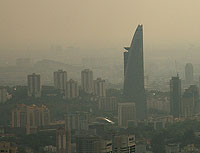
Take Malaysia, which for all intents and purposes is now an industrialized country and has carbon dioxide emissions that reflect that — emissions

Enlarge image
Kuala Lampur

Flickr
Malaysia's per capita emissions of carbon dioxide exceed the rates of China, India and France.
produced from the energy used to run factories, vehicles, and air-conditioning systems. By 2007 Malaysia had increased its total emissions fourfold since 1990, from 15 million tons of carbon to 68 million tons. (1990 is the base year used for calculating emissions reductions for countries under the Kyoto Protocol.)

Malaysia — which has a GDP greater than many European countries — now emits slightly more carbon dioxide per capita than Britain, which at 2.47 tons per head is a fairly middle-range European country. But while Britain is on course to meet its Kyoto target of a cut of 12.5 percent from 1990 levels, Malaysia can carry on raising its emissions as much as it likes.

U.S. per capita emissions, incidentally, are currently 5.3 tons of carbon, according to Oak Ridge. At the other extreme, those of Bangladesh are 0.08 tons.

A host of other Asian countries that we used to call “tiger economies” are in the same situation as Malaysia, and for similar reasons — they continue to increase their emissions above the levels of Kyoto countries that are trying hard to reduce theirs.

Taiwan’s emissions have doubled since 1990. Its per capita emissions are ahead of most of Europe. But it has no targets.

Likewise South Korea, which recently nudged above its neighbor Japan in per capita emissions. Yet while Japan has targets, South Korea does not. South Korea has been in the OECD club of rich nations since 1996, but on climate it still conveniently sits with the poor countries.

This must be a trifle embarrassing for South Korea’s most famous envoy, UN Secretary-General Ban Ki-moon, who is fast winning a personal reputation on climate change. Unlike his predecessor, Kofi Annan, he regularly turns up at climate negotiations, as he did in talks in Poznan, Poland, in December. In Bali in late 2007, his aggressive intervention saved the process from possible collapse. Perhaps it is time he devoted some energy to getting his home country on board.

A second group of countries with soaring emissions are in the Gulf region, where the huge energy demands from desalinating seawater often add to the emissions from industrialization, affluence, and profligate use of all the cheap local oil. This month, Abu Dhabi held a much-heralded world future energy summit. Tony Blair was there. Part of its purpose was to showcase a new “green city” Abu Dhabi is building called Masdar. Well, it’s a badly-needed start. Abu Dhabi is part of the United Arab Emirates, whose emissions have gone from 15 million tons of carbon in 1990 to 37 million tons in 2007. Its per capita emissions are now above those of the United States.

Since 1990, Saudi Arabia has doubled emissions, which at 4.5 tons of carbon per head are close to those of the United States. Bahrain, at 7.4 tons per head, is well ahead of the U.S. And Kuwait, which similarly has more than doubled emissions, has a per capita figure double that of the U.S. (Not far away, in Israel, emissions have doubled since 1990 and, per head, are now edging past Britain’s).
Enlarge image
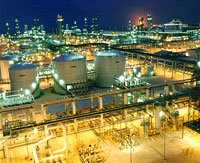
Qatar LNG

Qatar Liquefied Gas Company Ltd
Qatar, which has increased its carbon emissions nearly fivefold since 1990, is the world's largest exporter of liquified natural gas.
But the super-performer in the Gulf, the country that should rightly be crowned as the world’s worst carbon criminal, is Qatar. It is small — occupying a sand spit in the Gulf about the size of Connecticut. But its emissions in 2007 were 16 million tons, compared to 3.3 million tons in 1990. Most of the emissions come from its huge gas extraction industry, which is largely for export. But shared out among its population of 825,000, the emissions come to 19.3 tons of carbon per head, or almost eight times those of Britain, and considerably more than three times those of the U.S.

That’s a record — well, unless you count the U.S. Virgin Islands, which Oak Ridge records show emitted more than 25 tons of carbon per head in 2002, the most recent year for which figures are available. Much of the Virgin Islands’ emissions are from one of the world’s largest petroleum refineries.

Clearly we have a problem here. To label countries like Qatar and Taiwan as “developing” is a myth. It is certainly true that they have been emitting carbon in substantial amounts for far less time than Europe or North America. But it is increasingly untenable for them to hide at international negotiations with the nations of Africa and poor parts of Asia, piously opposing any emissions cuts for the developing world.

Give us a break. Kuwait and Saudi Arabia and South Korea and the rest are not poor nations. In any international negotiations, we need fairness in allocating emissions targets. And that, I believe, means allocations based on population size. We might need some separate rules for nations that still have fast-rising populations (though I can’t believe that any country would surreptitiously boost its population to get a few more emissions permits). But long term we should be headed for national entitlements based on population.

My favorite formula is called “contraction and convergence,” developed by a splendidly single-minded, violin-playing South African living in London named Aubrey Meyer, and publicized through his NGO, the Global Commons Institute.

Under his concept, we would listen to what scientists are saying and contract global emissions so as to stabilize concentrations of greenhouse gases in the atmosphere. But then we would apportion emissions entitlements according to a formula that gradually would converge national targets toward a level based strictly on population.

Of course, countries would be free to trade their entitlements – so the U.S. could buy from India, and so on. But the initial allocations would be transparent and equitable. It would take all the horse-trading out of the international negotiations.

I recommend you check out the graphs of how this could happen on Meyer's web site — especially if you work for the Obama team that is deciding how to approach climate change negotiations this year. Like me you may be left wondering why the world didn’t adopt this simple formula long ago.

In London this week, the UN’s chief climate diplomat, Yvo de Boer, said he thought that “in the long run,” emissions targets based on population were the way to go. So why not now? My proposal for Copenhagen is that governments grab the chance to think afresh on climate, and adopt this long-term solution that does away with the ridiculous anomalies that currently exist.

POSTED ON 29 Jan 2009 IN Climate Asia Middle East 

COMMENTS


This argument isn't, well, sustainable. We in the "clearly more developed" countries have a to have a very public and sincere truth and reconciliation effort to acknowledge and correct how our societies have failed to internalize the social, economic and environmental costs of virtually every aspect of our everyday life and work.
Posted by Will Duggan on 29 Jan 2009


On the contrary, Fred Pearce's argument is the only sustainable one there is. The alternative to per capita allocation is the present free-for-all based on economic and military force, in which the earth's resources are ultimately exhausted by the combattants. Meanwhile, we are in a bus hurtling towards a cliff at 80 miles per hour, arguing whether we should slow to 70 or to 60.
Posted by John Whiting on 29 Jan 2009


Too simple! All of the above arguments ignore enormous geographic and historical variation. Current per capita emission metrics give no consideration to historical variation, e.g. long term contributions by developed countries in North America and Europe versus the short history of emission by countries such as South Korea. There is also a question of ability to meet the goals. The technological advantage clearly resides with E.U. countries and the U.S. to make significant advances now, whereas developing countries depend on technologically advanced countries to market alternatives to fossil fuel power before they can achieve Kyoto. You can not assume equal blame or equal ability to adapt.
Posted by Tony Abbott on 29 Jan 2009


Fred Pearce should take some courses in biology and see what is the importance of CO2 in nature. With his consultancy with Clinton and Gore, he is still trying to convince everyone that CO2 is a bad gas and that the belt of gases around the planet within 15 Kilometer only include CO2 and no Oxygen, Nitrogen, Moisture, ammonia and other gases. These CO2 atoms are constantly rotating at 360 degrees and are reradiating infra red rays back to the earth. All the Concrete and glass used in the constructions of multistories buildings and roadways has nothing to do with the infra red radiations pesumed to be the cause of global warming; the orbit of the planet around the sun plays no role in bringing the planet close to sun or away from sun. May be he would be surprised to know that no one on this planet could live if there was no CO2 on this planet and the energy was not captured by the plants to feed all the animals and plants of the world including humans.
Posted by Dr. Mahmood Anwar on 29 Jan 2009


I just finished a wonderful new book called The Manhattan Project of 2009 Energy Independence Now by author Jeff Wilson. It is without a doubt the best book out there. We seriously need to get on with utilizing alternative energy. The high cost of oil this past year seriously damaged our economy and society. The trickle down effects will be felt for years to come. The cost of fuel affects the price of every consumer product. Oil is finite it will run out one day in the not too distant future. We are using oil globally at the rate of 2 X faster than new oil is being discovered. We have so much available to us in the way of natural energy, wind , solar, wave plus the modern technologies of hybrid etc. What America seems to lack is a plan. This book even outlines a plan, a legislative agenda. It is fascinating and brings the act of weaning America off oil into perspective.


Posted by Sherry Jansen on 29 Jan 2009


Fred is spot on. Contraction & Convergence provides the intellectual and ethical basis for a long term global climate deal that can do enough soon enough to avert climate chaos. Its per capita international carbon trade will bring income to developing nations and create strong financial incentives for all countries to cut carbon emissions. It also lays the foundation for a successful and equitable low carbon global economy. There's growing behind-the-scenes support for C&C, but if Obama could become its public champion, he'll demonstrate the visionary leadership that we all hope he delivers.
Posted by Michael Hutchinson on 29 Jan 2009


I'd be curious to know what Fred Pearce thinks of the Greenhouse Development Rights framework as an alternative to contraction and convergence?

http://www.ecoequity.org/GDRs/

Posted by Jamie on 29 Jan 2009


Your carbon quota per capita is the right ethical approach to the big problem we are facing.
I have only 2 questions:
.how can we get informations about the Global common Institute of your friend Meyer?
.the figures you give are in carbon quantity, not in CO2 quantity.
Regards.
Posted by JeandeBegles on 30 Jan 2009


Information on the Global Commons Institute and Contraction & Convergence is available at:

http://www.gci.org.uk/kite/Carbon_Countdown.pdf

A summary of C&C climate risk analysis is at:

BENN_C&C_Animation.exe
Posted by Terry .O'Connell on 30 Jan 2009


Dr. Mahmood Anwar, perhaps you need to take some courses in radiative physics to understand importance of CO2 and other gases in the greenhouse effect. This may come as a complete surprise to you, but all greenhouse gases combined, including water vapour, CO2, methane, nitrous oxide, ozone, CFCs and several other trace gases, constitute less than 0.5% of the atmosphere, yet that 0.5% is responsible for making Earth's average surface temperature 33C warmer than it would be if those greenhouse gases were not present, making life on Earth as we know it possible. The oxygen, nitrogen and argon that make up 99.5% of the atmosphere are completely transparent to light energy, including the infrared wavelengths that greenhouse gases absorb. That mean's they are not even part of the greenhouse effect, at least not until we start talking about turning that light energy into kinetic energy through molecular collision between excited greenhouse gas molecules and the nitrogen, oxygen and argon molecules that make up that 99.5%. That means increasing the concentration of greenhouse gases in the atmosphere has a more powerful effect than their very small portion of the atmosphere would suggest. And increasing them is exactly what humans are doing: nearly 38% for CO2, nearly 150% for methane, around 16% for nitrous oxide, while CFCs and several other man-made gases did not even exist until we invented them. Even water vapour is rising as the other gases warm the atmosphere.
Posted by JimEager on 11 Feb 2009


Hey folks I hate to tell you, but the climate is cooling.
Posted by John on 11 Feb 2009


Dear Jim Eager, according to the IPCC, man-made carbon dioxide is 3% of the total.

They state 119.6 billion metric tons is produced by respiration and primary production from land based plants decaying etc., another 90.6 billion metric tons from similar oceanic sources. The carbon dioxide from man made sources (fossil fuels) is 7.2 billion metric tons. This gives a total of 217.4 billion metric tons of production from all sources. The 7.2 billion metric tons of man-made CO2 is 3.3% of the total.

http://www.eia.doe.gov/bookshelf/brochures/greenhouse/Chapter1.htm

Source: the International Panel on Climate Change, Climate Change 2007, The Physical Sciences Basis, Figure 7.3 and table 7.1 (UK, 2007)

Since you seem to have a grasp of how greenhouse gases work (I would correct that all of the atmosphere is basically transparent to incoming short wavelength radiation. the long wave length reflected radiation is slowed by greenhouse gases. Of course you know that 95% are water vapor) you must realize that 11.55 PPM of CO2 produced by man cannot measurably raise the Earth's temperature. Obviously no calculation or test can show this minute amount of CO2 (relatively speaking of course) could warm the atmosphere unless you ascribe some magical qualities to man-made CO2. I'm sure you are smarter than that. Of course the models used by the IPCC cannot be claimed to be proof by any scientific method.

Agreed? I'm sure that if you are intellectually honest you will.
Posted by Dahun on 14 Mar 2009


Comments have been closed on this feature.
fred pearceABOUT THE AUTHOR
Fred Pearce is a freelance author and journalist based in the UK. He is environment consultant for New Scientist magazine and author of the recent books When The Rivers Run Dry and With Speed and Violence. His latest book is Confessions of an Eco-Sinner: Tracking Down the Sources of My Stuff (Beacon Press, 2008). Pearce has also written for Yale e360 on world population trends and the U.S.'s leadership role in tackling climate change.
MORE BY THIS AUTHOR


RELATED ARTICLES


The Clean Water Act at 40:
There’s Still Much Left to Do

The Clean Water Act of 1972, one of the boldest environmental laws ever enacted, turns 40 this year, with an impressive record of cleaning up America's waterways. But from New York Harbor to Alaska’s Bristol Bay, key challenges remain.
READ MORE

Taking Green Chemistry Out
Of The Lab and into Products

Paul Anastas pioneered the concept of green chemistry and has led the effort to rethink the way we design and make the products we use. In an interview with Yale Environment 360, he talks about the challenges of bringing this approach to policy making and the frustrations of tackling environmental issues in a politically polarized era.
READ MORE

Insurance Companies Face
Increased Risks from Warming

If the damages related to climate change mount in the coming decades, insurance companies may face the prospect of paying larger disaster claims and being dragged into global warming lawsuits. But many firms, especially in the U.S., have barely begun to confront the risks.
READ MORE

Besieged by Climate Deniers,
A Scientist Decides to Fight Back

Climate scientist Michael Mann, who has faced years of attacks from climate-change skeptics, explains why he believes bad-faith assaults on science have no place in a functioning democracy and why the truth about global warming will inevitably gain wide acceptance.
READ MORE

U.S. Fossil Fuel Boom
Dims Glow of Clean Energy

A surge in gas and oil drilling in the U.S. is helping drive the economic recovery and is enhancing energy security. But as the situation in Ohio shows, cheaper energy prices and the focus on fossil fuels has been bad news for the renewable energy industry.
READ MORE


MORE IN Opinion


The Clean Water Act at 40:
There’s Still Much Left to Do

by paul greenberg
The Clean Water Act of 1972, one of the boldest environmental laws ever enacted, turns 40 this year, with an impressive record of cleaning up America's waterways. But from New York Harbor to Alaska’s Bristol Bay, key challenges remain.
READ MORE

Besieged by Climate Deniers,
A Scientist Decides to Fight Back

by michael e. mann
Climate scientist Michael Mann, who has faced years of attacks from climate-change skeptics, explains why he believes bad-faith assaults on science have no place in a functioning democracy and why the truth about global warming will inevitably gain wide acceptance.
READ MORE

The Folly of Big Agriculture:
Why Nature Always Wins

by verlyn klinkenborg
Large-scale industrial agriculture depends on engineering the land to ensure the absence of natural diversity. But as the recent emergence of herbicide-tolerant weeds on U.S. farms has shown, nature ultimately finds a way to subvert uniformity and assert itself.
READ MORE

Shunning Nuclear Power
Will Lead to a Warmer World

by spencer r. weart
A physicist argues that if we allow our overblown and often irrational fears of nuclear energy to block the building of a significant number of new nuclear plants, we will be choosing a far more perilous option: the intensified burning of planet-warming fossil fuels.
READ MORE

Innovation is Not Enough:
Why Polluters Must Pay

by gernot wagner
Innovative energy technologies are certainly essential if the world is to curb carbon emissions. But in response to a recent e360 article by the co-founders of the Breakthrough Institute, an economist argues we must also cap emissions or put a price on carbon in order to avoid the worst impacts of climate change.
READ MORE

Beyond Cap and Trade,
A New Path to Clean Energy

by ted nordhaus and michael shellenberger
Putting a price and a binding cap on carbon is not the panacea that many thought it to be. The real road to cutting U.S. emissions, two iconoclastic environmentalists argue, is for the government to help fund the development of cleaner alternatives that are better and cheaper than natural gas.
READ MORE

On the Road Back to Rio,
Green Direction Has Been Lost

by fred pearce
Twenty years ago, an historic environmental summit in Rio de Janeiro produced groundbreaking treaties and high hopes that pressing issues would be addressed. But as organizers prepare for the Rio+20 conference in June, there is little on the agenda to suggest any substantive action will be taken.
READ MORE

As Roads Spread in Rainforests,
The Environmental Toll Grows

by william laurance
From Brazil to Borneo, new roads are being built into tropical forests at a dizzying pace, putting previously intact wilderness at risk. If we hope to preserve rainforests, a leading researcher says, new strategies must be adopted to limit the number of roads and reduce their impacts.
READ MORE

Solar Power Off the Grid:
Energy Access for World’s Poor

by carl pope
More than a billion people worldwide lack access to electricity. The best way to bring it to them — while reducing greenhouse gas emissions — is to launch a global initiative to provide solar panels and other forms of distributed renewable power to poor villages and neighborhoods.
READ MORE

In Australia’s New Carbon Tax,
A Host of Missed Opportunities

by richard denniss
The Australian government will begin imposing a tax on carbon emissions in mid-2012. But large giveaways to industry mean Australia’s scheme doesn’t go nearly far enough in reducing the nation’s CO2 emissions or providing economic stimulus.
READ MORE


Yale
Yale Environment 360 is
a publication of the
Yale School of Forestry
& Environmental Studies
.

SEARCH e360


Donate to Yale Environment 360

CONNECT

Twitter: YaleE360
e360 on Facebook
Donate to e360
View mobile site
Bookmark
Share e360
Email newsletter
Subscribe to our feed:
rss


ABOUT

About e360
Contact
Submission Guidelines
Reprints

e360 VIDEO

Warriors of Qiugang
The Warriors of Qiugang, a Yale Environment 360 video that chronicles the story of a Chinese village’s fight against a polluting chemical plant, was nominated for a 2011 Academy Award for Best Documentary (Short Subject). Watch the video.


DEPARTMENTS

Opinion
Reports
Analysis
Interviews
e360 Digest
Video Reports

TOPICS

Biodiversity
Business & Innovation
Climate
Energy
Forests
Oceans
Policy & Politics
Pollution & Health
Science & Technology
Sustainability
Urbanization
Water

REGIONS

Antarctica and the Arctic
Africa
Asia
Australia
Central & South America
Europe
Middle East
North America

e360 VIDEO REPORT

When the Water Ends
As temperatures rise and water supplies dry up, tribes in East Africa increasingly are coming into conflict. A Yale Environment 360 video reports on a phenomenon that could become more common: how worsening drought will pit groups — and nations — against one another. Watch the video.

e360 MOBILE

Mobile
The latest
from Yale
Environment 360
is now available for mobile devices at e360.yale.edu/mobile.


header image
Top Image: aerial view of Iceland. © Google & TerraMetrics.

e360 VIDEO REPORT

Leveling Appalachia
Leveling Appalachia: The Legacy of Mountaintop Removal Mining, an e360 video examining the environmental and human impacts of this mining practice, won the award for best video in the 2010 National Magazine Awards for Digital Media. Watch the video.


OF INTEREST


Yale