19 Jan 2009: Report

The Cost of the Biofuel Boom:
Destroying Indonesia’s Forests

The clearing of Indonesia’s rain forest for palm oil plantations is having profound effects – threatening endangered species, upending the lives of indigenous people, and releasing massive amounts of carbon dioxide into the atmosphere.

by tom knudson

As a child, Matt Aman grew up in the lush tropical lowland rain forest of Sumatra. Tigers padded through the underbrush, rarely seen and silent as shadows. “It made my skin prickle,” the indigenous leader recalled recently as he sat on the floor of a stick hut surrounded by fellow villagers.

“When I was young, it was easy to find the mouse deer, monitor lizard, and wild pigs,” Aman said.

The birds were majestic, too, he said, as he nodded and lit a cigarette. They filled the forest with a chorus of coos and trills that woke the Kubu village every morning. “We never hear those birds anymore,” Aman said.
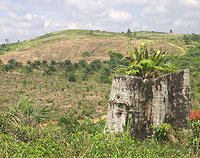
It is easy to see why. The storybook forest of his youth, the great green riot of reeds and vines, the cathedral-like thickets of fruit and hardwood trees — all of it is gone. In its place, for mile after monotonous mile, is a rolling carpet of palm trees, not the kind that sway in the wind at Waikiki, but a shorter, pudgier variety — the oil palm — that like corn and soybeans is rapidly becoming one of the world’s major sources of biofuel.

Not long ago, biofuels were billed as a green dream come true, a way to burn less fossil fuel and shrink our carbon footprint. But today, mounting evidence indicates that producing biofuels — particularly those derived from food crops such as corn and oil palm — may be doing considerably more harm to the planet than good, actually increasing greenhouse gas emissions and driving up food prices worldwide.

Some of the most devastating costs of the biofuel revolution are on display in Indonesia, where massive clearing of tropical forests for oil palm plantations has caused staggering environmental damage and tremendous loss of biodiversity. Only the Amazon and Africa’s Congo basin harbor more tropical forests than Indonesia, but the reality today is that all three regions are seeing their rain forests disappear at an alarming rate. And in the Amazon and Indonesia, growing world demand for food and biofuel is now driving much of the damage.

A flurry of scientific field work and environmental reports have linked the spread of oil palm plantations in Indonesia to the decimation of rain forests, increased conflict between logging and oil palm interests and rural and indigenous people, and massive CO2 emissions through logging, burning, and the draining of carbon-rich peat lands. And most of the trouble, as I learned on a recent visit, is playing out in the Indonesian lowland rain forests on Sumatra and Borneo, an ecosystem long regarded as a global hotspot for rare and endemic species — but perhaps not for much longer.

Over the past three years, researchers with the Zoological Society of London have searched exhaustively for tigers, clouded leopards, and other
“The tiger is going to go extinct if we don’t do something,” a wildlife biologist on Sumatra said.
rare mammals on oil palm plantations in Sumatra. They have turned up next to nothing. "Most endangered species were never detected,” they wrote in a report last year. Initially, they found hope along the edges of plantations where, against all odds, some tigers — which have roamed the rain forest for millennia — managed to survive. But even as their studies were underway, much of that land was also cleared, often illegally by settlers.

“If developed responsibly, oil palm should be able to provide economic growth and development without turning some of the earth’s most important tropical ecosystems into ecological deserts,” the researchers noted in the report. But they added: “This is a big `if.’ Achieving responsible development is a major challenge.”

Roughly the size of California, Sumatra is the sixth largest island in the world. But it is home to fewer than 400 Sumatran tigers, down from around 1,000 in the 1980s. Historical population figures are sketchy. But the big cat is believed to have lost 80 percent of its natural habitat over the past century, reducing the tigers to scattered groups in increasingly beleaguered forest oases.

“The tiger is going to go extinct if we don’t do something,” a wildlife biologist named Sunarto told me in Pekanbaru, the steamy capital of Sumatra’s Riau province, a center of oil palm planting.

For his part, Sunarto is working to persuade oil palm managers to leave strategic corridors of forest around plantations untouched so the endangered big cats do not become genetically isolated. But it’s a struggle.

Not long ago, he journeyed to a research site only to find the area cleared and burned to make way for an oil palm plantation. “The trees are gone,” said Sunarto, who is working on a Ph.D. through Virginia Polytechnic Institute. “The animals are gone. There are many places like that.”

According to Indonesia’s own figures, 9.4 million acres of forest have been planted with oil palm since 1996, an area larger than New Hampshire and
Indonesia
Connecticut combined. That works out to 2,000 acres a day, or about one football field a minute. Indonesia is the Kuwait of palm oil. Only Malaysia, which has less at stake biologically, produces more.

“This isn’t mowing your lawn or putting up a factory on the outskirts of town,” said Stephen Brend, a zoologist and field conservationist with the London-based Orangutan Foundation. “It’s changing everything as far as the eye can see.”

Like tigers, orangutans — which are found only in Sumatra and Borneo — are also being nudged into increasingly isolated population units by rain forest destruction. Their numbers are dropping, too. But because there are more of them — between 45,000 and 69,000 in Borneo and 7,300 in Sumatra — extinction is not an imminent threat.

“They are still going to be in the wild, but in fragmented populations that can never meet,” Brend told me one evening. “And if it’s reduced to that, we’ve just lost everything. It’s not only the orangutans. It’s what you lose alongside them — the birds, insects, pollinators, all the environmental services that forests give, as well as a thing of beauty.”

Indonesia has long been known for its heavy-handed logging and plantation clearing. Rain forests fall faster in Indonesia, in fact, than almost anywhere else on earth. But Riaz Saehu, a spokesman for the Indonesia Embassy in Washington, D.C., told me that under the country’s new president, Susilo Bambang Yudhoyono, who took power in October 2004, the era of widespread clearing for oil palm may be coming to a close.

“There is an effort to reduce plantation expansion,” Saehu said. “What we do now is basically to promote sustainability.”

Many scientists are skeptical. “After 23 years there, I must say they can talk the talk but never walk the walk,” Lisa Curran, director of Yale University’s Tropical Resources Institute, told me in an e-mail. “The richest folks in Indonesia are owners of these oil palm plantations, so the corruption and patronage are linked to the very top of the food chain and power structures.”

In 2006, Curran was awarded a so-called MacArthur genius award for her work on deforestation in Indonesia. “Oil palm is a disaster all the way around for biodiversity if converted from logged forest or peat swamp,” she said. “Oil palm is fine if they actually put it on totally degraded lands – but they don’t.”

Even if new planting were stopped tomorrow, it would be too late for the Kubu people I met in Sumatra, whose once-rich rain forest pantry has been stripped bare by an oil palm plantation. “I have lost my garden,” a Kubu
All forests release CO2 when logged. But Indonesia’s jungles and carbon-rich, peaty soils hemorrhage the stuff.
woman named Anna told me. “I cannot grow the rubber, bananas, chilies, and other things I need to feed my family.”

A plantation oil palm tree grew in her front yard. Not long ago, Anna said, plantation workers even bulldozed Kubu homes to plant oil palm.

“We tried to stop them,” she said. “We started crying. But the man said, 'Keep quiet or I’ll take you to the police.’”

In Jakarta, I told Art Klassen, regional director of the Tropical Forest Foundation — a science-based U.S. non-profit — about what I heard from the Kubu villagers. He did not seem surprised.

Indigenous land claims “are not enshrined in any legal framework,” he said. Oil palm, he continued, “occupies the land totally and squeezes out local populations. They become marginalized. They become slave workers for the oil palm industry basically. There is no other economic opportunity for them. That’s it. End of story.”

But it’s not just tribal people and wildlife that are displaced by oil palm. So, too, is the very atmospheric gas now at the center of the global warming debate: carbon dioxide. All forests release CO2 when logged. But Indonesia’s jungles and carbon-rich, peaty soils hemorrhage the stuff. Last year, a World Bank report put the loss from deforestation at 2.6 billion tons a year, making the impoverished southeast Asian island nation the third largest source of CO2 on Earth, behind China and the United States.

The week I visited Sumatra, Greenpeace activists aboard the Rainbow Warrior were blockading a shipment of palm oil off its coast. A banner tied to the ship’s mast read: “Palm Oil Kills Forests and Climate.”

Perhaps the right kind of biofuels can help slow carbon emissions. But scientists say that by rushing into biofuel production in recent years, we failed to look ahead. What would make the best biofuel? Switchgrass? Soybeans? Sunflower seeds? Algae? That’s open to debate, but one thing is certain: Raw materials for biofuels should not be grown on plantations hacked out of tropical forests that are home to the richest concentrations of plant, insect, bird, and animal species on the planet.


POSTED ON 19 Jan 2009 IN Biodiversity Biodiversity Climate Forests Pollution & Health Asia North America 

COMMENTS


Although cellulosic ethanol use has been very promising it is not without it's problems. The problem with biofuel is we have largely used corn in this process which only produces 400 gallons of ethanol per acre. Corn is a major food and feed for livestock. Using 20% of this staple for biofuel drove up the cost per bushel from 2.00 to over 6.00. Added to that dim fact the cost of energy to convert it is rather high. There is a tall reed type grass called Miscanthus (native to our country) that is capable of producing up to 1,500 gallons of ethanol per acre. Using a non-food source makes more sense. It also needs very little in the way of irrigation or fertilizer and can be grown on very poor soil thus not interfering with our existing food crop production. Bio fuels are a piece of the energy independence puzzle. We could if executed correctly replace 20-25% of our oil consumption with the production and utilization of biofuels. There is no one single answer to this major problem. There are many players in the big picture and it will take all of them to make the transformation our nation to a nation that is self sufficient and energy independent.

Jeff Wilson has an awesome new book out called The Manhattan Project of 2009 Energy Independence Now. I highly recommend this book. You can see it at his site http://www.themanhattanprojectof2009.com or read the reviews on amazon.com


Posted by Jerry on 19 Jan 2009


Agreed that it makes no sense to tear down rainforests for biofuels. But I think the author misses the far larger context of food and fiber demands. My understanding is that almost all palm oil is now going for food, and that indeed the run-up in food oil prices has caused suspension of palm biodiesel plans. Palm is a healthy oil whose demand is being driven by the shift from trasnfat oils. Does the author have any information on the actual amount of palm biodiesel being produced and the percentage of the overall Southeast Asian crop compared to food? I also understand that biodiesel plans have been announced and then not carried through even though tropical hardwoods are logged from the area. The fuel plans become an excuse for the logging.
Posted by Patrick Mazza on 21 Jan 2009


There is another plant that would produce a quality bio-diesel, and is something that can be grown along the ocean coast and in wetlands. Salicornia. It can be used for a wide range of things, from bio-diesel to edible oil products. I don't understand why this plant has gotten such little attention from the scientific community?! There is some current research being done and I think that with a little more support, this plant could "fuel" a huge revolution...
Posted by Brooke Gillespie on 22 Jan 2009


By doing all the modifications on the planet under the cloak of reducing carbon dioxide, I strongly believe that we are going to disturb the ecology of the biosphere which took millions of years to evolve without the help of all the distinguished scientists of Yale and Indonesia who have suddenly become directors of all activities on this planet. Aren’t we one of the species on the planet going through evolution like all the other animals? We need to learn how to survive the natural selection but should not plan modification of the homeostasis activities of the planet. If we are going to keep on blaming the CO2 for all the mess on this planet, then we do not know the ABC of the climatic activities of this planet. We can’t even modify the local weather of a desert and make frozen deserts of Alaska, Canada, Russia and Korea agriculturally productive. Extinction of species should not be a very critical issue. Millions of species were there on this planet and many of them had to go extinct in order for us and other species to survive on this planet at this age. A diversity mixture and elimination of inadequate is the backbone of the evolution on this planet even though they may appear very charming and attractive to us.
Posted by Dr. Mahmood Anwar on 22 Jan 2009


I agree with your factual and insightful report. This is trying to complement your observation with my own recent update on biofuel development impacts from a case study in Kapuas Hulu district, West Kalimantan province.

The update has concluded that: at first oil palm plantation is part of economic development and income generating strategy for local and national government. It is also expected to create more employment opportunity and help to alleviate poverty in rural areas. Palm oil and other biofuel crops, therefore, are seen to play important roles in energy development strategy while at the same time the overall biofuel development will contribute to poverty alleviation and help to create more employment.

Second, the our case study, however, shows that oil palm plantation development is not developed based on local needs and interests of local communities and indigenous peoples. In addition, local people’s subsistent livelihoods and other natural resources such as forests, rivers, fish, and other social and cultural values are under serious threat by these fast expansion and massive conversion of land, forest, rivers, and other resources to monoculture biofuel crops plantations.

Third, beside becoming major factor for land conversion, deforestation, and biodiversity lost, monoculture palm plantations still apply huge amount of non-biodegradable agrochemicals, fertilisers, pesticides, herbicides, fungicides, high methane emissions from processing mill effluents (POME), threatening food security and subsistent livelihoods, and lost of ecosystem goods and services.

Fourth, there are recently conducted researches and published reports have obviously disclosed many significant negative and ongoing social impacts and the consequences of oil palm plantation developments in Indonesia. The ongoing impacts amongst others are loss of ecosystems and services, common pool resources, economic cost of conversion to monoculture, reduction of income diversity and resilience to shocks, unfair pricing of palm fruits (FFB), debt bondage, exploitative labour conditions and insecurity, low wages, women are exposed to hazardous working conditions, and unsafe agrochemical applications, and used of child labour.

Norman Jiwan
Researcher at Sawit Watch, Indonesia, he also represents Sawit Watch as person in charge in the Executive Board of the Roundtable on Sustainable Palm Oil (RSPO)
Posted by Norman Jiwan on 02 Feb 2009


Everything in the article is true but it misses out on the information that turns the depressing story of an unmitigated tragedy into an article that conveys news of resistance, struggle, hope and ideas for people to connect with those efforts.

Groups throughout Indonesia, from farmers unions and indigenous communities to national groups such as Sawit Watch, who provided a comment above, are organising, often in collaboration with international groups, to stop forest conversion.

There are many stories of successful struggles at the local level by communities and local NGOs which have saved tens of thousands of hectares of forests from the bulldozers. There is now an international standard for palm oil, the RSPO, which if applied, would stop the worst excesses of the industry. And there is now a coalition of 50 of the biggest palm oil consumer businesses in the world calling for a moratorium on forest conversion by the Indonesian oil palm industry. RAN, FOE, WWF, Greenpeace, Forests Peoples Programme, and dozens of other US and international groups are cooperating with local partners in Indonesia to try and stop reckless forest destruction.

Despite what the article says, Indigenous peoples rights are enshrined in the Indonesian constitution, and Indonesia voted in support of the UN Declaration on the Rights of Indigenous Peoples. Last year, the President of Indonesia committed to reduce by 75% Indonesia's CO2 emissions from deforestation, which are the highest in the world.

Clearly there is a lot of work to do but a great deal that can be built on. I suggest that Yale Environment adopt guidance for its authors that articles should contain as much information about efforts to address the problem as about the problem itself. My own rule of thumb when writing articles and giving public talks is 10 per cent on the 'bad news' and 90 per cent on the efforts to address the problems.


Posted by Patrick Anderson on 05 Feb 2009


Is the destruction of rain forests for fuel based on widespread rigidity? By all and every means, we will avoid conservation, we will insist on an unsustainable economic rat race, we will not build or preserve pedestrian-oriented communities, And, of course, we will continue to destroy rain forests to fuel the Western lifestyle, the only viable lifestyle for all the world's people.
Posted by Trevor Burrowes on 15 Mar 2009


Yet another "green' initiative. Palm oil is subsidized as a "renewable" fuel with disasterous results. This is similar to the "green" idea of subsidizing the growing and conversion of corn for ethanol when it uses just as much fossil fuel to produce when farming, fertilizing, processing and transportation and produces more pollutants (during production) and lowers gas mileage at far higher costs.

Burning food for fuel has never been a good idea.
Posted by Dahun on 16 Mar 2009


Unfortunately Mr. Knudsen seems to have written this article "BonoChromatically." In other words, the rosy-pink glasses he is wearing only allow him to see the world in shades of climate change and impact to indigenous people, both of which are important issues.

But, the sad thing is that he has failed to explore the most important issue with any energy source- EROEI (Energy Returned On Energy Invested). EROEI is always the "superstory" about any energy topic. Pulitzer Prizes don't mean much if they reward PinkVision, do they? The EROEI of Palm Oil is incredibly difficult to calculate because of the "boundaries problem." (see related EROEI and boundaries issues discussions at TheOilDrum.com). If the EROEI of Palm Oil turns out to be less than 5 to 1 then PO is an energy sink and a giant waste of resources. Nobody can say for sure. All we know is the corruption of the oil-fueled Suharto Regime and their money- laundering accomplices in Honolulu and Switzerland set up the current political power structure in Indo that is driving the PO boom. My suggestion would be to re-write this type of article and restructure the EROEI of PO as the superstory and that will help people to understand the climate change and indigenous impact issues in proper relative context.

Welcome to the Peak Oil Challenge! Are you building your lifeboat or polishing your PinkShades?
Posted by J.B. Schag on 26 Apr 2009


Deforestation in Indonesia had occurred long before biofuel boom. It's a complex matters and worsens by the decentralization.

There are many factors contribute to deforestation such as low education level, change of lifestyle among indigenous people, illegal logging, and forest fires.

Posted by p on 03 Mar 2010


Comments have been closed on this feature.
tom knudsonABOUT THE AUTHOR
Tom Knudson writes about natural resources and the environment for the Sacramento Bee. Over the years, his reporting has been singled out for numerous journalistic honors, including two Pulitzer Prizes and a Reuters-I.U.C.N. Global Environmental Media Award. Support for his reporting on this story was underwritten by a grant from the Alicia Patterson Foundation in Washington D.C.
MORE BY THIS AUTHOR


RELATED ARTICLES


Can Wildlife Corridors
Heal Fragmented Landscapes?

Conservationists have long called for creating ecological corridors that would enable large mammals and other wildlife to roam more freely across an increasingly developed planet. But now scientists are taking a closer look at just how well these corridors are working and what role they might play in a warming world.
READ MORE

In Brazil, Palm Oil Plantations
Could Help Preserve the Amazon

In recent years, palm oil development in Malaysia and Indonesia has devastated tropical forests there. With Brazil on the verge of its own palm oil boom, can sustainable cultivation of the crop actually help save the rainforest, rather than hastening its destruction?
READ MORE

The Cerrado: Brazil’s Other
Biodiverse Region Loses Ground

While Brazil touts its efforts to slow destruction of the Amazon, another biodiverse region of the country is being cleared for large-scale farming. But unlike the heralded rainforest it borders, the loss of the cerrado and its rich tropical savanna so far has failed to attract much notice.
READ MORE

Indonesia’s Corruption Legacy
Clouds a Forest Protection Plan

Norway and other nations have vowed to invest billions of dollars to help preserve Indonesia’s remaining tropical forests. But can foreign involvement stem the tide of graft and uncontrolled logging that has steadily decimated one of the world’s largest areas of rainforest?
READ MORE

Sustainable Palm Oil:
Rainforest Savior or Fig Leaf?

The push to promote sustainable palm oil is turning into a test case for green consumerism. The outcome could help determine the future of the rainforests of Asia and Africa — and whether consumer pressure can really sway corporate giants.
READ MORE


MORE IN Reports


Africa’s Ambitious Experiment
To Preserve Threatened Wildlife

by caroline fraser
Five nations in southern Africa are joining together to create a huge conservation area that will extend across their borders and expand critical territory for elephants. But can these new protections reverse decades of decline for area wildlife while also benefiting the people who live there?
READ MORE

Melting Sea Ice Could Lead
To Pressure on Arctic Fishery

by ed struzik
With melting sea ice opening up previously inaccessible parts of the Arctic Ocean, the fishing industry sees a potential bonanza. But some scientists and government officials have begun calling for a moratorium on fishing in the region until the true state of the Arctic fishery is assessed.
READ MORE

Solar Windows: Transforming
Buildings Into Energy Producers

by dave levitan
The vast amount of glass in skyscrapers and office buildings represents enormous potential for an emerging technology that turns windows into solar panels. But major questions remain as to whether solar windows can be sufficiently inexpensive and efficient to be widely adopted.
READ MORE

Fighting A Last-Ditch Battle
To Save the Rare Javan Rhino

by rhett butler
Rhinoceroses worldwide are under siege as their habitat shrinks and poachers slaughter hundreds annually for their valuable horns. Now, in Indonesia, conservation groups are engaged in a desperate struggle to save the last 40 Javan rhinos on earth.
READ MORE

Insurance Companies Face
Increased Risks from Warming

by ben schiller
If the damages related to climate change mount in the coming decades, insurance companies may face the prospect of paying larger disaster claims and being dragged into global warming lawsuits. But many firms, especially in the U.S., have barely begun to confront the risks.
READ MORE

Hopes Fade for Cleanup
In Nigeria’s Oil-Rich Delta

by fred pearce
The Ogoniland region of Nigeria has long been badly polluted by decades of oil production that has fouled the delta and contaminated drinking water. A United Nations report has recommended a massive recovery initiative, but so far the Nigerian government has shown few signs it will agree to the cleanup project.
READ MORE

Betting on Technology to
Help Turn Consumers Green

by marc gunther
U.S. consumers tell researchers they want to buy environmentally friendly products, but so far they haven’t been doing that on a large scale. Now a host of companies and nonprofits are trying to use new technology — from smartphones to social networking — to make it easier for buyers to make the green choice.
READ MORE

U.S. Fossil Fuel Boom
Dims Glow of Clean Energy

by keith schneider
A surge in gas and oil drilling in the U.S. is helping drive the economic recovery and is enhancing energy security. But as the situation in Ohio shows, cheaper energy prices and the focus on fossil fuels has been bad news for the renewable energy industry.
READ MORE

Can Reforming the Farm Bill
Help Change U.S. Agriculture?

by jim robbins
For decades, farm bills in the U.S. Congress have supported large-scale agriculture. But with the 2012 Farm Bill now up for debate, advocates say seismic shifts in the way the nation views food production may lead to new policies that tilt more toward local, sustainable agriculture.
READ MORE

Scientists Warn of Low-Dose
Risks of Chemical Exposure

by elizabeth grossman
A new study finds that even low doses of hormone-disrupting chemicals — used in everything from plastics to pesticides – can have serious effects on human health. These findings, the researchers say, point to the need for basic changes in how chemical safety testing is conducted.
READ MORE


e360 digest
Yale
Yale Environment 360 is
a publication of the
Yale School of Forestry
& Environmental Studies
.

SEARCH e360


Donate to Yale Environment 360

CONNECT

Twitter: YaleE360
e360 on Facebook
Donate to e360
View mobile site
Bookmark
Share e360
Email newsletter
Subscribe to our feed:
rss


ABOUT

About e360
Contact
Submission Guidelines
Reprints

e360 VIDEO

Warriors of Qiugang
The Warriors of Qiugang, a Yale Environment 360 video that chronicles the story of a Chinese village’s fight against a polluting chemical plant, was nominated for a 2011 Academy Award for Best Documentary (Short Subject). Watch the video.


DEPARTMENTS

Opinion
Reports
Analysis
Interviews
e360 Digest
Video Reports

TOPICS

Biodiversity
Business & Innovation
Climate
Energy
Forests
Oceans
Policy & Politics
Pollution & Health
Science & Technology
Sustainability
Urbanization
Water

REGIONS

Antarctica and the Arctic
Africa
Asia
Australia
Central & South America
Europe
Middle East
North America

e360 VIDEO REPORT

When the Water Ends
As temperatures rise and water supplies dry up, tribes in East Africa increasingly are coming into conflict. A Yale Environment 360 video reports on a phenomenon that could become more common: how worsening drought will pit groups — and nations — against one another. Watch the video.

e360 MOBILE

Mobile
The latest
from Yale
Environment 360
is now available for mobile devices at e360.yale.edu/mobile.


header image
Top Image: aerial view of Iceland. © Google & TerraMetrics.

e360 VIDEO REPORT

Leveling Appalachia
Leveling Appalachia: The Legacy of Mountaintop Removal Mining, an e360 video examining the environmental and human impacts of this mining practice, won the award for best video in the 2010 National Magazine Awards for Digital Media. Watch the video.


OF INTEREST


Yale