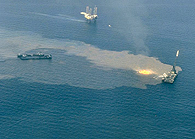
In June 1979, workers on the the Ixtoc I oil platform in the Bay of Campeche attempted to seal the exploratory well on the sea floor 160 feet below. A sudden burst of pressure sent a volatile bubble of oil and natural gas up the pipe, where it ignited and exploded. The burning rig collapsed and fell into the Gulf of Mexico, where the busted wellhead had started spewing oil. The flow could not be stopped until the following March — 290 days later. During that time, approximately 3 million barrels flowed into the Gulf, according the well’s owner, Petróleos Mexicanos (Pemex), the Mexican state oil company, though that was likely an underestimate. The resulting spill washed onto nearby beaches, coral reefs, and mangrove swamps and spread northward, hitting a stretch of the Texas coast.
“Substantial stretches of beach, tens of kilometers north of the well were just blackened — it looked like an asphalt road,” said Arne Jernelov, an environmental biochemist who led a United Nations team that analyzed the impact of the spill in 1980. “This had an extremely clear effect on crabs, mussels, snails that burrow in the sand in the intertidal zones — they were practically wiped out. There was also a very significant effect on shrimp, certain fish, squid, dependent on the location of the spawning places and the time of impact. In some of the important spawning places you had a year class or two wiped out.”
But, he said, “Five years later, the crabs and mussels were back on the beaches.”
We’ve had one massive ecotoxicological experiment underway these past three months.”
Though there are some crucial differences, Ixtoc I is the closest historical analog to the Deepwater Horizon spill. Both took place in the Gulf ofMexico in similar climates and ecological circumstances. Both were seemingly uncontrollable for a time and poured huge amounts of oil into Gulf waters. Both hit nearby coastal and underwater environments hard. As for the aftermath, history offers encouragement: The post-Ixtoc recovery was robust, indicating that the Deepwater Horizon spill’s impacts, though harsh in the short term, will dissipate over time.
“Things should pretty much return to normal,” said Jeff Short, the Pacific science director for the environmental group Oceana, who has studied the impacts of oil spills, including the Exxon Valdez disaster. “For the most part the Gulf will be pretty similar to what it was ecologically before the oil spill in 10 years — probably five.”
Of course, history never repeats itself exactly, and there are several new and distinct elements in play with the Deepwater Horizon disaster that have scientists worried, including the impacts on already-eroding Louisiana marshes and the heavy use of dispersants, which have helped spread massive amounts of oil throughout the water column. “We’ve had one massive ecotoxicological experiment underway these past three months,” said Ron Kendall, a professor of environmental toxicology at Texas Tech who is studying the spill.
But first, some perspective. The Gulf of Mexico owes much of its resilience to sheer vastness. It holds 643 quadrillion gallons; relatively speaking, the Deepwater Horizon spill is small (about 200 million gallons, a rounding error by comparison). By dint of the region’s geological history, the Gulf ecosystem is also accustomed to tolerating some oil: As much as 690,000 barrels of oil seep into gulf waters naturally each year (roughly twice the volume of the Exxon Valdez spill), according to a 2000 study. The marine ecology has evolved to accommodate it: it’s home to bacteria that metabolize oil. Warm temperatures and ample sunlight encourage this process, which goes much faster than in colder environments.
Yet the most important factor is something even more basic: evaporation. Jernelov’s UN study estimated that 50 percent of the Ixtoc oil evaporated, and 12 percent was degraded by sunlight and/or oil-eating microorganisms. Another 25 percent sank to the sea floor, some of that metabolized into microscopic fecal pellets. Only 6 percent landed on Mexican beaches, and less than 1 percent on Texas beaches.
This means that it’s very, very hard to catastrophically damage the Gulf ecosystem, even with a huge oil spill. Typically, spills do their worst damage locally, where accumulations of oil and its byproducts kill animals, suffocate plants, and, for a time, compromise food chains. With Ixtoc, there were many short-term effects. Populations of crabs, for instance, were nearly eliminated over a wide area and remained at low levels nine months later, according to the UN report. Scientists discovered large plankton blooms in affected areas, a sign of diminished oxygen that can suffocate other creatures.
But there were also some pleasant surprises: One study by scientists at the National Autonomous University of Mexico found that three shrimp populations in the Bay of Campeche were essentially unaffected by the spill. A study by investigators for the U.S. Interior Department found evidence of Ixtoc oil suspended in the water column months afterward; it also determined that while shrimp samples contained “low levels of chronic petroleum pollutants” (possibly because drilling and small spills were common in that area), only one could be linked to Ixtoc.
The mixed picture roughly tracks the initial damage of the Deepwater Horizon spill. Fishing in areas east of the Mississippi River has already reopened, as government scientists have found little evidence of contamination in fish populations in those places. There’s been no clear evidence of spill-related algae blooms in an area where the annual “dead zone” linked to Midwestern agricultural runoff from the Mississippi has been one of the largest ever this year.
Since the wellhead was capped July 15, much of the oil on the surface appears to have evaporated or otherwise dissipated, though there are still reports of tarballs and other forms of petroleum reaching the shore.
Unfortunately, there was little scientific follow-up on the Ixtoc spill after the first year or two.
Government scientists estimated last week that 74 percent of the approximately 4.9 million gallons of oil released into the Gulf is gone — 33 percent from efforts to collect, burn, or chemically disperse it, 25 percent through evaporation, and 16 percent through natural dispersal. Circumstance has played a role in limiting the damage: The outflow from the Mississippi has kept some oil away from the shoreline, and an unexpected eddy in the Gulf’s loop current kept it from being carried much further east or south.
Unfortunately, after the first year or two, there was little scientific follow-up on the Ixtoc spill. “The pattern with almost all spills is, there’s an effort immediately afterward but almost nothing done in the long term, which is a real crime,” said Wes Tunnell, a marine biologist at Texas A&M’s Harte Research Institute for Gulf of Mexico Studies, who participated in several scientific surveys of the Ixtoc damage at the time. That means that while it’s easy to observe ecosystems bouncing back in the broad sense, the underlying processes and possible residual damage remain hidden.
Tunnell recently returned to some beaches and coral reefs affected by the Ixtoc spill in Mexico. Most looked fine. In some places, he found clumps of weathered oil in the same spots he had identified them 30 years earlier — but they were only 5 or 10 percent as big. In one area of coastal mangrove swamp, he found some residual damage where the oil had penetrated to the roots and killed the plants, though it was limited.
The biggest unknown, scientists say, is the oil that remains out in the open sea.
Mangrove swamps are a good ecological analog to Louisiana marshes. “They both are in quiet waters, serve the same function as being nursery grounds for many kinds of fish, shrimp, etc.,” Tunnell said. Louisiana’s marshes are already in the midst of a much larger disaster: They have been sinking and eroding for the past century, the result of the leveeing of the Mississippi, which cut off their annual replenishing supply of fresh silt. The oil and gas industry and the U.S. Army Corps of Engineers carved the marshes up with channels, hastening the process. They are disappearing at the rate of 24 square miles per year, or a football field every 38 minutes. By contrast, only a few hundred acres of marsh have been oiled.
“The amount of wetland loss that is going to occur as a result of this is small relative to the ongoing problem,” said Denise Reed, a coastal wetlands scientist at the University of New Orleans. The reason is that, to do real damage, the oil would have to penetrate past the outer edges of the marshes. But so far, it has stuck to the edges. “For the most part, land loss has been an interior marsh thing,” Reed said. “Wetlands falling apart from the inside out, soils eroding such that plants cannot survive. It’s this kind of interior deterioration that’s been the story for the last 50 years. It’s the deterioration as the result of profound changes in the landscape. Oil is really an edge issue.”
Alexander Kolker, a Tulane University coastal scientist who is surveying the marsh damage, said the oil typically penetrates 15 to 30 feet into the marsh, sometimes more, then stops. “Which fits with what we generally know: They are a trap, a filter for the estuary,” he said. To kill marsh grass, oil must coat the plant and penetrate to the root. So while grasses are dying in some areas, in others, such as eastern Barataria Bay, they have already begun to grow back. However, the damage could get much worse if a hurricane storm surge pushed offshore oil inland, soaking marsh interiors.
How long can the Gulf of Mexico take repeated environmental disasters?
The biggest unknown, scientists say, is the oil that remains out in the open sea, mostly underwater, where it might remain for a long time. Oil spewing from the well and on the surface was treated with nearly 2 million gallons of dispersants, which created droplets of differing densities that now float throughout the water column, some in plumes, some in lower concentrations. “By dispersing, you end up spreading it out over a much wider area,” said Doug Rader, the chief ocean scientist for the Environmental Defense Fund. “It’s like a volcano’s cone of ash, but moving more slowly. Some rises, then rains back toward the bottom.”
No one is quite sure what kind of damage this mixture of dispersant, oil, and its constituent chemicals can do to marine organisms. The deeper down these droplets are, the less likely they are to be metabolized or otherwise degrade, and the more mischief they may cause, especially if a storm churns them up and sends them someplace new. The toxicity of the dispersant BP has used, Corexit 9500, is hotly debated. Kendall says he believes the use of dispersants facilitated the release of toxic oil components — including benzene, a carcinogen, and toluene, which can cause neurological damage — that remain in the water.
Some science suggests the sustained exposure to low concentrations of oil and oil byproducts in water or other environments can affect the growth of fish. A paper co-authored by Oceana’s Jeff Short concluded that pink salmon embryos were harmed by proximity to extremely low concentrations of weathered oil and its byproducts on gravel or other media. In any case, at this point the long-term effects from the chemical cocktail in the Gulf are mostly hypothetical; it will take years of monitoring to get a sense of the impact on ecosystems.
If the spill damage indeed fades quickly, questions will linger as to how long the Gulf of Mexico, even with its great size and diversity, can take repeated environmental disasters, large and small. Historically it’s bounced back well, but incremental hits can take a toll. “The Gulf was likely a bit healthier 30 years ago than today,” Tunnell said. “We’ve added a lot of insults in the last 20 years: overfishing, poor fishing techniques that destroy habitats, construction along shorelines that results in pollution, dredging. You assume that today, with all these insults we’ve added, it’s not as resilient today.”