23 Feb 2010: Opinion

The U.S. Chamber: A Record of
Obstruction on Climate Action

The U.S. Chamber of Commerce has been fighting climate-change legislation and is now opposing federal efforts to regulate CO2 emissions. Its actions stand in stark contrast to an earlier business group, which more than a century ago fought to create New York’s vast Adirondack Park.

by shaun goho

In 1883, New York faced an environmental crisis. Water levels were falling in the state’s rivers and canals, impeding travel and shipping. Scientists and editorial writers placed the blame on the logging and burning of the Adirondacks, which prevented the forests from exercising their usual moderating influence on stream flows. With the loss of the forests, it was feared, the steady release of water would be replaced by a cycle of floods and low water.

To make matters worse, these impacts were the result of logging only on the fringes of the Adirondack region. But in 1883, the Adirondack Railroad Company proposed to build a line through the heart of the forest. The inevitable expansion of logging into the interior would, in the words of a New York Tribune article, result in “disastrous climatic changes, ... wasting freshets and parching drou[ghts].”
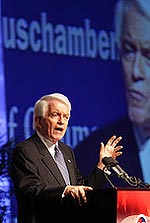
Donohue
U.S. Chamber of Commerce president Thomas J. Donohue has adopted a hard-line stance against action on climate change.
As the newspapers filled with editorials calling for the protection of the “North Woods,” an unlikely champion of environmental protection responded: the New York Chamber of Commerce. A chamber committee proposed that the state purchase up to 4 million acres and “keep it for all time as a great forest preserve.” This was the crucial first step toward the creation in 1892 of the Adirondack Park, which today encompasses 6 million acres and is the largest publicly protected area in the contiguous United States. Given the powerful railroad and timber interests arrayed on the other side, the birth of the park would not have been possible without the early advocacy of the chamber.

Contrast this history with the actions of the U.S. Chamber of Commerce today. The chamber, by far the largest lobbying force on Capitol Hill — having spent more than $65 million in 2009 — is actively campaigning against meaningful climate change legislation. It is also taking a lead role in challenging the Environmental Protection Agency’s (EPA) attempts to regulate greenhouse gases under the Clean Air Act. More fundamentally, it continues to cast doubt on climate change science and sow fears through exaggerated claims about the economic consequences of greenhouse gas regulation.

These influential business lobbies, acting 125 years apart, took two sharply different approaches to the most pressing environmental issues of the day. Their divergent paths cast the U.S. chamber in a sorry light, and ensure that it will one day be judged harshly by history.

One major difference between the two groups is that the New York chamber sought out — and followed — the advice of scientists. That era, too, had its deniers. One member of the State Assembly suggested that “the
The U.S. Chamber of Commerce has a long history of disputing the human impact on climate.
Hudson River is an arm of the sea, subject to tides, and there will be plenty of water upon which to float the commerce of the State if not a drop of water flows into it from the Adirondack region.” The chamber did not side with those views, but instead followed the advice of scientists like Charles Sprague Sargent, director of the Arnold Arboretum at Harvard. Sargent told the chamber that “no doubt could possibly exist as to the necessity of putting a stop to the work of destruction now going on in the Adirondacks.”

By contrast, the U.S. Chamber of Commerce has a long history of disputing the human impact on climate and of promoting the work of climate change deniers. In 2001, William Kovacs — then the Chamber’s Vice President of Environmental Policy — claimed in an appearance on CNNfn that “there’s no link between greenhouse gases and human activity.” In a 2008 memo to the Chamber’s Board of Directors, chamber President Thomas J. Donohue claimed that “scientific inquiry” into global warming “should continue... given the recent reports indicating a cooling trend.” The National Chamber Foundation, the chamber’s nonprofit affiliate, named books by climate change deniers among its top ten recommended books of 2008 and 2009.

Moving from words to actions, last spring the chamber formally challenged the findings underlying the EPA’s decision that greenhouse gas emissions endanger the public health and welfare and should therefore be regulated. Kovacs claimed that the goal of this challenge was to create the “Scopes monkey trial of the 21st century” — a reference to the infamous prosecution of a Tennessee schoolteacher for his teaching of evolution in the 1920s. According to Kovacs, a public hearing on the endangerment finding “would be the science of climate change on trial.” This month, the chamber became one of more than a dozen groups, states, and corporations filing petitions to block the EPA from regulating carbon dioxide emissions.
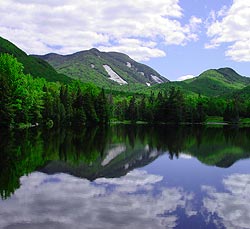
Adirondacks
iStock
In the late 1800s, the New York Chamber of Commerce focused on the long-term economic impacts of Adirondack deforestation.
A second key difference between the two chambers is that the New York chamber took a broad and long view of its members’ economic interests. The timber and railroad industries stood to make large profits from the destruction of the Adirondack forest. Nevertheless, the New York chamber focused not on these lost short-term profits but on the potentially devastating long-term economic impacts of Adirondack deforestation for all of its members. Declining stream flows meant, Harper’s Weekly wrote, that “agriculture will suffer, manufactures will languish for want of power, and the great internal waterways of the continent will be rendered useless for commercial interchanges.”

Today, the U.S. chamber appears not to recognize the economic threat posed by climate change. Instead, the chamber’s leadership continues to trot out exaggerated and one-sided claims about how the regulation of greenhouse gases would eliminate jobs and “strangle the economy.” While some companies in the fossil fuel and power sectors will face reductions in profits under a cap-and-trade scheme, the long-term consequences of unchecked climate change will be harmful and expensive for everyone.

In fact, as many forward-looking companies recognize, cap-and-trade legislation will be good for business. Among other things, it will provide incentives for U.S. businesses to invest in the next generation of clean
In an unprecedented show of dissent, corporations have renounced their membership in the U.S. chamber.
energy technologies. This impetus is long overdue, as the country falls behind China and Europe in this area. In an unprecedented show of dissent, corporations such as Apple, Exelon, Johnson & Johnson, Nike, and Pacific Gas and Electric have either renounced their membership in the chamber or expressed dismay at the chamber’s position. Moreover, many local chambers — including the Greater New York Chamber of Commerce, the San Francisco Chamber of Commerce, and the Greater Seattle Chamber of Commerce — have distanced themselves from the U.S. chamber on climate change.

In recent months, the chamber, apparently stung by the series of resignations and the withering criticism in the press, appears to have softened its tone. But underneath the new rhetoric there appears to be

More from Yale e360

A Journalist Reflects on the Rising Heat in Climate Debate
Although he writes one of the most popular blogs on the environment, Dot Earth author Andrew Revkin recognizes both the drawbacks and potential of the Web for exploring complex issues. In an interview with Yale Environment 360, Revkin explains why the rhetoric surrounding climate change has gotten so hot.

Apocalypse Fatigue: Losing
the Public on Climate Change

Even as the climate science becomes more definitive, polls show that public concern in the United States about global warming has been declining. What will it take to rally Americans behind the need to take strong action on cutting carbon emissions?
little, if any, change in substance. The chamber’s chief legal officer said the chamber was not challenging “scientific issues related to climate change.” Yet despite that statement, the chamber continues to do all it can to block any regulation of planet-warming greenhouse gas emissions, clearly demonstrating that it has still not learned the lessons that the New York chamber mastered more than 125 years ago. The U.S. chamber still stubbornly refuses to acknowledge the scientific consensus that climate change is real and it continues to brush aside the serious economic risks that climate change poses.

In the words of Peter Darbee, chairman and CEO of Pacific Gas & Electric, “an intellectually honest argument over the best policy response to the challenges of climate change is one thing; disingenuous attempts to diminish or distort the reality of these challenges are quite another.”

As long as the chamber adopts the latter approach, it cannot be a legitimate participant in the public debate on cap-and-trade legislation.

POSTED ON 23 Feb 2010 IN Climate Policy & Politics Pollution & Health North America North America 

COMMENTS


The assertions that the U.S. Chamber of Commerce "continues to cast doubt on climate change science", "is actively campaigning against meaningful climate change legislation" and "continues to do all it can to block any regulation of planet-warming greenhouse gas emissions" are simply not true.

We address the science question here: http://www.uschamber.com/facts

And clearly lay out our support for comprehensive climate legislation here: http://www.chamberpost.com/2009/11/climate-change---a-different-approach.html

Bradley Peck
Senior Director, Communications Publishing
U.S. Chamber of Commerce

Posted by Bradley Peck on 24 Feb 2010


Thank you for posting Mr. Josten's letter. However, sorry to say but I hardly think it is affirmation of the Chamber's willingness to support climate legislation. Instead, the environment and greenhouse gases seem like an afterthought to further push an agenda not aligned with actual emission reduction. Offshore drilling, regardless of the environmental cautions taken, will not get us any closer to avoiding a climatic catastrophe. Nor at this rate will clean coal. Or protecting individual and consumer property rights.

Please do not say that you are supporting climate legislation when actually everything you support has nothing to do with addressing the problem.

Posted by Katherine Dart on 24 Feb 2010


I don't believe there's a scientific consensus on global warming and I doubt the actions of mankind will cause a climatic catastrophe. Prohibiting most of the Adirondacks from private enterprise allowed nature in that area to unfold as nature does in four season climate zones, with each season a regeneration with no input from mankind. It isn't exactly a pristine environment, you find discards, a couch, tires and construction materials, but nature will absorb those in it's own time in much the same manner it will cities and even those of us writing and reading this.

This is more a subject for historians and anthropologists than lawyers, all the world's lawyers combined with all the politicians cannot devise laws to hurry or slow nature. "Meaningful climate change" for Al Gore and his ilk has more to do with enriching themselves than saving planet earth. Time marches on, the last of the global warming hysterics will be dust long before man can predict the weather for the next day or week, to say nothing about decades or centuries from now.

Posted by Vernon Clayson on 24 Feb 2010


It is the brazen collective mendacity of the US Chamber of Commerce that is so discreditable. To claim to be no longer obstructing the control of greenhouse gasses, while in reality obviously doing just that, and doing so very publicly, smears US business as a whole with a taint that many firms do not deserve.

Given the groundswell of interest in a new global boycott of American goods (from electronics to foodstuffs) those firms locking the US CoC into its outdated obedience to the fossil fuel lobby need to review their strategy.

Posted by Lewis Cleverdon on 24 Feb 2010


Comments have been closed on this feature.
shaun gohoABOUT THE AUTHOR
Shaun Goho is a staff attorney and clinical instructor at the Emmett Environmental Law and Policy Clinic at Harvard Law School, where he supervises students working on litigation and other projects addressing a variety of environmental issues, including climate change, renewable energy, and water pollution. His research interests include environmental history and administrative law.


RELATED ARTICLES


Could a Changing Climate
Set Off Volcanoes and Quakes?

A British scientist argues that global warming could lead to a future of more intense volcanic eruptions and earthquakes. And while some dismiss his views as preposterous, he points to a body of recent research that shows a troubling link between climate change and the Earth’s most destructive geological events.
READ MORE

Insurance Companies Face
Increased Risks from Warming

If the damages related to climate change mount in the coming decades, insurance companies may face the prospect of paying larger disaster claims and being dragged into global warming lawsuits. But many firms, especially in the U.S., have barely begun to confront the risks.
READ MORE

Hopes Fade for Cleanup
In Nigeria’s Oil-Rich Delta

The Ogoniland region of Nigeria has long been badly polluted by decades of oil production that has fouled the delta and contaminated drinking water. A United Nations report has recommended a massive recovery initiative, but so far the Nigerian government has shown few signs it will agree to the cleanup project.
READ MORE

Besieged by Climate Deniers,
A Scientist Decides to Fight Back

Climate scientist Michael Mann, who has faced years of attacks from climate-change skeptics, explains why he believes bad-faith assaults on science have no place in a functioning democracy and why the truth about global warming will inevitably gain wide acceptance.
READ MORE

Innovation is Not Enough:
Why Polluters Must Pay

Innovative energy technologies are certainly essential if the world is to curb carbon emissions. But in response to a recent e360 article by the co-founders of the Breakthrough Institute, an economist argues we must also cap emissions or put a price on carbon in order to avoid the worst impacts of climate change.
READ MORE


MORE IN Opinion


The Clean Water Act at 40:
There’s Still Much Left to Do

by paul greenberg
The Clean Water Act of 1972, one of the boldest environmental laws ever enacted, turns 40 this year, with an impressive record of cleaning up America's waterways. But from New York Harbor to Alaska’s Bristol Bay, key challenges remain.
READ MORE

Besieged by Climate Deniers,
A Scientist Decides to Fight Back

by michael e. mann
Climate scientist Michael Mann, who has faced years of attacks from climate-change skeptics, explains why he believes bad-faith assaults on science have no place in a functioning democracy and why the truth about global warming will inevitably gain wide acceptance.
READ MORE

The Folly of Big Agriculture:
Why Nature Always Wins

by verlyn klinkenborg
Large-scale industrial agriculture depends on engineering the land to ensure the absence of natural diversity. But as the recent emergence of herbicide-tolerant weeds on U.S. farms has shown, nature ultimately finds a way to subvert uniformity and assert itself.
READ MORE

Shunning Nuclear Power
Will Lead to a Warmer World

by spencer r. weart
A physicist argues that if we allow our overblown and often irrational fears of nuclear energy to block the building of a significant number of new nuclear plants, we will be choosing a far more perilous option: the intensified burning of planet-warming fossil fuels.
READ MORE

Innovation is Not Enough:
Why Polluters Must Pay

by gernot wagner
Innovative energy technologies are certainly essential if the world is to curb carbon emissions. But in response to a recent e360 article by the co-founders of the Breakthrough Institute, an economist argues we must also cap emissions or put a price on carbon in order to avoid the worst impacts of climate change.
READ MORE

Beyond Cap and Trade,
A New Path to Clean Energy

by ted nordhaus and michael shellenberger
Putting a price and a binding cap on carbon is not the panacea that many thought it to be. The real road to cutting U.S. emissions, two iconoclastic environmentalists argue, is for the government to help fund the development of cleaner alternatives that are better and cheaper than natural gas.
READ MORE

On the Road Back to Rio,
Green Direction Has Been Lost

by fred pearce
Twenty years ago, an historic environmental summit in Rio de Janeiro produced groundbreaking treaties and high hopes that pressing issues would be addressed. But as organizers prepare for the Rio+20 conference in June, there is little on the agenda to suggest any substantive action will be taken.
READ MORE

As Roads Spread in Rainforests,
The Environmental Toll Grows

by william laurance
From Brazil to Borneo, new roads are being built into tropical forests at a dizzying pace, putting previously intact wilderness at risk. If we hope to preserve rainforests, a leading researcher says, new strategies must be adopted to limit the number of roads and reduce their impacts.
READ MORE

Solar Power Off the Grid:
Energy Access for World’s Poor

by carl pope
More than a billion people worldwide lack access to electricity. The best way to bring it to them — while reducing greenhouse gas emissions — is to launch a global initiative to provide solar panels and other forms of distributed renewable power to poor villages and neighborhoods.
READ MORE

In Australia’s New Carbon Tax,
A Host of Missed Opportunities

by richard denniss
The Australian government will begin imposing a tax on carbon emissions in mid-2012. But large giveaways to industry mean Australia’s scheme doesn’t go nearly far enough in reducing the nation’s CO2 emissions or providing economic stimulus.
READ MORE


e360 digest
Yale
Yale Environment 360 is
a publication of the
Yale School of Forestry
& Environmental Studies
.

SEARCH e360


Donate to Yale Environment 360

CONNECT

Twitter: YaleE360
e360 on Facebook
Donate to e360
View mobile site
Bookmark
Share e360
Email newsletter
Subscribe to our feed:
rss


ABOUT

About e360
Contact
Submission Guidelines
Reprints

e360 VIDEO

Warriors of Qiugang
The Warriors of Qiugang, a Yale Environment 360 video that chronicles the story of a Chinese village’s fight against a polluting chemical plant, was nominated for a 2011 Academy Award for Best Documentary (Short Subject). Watch the video.


DEPARTMENTS

Opinion
Reports
Analysis
Interviews
e360 Digest
Video Reports

TOPICS

Biodiversity
Business & Innovation
Climate
Energy
Forests
Oceans
Policy & Politics
Pollution & Health
Science & Technology
Sustainability
Urbanization
Water

REGIONS

Antarctica and the Arctic
Africa
Asia
Australia
Central & South America
Europe
Middle East
North America

e360 VIDEO REPORT

When the Water Ends
As temperatures rise and water supplies dry up, tribes in East Africa increasingly are coming into conflict. A Yale Environment 360 video reports on a phenomenon that could become more common: how worsening drought will pit groups — and nations — against one another. Watch the video.

e360 MOBILE

Mobile
The latest
from Yale
Environment 360
is now available for mobile devices at e360.yale.edu/mobile.


header image
Top Image: aerial view of Iceland. © Google & TerraMetrics.

e360 VIDEO REPORT

Leveling Appalachia
Leveling Appalachia: The Legacy of Mountaintop Removal Mining, an e360 video examining the environmental and human impacts of this mining practice, won the award for best video in the 2010 National Magazine Awards for Digital Media. Watch the video.


OF INTEREST


Yale