24 Jan 2013: Report

To Tackle Runoff, Cities
Turn to Green Initiatives

Urban stormwater runoff is a serious problem, overloading sewage treatment plants and polluting waterways. Now, various U.S. cities are creating innovative green infrastructure — such as rain gardens and roadside plantings — that mimics the way nature collects and cleanses water.

by dave levitan

In Northeast Philadelphia, along busy Kensington Avenue, sits a small park. What used to be flat ground is now sloping terrain that contains a low-lying area intended to gather and funnel storm water. At the park’s southern end is a depression lined with well-arranged plants — a new landscape carefully engineered to change how water flows through the area.

This is Womrath Park, one of a handful of “green infrastructure” projects Philadelphia has begun — with many more to come — aimed at tackling a widespread urban environment problem. Ten trillion gallons of rainwater per year flow over rooftops and roads around the U.S., picking up contaminants that include bacteria, oil and grease, metals, pesticides, and many others. When a rainstorm is big enough, the runoff causes overflows from outdated sewer systems that combine both raw sewage and stormwater in a single pipe. This tide of pollutants ends up in surrounding waterways that serve as drinking water sources and recreational areas.

“Stormwater runoff is one of the largest water pollution issues facing the U.S. today,” says Larry Levine, a senior attorney in the Natural Resource Defense Council’s water program.
View gallery
Philadelphia Stormwater Planters

Philadelphia Water Department
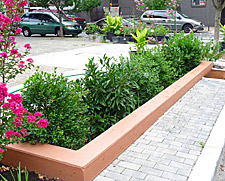
A stormwater planter at Columbus Square in Philadelphia.
Now, however, numerous cities around the country — including Philadelphia, New York, Washington, Portland, and Seattle — have embarked on innovative stormwater runoff fixes that rely not so much on the old “gray infrastructure” of huge, piped systems and sewage treatment plants, but rather on new green infrastructure techniques to collect and treat stormwater at the street level.

Green infrastructure mimics how nature handles rainwater through the use of porous surfaces, rather than impervious surfaces like roadways. These techniques are decentralized. Instead of one facility or large underground tank to store water when a big storm hits, the idea is to eliminate the need for such storage through the use of green rooftops, roadside plantings, carefully landscaped parks, rain gardens, rain barrels, and other swatches of nature dropped down inside the landscape of modern cities.

The plants and soils collect water during a storm, preventing it from either running into sewer systems at all, or at least slowing it down to prevent overflows. Green infrastructure can also help clean some pollution from the water and can even be used to gather water for re-use.

“The green infrastructure approach says, ‘Let’s get the water out of those sewer systems in the first place before it has a chance to convey all that pollution into our waterways,’” says Levine. “And the way to do that is to
Advocates say going green is a far more cost-effective method than constructing wastewater treatment plants.
put back into our built environment features that mimic the way nature handles rainwater in the natural water cycle. It doesn’t necessarily mean replacing a paved street with a park, but it means putting enough green space into the design of your roadway that you can capture runoff from that paved space.”

These types of green projects carry numerous ancillary benefits, Levine notes, from improving surrounding property values, to reducing in the urban heat island effect, to lowering asthma rates.

Green stormwater infrastructure means thousands of individual projects in big cities like New York or Philadelphia. The price tag — Philadelphia is spending around $3 billion, and the country as a whole needs something like $63 billion just in fixes to stormwater-related sewage overflows — is high. But advocates say going green is eventually a far more cost-effective method than constructing large wastewater treatment plants. Philadelphia and other cities are using city and federal funding to finance these green infrastructure projects.

Valessa Souter-Kline, a representative of the Philadelphia Water Department, says the decentralized concept of green infrastructure development represents a major challenge. “No one is saying ‘no’ to the idea,” says Souter-Kline, standing at the bottom of the rain garden in Womrath Park. “The issue is the scale. You just need so much of this.” On any given project, she says, the Philadelphia Water Department will likely have to work with the streets department, parks and recreation, utility companies, and other stakeholders.

Levine and others say the new methods of stormwater runoff control deal with a key flaw in the landmark 1972 Clean Water Act — “nonpoint source” pollution.

“It is a very different way of approaching water infrastructure than we have typically had in this country,” Levine says. “We’re talking about thousands of rain gardens and green roofs, and pavement installations, and street trees, and that’s a different sort of a public works project to manage, administer, and maintain. That brings all sorts of challenges along with it
‘To a greater or lesser degree, cities everywhere are starting to look at this,’ says one expert.
that cities are really rapidly having to adapt to and learn the best ways to deal with.”

Despite the difficulties, these projects are gaining momentum. “To a greater or lesser degree, cities everywhere are starting to look at this,” says Ed McMahon, a senior resident fellow at the Urban Land Institute in Washington D.C., and the co-author of a 2006 book on green infrastructure. “One of the things that they’ve started to recognize is that using natural systems oftentimes can be less costly than the structural approach to stormwater management.”

While eastern cities have recently launched large projects to address stormwater, some cities on the West Coast have been making incremental progress for far longer. Seattle and Portland have strong programs, including incentives in Seattle to install rain barrels on private property within watersheds served by combined sewer systems. Portland is planning to build 2,200 green infrastructure installations around the city and has a runoff retention standard that applies to building projects with even small amounts of impervious surfaces.

But on the East Coast, Philadelphia is the clear frontrunner. In June 2011, the city approved the Green City, Clean Waters program, a 25-year, $3 billion plan to reduce combined sewer overflows. In April 2012, the Environmental Protection Agency (EPA) signed off on the project, and EPA administrator Lisa Jackson said she hoped the city would serve as a model for the rest of the country. Philadelphia was the only city to meet all the requirements for “Emerald” status in the NRDC’s latest “Rooftop to Rivers” report on stormwater management.

View gallery
Philadelphia Stormwater Planters

Philadelphia Water Department
So-called “porous streets” — like this one in Philadelphia — allow stormwater to soak through the surface, where it is stored underground.
So far, Philadelphia’s program has yieldedstormwater tree trenches, planters and water basins, 40 rain gardens, rain barrel pilot projects, 10 swales (low-lying areas that collect runoff), and a few dozen other projects. In Womrath Park, completed in 2012, stormwater flows through a swale and into a depression at the end, a rain garden. Some water infiltrates directly into the soil and groundwater, while the rest is held up and released slowly into the sewers to avoid overflows into Frankford Creek, only a few blocks away. Citywide, the idea is to be able to capture an inch of rainfall during storms and reduce combined sewage overflows by 7.9 billion gallons per year, or about 85 percent.

Elsewhere, the EPA signed an agreement with Washington, D.C., in December 2012 that closely resembles the Philadelphia program. Washington will start with a series of green infrastructure projects in the Potomac and Rock Creek watersheds. On a federal scale, the EPA is partnering with many other municipalities and watersheds to provide funding and assistance with stormwater infrastructure improvements.

New York City represents perhaps the biggest challenge. Levine says New York has 30 billion gallons of combined sewage overflow every year, and impervious surfaces cover 72 percent of the city. The city has committed to providing green infrastructure for 10 percent of the impervious surface area over the next 20 years, capable of capturing one inch of rain during storms. Roughly $730 million in public funding will be spent on green infrastructure over the next 10 years. “So any one-inch rainstorm or less, there is going to be a place for that water to go without making it into the sewer system,” Levine says.

Other ideas are in the works as well. Ate Atema, an architect, is working on an initiative called Street Creeks intended to reduce pollution flowing from the notorious Gowanus Canal area in Brooklyn. Built in 1869, the Gowanus was lined by chemical plants and other industrial sites that spent a century dumping toxic waste products into the water. As a result, it is among the most polluted urban waterways in the country, and was named a Superfund site in 2010. The canal also receives stormwater runoff from the hilly neighborhoods of Park Slope and Cobble Hill on either side.

Atema’s Street Creeks is a simple, modular way of capturing the “first flush” of stormwater that flows down the hill from Prospect Park toward the Gowanus.

MORE FROM YALE e360

How No-Flush Toilets Can
Help Make a Healthier World

How No-Flush Toilets Can Help Make a Healthier World
Inadequate sewage systems and the lack of toilets in much of the developing world have created a major public health and environmental crisis. Now various innovators are promoting new kinds of toilets and technologies that use little or no water and recycle the waste.
READ MORE
“The first 0.15 inches of rain more or less takes 80 percent of the mass contaminant load off the streets,” Atema says. His plan would handle this “first flush” by constructing roadside creeks, about 18 inches deep and two feet wide, that would funnel stormwater toward a bioswale, where soils and plants could slow and clean the runoff.

To minimize costs, Atema says the plan would aim to install the “street creeks” on blocks undergoing other types of maintenance. In the Gowanus area, the project could eventually cover 250 blocks that flow toward the Canal. The cost of the project has not yet been calculated. Atema says the idea is still in the design phase, but talks with the city have begun.

These projects demonstrate a realization that nature is often very good at things we humans find hard to accomplish through classic, straight-line engineering.

“When people start really thinking about how a natural approach to the management of water, the cleaning of air, and so forth, can actually reduce costs and increase value at the same time,” says McMahon of the Urban Land Institute, “I just think that it’s inevitable that we’re going to see this as a much more preferred approach going forward.”

POSTED ON 24 Jan 2013 IN Business & Innovation Energy Policy & Politics Pollution & Health Science & Technology Sustainability Urbanization North America North America 

COMMENTS


Rain gardens.
Posted by Bob on 24 Jan 2013


Two things strikes me in this very interesting article:

First, urban solutions generally seem to assume the action has to be within the urban footprint. The scale is limited & costs tend to be high because of intense competition for space. There seems - it is certainly the case in the UK - to be an invisible barrier between the city and the land surrounding it, which potentially can yield benefits at a much larger scale and lower cost. My experience suggests this is cultural - certainly in the UK urban & rural in Government don't talk to or understand each other.

Leading on from that, the comment from Valessa Souter-Kline reflects my own experience - that many of the biggest hurdles are organisational & political rather than practical.

When we managed to join up forestry & urban regeneration on the eastern fringes of London and around the post-industrial cities of Manchester & Liverpool the results have been extraordinary and, with imagination and more scale could be transformative.

Posted by Roderick Leslie on 25 Jan 2013


Unhappily, Portland, Maine has succumbed to the mechanical engineering approach to storm water control.

Tomorrow morning we begin digging two huge trenches under Baxter Boulevard---the jewel of the city---to store storm water. Each will hold a million gallons.

This dig will entail huge emissions of CO2 from the trucks that will cart the soil away.

One wonders if these projects---as opposed to green infrastructure---are not a kind of gift to
the local excavating companies?

Posted by Alfred Padula on 27 Jan 2013


I sincerely hope that the author can get this article to the staffs of Mayor Bloomberg and Governors Christie and Cuomo. This is how Sandy rebuilding should be tackled.

Posted by Trevor Burrowes on 15 Feb 2013


I recently attdneed a seminar given by Jim Urban on urban soils, which I found to be long overdue in this industry. What struck me the most was his mention of the book 1491, which I had read this past spring. The intriguing part of that mention was that he only referenced the first half of the book, covering the terra forming of the forests of the eastern United States but not the last third of the book dealing with the creation of Terra Preta soils, by the Amerindians of the Amazon Basin. Terra Preta soils appear to be the Rosetta stone of all of the questions about fertility, carbon and flora in the soil. This appears to represent a new topic that promises astounding possibilities for the green industry as well as the rest of the world.

Posted by Adel on 26 Feb 2013


How would street-side water channels interact with bike lanes in NYC?

Posted by Matt Isles on 06 Mar 2013


How economic such a plan is?

Dr. A. Jagadeesh Nellore (AP), India

Posted by Dr.A.Jagadeesh on 26 Apr 2013


POST A COMMENT

Comments are moderated and will be reviewed before they are posted to ensure they are on topic, relevant, and not abusive. They may be edited for length and clarity. By filling out this form, you give Yale Environment 360 permission to publish this comment.

Name 
Email address 
Comment 
 

dave levitanABOUT THE AUTHOR
Dave Levitan is a freelance journalist based in Philadelphia who writes about energy, the environment, and health. His articles have been published by Reuters, SolveClimate, IEEE Spectrum, and Psychology Today. In previous articles for Yale Environment 360, he has written about the potential of self-driving cars and about vehicle-to-grid technology involving electric cars.
MORE BY THIS AUTHOR


RELATED ARTICLES


Harnessing Citizen Power to
Fund a U.S. Solar Revolution

Environmental activist Billy Parish believes the best way to fight climate change is to fund the renewable energy projects that will supplant fossil fuels. In an interview with Yale Environment 360, he discusses how “crowdfunding” can help lead to the widespread adoption of solar power.
READ MORE

Copenhagen’s Ambitious Push
To Be Carbon Neutral by 2025

The Danish capital is moving rapidly toward a zero-carbon future, as it erects wind farms, transforms its citywide heating systems, promotes energy efficiency, and lures more people out of their cars and onto public transportation and bikes.
READ MORE

Designing the Urban Landscape
To Meet 21st Century Challenges

Martha Schwartz, a professor at Harvard’s Graduate School of Design, explains in a Yale Environment 360 interview how creative landscape architecture can help cities become models of sustainability in a world facing daunting environmental challenges.
READ MORE

Green Crude: The Quest to
Unlock Algae’s Energy Potential

A host of startup companies are pursuing new technologies that they claim will soon lead to large-scale commercialization of biofuels made from algae. But questions remain about the viability and environmental benefits of what some of its developers are calling “green crude.”
READ MORE

With Funding Tight, Cities are
Turning to Green Infrastructure

From Seattle to Sweden, an ever-growing number of city and regional governments are using roof gardens, specially designed wetlands, and other forms of “green infrastructure” to rein in pollution from countless diffuse sources — and to save money.
READ MORE


MORE IN Reports


In Post-Tsunami Japan, A Push
To Rebuild Coast in Concrete

by winifred bird
In the wake of the 2011 tsunami, the Japanese government is forgoing an opportunity to sustainably protect its coastline and is instead building towering concrete seawalls and other defenses that environmentalists say will inflict serious damage on coastal ecosystems.
READ MORE

How Mussel Farming Could
Help to Clean Fouled Waters

by paul greenberg
Along the shores of New York Harbor, scientists are investigating whether this ubiquitous bivalve can be grown in urban areas as a way of cleansing coastal waters of sewage, fertilizers, and other pollutants.
READ MORE

A Key Experiment to Probe the
Future of Our Acidifying Oceans

by peter friederici
In a Swedish fjord, European researchers are conducting an ambitious experiment aimed at better understanding how ocean acidification will affect marine life. Ultimately, these scientists hope to determine which species might win and which might lose in a more acidic ocean.
READ MORE

Declining Bee Populations Pose
A Threat to Global Agriculture

by elizabeth grossman
The danger that the decline of bees and other pollinators represents to the world’s food supply was highlighted this week when the European Commission decided to ban a class of pesticides suspected of playing a role in so-called “colony collapse disorder.”
READ MORE

Fires Burn More Fiercely
As Northern Forests Warm

by dylan walsh
From North America to Siberia, rising temperatures and drier woodlands are leading to a longer burning season and a significant increase in forest fires. Scientists warn that this trend is expected continue in the years ahead.
READ MORE

Will Electric Bicycles Get
Americans to Start Pedaling?

by marc gunther
Electric bicycles are already popular in Europe and in China, which has more e-bikes than cars on its roads. Now, manufacturers are marketing e-bikes in the U.S., promoting them as a "green" alternative to driving.
READ MORE

Copenhagen’s Ambitious Push
To Be Carbon Neutral by 2025

by justin gerdes
The Danish capital is moving rapidly toward a zero-carbon future, as it erects wind farms, transforms its citywide heating systems, promotes energy efficiency, and lures more people out of their cars and onto public transportation and bikes.
READ MORE

How Ontario Is Putting an End
To Coal-Burning Power Plants

by keith schneider
Ontario is on the verge of becoming the first industrial region in North America to eliminate all coal-fired electrical generation. Here’s how Canada’s most populous province did it — and what the U.S. and others can learn from it.
READ MORE

Long Outlawed in the West,
Lead Paint Sold in Poor Nations

by rebecca kessler
A new study finds that household lead paint — banned for years in the U.S. and Europe because of its health effects on children — is commonly sold in the African nation of Cameroon. Is lead paint the latest case of Western companies selling unsafe products in developing countries?
READ MORE

Can a Divestment Campaign
Move the Fossil Fuel Industry?

by brooke jarvis
U.S. climate activists have launched a movement to persuade universities, cities, and other groups to sell off their investments in fossil fuel companies. But while the financial impact of such divestment may be limited, the campaign could harm the companies in a critical sphere — public opinion.
READ MORE


e360 digest
Yale
Yale Environment 360 is
a publication of the
Yale School of Forestry
& Environmental Studies
.

SEARCH e360


Donate to Yale Environment 360

CONNECT

Twitter: YaleE360
e360 on Facebook
Donate to e360
View mobile site
Bookmark
Share e360
Email newsletter
Subscribe to our feed:
rss


ABOUT

About e360
Contact
Submission Guidelines
Reprints

e360 PHOTO GALLERY

To Catch a Rhino Welz
South African photojournalist Adam Welz documents the harrowing relocation of six white rhinos to a region that has lost all its rhinos to poaching. View the gallery.


DEPARTMENTS

Opinion
Reports
Analysis
Interviews
e360 Digest
Podcasts
Video Reports

TOPICS

Biodiversity
Business & Innovation
Climate
Energy
Forests
Oceans
Policy & Politics
Pollution & Health
Science & Technology
Sustainability
Urbanization
Water

REGIONS

Antarctica and the Arctic
Africa
Asia
Australia
Central & South America
Europe
Middle East
North America

e360 VIDEO

Into Heart of Ecuador Yasuni
A Yale Environment 360 video explores Ecuador’s threatened Yasuni Biosphere Reserve with scientists inventorying its stunning forests and wildlife. Watch the video.

e360 MOBILE

Mobile
The latest
from Yale
Environment 360
is now available for mobile devices at e360.yale.edu/mobile.

e360 VIDEO

Colorado River Video
In a Yale Environment 360 video, photographer Pete McBride documents how increasing water demands have transformed the Colorado River, the lifeblood of the arid Southwest. Watch the video.


header image
Top Image: aerial view of Iceland. © Google & TerraMetrics.

e360 VIDEO

Warriors of Qiugang
The Warriors of Qiugang, a Yale Environment 360 video that chronicles the story of a Chinese village’s fight against a polluting chemical plant, was nominated for a 2011 Academy Award for Best Documentary (Short Subject). Watch the video.


OF INTEREST


Yale