Ellen Mosley-Thompson and her husband, Lonnie Thompson, are two of the world’s most respected climatologists and glaciologists, traveling around the globe to bore holes in shrinking glaciers and ice sheets. Mosley-Thompson works mainly at the poles, in Greenland and Antarctica, while her husband has done more ice corings of low-latitude glaciers — in the Andes, Africa, and the Himalayas — than any other person alive. Their work, taken together, paints a sobering portrait of the rapid retreat of most of the world’s glaciers and ice caps in the face of the buildup of planet-warming greenhouse gases.
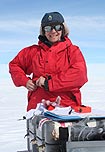
Several months ago, during the Antarctic summer, Mosley-Thompson — the director of the Byrd Polar Research Center at Ohio State University — returned to Antarctica for the ninth time to head a six-person expedition to the Bruce Plateau on the Antarctic Peninsula.
The peninsula has warmed faster than almost any other place on Earth, with winter temperatures increasing by 11 degrees F over the past 60 years and year-round temperatures rising by 5 degrees F. As a result, sea ice now covers the western Antarctic Peninsula three months less a year than three decades ago, 90 percent of glaciers along the western Antarctic Peninsula are in retreat, and large floating ice shelves are crumbling.
The most famous of those ice shelves is the Larsen B, a slab of ice — once the size of Connecticut — that disintegrated spectacularly in 2002 in the Weddell Sea. Mosley-Thompson’s expedition was part of a larger study to research the collapse of the Larsen A & B ice shelves and to place this major event in the context of previous eras of climate change.
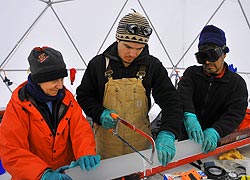
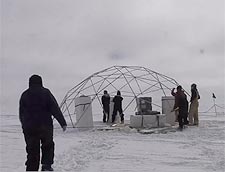
Working for 42 days in frigid temperatures at 6,500 feet, Mosley-Thompson and her team encountered numerous hardships and difficulties, including the loss of ice drills. Thanks to the ingenuity and engineering skills of her team members, the group finally succeeded in drilling 1,462 feet to the bedrock atop the Bruce Plateau. When the ice cores return to Ohio State in June, Mosley-Thompson and her colleagues hope to analyze the ice to track the history of climate change for thousands of years, perhaps to the last glacial period and beyond.
But even before she analyzes her latest drilling samples, Mosley-Thompson tells Yale Environment 360 senior editor Fen Montaigne, one thing is clear: the retreat of the world’s glaciers, coupled with evidence from other Antarctic ice cores showing atmospheric concentrations of CO2 at their highest levels in more than 800,000 years, “tells us very clearly that we have a serious problem.”
Yale Environment 360: I wondered if you could describe for our readers the purpose of this ice coring expedition.
Helen Mosley-Thompson: We were part of a much larger International Polar Year project sponsored by the National Science Foundation. The name of the big project is LARISSA. This was a very large, multidisciplinary international effort to get a better understanding of the interaction of the various systems operating in the Larsen B embayment — for example, the oceanographic system, the ice system, the ecological system, the atmosphere.
e360: And [the Bruce Plateau] is basically a big ice cap or glacier in the midst of these beautiful mountains that run the length of the Antarctic Peninsula?
Mosley-Thompson: Yes, that’s correct. Actually, the Bruce Plateau itself is relatively narrow at the spot where we were drilling. So on our six clear days — we were there 42 days — we had excellent horizon. We could see mountains and we could look out into the distance where we knew the remaining part of the Larsen B Ice Shelf and the Larsen C Ice Shelf were out to the east.
e360: Was [this project] basically an attempt to understand the warming behind the break up of the Larsen B [Ice Shelf] and how it fits into a climate history record?
“The question is how much additional ice is being dumped through those major glaciers?”
Mosley-Thompson: Yes. Of course the break up of the ice essentially makes an area available that has not been available for five to ten thousand years. So the idea is that the ecologists could actually look at an ecosystem on the ocean bottom in an area that, eight or nine years ago, was covered by ice — and [had been] for thousands of years — [compared] to one that is now open water. And of course the ecosystems in that area will be adjusting to the new normal. So the idea for the ecologists was that they would be able to look at the potentially rapid changes in a disturbed ecosystem.
For the glaciologists, one of the critical things that they wanted to examine closely was — and still is — since the 2002 break up, how much more rapidly are the land-based glaciers discharging ice out into the ocean. Some measurements back in 2004 based upon satellite imagery suggested some of those glaciers increased their flow speed by four to eight times. Because if the ice shelf is gone, then you’ve lost that buttressing effect. And so the question really is how much additional ice is being dumped through those major glaciers?
e360: And, the glaciers whose motion to the sea is being accelerated because the ice shelf isn’t holding them back, that leads to direct sea level rises?
Mosley-Thompson: That’s correct. Any ice that’s on land that you put in the water will raise sea level. And so then the marine group had people who were looking at changes in marine geochemistry. They have chemical measurements of the ocean, they have drilled cores in the ocean bottom along the outer margins of the Larsen B, when it was in place. And the idea is that they could now come into the area that was ice covered very recently and collect new cores. So then [we] integrate those records, [and] where appropriate, where the time scales overlap, compare with the records that we’ll be getting from the cores that we drilled.
You know one of the things we don’t really know for that region is how extensive the ice cover on the peninsula was during the last glacial stage, when North America, from Canada and the northern part of the U.S., and the Finnish/Scandinavian area, was covered by these large ice sheets during the last glaciation. The perception is that you would have had more extensive ice cover in the Antarctic Peninsula, but there’s no evidence to either support or refute that. Those records [are] not in hand yet. And so one of the big questions for the ice core that we drilled was, does the basal or bottom ice contain ice that was deposited during the last glacial stage, or has all of the ice that exists on the spine of the peninsula been deposited since the beginning of Holocene.
e360: Which is what, ten, twelve thousand years ago?
Mosley-Thompson: Exactly. And so we don’t have those answers yet. The ice cores that we drilled won’t even arrive in Columbus, Ohio [until] June 18th. So they’re still in transit.
e360: What are you hoping to find out about the climate records of the recent thousands of years?
Mosley-Thompson: Well we want as many details as we possibly can. So we’ll be looking at the oxygen and hydrogen isotopic ratios that tell us something about the temperatures in the area. We’ll be measuring particulates. We’ll be looking at the sulfate — that, we already know, gives us an excellent record of the volcanic activity. We’re going to look at something called methane sulfonic acid, MSA. If you have more MSA, the thinking is that you probably then have more open water because the primary source for that would be from phytoplankton. So we’re going to be looking at this to see if it might be consistent with other evidence that would tell us whether the sea ice was more extensive, less extensive, or absent.
e360: MSA, from the photosynthetic process that involves phytoplankton’s growth, would put compounds into the atmosphere that you could actually find in the [glacial] ice?
“Our intent is to analyze the [ice] core in the highest possible time resolution.”
Mosley-Thompson: Right. They convert to dimethyl sulfide, DMS. DMS is actually what is put in the atmosphere and then that converts to this MSA. That’s what we can measure in the ice. We also have a facility here that we’ve just implemented or installed in the last few months that can do what’s called trace element analysis. So if there are specific areas of the core that are of interest — I mean once we have constructed a robust time scale for the core, there will be periods in the past that are of specific interest to the climatological community. We can then go into those parts of the core and measure very, very tiny concentrations.
e360: What do you think is the minimum age that you’ll be able to go back to?
Mosley-Thompson: We picked up 100 percent of the ice [down to the bedrock], contained in 445 meters of core. So what that means is that as we get lower and lower in the core, time is going to become very compressed. We do not know at what point we will lose our ability to pick up annual variation. Our intent is to analyze the core in the highest possible time resolution, so that we don’t lose any valuable information. But there will be a point beyond which we will not be able to look at the seasonally varying parameters and count those years.
e360: And that’s because the weight of the snow and ice just compresses those years so tightly that you can’t distinguish them.
Mosley-Thompson: That’s right… But we should know pretty quickly whether or not that bottom ice was deposited during a warm period, like the Holocene, or during a somewhat [colder] or much colder period, like the end of the last glacial stage. And we’ll know that from the oxygen and hydrogen isotopic ratios. There’s a very clear signature in the depletion of oxygen 18 [indicating cooling] in the glacial stage ice… We anticipate that this ice probably did build up in the latter part of the last glaciation. Knowing that answer will provide some really interesting constraints on what the climate must have been like at the end of the last glacial and in the early Holocene period.
Another thing that our team here at Ohio State is intently studying is a fairly large abrupt climate event around 5,200 years ago that seems to be very widespread, and no driving mechanism has yet been identified for that. We do not know whether there’s any signature of it in Antarctica. But since this event was most strongly expressed in mid- to low- latitudes, if it is in Antarctica you would expect it’s going to be in the peninsula for sure, because of the [Antarctic Peninsula’s] tighter connection to the mid-latitudes of the southern hemisphere.
e360: Is this the same signal that your husband, Lonnie Thompson, picked up in some Andean glaciers?
Mosley-Thompson: Exactly. The Quelccaya ice cap in the southern Andes of Peru is rapidly retreating, and as it has retreated the plant deposits are exposed and they’re very fresh, which means that they’ve never been exposed before. They literally dry out in the course of a year and so these are fresh plant deposits, but they’re all 5,200 years old. Which means that that ice cap advanced over those plants and that ice cap has never been smaller for 5,200 years. But there is evidence for this abrupt shift all the way from logs that are now coming out of glaciers in Alaska as they retreat, [to] very rapid changes in bogs in Patagonia. All throughout the tropical regions there are different types of evidence suggesting a very rapid change. And the change wasn’t consistent. In some areas the change was to cold and dry and in other areas it was to cold and wet. So is it evident in the [Antarctic] Peninsula? That’s one of the key things we want to answer.
e360: Out of your core atop the Bruce Plateau, do you expect that for quite a few hundred or more than a thousand years back you will have a good CO2 and temperature record?
Mosley-Thompson: There is no reason to expect that we will not.
e360: As some of our readers may know, there have been some extremely deep ice cores taken in Antarctica at Dome C that go back 800,000 or 900,000 years.
Mosley-Thompson: Right.
e360: I understand that the Dome C record shows very clearly that we’ve got more CO2 in our atmosphere now than at any time in 800,000 years.
It’s like these glaciers are just literally being decapitated. And it’s very frightening.”
Mosley-Thompson: Oh yeah. Very clearly. If you look back over the eight glacial/interglacial cycles, you essentially see that CO2 never rises above 300 parts per million and we’re at about 389 now. Methane never rises above about 800 parts per billion, and I think we’re at about 1,700 parts per billion. So we’re clearly outside the range of natural variability. I personally think that graph simply showing the natural fluctuations in those two important greenhouse gases, over almost a million years of Earth history — and then you see the two dots [today] that are so much higher than anything that we see in that near-million history — tells us very clearly that we have a serious problem.
e360: I know you have done a lot of ice coring in Greenland and Antarctica and I know your husband has done groundbreaking work in low-latitude glaciated areas like the Andes and the Himalaya. What does this cumulative ice coring work show about what we’re experiencing in the last century or so in terms of the warming of the planet?
Mosley-Thompson: Well, from the tropical work, the cores in the Andes and the Himalaya, the oxygen isotopic ratio in those cores, when you stack those cores together, show very clearly that the last 50 or 60 years have been the warmest in the last 2,000 years. There’s a lot of regional variability. So for example, we’ll often hear that the Medieval Warm Period, roughly 1,000 years ago, was as warm as today. And it’s interesting if we look at the three ice cores from the Andes, we do see a Medieval Warm Period signature and a very, very distinct Little Ice Age cool signature. That’s not surprising because both the Medieval Warm Period and the Little Ice Age are expressed most strongly around the Atlantic Basin. And the moisture that builds the glaciers in the Andes of Peru actually comes from the southern part of the North Atlantic and the equatorial Atlantic, and not from the Pacific, as people might think. So these Andean cores showed a very distinct Atlantic signature.
But the four cores from the Tibetan Himalaya show virtually no signature of medieval warming or Little Ice Age cooling. They’re sampling a totally different region, and so when we put these records together, the medieval warming is very modest and the Little Ice Age signature is strongly muted as well. And what really stands out when you put these all together and into the composite, is the last 60 years. The oxygen isotopic enrichment in the tops of the cores [indicating warming] is very striking.
The other thing that we are now seeing, particularly with the tropical ice fields — and it’s not something that we really were looking for when we started going to the high mountains — is that these glaciers are retreating very rapidly. And, in fact, several of the ice fields, particularly one that we recently published the results [for] in the southwestern Himalaya, it has not gained mass or has no ice that was deposited after 1950. It’s like these glaciers are just literally being decapitated. And it’s very frightening.
e360: When you see global warming skeptics seize on a bit of sloppy work in the IPCC report that predicted the end of Himalayan glaciers in 2035, the skeptics then say, “Well, see, the glaciers aren’t melting.” It must be extremely frustrating to you that this kind of misinformation gets out to the public when in fact you and your husband see that the world’s glaciers are disappearing at a very rapid rate.
Mosley-Thompson: Of course it is frustrating, but you know any time that a system, a human system, shows change and people may have to make changes and there are clearly economic consequences, you get into these debates. The unfortunate thing is that scientists generally operate by one set of rules, and the way that we debate and the words that we use and the standards to which we try to hold ourselves are quite different for political debate. In political debate you can use quite different language, things don’t have to be precise, you can virtually lie if you want to and then apologize later. But a scientist, if you speak untruthfully, then what’s on the line for you as a scientist is your credibility and your reputation. But frankly, I’d like to turn that around and say that when you look at the breadth of the Intergovernmental Panel on Climate Change reports, and how much information is in there, the fact that this must be the most egregious error, otherwise they would be making more of something else — I think it’s astounding that the IPCC got as much right as they did because there was just tremendous potential for error.
e360: You and your husband work in the world’s ice zones, and so you’re getting a first-hand and almost shocking look at the rate of melt. Do you sometimes wish that if the general public could somehow accompany you on your work they would have a much greater sense of urgency about doing something about global warming?
Mosley-Thompson: Well, you know, a picture is worth a thousand words. Generally when we go and give talks and we show that the loss of ice is occurring in virtually every environment that has ice, people walk out and say, “Wow, I just didn’t realize the scope of this.”
e360: And if we don’t begin to rein in CO2 emissions, where do you think the cryosphere, the Earth’s ice zone, is heading?
Mosley-Thompson: To the oceans. Ultimately that’s where all water goes, to the lowest level.