11 Nov 2010: Report

China Turns to Biogas to
Ease Impact of Factory Farms

In China, millions of tons of waste from livestock farms are causing severe water pollution and massive emissions of methane. Now, some large livestock operators are turning to biogas fuel production in hopes of creating “ecological” factory farms.

by eliza barclay

Ye Kaifang says his parents never dreamed he’d become a farmer. They made a fortune selling shipping boxes to computer companies and assumed Ye would take over the family business. Instead, he took his trust fund and used it to buy pigs.

Ye now has 8,000 of them on an 82-acre farm near the town of Cixi in Zhejiang province in southern China. The farm is set in a carefully cultivated green valley that’s quickly transforming from subsistence agriculture into agri-business. His farm is what might be called a Concentrated Animal Feeding Operation, or CAFO, in the United States — an intensive model that’s been heavily criticized by environmentalists.

But Ye, who’s 30, isn’t your typical farmer — he studied business in England and has a bachelor’s degree, and he prefers loafers to boots. His farm is also different than the American pig farms you usually detect with your nose before you see any animals: it smells only faintly of waste. He says that’s because it’s an ecological CAFO, which sounds a bit like an oxymoron. “The whole system is pollution-free, zero-emission, and energy saving,” says Ye. “The key is the biogas digester.”
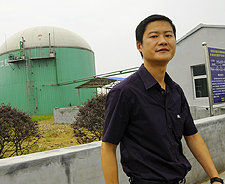
China Biogas Plant
Photo by Eliza Barclay
Ye Kaifang stands in front of his farm's biogas digester, which converts animal waste into usable fuel.
Biogas digestion takes the nuisances of most large animal farms — solid, liquid, and gaseous wastes — and turns them into resources that farmers can use and even sell. Raw pig waste is usually a liability for farmers: It’s full of pathogens and compounds like ammonia that can ruin crops and soil if applied directly. It also is prone to running off into waterways and leaching into groundwater.

Water pollution is rampant in China, and animal farms large and small are a big part of the problem. The 2010 national pollution survey revealed that the livestock industry was responsible for dumping 243 million tons of feces and 163 million tons of urine into water resources in 2007, causing eutrophication and high chemical oxygen demand (COD). Some of that waste eventually ends up in the ocean, where the organic matter, nitrogen, and phosphorus overwhelm the marine ecosystem. The South China Sea today is largely a dead zone with frequent red tides and little remaining life because of run-off from upstream agriculture.

Ye thinks his biogas digester may be part of the solution. It cost about $600,000, but Ye only paid for half while the central, provincial, and local governments picked up the rest with subsidies. It is a round green tank about 15 feet high with a bulbous white top. The bottom half is a chamber where wet waste piped from the nearby pig sheds and dry waste delivered from the sheds by trucks are mixed with straw and water. The
China is the world’s largest source of methane from manure, emitting one-fifth the global total.
chamber is airtight, and inside microbes thrive in the anaerobic environment. As they eat away at the waste, the microbes release gases — the stinky ones — which, instead of irritating the noses of neighbors and eventually escaping to the atmosphere, are stored in the spherical upper compartment of the tank. The anaerobic digestion also kills most pathogens, lowers the COD, and makes nutrients better available to plants.

One reason Ye likes the system is that it’s a free source of nutrient-rich fertilizer he can use on crops that he grows to feed his pigs. Unlike American farmers who typically buy animal feed like corn and soy wholesale, some large Chinese farmers grow their own feed — a combination of green crops like alfalfa and ryegrass. Ye calls it “salad for pigs.”

Ye also uses the fertilizer to grow organic vegetables, which he hopes to eventually sell in China and abroad. Though the organic market in China is still very small compared to the United States, he believes that will soon change. “There’s huge demand for high quality vegetables and meat as consumers are growing increasingly concerned about food safety,” Ye said.

The biogas digester also helps him lower his contribution to global warming. Pig waste naturally gives off methane, a greenhouse gas 23 times more potent than carbon dioxide. China is the world’s largest source of methane from manure and emitted roughly 3.8 million tons in 2004 —
The government considers small farms inefficient because they don’t produce enough meat.
over one-fifth of the global total. The biogas digester captures the methane and turns it into fuel — essentially, natural gas. Burning it still produces greenhouse gases, but fewer.

Long before climate change created a new impetus to capture biogas on a large scale, Chinese farmers were using biogas as a source of rural energy. The traditional digester is essentially an underground pit for food waste, animal manure, and human feces. It can’t store excess gas the way Ye’s digester can, but it’s fine for cooking and heating. The Ministry of Agriculture estimates about 35 million small digesters are in use in rural areas of China today.

More than half of China’s livestock is produced on those small farms; in the case of pigs, that’s 250 million animals. But the government considers those farms inefficient because they don’t produce enough meat fast enough to feed voracious urban consumers whose ranks are steadily growing. To meet that need, the government is offering incentives to businessmen like Ye to finance industrial-scale farms. “The government wants farms to be big,” says Ye.

Not only does the government want more meat but it also wants more control over farmers. Indeed, officials have struggled for years to stop small farmers from letting their animal waste run off. “The government believes that large scale farms can be more easily managed than small farms because you don’t have so many different pollution points to worry about,” said Tang Zhishao, an official with the Ministry of Agriculture.
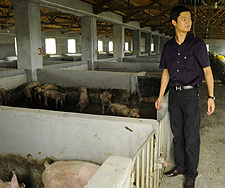
China Biogas Plant
Photo by Eliza Barclay
Ye Kaifang has about 8,000 pigs on his farm in south China's Zhejiang province.
But even if big farms are easier to regulate, the environmental stakes remain high. Xu Cheng, a professor at China Agricultural University, has estimated that only 3 percent of China’s large and medium-sized livestock operations have facilities to treat animal wastes. To avert future environmental disasters like leaks or spills of wastewater from large farms and to capture methane, the government has decreed that all farms with more than 1,000 cows, 10,000 pigs or 100,000 chickens must install biogas digesters. In Zhejiang province, one of China’s richest and most environmentally progressive, the local government recently decided that all farms with more than 50 pigs must have biogas digesters.

In downtown Hangzhou, the biggest city in Zhejiang, Cai Changda runs a company that has built more than 70 biogas and wastewater treatment projects in China. “The first goal of these projects is to solve the pollution problem,” Cai said. But Cai and others also say that big biogas is increasingly seen as a potentially lucrative opportunity for power generation. China is hungry for power, especially power that’s cleaner than the coal. And biogas is a potentially significant source of cleaner energy. According to the Chinese Academy of Sciences, manure could generate about 130 billion cubic meters of methane annually, the fuel-source equivalent of 102 million tons of coal.

Since 2005, the European Union has had an emissions trading scheme, and biogas projects are among the variety of ways companies are mitigating and offsetting emissions. The United States lacks a trading scheme, but the Environmental Protection Agency has 151
Environmentalists worry about the scale of Chinese farms, which can exceed the largest U.S. operations.
biogas projects on commercial farms as part of its AgSTAR program, a voluntary initiative to reduce methane emissions from farms.

But even if biogas can help a large farm drastically reduce emissions and pollution, some environmentalists are still skeptical of the notion of “ecological CAFOs.” And they worry about the scale of some of the Chinese farms, which exceed even the largest operations in the United States. One example is DQY, an egg producer with a biogas digester outside Beijing that houses 3 million chickens.

Danielle Nierenberg, a researcher on agriculture issues for the Worldwatch Institute, says wastewater from these farms remains a problem even with digesters: The residue is less toxic and dangerous than raw waste but it still has nitrogen and phosphorus — nutrients that are good for soil but pollutants once they enter waterways. And Wu Weixing, an environmental engineer at Zhejiang University, says that the current biogas technology is good at reducing COD but not ammonia and phosphate. “We need even better technology and more land to absorb the nutrients,” said Wu. “That technology exists but it’s still too expensive and people demand cheap meat.”

Tang Zhishao, the Chinese agriculture official, conceded this point as well. “Biogas cannot completely solve the problem of pollution from livestock,” Tang said. “Even the slurry and sludge and residue from the digester are a problem because you need large areas to absorb the waste.” And in heavily-populated China, little land is available. Ye, who grows his own feed on dozens of acres of land, can spread the residue around there, but not all farmers have that luxury.

MORE FROM YALE e360

Growing Shortages of Water
Threaten China’s Development

Growing Shortages of Water Threaten China’s Development
With 20 percent of the world’s population but just 7 percent of its available freshwater, China faces serious water shortages as its economy booms and urbanization increases. The government is planning massive water diversion projects, but environmentalists say conservation — especially in the wasteful agricultural sector — is the key.
READ MORE
Big farms also typically rely on antibiotics to keep animals healthy, but the drugs can filter into waterways rendering them less effective for animals and humans. Nierenberg is also concerned that the Chinese may be using biogas digesters to justify building the biggest farms in the world. “They have more animals in their feedlots and farms than we do in the United States,” said Nierenberg. “For China I could see [biogas] as an incentive to have more factory farms and more digesters.”

Back in Cixi, Ye, the pig farmer, remains convinced his farm helps the environment. And with China’s growing demand for meat, he thinks it’s the best model for the future. “Only large farms can ensure environmental protection,” he said. But that’s a theory that young, ambitious farmers like Ye will have to test and prove right or wrong.

POSTED ON 11 Nov 2010 IN Business & Innovation Climate Energy Science & Technology Sustainability Antarctica and the Arctic Asia 

COMMENTS


Obviously the concern is not to have biogas under control but farming. "Pollution" caused by manure in small farming is everything but a pollution if biogas is used to cook: manure is used instead of synthetic fertilizers and is well spread. Converslely, spreading industrial manure from pig plants is a known source of heavy pollution in industrial farming. For instance in France, in the west part where all pig plants are concentrated, people are regularly advised by authority to drink bottled water. This is for the end result of the industrializatin of pig farming in Europe: the death of many water streams.

Posted by kervennic on 11 Nov 2010


It's good to hear that now China is heading toward the search of alternate energy and cutting off its co2 emission. After Denmark Summit China look some serious about emission reduction but its neighbour India has not taken any concern as its nearer for next COP. I just want to give short information to writer that Nepal a landlocked between China and India, and is in fourth place in world to face climate change but since a decade this poor country is designing and implementing CDM projects.

So after all economic globalization has made environmental problem a no boundary. So LDC should be focused more for combacting environmental problems.

Posted by Anil Bhandari on 12 Nov 2010


If you're clever you can couple a biogas plant with a solar thermal plant to do hydrocarbon steam reformation.

Here methane is reacted with steam on a metal catalyst to produce four moles of hydrogen for every mole of methane. This hydrogen can then be put through a fuel cell to produce electricity at a very high efficiency.

It's expensive and technical, but it's also a great renewable energy technology.

Posted by Alex on 23 Nov 2010


I read with interest the excellent article by eliza barclay.

The gases methane, hydrogen and carbon monoxide can be combusted or oxidized with oxygen. Air contains 21% oxygen. This energy release allows biogas to be used as a fuel. Biogas can be used as a low-cost fuel in any country for any heating purpose, such as cooking. It can also be used in modern waste management facilities where it can be used to run any type of heat engine, to generate either mechanical or electrical power. Biogas can be compressed, much like natural gas, and used to power motor vehicles and in the UK for example is estimated to have the potential to replace around 17% of vehicle fuel. Biogas is a renewable fuel, so it qualifies for renewable energy subsidies in some parts of the world.
Biogas can be utilized for electricity production on sewage works, in a CHP gas engine, where the waste heat from the engine is conveniently used for heating the digester; cooking; space heating; water heating; and process heating. If compressed, it can replace compressed natural gas for use in vehicles, where it can fuel an internal combustion engine or fuel cells and is a much more effective displacer of carbon dioxide than the normal use in on-site CHP plants.

Methane within biogas can be concentrated via a biogas upgrader to the same standards as fossil natural gas (which itself has had to go through a cleaning process), and becomes biomethane. If the local gas network allows for this, the producer of the biogas may utilize the local gas distribution networks. Gas must be very clean to reach pipeline quality, and must be of the correct composition for the local distribution network to accept. Carbon dioxide, water, hydrogen sulfide and particulates must be removed if present. If concentrated and compressed it can also be used in vehicle transportation. Compressed biogas is becoming widely used in Sweden, Switzerland, and Germany. A biogas-powered train has been in service in Sweden since 2005(Sorce: Wikipedia)..

In Pakistan and India biogas produced from the anaerobic digestion of manure in small-scale digestion facilities is called gobar gas; it is estimated that such facilities exist in over two million households in India and in hundreds of thousands in Pakistan, particularly North Punjab, due to the thriving population of lifestock . The digester is an airtight circular pit made of concrete with a pipe connection. The manure is directed to the pit, usually directly from the cattle shed. The pit is then filled with a required quantity of wastewater. The gas pipe is connected to the kitchen fireplace through control valves. The combustion of this biogas has very little odour or smoke. Owing to simplicity in implementation and use of cheap raw materials in villages, it is one of the most environmentally sound energy sources for rural needs. One type of these system is the Sintex Digester. Some designs use vermiculture to further enhance the slurry produced by the biogas plant for use as compost.[
The Deenabandhu Model is a new biogas-production model popular in India. (Deenabandhu means "friend of the helpless.") The unit usually has a capacity of 2 to 3 cubic metres. It is constructed using bricks or by a ferrocement mixture. The brick model costs approximately 18,000 rupees and the ferrocment model 14,000 rupees, however India's Ministry of Non-conventional Energy Sources offers a subsidy of up to 3,500 rupees per model constructed.
When contries in Europe like Germany,Denmark etc., where maximum temperature in a year hardly crosses 25 degrees celsius are using Biogas for for power production sunbelt countries like India are yet to adopt this.

Yet another option is Biogas production with 80 percent Waterhyacinth( Eichhornia Crassipes )(Which has become a menace) and 20 percent animal dung. in biogas production. 1 hectare of weed can produce 100 tons of dry water hyacinth/year which could produce 30,000 cu.m of gas sufficient to supply cooking for 40 families. The residual slurry must be used as mulch.

Dr.A.Jagadeesh Nellore(AP), India

Posted by Dr.a.Jagadeesh on 25 Nov 2010


Perhaps they can use Biogas digesters in China's burgeoning cities, to control the output of human waste. Given the lack of suitable infrastructure biogas digesters might be able to provide an economical alternative.

Posted by Donald on 26 Nov 2010


How to export biogas technolgy model from China to Latin American region?

Posted by Carlos Sánchez from Bogota, Colombia. South America. on 24 Jul 2011


There should be no factory farms in the first place. Being good environmental stewards includes having respect for the other earthlings, and factory farms are about as morally vacant as you can get.

Posted by Candice on 18 Sep 2011


POST A COMMENT

Comments are moderated and will be reviewed before they are posted to ensure they are on topic, relevant, and not abusive. They may be edited for length and clarity. By filling out this form, you give Yale Environment 360 permission to publish this comment.

Name 
Email address 
Comment 
 

eliza barclayABOUT THE AUTHOR
Eliza Barclay is a Washington D.C.-based journalist who writes about public health, the environment, immigration, economic development, and food. Her work has appeared in The Atlantic, The New York Times, The Washington Post, FORTUNE, National Geographic News, The Lancet and numerous other publications.


RELATED ARTICLES


Can Smarter Growth Guide
China’s Urban Building Boom?

The world has never seen anything like China’s dizzying urbanization boom, which has taken a heavy environmental toll. But efforts are now underway to start using principles of green design and smart growth to guide the nation’s future development.
READ MORE

In Fast-Track Technology, Hope
For a Second Green Revolution

With advances in a technique known as fast-track breeding, researchers are developing crops that can produce more and healthier food and can adapt and thrive as the climate shifts.
READ MORE

China’s Reforestation Programs:
Big Success or Just an Illusion?

China has undertaken ambitious reforestation initiatives that have increased its forest cover dramatically in the last decade. But scientists are now raising questions about just how effective these grand projects will turn out to be.
READ MORE

A Development Expert Relies
On the Resilience of Villagers

Geographer Edward Carr has worked extensively in sub-Saharan Africa, where climate change and other environmental threats present a growing challenge. In an interview with Yale Environment 360, Carr talks about why any outside aid to the developing world must build on the inherent capability of the local residents.
READ MORE

What Rising Temperatures May
Mean for World’s Wine Industry

Warming temperatures associated with climate change are already affecting vineyards from France to Chile, often in beneficial ways. But as the world continues to warm, some traditional winemaking regions are scrambling to adapt, while other areas see themselves as new wine frontiers.
READ MORE


MORE IN Reports


As Arctic Sea Ice Declines,
Polar Bear Patrol Gets Busy

by ed struzik
Polar bears have long come ashore in Churchill, Manitoba, the self-styled ‘Polar Bear Capital of the World.’ But as summer sea ice steadily disappears in Hudson Bay, bears are being marooned on land for longer periods of time — and that is generating a lot of work for the Polar Bear Alert Team.
READ MORE

Can Smarter Growth Guide
China’s Urban Building Boom?

by david biello
The world has never seen anything like China’s dizzying urbanization boom, which has taken a heavy environmental toll. But efforts are now underway to start using principles of green design and smart growth to guide the nation’s future development.
READ MORE

In Fast-Track Technology, Hope
For a Second Green Revolution

by richard conniff
With advances in a technique known as fast-track breeding, researchers are developing crops that can produce more and healthier food and can adapt and thrive as the climate shifts.
READ MORE

A Vast Canadian Wilderness
Poised for a Uranium Boom

by ed struzik
Canada’s Nunavut Territory is the largest undisturbed wilderness in the Northern Hemisphere. It also contains large deposits of uranium, generating intense interest from mining companies and raising concerns that a mining boom could harm the caribou at the center of Inuit life.
READ MORE

For the Electric Car,
A Slow Road to Success

by jim motavalli
The big electric car launches of 2011 failed to generate the consumer excitement that some had predicted. But as new battery technologies emerge and tougher mileage standards kick in, automakers and analysts still believe that electric vehicles have a bright future.
READ MORE

Building a Better Bulb:
Lighting Revolution Advances

by dave levitan
With the industry’s support and despite political opposition, new U.S. lighting efficiency standards went into effect this month. This move, along with similar actions in Europe and China, is helping spur new technologies that will change the way the world's homes and businesses are illuminated.
READ MORE

Florida Counties Band Together
To Ready for Warming’s Effects

by michael d. lemonick
While U.S. action on climate change remains stalled, four south Florida counties have joined forces to plan for how to deal with the impacts — some of which are already being felt — of rising seas, higher temperatures, and more torrential rains.
READ MORE

As Fukushima Cleanup Begins,
Long-term Impacts are Weighed

by winifred bird
The Japanese government is launching a large-scale cleanup of the fields, forests, and villages contaminated by the Fukushima nuclear disaster. But some experts caution that an overly aggressive remediation program could create a host of other environmental problems.
READ MORE

What Rising Temperatures May
Mean for World’s Wine Industry

by john mcquaid
Warming temperatures associated with climate change are already affecting vineyards from France to Chile, often in beneficial ways. But as the world continues to warm, some traditional winemaking regions are scrambling to adapt, while other areas see themselves as new wine frontiers.
READ MORE

Can ‘Climate-Smart’ Agriculture
Help Both Africa and the Planet?

by fred pearce
One idea promoted at the Durban talks was “climate-smart agriculture," which could make crops less vulnerable to heat and drought and turn depleted soils into carbon sinks. The World Bank and African leaders are backing this new approach, but some critics are skeptical that it will benefit small-scale African farmers.
READ MORE


e360 digest
Yale
Yale Environment 360 is
a publication of the
Yale School of Forestry
& Environmental Studies
.

SEARCH e360


Donate to Yale Environment 360

CONNECT

Twitter: YaleE360
e360 on Facebook
Donate to e360
View mobile site
Bookmark
Share e360
Email newsletter
Subscribe to our feed:
rss


ABOUT

About e360
Contact
Submission Guidelines
Reprints

e360 VIDEO

Warriors of Qiugang
The Warriors of Qiugang, a Yale Environment 360 video that chronicles the story of a Chinese village’s fight against a polluting chemical plant, was nominated for a 2011 Academy Award for Best Documentary (Short Subject). Watch the video.


DEPARTMENTS

Opinion
Reports
Analysis
Interviews
e360 Digest
Video Reports

TOPICS

Biodiversity
Business & Innovation
Climate
Energy
Forests
Oceans
Policy & Politics
Pollution & Health
Science & Technology
Sustainability
Urbanization
Water

REGIONS

Antarctica and the Arctic
Africa
Asia
Australia
Central & South America
Europe
Middle East
North America

e360 VIDEO REPORT

When the Water Ends
As temperatures rise and water supplies dry up, tribes in East Africa increasingly are coming into conflict. A Yale Environment 360 video reports on a phenomenon that could become more common: how worsening drought will pit groups — and nations — against one another. Watch the video.

e360 MOBILE

Mobile
The latest
from Yale
Environment 360
is now available for mobile devices at e360.yale.edu/mobile.


header image
Top Image: aerial view of Iceland. © Google & TerraMetrics.

e360 VIDEO REPORT

Leveling Appalachia
Leveling Appalachia: The Legacy of Mountaintop Removal Mining, an e360 video examining the environmental and human impacts of this mining practice, won the award for best video in the 2010 National Magazine Awards for Digital Media. Watch the video.


OF INTEREST


RESOURCES


Yale