13 Jan 2011: Report

Massive Outbreak of Jellyfish
Could Spell Trouble for Fisheries

The world’s oceans have been experiencing enormous blooms of jellyfish, apparently caused by overfishing, declining water quality, and rising sea temperatures. Now, scientists are trying to determine if these outbreaks could represent a “new normal” in which jellyfish increasingly supplant fish.

by richard stone

Among the spineless creatures of the world, the Nomura’s jellyfish is a monster to be reckoned with. It’s the size of a refrigerator — imagine a Frigidaire Gallery Premiere rather than a hotel minibar — and can exceed 450 pounds. For decades the hulking medusa was rarely encountered in its stomping grounds, the Sea of Japan. Only three times during the entire 20th century did numbers of the Nomura’s swell to such gigantic proportions that they seriously clogged fishing nets.

Then something changed. Since 2002, the population has exploded — in jelly parlance, bloomed — six times. In 2005, a particularly bad year, the Sea of Japan brimmed with as many as 20 billion of the bobbing bags of blubber, bludgeoning fisheries with 30 billion yen in losses.

Why has the Nomura’s jellyfish become a recurring nightmare? The answer could portend trouble for the world’s oceans. In recent years, populations of several jellyfish species have made inroads at the expense of their main competitor — fish — in a number of regions, including the Yellow Sea, the Gulf of Mexico, and the Black Sea. Overfishing and deteriorating coastal water quality are chief suspects in the rise of jellies. Global warming may be adding fuel to the fire by making more food available to jellyfish and opening up new habitat. Now, researchers fear, conditions are becoming so bad that some ecosystems could be approaching a tipping point in which jellyfish supplant fish.
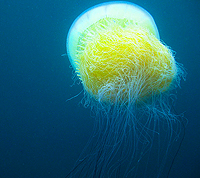
Nomura's jellyfish
Wikimedia Commons
When an ecosystem is dominated by jellyfish, such as this Nomura’s jellyfish, “fish will mostly disappear,” one ecologist says.
Essential to thwarting any potential jellyfish takeover is a better understanding of the complicated dynamics between fish and jellyfish. Jellyfish — free-swimming gelatinous animals — are a normal element of marine ecosystems. Fish and jellyfish both compete for plankton. The predators keep each other in check: 124 kinds of fish species and 34 other species, including leatherback turtles, are known to dine on jellyfish, while jellies prey on fish eggs and, occasionally, on fish themselves. Juvenile fish of some species take refuge amid tentacles and eat jellyfish parasites. Fish and jellyfish “interact in complex ways,” says Kylie Pitt, an ecologist at Griffith University in Australia.

Overfishing can throw this complex relationship out of kilter. By removing a curb on jellyfish population growth, overfishing “opens up ecological space for jellyfish,” says Anthony Richardson, an ecologist at CSIRO Marine and Atmospheric Research in Cleveland, Australia. And as jellyfish flourish, he says, their predation on fish eggs takes a heavier and heavier toll on battered fish stocks.

“When an ecosystem is dominated by jellyfish, fish will mostly disappear,” says ecologist Sun Song, director of the Institute of Oceanology in Qingdao, China. “Once that happens,” he contends, “there is almost no method to deal with it.” Just think of attempting to purge the Sea of Japan of billions of Nomura’s jellyfish, many of them hovering meters below the surface and therefore invisible to satellites or the naked eye. Total jelly domination would be like turning back the clock to the Precambrian world, more than 550 million years ago, when the ancestors of jellyfish ruled the seas.

Sun and others are racing to get a handle on the likelihood of such a marine meltdown coming true. Like their foe, the subject is slippery. It’s an enigma, for starters, why particular jellyfish run rampant. The troublemakers “are only a small fraction of the several thousand species of jellyfish out there,” says Richardson. These uber-jellies reproduce like mad, grow fast, eat most anything, and can withstand poor water quality. They are tough, Richardson says — “like cockroaches.”

The big question is whether these cockroaches of the sea are poised to hijack marine ecosystems. There’s anecdotal evidence that jellyfish blooms are becoming more frequent. But there are also cases in which jellyfish gained the upper hand on an ecosystem, only to suddenly relinquish it. For
No one can say for sure whether severe jellyfish blooms are a passing regional phenomenon or a global scourge.
instance, biomass of Chrysaora jellyfish in the east Bering Sea rose sharply during the 1990s and peaked in 2000. Chrysaora then crashed and stabilized after 2001, apparently due to a combination of warmer sea temperatures and a rebound in numbers of walleye pollock, a competitor for zooplankton.

The jury is out on whether other jelly-blighted waters can regain ecological balance as quickly as the Bering Sea did. For that reason, says Pitt, no one can say for sure whether severe jellyfish blooms are a passing regional phenomenon or a global scourge requiring urgent measures to combat their spread.

Pitt is one of a small band of jellyfish researchers hoping to settle that question. With support from the National Center for Ecological Analysis and Synthesis in Santa Barbara, Calif., she and her colleagues on the center’s Jellyfish Working Group are gathering up datasets from around the world on jellyfish blooms. They expect to have a global picture — and be able to take the measure of their foe — in about a year, Pitt says.

Jellyfish clearly have an impact on human activity. Besides fouling fishing nets, they invade fish farms, block cooling intakes at coastal power plants, and force beach closures. Some jellies pose a mortal threat. Dozens of
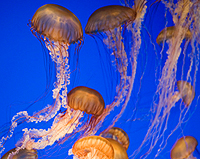
jellyfish
Image Source
Jellyfish blooms can be caused by eutrophication, which can create dead zones around mouths of rivers.
people die each year from jellyfish stings, far more than from encounters with other marine creatures, including sharks. A box jellyfish, the Chironex sea wasp, may be the most lethal animal on the planet: Its toxin can kill a person in three minutes. Global warming may allow deadly jellyfish, now mostly found in tropical and subtropical waters, to conquer new turf in temperate waters as sea surface temperatures rise, warns Richardson. “It’s very likely that venomous jellyfish will move toward the poles,” he says.

While that could be a big blow for tourism, far more worrisome to many researchers is the threat that jellies pose to fish stocks. The most important helping hand for jellyfish may be overfishing. In one well-documented episode, the devastation of sardine stocks appear to have cleared the way for the rise of Chrysaora off Namibia, in waters known as the northern Benguela. Recent research cruises there have hauled in about four times as much jelly biomass as fish biomass.

Another ecosystem tweak that benefits jellyfish is eutrophication. A flood of nutrients from agricultural runoff and sewage spurs phytoplankton growth in coastal waters, providing a feeding bonanza for jellyfish. Eutrophication, usually around the mouths of major rivers, can also create low-oxygen dead zones that jellyfish generally tolerate better than fish.

Global warming may also abet regime change. Warmer ocean temperatures are correlated with jellyfish blooms. A possible explanation, says Richardson, is that warming leads to nutrient-poor surface waters. Such conditions favor flagellates, a kind of zooplankton, over diatoms, a kind of phytoplankton. Flagellate-dominated food webs may be more favorable to
The waters off North Asia may be acutely vulnerable to jellyfish invasion.
jellyfish, he says.

For reasons yet to be fully fathomed, the waters off North Asia may be acutely vulnerable to a jellyfish invasion. Since 2000 or so, the Nomura’s jellyfish and two other species — Aurelia aurita and Cyanea nozakii — have been plaguing the Yellow Sea. In the past 5 years, anchovy catches there have decreased 20-fold, says Sun. Perhaps as a result, just like off Namibia, jellyfish are seizing the day. During a research cruise in the Yellow Sea in the summer of 2009, jellyfish amounted to 95 percent of the biomass netted by the scientists.

Alarmed by this ascendancy of jellyfish, Sun is leading a five-year initiative to unravel why jellyfish have become a perennial pest. Among other things, his team will hunt for the elusive cradle of jellyfish in the Yellow Sea. Species of Cnidaria, the phylum with the vast majority of jellyfish, can spend years on the sea bottom as polyps. These reproduce asexually, popping off medusae — the familiar bell-shaped form of cnidarian jellies — that drift up toward the surface. Scientists speculate that polyps may be gaining a stronger foothold in North Asia at the expense of mollusks and other bottom-dwelling creatures. The Chinese group will search for polyps in the Yellow Sea and East China Sea.

A Looming Oxygen Crisis and
Its Impact on World’s Oceans

A Looming Oxygen Crisis and Its Impact on World’s Oceans
As warming intensifies, scientists warn, the oxygen content of oceans across the planet could be more and more diminished, with serious consequences for the future of fish and other sea life, Carl Zimmer writes.
READ MORE
One possibility in these seas is that coastal and offshore construction and engineering works are creating new habitat for polyps. Structures as diverse as drilling platforms, embankments, and aquaculture frames introduce smooth surfaces made of plastic and other materials into the marine environment. In the past two decades, as China’s economy boomed, such structures have proliferated, says Yu Zhigang, a marine chemist at Ocean University of China in Qingdao. The Chinese initiative will test the hypothesis that artificial landscapes are cradles for jellyfish polyps.

The bottom line is that multiple factors may favor jellyfish over fish, says Shin-ichi Uye, an ecologist at Hiroshima University who has charted the rapid rise of the Nomura’s jellyfish in the Sea of Japan. The recipe for what makes jellyfish run amuck likely varies by region, and for that reason may take time to decipher. But the future of the world’s fisheries may well depend on it.

POSTED ON 13 Jan 2011 IN Biodiversity Oceans Policy & Politics Asia 

COMMENTS


This article is one of so many in the last few years to go on and on about the perils of jellies, those "cockroaches" of the sea, yet never turn the story in the direction it should point. Right back in the mirror.

Posted by Kevin on 13 Jan 2011


[sigh]"cockroaches" again?
Help us monitor ocean health by reporting your jelly sightings to our database at http://jellywatch.org

Posted by Jellywatch on 13 Jan 2011


Links and abstracts for 30 news stories on jellyfish blooms since January 2008 -- by no means complete, but giving a sense of the history of this story -- with punchlines: http://www.apocadocs.com/cgi-bin/docdisp.cgi?tag=jellyfish

Jellyfish are strange canaries.

Posted by ApocaDoc Michael on 14 Jan 2011


More people should learn to enjoy eating jellyfishes. They taste real good. For example in east Asia many are eating jellyfish. Why start commercial industrial fishing of jellyfish and promote it as a food.

Posted by Yellyfish tastes good. on 16 Jan 2011


Yellyfish has it right, this should be looked upon as a possibility, not a hindrance.

Wikipedia states that only 12 of 85 jellyfish are harvested for consumption. Why is that?

I really hate to see this kind of depressing articles where it's basically stated "this is how it might be, oh well". Why not have government-subsidized fisheries look into harvesting jellyfish? You create jobs, improve conditions for other fisheries and give options to consumers.

Of course, the problem may be that jellyfish are considered "ewwwwwwww" and are also much harder to get profit from than regular fish. According to Wikipedia you get 7-10 percent worth of eating from a jellyfish whereas from a fish you get what, 70 percent?

Posted by MH on 06 Feb 2011


The idea of eating jellyfish is downright disgusting, but what about processing them into feedstock for feeding other animals?

Many fish farms (such as Salmon) require catching other fish to feed them, so they really don't do much to help the problem of overfishing.
Catching & processing jellyfish into a form palatable to other fish (or to cattle, or other domestic landbased livestock) could be an enormous benefit for ocean health, and maybe one of the few ways to help fisheries without shutting severely restricting catch.
Posted by DES on 10 Mar 2011


Why is it that when discussing the possibilities of why there is a Nomura Jellyfish problem the most obvious reason is avoided?

When Nomuras are hatched they are the size of a grain of rice which makes them part of the plankton cycle. Baleen whales eat millions of plankton per mouthful. Japanese whalers have killed all the Baleen whales in Japanese waters and have upset the predator/prey balance. Millions of Nomura Jellyfish which would've been devoured at the plankton stage are reaching maturity. So stop blaming Global Warming and all that other nonsense and put the blame where it belongs, the Japanese whaling industry. Unless and until the good citizens of Japan take steps to kill the whaling industry, they will have to learn how to eat Jellyfish.

Posted by Sonny Simmons on 30 Jun 2012


Comments have been closed on this feature.
richard stoneABOUT THE AUTHOR
Richard Stone oversees Science Magazine’s Asia news coverage. He opened Science’s Beijing bureau in October 2007 after a two-year stint in Bangkok. His writing has also appeared in Discover, Smithsonian, and National Geographic, and he is the author of Mammoth: The Resurrection of an Ice Age Giant. In a previous article for Yale Environment 360, he wrote about efforts to save endangered species in the Yangtze River.
MORE BY THIS AUTHOR


RELATED ARTICLES


How Mussel Farming Could
Help to Clean Fouled Waters

Along the shores of New York Harbor, scientists are investigating whether this ubiquitous bivalve can be grown in urban areas as a way of cleansing coastal waters of sewage, fertilizers, and other pollutants.
READ MORE

A Key Experiment to Probe the
Future of Our Acidifying Oceans

In a Swedish fjord, European researchers are conducting an ambitious experiment aimed at better understanding how ocean acidification will affect marine life. Ultimately, these scientists hope to determine which species might win and which might lose in a more acidic ocean.
READ MORE

Blocked Migration: Fish Ladders
On U.S. Dams Are Not Effective

Fishways on rivers in the U.S. Northeast are failing, with less than 3 percent of one key species making it upriver to their spawning grounds, according to a new study. The researchers’ findings provide a cautionary tale for other nations now planning big dam projects.
READ MORE

A Leading Marine Biologist
Works to Create a ‘Wired Ocean’

Stanford University scientist Barbara Block heads a program that has placed satellite tags on thousands of sharks, bluefin tuna, and other marine predators to better understand their life cycles. Now, using data available on mobile devices, she hopes to enlist public support for protecting these threatened creatures.
READ MORE

Will Reform Finally End The
Plunder of Europe’s Fisheries?

Maria Damanaki, Europe’s crusading fisheries minister, is making major headway in changing a cozy, “old boys” network that over-subsidized the European fishing industry and brought about the severe overfishing of the continent’s marine bounty.
READ MORE


MORE IN Reports


A Plague of Deforestation
Sweeps Across Southeast Asia

by daniel drollette
Illegal logging and unchecked economic development are taking a devastating toll on the forests of Vietnam and neighboring countries, threatening areas of biodiversity so rich that 1,700 species have been discovered in the last 15 years alone.
READ MORE

In Post-Tsunami Japan, A Push
To Rebuild Coast in Concrete

by winifred bird
In the wake of the 2011 tsunami, the Japanese government is forgoing an opportunity to sustainably protect its coastline and is instead building towering concrete seawalls and other defenses that environmentalists say will inflict serious damage on coastal ecosystems.
READ MORE

How Mussel Farming Could
Help to Clean Fouled Waters

by paul greenberg
Along the shores of New York Harbor, scientists are investigating whether this ubiquitous bivalve can be grown in urban areas as a way of cleansing coastal waters of sewage, fertilizers, and other pollutants.
READ MORE

A Key Experiment to Probe the
Future of Our Acidifying Oceans

by peter friederici
In a Swedish fjord, European researchers are conducting an ambitious experiment aimed at better understanding how ocean acidification will affect marine life. Ultimately, these scientists hope to determine which species might win and which might lose in a more acidic ocean.
READ MORE

Declining Bee Populations Pose
A Threat to Global Agriculture

by elizabeth grossman
The danger that the decline of bees and other pollinators represents to the world’s food supply was highlighted this week when the European Commission decided to ban a class of pesticides suspected of playing a role in so-called “colony collapse disorder.”
READ MORE

Fires Burn More Fiercely
As Northern Forests Warm

by dylan walsh
From North America to Siberia, rising temperatures and drier woodlands are leading to a longer burning season and a significant increase in forest fires. Scientists warn that this trend is expected continue in the years ahead.
READ MORE

Will Electric Bicycles Get
Americans to Start Pedaling?

by marc gunther
Electric bicycles are already popular in Europe and in China, which has more e-bikes than cars on its roads. Now, manufacturers are marketing e-bikes in the U.S., promoting them as a "green" alternative to driving.
READ MORE

Copenhagen’s Ambitious Push
To Be Carbon Neutral by 2025

by justin gerdes
The Danish capital is moving rapidly toward a zero-carbon future, as it erects wind farms, transforms its citywide heating systems, promotes energy efficiency, and lures more people out of their cars and onto public transportation and bikes.
READ MORE

How Ontario Is Putting an End
To Coal-Burning Power Plants

by keith schneider
Ontario is on the verge of becoming the first industrial region in North America to eliminate all coal-fired electrical generation. Here’s how Canada’s most populous province did it — and what the U.S. and others can learn from it.
READ MORE

Long Outlawed in the West,
Lead Paint Sold in Poor Nations

by rebecca kessler
A new study finds that household lead paint — banned for years in the U.S. and Europe because of its health effects on children — is commonly sold in the African nation of Cameroon. Is lead paint the latest case of Western companies selling unsafe products in developing countries?
READ MORE


e360 digest
Yale
Yale Environment 360 is
a publication of the
Yale School of Forestry
& Environmental Studies
.

SEARCH e360


Donate to Yale Environment 360

CONNECT

Twitter: YaleE360
e360 on Facebook
Donate to e360
View mobile site
Bookmark
Share e360
Email newsletter
Subscribe to our feed:
rss


ABOUT

About e360
Contact
Submission Guidelines
Reprints

e360 PHOTO GALLERY

To Catch a Rhino Welz
South African photojournalist Adam Welz documents the harrowing relocation of six white rhinos to a region that has lost all its rhinos to poaching. View the gallery.


DEPARTMENTS

Opinion
Reports
Analysis
Interviews
e360 Digest
Podcasts
Video Reports

TOPICS

Biodiversity
Business & Innovation
Climate
Energy
Forests
Oceans
Policy & Politics
Pollution & Health
Science & Technology
Sustainability
Urbanization
Water

REGIONS

Antarctica and the Arctic
Africa
Asia
Australia
Central & South America
Europe
Middle East
North America

e360 VIDEO

Into Heart of Ecuador Yasuni
A Yale Environment 360 video explores Ecuador’s threatened Yasuni Biosphere Reserve with scientists inventorying its stunning forests and wildlife. Watch the video.

e360 MOBILE

Mobile
The latest
from Yale
Environment 360
is now available for mobile devices at e360.yale.edu/mobile.

e360 VIDEO

Colorado River Video
In a Yale Environment 360 video, photographer Pete McBride documents how increasing water demands have transformed the Colorado River, the lifeblood of the arid Southwest. Watch the video.


header image
Top Image: aerial view of Iceland. © Google & TerraMetrics.

e360 VIDEO

Warriors of Qiugang
The Warriors of Qiugang, a Yale Environment 360 video that chronicles the story of a Chinese village’s fight against a polluting chemical plant, was nominated for a 2011 Academy Award for Best Documentary (Short Subject). Watch the video.


OF INTEREST


Yale