04 Sep 2012: Opinion

A Summer of Extremes
Signifies the New Normal

This summer has seen record heat waves and wildfires in the U.S, the worst flooding in Beijing’s modern history, and droughts that devastated the U.S. corn crop and led India to set up “refugee camps” for livestock. These extreme events were not freak occurrences — this is how the earth works now.

by bill mckibben

Just as the baseball season now stretches nearly into November, and the National Football League keeps adding games, so the summer season is in danger of extending on both ends, a kind of megalomaniac power grab fueled by the carbon pouring into the atmosphere.

In fact, you could argue that the North American summer actually started two days before the official end of winter this year, when the town of Winner, South Dakota turned in a 94-degree temperature reading. It was part of that wild July-in-March heat wave that stretched across two-thirds of the country, a stretch of weather so bizarre that historian Christopher Burt called it “probably the most extraordinary anomalous heat event” that the nation has ever seen. International Falls, “the icebox of the nation,” broke its heat records 10 straight days, and Chicago nine. In Traverse City, Michigan, on March 21, the record high was 87 degrees. But the low was 62 degrees, which was 4 degrees higher than the previous record high. The technical word for that is, insane.

And it wasn’t just the U.S. — new March records were set everywhere from Perth to Reykjavik, not to mention (this is the gun on the wall in Act One) Summit Station at the top of the Greenland Ice Cap.

Plants, responding in their plantlike ways, blossomed. And so, though April was warmer than normal, the expected frosts killed an awful lot of fruit before it could ever get started. Traverse City, for instance, sits at the heart of the U.S. cherry crop — but not this year. Still, April was a warmish pause, and May warm as well, with the heat gathering. And then right around the solstice in June, all hell broke loose — or at least something of a similar
In Dodge City, Kansas, the temperature reached 111 degrees for the first time since record keeping began in 1874.
temperature.

While Tropical Storm Debby, the earliest fourth-named storm ever, was drenching Florida, fires were breaking out in New Mexico and Colorado that would become the largest and most expensive in those states’ histories. As the Front Range of the Rockies set all-time temperature records, horrible wild fires obliterated homes in Colorado Springs and Fort Collins. (They also chased the world’s premier climate researchers from their offices in Boulder, though that didn’t stop them from explaining to reporters that global warming was “setting the table” for these blazes.)

And then the heat started moving east. They’ve been taking the temperature in Dodge City, Kansas since 1874 (one of the longest continuous readings in the country), and June 27 was the very first time it had reached 111 degrees. And it just kept getting hotter as the high pressure slid east — Tennessee, Georgia, Kentucky, Illinois, the Carolinas, Virginia were all in the triple digits day after day after day. Some “relief” came in the form of a derecho (new occasions teach new words), a “straight line wind” that blew from Indiana to the Atlantic Ocean in a matter of hours, knocking out power for 5 million people, many of whom sweltered for days since the heat simply picked back up where it had left off. Things got so bad in Washington, D.C., where the longest heat wave ever recorded stretched into July, that one TV weatherman simply asked “Do you have a walk-in freezer you can move into for the weekend?”

And almost unnoticed, a young ice researcher named Jason Box published a paper predicting that sometime soon the top of the entire Greenland ice sheet would get warm enough to melt. “We’re near a tipping point,” he said.
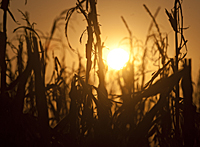
Drought Damaged Indiana Corn Stalks

Saul Loeb/AFP/Getty Images
Corn stalks damaged by widespread drought in Oakland City, Indiana.
As Americans sweltered through the record temperatures, and as the wildfires sent plumes of smoke across the continent, and as utilities tried to patch up the storm-damaged grid, a new specter started stalking the nation. As usual, the money guys noticed first: the price of corn spiked 12 percent in two days right at the end of June, as fear began to build that the heat was damaging crops across the Midwest. And not just the heat — the same high pressure that was letting temperatures soar also blocked storms from watering the country’s midsection. (July, it would turn out, saw the lowest number of tornadoes in history, which was about the only good news.)

Soon the story was relentless drought. Farmers reported that corn plants were going into “defensive mode,” rolling their leaves to prevent water loss. Experts on the evening news were explaining corn sex — how it could simply get too hot and dry for the plants to fertilize. (As one agronomist put it, “we’re in uncharted water, except there is no water.”) Shots of cracked earth and stunted ears of corn were the new commonplace, as the size of the drought matched the worst of the 1980s, and then the 1950s, and then had the meteorologists pulling out their charts to see what the Dust Bowl had looked like. (A lot like this, as it turned out.) July turned out to be the warmest month ever recorded in the United States, any month, any year.

State fairs reported small pigs (“they don’t have their virility in this heat”), and ranchers reported that bulls were, well, uninterested once the heat topped 105. Agribusiness had federal crop insurance to turn to — the big
Much of India’s grain belt has been in drought, while the U.K. endured the worst flooding in modern history.
losers were, as usual, people in poor countries around the world. Because it wasn’t just the U.S. grain harvest that was failing — drought across Russia was tempting the Kremlin to shut down grain exports for the second time in three years, and the Indian monsoon was fitful at best, with large parts of the subcontinent’s grain belt in official drought. Corn and soybeans were fetching 30 percent and then 40 percent more then they had just weeks before. Where it wasn’t drought, it was deluge — the U.K. was enduring the wettest weather in its history, and Beijing the worst flooding in its modern history.

And Greenland? In Greenland in July they set a new all-time temperature record on the top of the glacier. Which is pretty much exactly where you’d least want to set a new record, considering that’s there’s 20 feet of sea level in that block of ice. Just as researcher Jason Box had predicted six weeks before, satellites showed a day when the top of the entire ice sheet turned to liquid.

Meanwhile, the surrounding Arctic Ocean spent all summer melting ahead even of 2007’s record pace — at first it was out front just by a nose, but then as August came on, the melt accelerated, until an area the size of South Carolina was vanishing daily. On August 26, with almost a month left in the melt season, the old record low for summer sea ice extent disappeared beneath the waves.

I could go on and on with accounts of this wildest of summers: “refugee camps” for livestock in arid India; the warmest rainstorm ever recorded in Mecca in early summer (109 degrees), a mark that lasted about six weeks until it was broken in the California desert in August (115 degrees); traffic on the Mississippi grinding to a halt as the water level fell and fell and fell; a record area of the continental U.S. burned by wildfires before the summer was even over. Ad infinitum.

MORE FROM YALE e360

Arctic Tipping Point:
A North Pole Without Ice

Arctic Tipping Point: A North Pole Without Ice
Scientists say this year’s record declines in Arctic sea ice extent and volume are powerful evidence that the giant cap of ice at the top of the planet is on a trajectory to largely disappear in summer within a decade or two, with profound global consequences.
READ MORE
But best to end with the words of our leading climatologist, James Hansen, who in August published a peer-reviewed paper in the Proceedings of the National Academy of Sciences. As he had at every stage of the global warming saga, Hansen laid out what was happening with devastating clarity. There’s always been extreme heat, he showed — but the one-degree increase in global temperature we’ve seen so far has been enough to shift the bell curve sharply to the left. In the old summer, the one most of us grew up in, 0.1 to 0.2 percent of the surface area of the planet was dealing with “extreme heat anomalies” at any given moment. Now it was approaching 10 percent. The math, he said, was clear: It “allows us to infer that the area covered by extreme hot anomalies will continue to increase in coming decades and that even more extreme outliers will occur.”

In other words, this is no freak summer. This is how the earth works now.

POSTED ON 04 Sep 2012 IN Business & Innovation Climate Energy Oceans Policy & Politics Pollution & Health Science & Technology North America North America 

COMMENTS


Ho hum. Yes, we are all going to die from extreme weather. Just think what might have happened if this story came out during the 1930's when we really did have extreme weather across the globe.

Posted by Pete on 04 Sep 2012


Although labelled opinion, this piece is an excellent summary of facts to help the world perceive the appearance of demonstrable trends. It is nice to see Mr. McKibben return to real writing for adults rather than the hand-wringing drivel at 350.org meant to exhort teens into unfocused action.

Posted by Andrew McCammon on 05 Sep 2012


Thanks Bill. Many of your readers are aware of increasing occurrences of damaging weather and polar meltdowns. If reporting of these events are used for the purpose of encouraging robust
governmental response, I wonder what the leaders of international security will do when atmospheric oxygen runs low as forests and plankton succumb to our insanely foolish contamination of the entire biosphere by carbonic acid.

It seems to be a terrible historic mistake to define fossil carbon as "FUEL," doesn't it?

Posted by James Newberry on 06 Sep 2012


I thought that extreme weather events couldn't be used by skeptics. Why can they be used by you?

Posted by Bill McBride on 06 Sep 2012


The ocean was 20 feet higher 135,000 years ago and 350 feet lower 25,000 years ago. The earth is 3 million miles closer to the sun in this orbit cycle, the ozone hole is larger at this moment in time, there are more than a dozen causes for climate, not in the climate study, making the study that flawed.

$25,000 reward for the proof humans cause climate change.

I have been investigating climate science since 2007, and have requested the proof more than 16,000 times and nothing.

Bruce A. Kershaw
co2u.info

Posted by Bruce A. Kershaw on 06 Sep 2012


Bill McKibben,

My thanks Bill for another great article. Your courage is exemplary.

The vicious personal attacks you have had to endure are now legendary.

They encourage me in my attempts to raise awareness of man-made global warming and the consequential climate change.

Take care and may Almighty God bless you in this work. You are not alone.


Bill McBride,

You’re not a skeptic. -) Denial is a disease.


Bruce A. Kershaw,

I’d offer a $25,000 reward for you to grow up and act your age.

Posted by Matthew Rosenbaum on 07 Sep 2012


I have the same problem James. The cold winter and cool summer in Europe cannot be used by skeptics, but the hot summer (and March) in the U.S. can be used by warmists. Through July of this year, 2012 is the 7th warmest of the last 10 years (4th coolest), and the 2nd coolest since 2004. The extremes this year have been localized to the U.S. midwest temperatures - and the Arctic. Even so, most of the high temperatures of the 1930s have not been broken. Storms, flooding, SLR, and other such extremes are low this year, so the argument that extremes are increasing, does not hold for 2012.

Posted by Daniel on 07 Sep 2012


Thank you for an excellent documentation.

Posted by Helen A Ojario on 12 Sep 2012


As usual, the Fox News set shows up to spread their Gospel of Denial. We just have to admit that there are profoundly stupid people in America today prancing around under the Republican banner, too stupid to understand reality, and doing the dirty work for their corporate masters.

Posted by Farfel on 29 Sep 2012


Science is questioned and tested, not ~ Belief ~

~ Belief is not science or the scientific method ~

The basic law of heat transfer science is: rejected by climate scientists, along with all climate history. Montana had California's climate 1,000 years ago, for 200 years. There is up to 70 times the CO2 in the ocean than in the air, from continuous volcanic activity below sea level.

All life comes from the Ocean through evaporation of Ocean by the Sun.

Science is: Skeptism,

not ~ Belief ~ in a prediction that rejectes proven knowledge.

This planet is warming again, and will cool again, there have been Ice ages, little Ice ages and mini Ice ages, with much higher levels of carbon based oxygen.

Bill McKibben is: not a scientist

Posted by Bruce A. Kershaw on 05 Oct 2012


POST A COMMENT

Comments are moderated and will be reviewed before they are posted to ensure they are on topic, relevant, and not abusive. They may be edited for length and clarity. By filling out this form, you give Yale Environment 360 permission to publish this comment.

Name 
Email address 
Comment 
 

bill mckibbenABOUT THE AUTHOR
Bill McKibben is the founder of 350.org. The author of a dozen books about the environment, most recently Eaarth: Making a Life on a Tough New Planet, he has previously written for Yale Environment 360 about the battle over the Keystone XL pipeline and about the failures of the Copenhagen climate talks. He has also spoken in an e360 interview about the the power of the fossil fuel industry.
MORE BY THIS AUTHOR


RELATED ARTICLES


Probing the Reasons Behind
The Changing Pace of Warming

A consensus is emerging among scientists that the rate of global warming has slowed over the last decade. While they are still examining why, many researchers believe this phenomenon is linked to the heat being absorbed by the world’s oceans.
READ MORE

In Tibet, Change Comes to the
Once-Pristine Roof of the World

Renowned biologist George Schaller has been traveling to the Tibetan Plateau for nearly three decades, studying its unique wildlife. But with climate change and overgrazing taking a toll on the landscape, he reports, scientists and the Chinese government are working to preserve one of the planet’s wildest places.
READ MORE

Too Big to Flood? Megacities
Face Future of Major Storm Risk

As economic activity and populations continue to expand in coastal urban areas, particularly in Asia, hundreds of trillions of dollars of infrastructure, industrial and office buildings, and homes are increasingly at risk from intensifying storms and rising sea levels.
READ MORE

At Edge of Peruvian Andes,
Tracking Impacts of Warming

The Andes in eastern Peru, with steep slopes and remarkable biodiversity, are what one scientist calls a “perfect laboratory” for studying the effects of climate change. E360 contributor Elizabeth Kolbert trekked there with researchers seeking to determine if tree populations can move uphill fast enough to survive warming temperatures.
READ MORE

Florida Counties Band Together
To Ready for Warming’s Effects

While U.S. action on climate change remains stalled, four south Florida counties have joined forces to plan for how to deal with the impacts — some of which are already being felt — of rising seas, higher temperatures, and more torrential rains.
READ MORE


MORE IN Opinion


As Final U.S. Decision Nears,
A Lively Debate on GM Salmon

In an online debate for Yale Environment 360, Elliot Entis, whose company has created a genetically modified salmon that may soon be for sale in the U.S., discusses the environmental and health impacts of this controversial technology with author Paul Greenberg, a critic of GM fish.
READ MORE

Should Polluting Nations Be
Liable for Climate Damages?

by fred pearce
An international agreement to study how to redress developing nations for damages from climate change illustrates how ineffective climate diplomacy has been over the last two decades. But this move may pave the way for future court suits against polluting countries and companies.
READ MORE

Hurricane Sandy Relief Bill
Fails to Face Coastal Realities

by rob young
As part of the sorely-needed aid package to help victims of Hurricane Sandy, Congress is also considering spending billions on ill-advised and environmentally damaging beach and coastal rebuilding projects that ignore the looming threats of rising seas and intensifying storms.
READ MORE

In U.S., the Lure of Export May
Further Fuel Natural Gas Boom

by shaun goho
As the United States experiences a glut of natural gas, a host of facilities are being proposed that would convert gas to a liquid and export it. But before embracing a gas export boom, the nation should carefully weigh the implications for both the economy and the environment.
READ MORE

Will President Obama Seize
Moment on Climate Change?

by william becker
Climate change received scant attention in the election campaign. But with public concern about global warming growing in the wake of Hurricane Sandy, President Obama has an unprecedented opportunity to take bold action on climate and clean energy.
READ MORE

Forget the Kyoto Accord
And Tax Carbon Consumption

by dieter helm
Given the failure of international climate negotiations, a tax on carbon consumption is the most effective way of lowering CO2 emissions. If nations are serious about addressing climate change, then they must pay for the carbon pollution caused by what they consume.
READ MORE

Why Are Environmentalists
Taking Anti-Science Positions?

by fred pearce
On issues ranging from genetically modified crops to nuclear power, environmentalists are increasingly refusing to listen to scientific arguments that challenge standard green positions. This approach risks weakening the environmental movement and empowering climate contrarians.
READ MORE

Natural Gas and Its Role
In the U.S. Energy Endgame

by kevin doran and adam reed
The boom in natural gas production has undeniable benefits for the United States. But two policy analysts argue that embracing a monolithic energy future dominated by gas will mean the loss of a golden opportunity: Leveraging cheap, abundant gas to create a sustainable future based on renewable power.
READ MORE

Fifty Years After Silent Spring,
Attacks on Science Continue

by frank graham jr.
When Silent Spring was published in 1962, author Rachel Carson was subjected to vicious personal assaults that had nothing do with the science or the merits of pesticide use. Those attacks find a troubling parallel today in the campaigns against climate scientists who point to evidence of a rapidly warming world.
READ MORE

Shoot the Messenger: Carolina’s
Costly Mistake on Sea Level Rise

by rob young
The North Carolina Senate has approved legislation that would prohibit the state from considering projected sea level increases in its coastal management strategy. But a scientist involved in the debate argues that ignoring these projections will wind up costing North Carolina — and the rest of the U.S. — far more.
READ MORE


e360 digest
Yale
Yale Environment 360 is
a publication of the
Yale School of Forestry
& Environmental Studies
.

SEARCH e360


Donate to Yale Environment 360

CONNECT

Twitter: YaleE360
e360 on Facebook
Donate to e360
View mobile site
Bookmark
Share e360
Email newsletter
Subscribe to our feed:
rss


ABOUT

About e360
Contact
Submission Guidelines
Reprints

e360 PHOTO GALLERY

To Catch a Rhino Welz
South African photojournalist Adam Welz documents the harrowing relocation of six white rhinos to a region that has lost all its rhinos to poaching. View the gallery.


DEPARTMENTS

Opinion
Reports
Analysis
Interviews
e360 Digest
Podcasts
Video Reports

TOPICS

Biodiversity
Business & Innovation
Climate
Energy
Forests
Oceans
Policy & Politics
Pollution & Health
Science & Technology
Sustainability
Urbanization
Water

REGIONS

Antarctica and the Arctic
Africa
Asia
Australia
Central & South America
Europe
Middle East
North America

e360 VIDEO

Into Heart of Ecuador Yasuni
A Yale Environment 360 video explores Ecuador’s threatened Yasuni Biosphere Reserve with scientists inventorying its stunning forests and wildlife. Watch the video.

e360 MOBILE

Mobile
The latest
from Yale
Environment 360
is now available for mobile devices at e360.yale.edu/mobile.

e360 VIDEO

Colorado River Video
In a Yale Environment 360 video, photographer Pete McBride documents how increasing water demands have transformed the Colorado River, the lifeblood of the arid Southwest. Watch the video.


header image
Top Image: aerial view of Iceland. © Google & TerraMetrics.

e360 VIDEO

Warriors of Qiugang
The Warriors of Qiugang, a Yale Environment 360 video that chronicles the story of a Chinese village’s fight against a polluting chemical plant, was nominated for a 2011 Academy Award for Best Documentary (Short Subject). Watch the video.


OF INTEREST


Yale