08 Apr 2010: Analysis

The Natural World Vanishes:
How Species Cease To Matter

Once, on both sides of the Atlantic, fish such as salmon, eels, and, shad were abundant and played an important role in society, feeding millions and providing a livelihood for tens of thousands. But as these fish have steadily dwindled, humans have lost sight of their significance, with each generation accepting a diminished environment as the new norm.

by john waldman

If you are a resident of the East Coast of the United States or of Western Europe, when did you last attend a shad bake, eat an eel, or watch Atlantic salmon vault a waterfall? Community shad bakes once celebrated the return of American shad to rivers as a marker of spring. Recently though, a dearth of shad led to a “shadless shad bake” on the Hudson — a river that in its glory days supplied more than four million pounds of shad in one season. Eels were widely consumed by Europeans and Americans in the 1800s and were often featured on holiday tables. And salmon once ran inland in countless numbers, providing sport and food; today, only a few hundred wild salmon remain in the eastern U.S., migrating up a handful of rivers in Maine to spawn.

Today, most people in the U.S. and Europe are scarcely aware that eels, wild Atlantic salmon, shad, and alewives — once-vital sources of food and employment — are no longer a part of their ordinary experience. This decline in importance is a manifestation of a loss of standing in society for these fishes, part of a larger phenomenon involving a regrettable interplay between ecology and the social order.

Every generation takes the natural environment it encounters during childhood as the norm against which it measures environmental decline later in life. With each ensuing generation, environmental degradation generally increases, but each generation takes that degraded condition as the new normal. Scientists call this phenomenon “shifting baselines” or “inter-generational amnesia,” and it is part of a larger and more nebulous reality — the insidious ebbing of the ecological and social relevancy of declining and disappearing species.

My colleague, Karin E. Limburg, and I have come up with another term for the broader context of this phenomenon: “eco-social anomie.” Anomie is defined as a state or condition of individuals or society characterized by a breakdown of social priorities and values. Eco-social anomie describes a biological and cultural
As species disappear, they lose relevance to a society and a constituency to champion their revival.
feedback loop that spirals toward this breakdown: As species disappear, they lose both relevance to a society and the constituency to champion their revival, further hastening their decline. A vivid example of this was highlighted in a recent study in Conservation Biology, in which researchers found that younger residents along China’s Yangtze River knew little or nothing of the river dolphin, the bajii — now believed to be extinct — and the threatened paddlefish.

“Our data from the Yangtze shows that, in certain cultural environments at least, local communities will immediately start to forget about the existence of even large, charismatic species as soon as these species stop being encountered on a fairly regular basis,” said Samuel Turvey, lead author of the study.

In the case of migratory fish, their once-vital niche in society is often reduced to vestigial place names, such as the Sturgeon Pool in the Hudson watershed in New York and the Salmon Kill on the Housatonic in Connecticut, which today offer local color — but no eponymous fish. Numerous measures show that the two-dozen migratory fishes of both shores of the North Atlantic have seen profound reduction. An historical review that I conducted with Limburg, of the State University of New York — College of Environmental Science and Forestry, on the sturgeons, salmon, shads, eels and other fishes that migrate between fresh and salt waters revealed deeply alarming statistics. Of 35 studies of the long-term fate of migratory fish, relative abundances had dropped below 98 percent from historic highs for 13 species, and below 90 percent for another 11, with most species reaching their lowest levels in recent years.

Numerous populations of these fishes persist at sharply reduced levels, but all species had suffered local extirpations and many are now classified as threatened or endangered. A particularly worrisome case is the European sea sturgeon, so highly regarded that in the 1300s it was designated as a “royal fish” by England’s King Edward II. Sea sturgeon once comprised almost 20 populations in rivers between the Baltic Sea and the Black Sea; they are now restricted to a vanishingly small stock in France’s Gironde River.
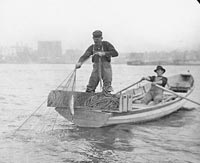
Shad fishing
New York State Archives
In this 1899 photo, a man pulls a net while shad fishing on the Hudson River.
Even such lightly fished species as alewife are now protected from any harvest in several U.S. states because of recent population crashes. Habitat loss (especially damming), overfishing, pollution, and, increasingly, climate change have all contributed to declines in this group. Warming is already altering the geographic ranges and timing of migrations of some fishes, which likely will create “mismatches” to their established ecological relationships.

Because of their remarkably high abundances and importance in early Colonial times and the sheer magnitude of their subsequent collapse, North Atlantic diadromous fishes — those that migrate between salt and fresh water — offer a particularly egregious example of eco-social anomie. Here is a generalized history: As industrialization intensified, already overharvested migratory fish populations were sacrificed for the construction of dams for power mills. This blockage of spawning habitat reduced runs further, wiping out upriver fisheries and causing downriver fisheries to dwindle or perish. The fundamental aquatic ecology of these systems also was harmed: With fewer adults entering rivers and fewer juveniles leaving them, the normal energy transfers between fresh and marine waters were reduced, and interdependencies between diadromous fishes and their associated animal and plant communities withered.

With catches diminished, local dependencies on this food source declined, and with that, a primary constituency for the welfare of the fish runs. Industrialization led to increased contamination, growing human populations led to greater discharge of sewerage, and rivers began to serve more as power sources and gutters for societal wastes than as productive ecosystems. The disappearing migratory fishes may have granted “permission” for additional ecosystem corruption because there was less cost in further debilitating rivers.

Mitigation for the loss of wild runs of these fishes was most often in the form of the easy but nearly always ineffective — if not downright destructive — stocking of hatchery-reared specimens. The exquisitely
To end the steady degradation of ecosystems, we need to rewind important historical connections.
fine-tuned life histories of natural runs to their home rivers became quashed by mass-produced specimens that were less fit, but that nonetheless competed with any remaining wild individuals, reducing their fitness, too, as they interbred. Responsibility for the continuity of the runs shifted away from maintaining ecological integrity of fish runs and rivers to what amounted to a cosmetic patch via outsourcing. Abundant research has shown that a fish is not a fish is not a fish.

As Richard Judd wrote in Common Lands, Common People, “An artificial resource maintained in a habitat no longer capable of spontaneous growth, fish became a property of the state rather than an element of the providential natural landscape.”

To put an end to the steady degradation of many ecosystems — marine and otherwise — we need to rewind important historical connections and dependencies. But tools to do so are also necessary: funding, legislation and, finally, education to rebuild societal awareness and the will to effect needed changes.

In the U.S., until the importance and legal standing of these fishes and their habitats were elevated with the Clean Water Act of 1972 and other environmental statutes, resource managers lacked the means to do much except to try and maintain existing baselines. Since then, a few victories have been won and critical precedents set. It took a population crash of Chesapeake Bay striped bass in the 1980s to push Congress into enacting laws that forced the necessary draconian changes to those fisheries. But these fish made a celebrated comeback, showing what can be accomplished with a truly determined effort. The striped bass was fortunate because it had a vocal constituency of commercial and recreational fishermen calling for its revival.

The lesson from this — one which has been learned the hard way across all kinds of fisheries — is to avoid reaching the crisis stage. This philosophy, known as the “precautionary principle,” is beginning to take hold with the simple wisdom of erring conservatively in setting fish harvests.

Maine has shown exemplary leadership in reopening rivers to migratory fishes with the dismantling of the Edwards Dam on the Kennebec River in
The striped bass had a vocal constituency of fishermen calling for its revival.
1999, an action that allowed sturgeons, shad, and striped bass to swim and spawn in a 17-mile stretch of the river that was blocked for a century. Similar efforts are underway in Maine’s Penobscot River, and these include novel compromises that will maintain hydroelectric power generation levels while eventually reopening hundreds of miles of main-stem river and tributaries.

Many smaller dam-removal and fish-passage efforts are also underway on both sides of the Atlantic, including efforts to bring Atlantic salmon back to the Thames, the Rhine, and the Seine. Maine also is home to the newly formed Diadromous Species Restoration Research Network that will help coordinate restoration efforts of academic, government, and watershed activists and residents, both in the Penobscot River and throughout the northeast.

Alewives were once so numerous along the eastern coast of the U.S. that they were likened to the passenger pigeons of the sea. Sadly, precipitous decline across much of their range is reminiscent of the passenger pigeon’s demise. A new amendment to the Atlantic States Marine Fisheries Commission’s Interstate Management Plan for alewife and its relatives calls for detailed restoration, adapted to the state level.

MORE FROM YALE e360

With Temperatures Rising,
Here Comes ‘Global Weirding’

Fish
They’re calling it “global weirding” — the way in which rising temperatures are causing species to change their ranges, the timing of their migrations, and the way they interact with other living things. And the implications of all this are only beginning to be understood.
READ MORE
Many grassroots organizations also are fighting for protection and restoration of their alewife spawning creeks on a local level. Reconnecting the public with their neighborhood alewife run has been brought to an advanced plane in the Ipswich River, Massachusetts, with an innovative Adopt-a-Herring Program, where students track radio-tagged individuals as they migrate upriver, learning much about fish and stream biology along the way, as well as regaining a sense of responsibility for securing continuity for this natural phenomenon.

Although we are still far from hearing the societal shout on their behalf that is needed, voices are rising as numbers of many North Atlantic diadromous fishes continue to dwindle. But it will require greater concerted action to actually reverse their vicious spiral. Until then, these creatures would be advised to heed the words of Henry David Thoreau, from A Week on the Concord and Merrimack Rivers: “Keep a stiff fin then, and stem all the tides thou mayst meet.”

POSTED ON 08 Apr 2010 IN Biodiversity Pollution & Health North America North America 

COMMENTS


That's how it is (thought it doesn't have to be) with the human mind. We can become used to the most desolate of environments, and think it okay, because to correct, to work through towards solutions requires effort and sacrifice and sharing. We're not so good with these, no in totality. We have our moments, and we string these moments together and form some sort of cohesive bond of society and "progression" of civilization, but we're mostly just making it up as we go along, without understanding the finer points. That takes time. Question is, how much time have we?

Enough.

Posted by Mustang on 08 Apr 2010


This tragic vanishing is also occuring in the iconic Salmon species of the Pacific Ocean. While hatcheries did prop up some runs for a while, now we have the threat of global corporations rearing lucrative Atlantic Salmon in open net pens along all the wild Salmon migration routes. This poses a huge risk of disease and parasite transfer, so unless we can force government to remove fish farms from wild Salmon migration routes, it's only a matter of time before "privatized" Salmon kill off all the wild ones.

Do us and the wild Salmon a favour and stop eating "pharmed salmon" from BC until they switch to closed containment aquaculture on land.

Posted by Steelhead on 08 Apr 2010


Shifting baselines aren't only generational. Individuals seem to develop amnesia when it comes to a degraded environment. They compare this autumn to the last autumn - not an autumn 10 or 20 or more years ago.

Thus it was in 2009 that when leaves never turned brilliant colors, but just fell to the ground - a month ahead of normal - nobody noticed. As trees are rapidly dying, people seem to have forgotten that they rarely used to fall over, or exhibit broken branches, thin crowns, and splitting, peeling bark.

The same can be said for the bird population. People seem to have forgotten what life was like when the air was full of the sounds of birds, most of which are now dead. We should really stop polluting our environment before our species is next on the extinction list.

Posted by Gail on 08 Apr 2010


To whom it may concern and President Obama,

Please issue an executive order outlawing all aquatic pesticides being applied to our estuaries. The recent listing of the Pacific Smelt as threatened along with Kim Patten's revelation concerning (90 percent) major declines of ghost and mud shrimp at the Dept. of Agriculture's Burrowing Shrimp Conference held March 12th, 2010 in Long Beach Wa, should at the very least, inspire you to stop this poisoning / polluting of our waters. These chemicals, carbaryl, glyphosate, imazapyr and other inert chemicals used and endorsed by certain oyster growers in Grays Harbor and Willapa Bay Wa. are decimating our fisheries. Oyster FARMING is not a fishery. They are not even NATIVE! Please issue this order immediately and SAVE OUR SALMON and other NATIVE fish by saving the food chain! Steve and Cynthia Ocean Shores, Wa (govanswers@gmail.com)

p.s. Please don't eat the farmed oysters from these areas as they spray/filter chemicals

Posted by cindy bova on 08 Apr 2010


There was really no problem when human predation of the oceans was limited to a few millions of individuals. Then, even with only plant and animal derived fibers, a bit of stone or bone or, later, maybe a little metal, it was pretty easy to fill a basket with yummy snacks.

Now, with several billions of predatory humans, the old stories of schools so thick you could walk across the sea on the backs of the fish seem to make no sense, even metaphorically.

Does it take a genius, here, to figure out the imbalance?

Posted by OldStone50 on 09 Apr 2010


It's sad that American Shad are now the most numerous anadromous fish in the Columbia river and considered trash fish by most west coasters. It only took changing that mighty river into a series of lakes to kill off the salmon and let the shad thrive.

Posted by Dave on 09 Apr 2010


I am just reading eco-cide, a book given to me by Dr.Vandana Shiva. It provides a historic account of the tragic loss of species extinction on our environment and world. Devastating.

We started www.ediblegardens.com to try to address the issue of this same irrevocable loss with our staple food crops - the seeds are rapidly disappearing and it really seems like the general population just isn't all that concerned with things like feeding ourselves and biodiversity, much less species loss.

Collectively we need to lower our consumption of stuff - it's killing everything and the price is just too high...

Posted by william martin on 11 Apr 2010


So, basically, the authors have thought of a very complicated name ("Eco-social anomie describes a biological and cultural feedback loop that spirals toward this breakdown") for a basic phenomenon: people forget.

Good luck in coming up with a rallying to stop mass-extinction!

Posted by daniel on 18 Apr 2010


Bova wrote:" Now, with several billions of predatory humans, the old stories of schools..."
The issue would be better focused on the resources being used, not necessarily the billions of people. It has been estimated that Bangladesh people have a zero ecological footprint whereas Americans use the resources of ten times their numbers. To put this numerically Americans use the equivalent resources of 3 billion other people on the planet.

Posted by hugh j curran on 22 Apr 2010


All you need to do is look at a high resolution satellite image of Bangladesh to see that the ecological foot print is far from zero. Low per-capita consumption is easily made up by increasing the "capitas". Unfortunately the number of "capitas" is increasing in both America and Bangladesh.

Posted by Killifish on 13 May 2010


Comments have been closed on this feature.
john waldmanABOUT THE AUTHOR
John Waldman, a professor of biology at Queens College, New York, works on the ecology and evolution of anadromous fishes, historical ecology, and urban waterways. Before joining Queens College, he worked for 20 years at the Hudson River Foundation for Science and Environmental Research. He is the author of Heartbeats in the Muck: A Dramatic Look at the History, Sea Life, and Environment of New York Harbor. In a previous article for Yale Environment 360, he wrote about the ways that warming temperatures are causing the “global weirding” phenomenon.
MORE BY THIS AUTHOR


RELATED ARTICLES


As Threats to Biodiversity Grow,
Can We Save World’s Species?

With soaring human populations and rapid climate change putting unprecedented pressure on species, conservationists must look to innovative strategies — from creating migratory corridors to preserving biodiversity hotspots — if we are to prevent countless animals and plants from heading to extinction.
READ MORE

Monitoring A Grim Rise
In the Illegal Ivory Trade

For two decades, TRAFFIC’s Tom Milliken has tracked the illicit ivory trade that has led to the continued slaughter of Africa’s elephants. In an interview with Yale Environment 360, Milliken talks about the recent increase in ivory seizures and the criminal gangs that supply Asia’s black market for ivory.
READ MORE

Northwest Oyster Die-offs Show
Ocean Acidification Has Arrived

The acidification of the world’s oceans from an excess of CO2 has already begun, as evidenced recently by the widespread mortality of oyster larvae in the Pacific Northwest. Scientists say this is just a harbinger of things to come if greenhouse gas emissions continue to soar.
READ MORE

Can Vulnerable Species
Outrun Climate Change?

Recent studies shed light on the key question of whether certain species, including slow-moving amphibians, can move swiftly enough to new territories as their old habitats warm. The challenges are formidable, especially if human-caused warming continues at such a rapid rate.
READ MORE

Climate Relicts: Seeking Clues
On How Some Species Survive

In pockets ranging from mountain peaks to bogs, scientists are discovering plants and animals that survived previous eras of climate change. Now, conservation biologists say, these climate “relicts” could shed light on how some species may hang on in the coming centuries.
READ MORE


MORE IN Analysis


The Vital Chain: Connecting
The Ecosystems of Land and Sea

by carl zimmer
A new study from a Pacific atoll reveals the links between native trees, bird guano, and the giant manta rays that live off the coast. In unraveling this intricate web, the researchers point to the often little-understood interconnectedness between terrestrial and marine ecosystems.
READ MORE

Could a Changing Climate
Set Off Volcanoes and Quakes?

by fred pearce
A British scientist argues that global warming could lead to a future of more intense volcanic eruptions and earthquakes. And while some dismiss his views as preposterous, he points to a body of recent research that shows a troubling link between climate change and the Earth’s most destructive geological events.
READ MORE

China’s Looming Conflict
Between Energy and Water

by christina larson
In its quest to find new sources of energy, China is increasingly looking to its western provinces. But the nation’s push to develop fossil fuel and alternative sources has so far ignored a basic fact — western China simply lacks the water resources needed to support major new energy development.
READ MORE

As Threats to Biodiversity Grow,
Can We Save World’s Species?

by lee hannah
With soaring human populations and rapid climate change putting unprecedented pressure on species, conservationists must look to innovative strategies — from creating migratory corridors to preserving biodiversity hotspots — if we are to prevent countless animals and plants from heading to extinction.
READ MORE

Linking Weird Weather to
Rapid Warming of the Arctic

by jennifer francis
The loss of Arctic summer sea ice and the rapid warming of the Far North are altering the jet stream over North America, Europe, and Russia. Scientists are now just beginning to understand how these profound shifts may be increasing the likelihood of more persistent and extreme weather.
READ MORE

Rethinking Carbon Dioxide:
From a Pollutant to an Asset

by marc gunther
Three startup companies led by prominent scientists are working on new technologies to remove carbon dioxide from the atmosphere. The scientific community is skeptical, but these entrepreneurs believe the process of CO2 removal can eventually be profitable and help cool an overheating planet.
READ MORE

Busting the Forest Myths:
People as Part of the Solution

by fred pearce
The long-held contention that rural forest communities are the prime culprits in tropical forest destruction is increasingly being discredited, as evidence mounts that the best way to protect rainforests is to involve local residents in sustainable management.
READ MORE

China’s Reforestation Programs:
Big Success or Just an Illusion?

by jon r. luoma
China has undertaken ambitious reforestation initiatives that have increased its forest cover dramatically in the last decade. But scientists are now raising questions about just how effective these grand projects will turn out to be.
READ MORE

As Coal Use Declines in U.S.,
Coal Companies Focus on China

by jonathan thompson
With aging coal-fired U.S. power plants shutting down, major American coal companies are exporting ever-larger amounts of coal to China. Now, plans to build two new coal-shipping terminals on the West Coast have set up a battle with environmentalists who want to steer the world away from fossil fuels.
READ MORE

The New Story of Stuff:
Can We Consume Less?

by fred pearce
A new study finds that Britons are consuming less than they did a decade ago, with similar patterns being seen across Europe. Could this be the beginning of a trend in developed countries? Might we be reaching “peak stuff”?
READ MORE


e360 digest
Yale
Yale Environment 360 is
a publication of the
Yale School of Forestry
& Environmental Studies
.

SEARCH e360


Donate to Yale Environment 360

CONNECT

Twitter: YaleE360
e360 on Facebook
Donate to e360
View mobile site
Bookmark
Share e360
Email newsletter
Subscribe to our feed:
rss


ABOUT

About e360
Contact
Submission Guidelines
Reprints

e360 VIDEO

Warriors of Qiugang
The Warriors of Qiugang, a Yale Environment 360 video that chronicles the story of a Chinese village’s fight against a polluting chemical plant, was nominated for a 2011 Academy Award for Best Documentary (Short Subject). Watch the video.


DEPARTMENTS

Opinion
Reports
Analysis
Interviews
e360 Digest
Video Reports

TOPICS

Biodiversity
Business & Innovation
Climate
Energy
Forests
Oceans
Policy & Politics
Pollution & Health
Science & Technology
Sustainability
Urbanization
Water

REGIONS

Antarctica and the Arctic
Africa
Asia
Australia
Central & South America
Europe
Middle East
North America

e360 VIDEO REPORT

When the Water Ends
As temperatures rise and water supplies dry up, tribes in East Africa increasingly are coming into conflict. A Yale Environment 360 video reports on a phenomenon that could become more common: how worsening drought will pit groups — and nations — against one another. Watch the video.

e360 MOBILE

Mobile
The latest
from Yale
Environment 360
is now available for mobile devices at e360.yale.edu/mobile.


header image
Top Image: aerial view of Iceland. © Google & TerraMetrics.

e360 VIDEO REPORT

Leveling Appalachia
Leveling Appalachia: The Legacy of Mountaintop Removal Mining, an e360 video examining the environmental and human impacts of this mining practice, won the award for best video in the 2010 National Magazine Awards for Digital Media. Watch the video.


OF INTEREST


Yale