05 Nov 2009: Analysis

The Nitrogen Fix:
Breaking a Costly Addiction

Over the last century, the intensive use of chemical fertilizers has saturated the Earth’s soils and waters with nitrogen. Now scientists are warning that we must move quickly to revolutionize agricultural systems and greatly reduce the amount of nitrogen we put into the planet's ecosystems.

by fred pearce

A single patent a century ago changed the world, and now, in the 21st century, Homo sapiens and the world we dominate have an addiction. Call it the nitrogen fix. It is like a drug mainlined into the planet’s ecosystems, suffusing every cell, every pore — including our own bodies.

In 1908, the German chemist Fritz Haber discovered how to make ammonia by capturing nitrogen gas from the air. In the process he invented a cheap new source of nitrogen fertilizer, ending our dependence on natural sources, whether biological or geological. Nitrogen fertilizer fixed from the air confounded the mid-century predictions of Paul Ehrlich and others that global famine loomed. Chemical fertilizer today feeds about three billion people.

But the environmental consequences of the massive amounts of nitrogen sent coursing through the planet’s ecosystems are growing fast. We have learned to fear carbon and the changes it can cause to our climate. But one day soon we may learn to fear the nitrogen fix even more.

A major international survey published in September in Nature listed the
Artificial nitrogen is as ubiquitous in water as man-made carbon dioxide is in the air.
nitrogen cycle as one of the three “planetary boundaries” that human interventions have disturbed so badly that they threaten the future habitability of the Earth. The others — according to the study by Johann Rockstrom, of the Stockholm Environment Institute, and 27 other environmental scientists – are climate change and biodiversity loss.

Nitrogen affects more parts of the planet’s life-support systems than almost any other element, says James Galloway of the University of Virginia, who predicts: “In the worst-case scenario, we will move towards a nitrogen-saturated planet, with polluted and reduced biodiversity, increased human health risks and an even more perturbed greenhouse gas balance.”

The problem is that we waste most of Haber’s fertilizer. Of 80 million tons spread onto fields in fertilizer each year, only 17 million tons gets into food. The rest goes missing. This is partly because the fertilizer is wastefully applied, and partly because the new green-revolution crops developed to grow fat on nitrogen fertilizer are also wasteful of the nutrient. The nitrogen efficiency of the world’s cereals has fallen from 80 percent in 1960 to just 30 percent today.

Artificial nitrogen washes in drainage water from almost every field in the world. It is as ubiquitous in water as man-made carbon dioxide is in the air. It is accumulating in the world’s rivers and underground water reserves, choking waterways with algae and making water reserves unfit to drink without expensive clean-up.

Most of the man-made nitrogen fertilizer ever produced has been applied to fields in the last quarter-century. Nature has some ability to reverse man-made fixing of nitrogen, converting it back into an inert gas — a process called denitrification. But last year, Patrick Mulholland of the Oak Ridge National Laboratory in Tennessee reported that the system is being overwhelmed. Many rivers in the U.S. are now so nitrogen-saturated that they are losing their ability to denitrify pollution.

Most of this excess nitrogen ends up in the oceans, where it is killing whole ecosystems. Excess nitrogen is the cause of the growing number of oxygen-depleted “dead zones” in the oceans, says Mulholland.

Why should a fertilizer kill? It is just too much of a good thing. It over-fertilizes the water, producing such large volumes of algae and other biomass that it consumes all the oxygen in the water, causing the ecosystem to crash. Coastal bays, inlets and estuaries around the world are succumbing.

A study earlier this year found that algal blooms dump domoic acid, a neurotoxin, onto the ocean floor, where it persists for weeks. “The first signs are often birds washing up on the shore or seals acting funny, aggressive and twitching, looking as if they were drunk,” says Claudia Benitez-Nelson of the University of South Carolina.
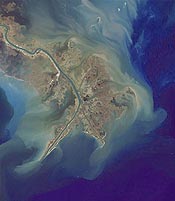
Dead Zone
NASA
Fertilizer running down the Mississippi and Missouri Rivers create a so-called “dead zone,” visible in this 1999 NASA satellite image.
Notoriously, fertilizer running down the Mississippi-Missouri river system creates a “dead zone” in the Gulf of Mexico. Typically, around 20,000 square kilometers of ocean forms a layer without oxygen or fish – killed by the nitrogen fix.

The number of dead zones has “spread exponentially since the 1960s,” says Robert Diaz of the Virginia Institute of Marine Science in Gloucester Point. He counted more than 400 in a study for Science last year. They now cover a quarter of a million square kilometers, usually where rivers discharge large amounts of fertilizers and sewage into relatively enclosed oceans.

You find these dead zones in the waters between Japan and Korea; in the Black Sea, where an invasion of alien jelly fish in the 1980s wiped out most native species; off the tourist beaches of the northern Adriatic; in Chesapeake Bay and the ocean waters off Oregon; and in the semi-enclosed Baltic Sea, the largest dead zone in world.

Nitrogen is a vital nutrient in soils, essential for growing crops. Soils recycle nitrogen in organic waste, including animal dung. But before Haber’s discovery, the only way of adding more atmospheric nitrogen to soils was through capture by the bacteria that live in a small number of nitrogen-fixing plants, including legumes like clover and beans.

In the 19th century, densely-packed countries like Germany and Britain began to improve the fertility of their soils by importing nitrogen in the form of guano from the Pacific islands of Peru, and saltpetre mined in Chile. Geological nitrogen was a geopolitical resource as vital as oil today.

Appeals were made for science to come up with a new method of producing nitrogen in a form that plants could absorb. Haber won the race, filing his patent for fixing ammonia, a molecule made of nitrogen and hydrogen atoms, from the inert nitrogen gas that makes up 70 percent of the air.

Now, ammonia could readily be turned into chemical fertilizer and added to the world’s fields as easily as cow dung. German industrialist Carl Bosch opened the first factory near Ludwigshafen in 1913. It was in the nick of time for Germany. During the First World War, unable to receive shipments of guano from South America because of a British naval blockade, Germany would quickly have starved but for the Haber-Bosch process.

Outside Europe, few initially took up chemical fertilizers to intensify their farming. It was usually cheaper and easier to expand farming — draining
Much of the nitrogen in our bodies today comes from giant chemical factories.
marshes, ploughing prairies and clearing forests. But by the 1960s, as world population soared, fertilizer manufacture took off, and plant breeders developed new lines of high-yielding crops that responded best to the nitrogen fix. During this “green revolution,” there was an eight-fold increase in global production of nitrogen fertilizer from the 1960s to the 1980s.

Today, of 175 million tons of nitrogen applied to the world’s croplands in a year, almost 50 percent is from chemical fertilizer. It has raised the “carrying capacity” of the world’s soils from 1.9 people per hectare of farmland to 4.3 — and 10 in China, where applications reach twice anything seen in Europe.

This is a profound change to the biochemistry of life on Earth — and to our own bodies. Today, much of the nitrogen in our bodies comes not from biological sources but from giant chemical factories. We are, in a real sense, as much chemistry as biology. Vaclav Smil, the distinguished Canadian researcher into food and the environment at the University of Manitoba, calls the nitrogen fix “an immense and dangerous experiment.”

Besides fertilizer, we are also making biologically available nitrogen by burning fossil fuels. Power stations emit nitrogen oxides that create acid rain, the environmental scourge of industrialized countries in the 1980s and 1990s. Nitrogen oxides in the air are also potent greenhouse gases, adding to global warming, and even reach the stratosphere, where they join chlorine and bromine compounds in eating up the protective ozone layer.

“Most of the world’s biodiversity hotspots are receiving doses of nitrogen from the air and in water at levels known to damage many species,” according to Gareth Phoenix of the University of Sheffield in England. Yet the issue has never been addressed by the UN Convention on Biological Diversity.

In temperate lands, this is turning heaths into grasslands, while grasslands typically lose a quarter of their species richness. Within nitrogen-flooded ecosystems, aggressive outside species outperform most natives. So nitrogen is the hidden force behind invasions of alien species around the world.

The prognosis is not good. The scientists who wrote the Nature paper on planetary boundaries argued that human nitrogen releases to the natural environment should be cut by three quarters, to around 35 million tons. But on current trends, global nitrogen use on farmland is set to double to 220 million tons a year by 2050 – more than six times the safe threshold.

The danger is that nature’s ability to process this excess nitrogen and return it to the atmosphere will be overwhelmed, and we will end up inhabiting a nitrogen-saturated planet, with nitrogen driving global warming, acidifying air, eating the ozone layer, reducing biodiversity, and killing the oceans.

More from Yale e360

New Study Warns of
Crossing Planetary Boundaries

The Earth has nine biophysical thresholds beyond which it cannot be pushed without disastrous consequences, the authors of a paper in the journal Nature report. Ominously, these scientists say, we have already moved past three of these tipping points, Carl Zimmer writes.

Nature Report a Reminder
of the Limits to Growth

It has been more than 30 years since a groundbreaking book predicted that if growth continued unchecked, the Earth’s ecological systems would be overwhelmed within a century. Bill McKibben writes that the new Nature study should serve as an eleventh-hour warning that cannot be ignored.
What can be done? To meet the target cited in the Nature study requires a transformation of the world’s agriculture as profound as the transformation of energy industries needed to meet targets for cutting greenhouse gases. There is an urgent need, says Smil, to breed crops that are far more efficient at absorbing the nitrogen in fields, and for developing farming systems that manage nitrogen far better.

Luckily the potential is considerable. In China, where nitrogen application to fields is among the highest in the world, a study by a group of scientists led by Wilfried Winiwarter and Tatiana Ermolieva of the International Institute for Applied Systems Analysis found that better on-farm management of nitrogen could cut nitrous oxide emissions to the environment by 25 percent without damaging farm output.

Galloway says the flow of nitrogen through the environment can also be reduced by decreased emissions from burning fossil fuels — perhaps as a byproduct of efforts against climate change. And better sewage treatment in cities could convert nitrates that have passed through the human gut into safe gaseous nitrogen.

If anything exemplifies humanity’s growing impact on the planet’s life-support systems, it is the way we are overwhelming the nitrogen cycle. There are solutions. But for now we are hooked. As Smil put it: “In just one lifetime, humanity has developed a profound chemical dependence.”

POSTED ON 05 Nov 2009 IN Oceans Pollution & Health Pollution & Health North America North America 

COMMENTS


On top of all of the problems created by fertilizer, 5 percent of the world's natural gas production is being used to make it. We are running out of the easy gas, and getting it out of shale in the midwest has huge environmental impacts. When we run out of gas we are back to guano.

Posted by Lloyd Alter on 05 Nov 2009


How would nitrogen dependence be reduced if we stopped eating meat? Certainly plants that feed livestock are fertilized. I lack the data to run the numbers on that, but someone at Yale just might be able to.

Posted by Chris O. on 05 Nov 2009


Great piece, Fred. Just wanted to add that denitrification doesn't just produce inert nitrogen gas but also nitrous oxide, a powerful GHG. So over-fertilization loads the air with nitrogen as well as the soil/water.

Posted by niall dunne on 05 Nov 2009


As a hill farmer on the Cambrian mountains in Wales I use no chemical fertilizers - both for ethical and commercial reasons - Our pastures are fertilized with traditional processed FYM and with our livestocks' dung (sheep, pigs, chickens, cattle & shepherding ponies).

In answer to the enquiry concerning meat production and nitrogen abuse, I'd point out that fodder crops for CAFO production must, just like a monoculture food crop like soya, be dependent on artificial nitrogen inputs, but as a lobbying point it is scarcely valid - sustainable agriculture is about the symbioses of mixed farming, not the exclusion of livestock.

With regard to the impacts of airborne man-made nitrogen compounds, these mountains have lost about a half of their carrying capacity in the last century (my neighbour has flock records back to 1880). Species diversity has declined greatly and, since 2000, we've had green algae choking the streams even up on the open commons at 1,400ft even in January. This is way above any farm inputs - (at 52 N the farms here do go much over 1.000ft).

In terms of remedy, can anyone say how much a slow feed of lime to the watercourses would do to help at least the aquatic life ?

Regards, Lewis

Posted by Lewis Cleverdon on 09 Nov 2009


An erudite article by Fred Pearce on the nitrogen fix which few are aware of, but many rush to deny. How could we feed the world if we ceased to use chemical fertilisers? rather begs the question and the estimates provided "It has raised the “carrying capacity” of the world’s soils from 1.9 people per hectare of farmland to 4.3 — and 10 in China" ought to be pause for thought for those who argue that we need a population increase in the UK to maintain economic prosperity (pensions?).

But on the point of linking biodiversity loss to nitrogen. Nitrogen in farming goes hand in hand with the use/abuse of glyphosate which has been specifically formulated to eliminate other "biodiverse plants" that may compete with the crop and reduce commercial yields by inhibiting photosynthesis. In otherwords glyphosate inhibits the uptake of CO2 and the release of O2 by plants. Is it just the nitrogen that causes the "dead zones"?

How big a factor then is nitrogen and glyphosate in climate change? The fast answer might be that there is an uptake of carbon by the crop - not a problem - ignoring downstream impacts. is there any data comparing the biomass output per unit area of a chemical fed crop and that produced by the natural ecosystem in the same soil/location having regard for the total energy input?

Posted by Dave Stanley on 09 Nov 2009


You've raised an important issue: management of agricultural nitrogen does indeed need to be improved. This short article tries to cover a wide range of complex and interrelated points. As a result, several important nuances are lost.

Nitrogen use efficiency (NUE) is low (around 40 percent) as a global average, but that hides significant variations, including the fact that maize NUE has risen to about 80 percent in the U.S. Corn Belt. Best practices need to be applied more widely and adapted to local conditions.

It is wrong to say that falling NUE rates are due to Green Revolution crops using nitrogen less efficiently. Falling efficiency was due to moving from a situation of scarce nitrogen to relative abundance. In general, the scarce, limiting nutrient will be used quite efficiently by the biological system in question. The global trend showed an initial fall and then steady recovery in efficiency since the 1980s as management practices have improved.

It is also misleading to say "This is a profound change to the biochemistry of life on Earth — and to our own bodies. Today, much of the nitrogen in our bodies comes not from biological sources but from giant chemical factories." The nitrogen forms that are taken up by plants and thus by our bodies are chemically identical, so there has been no biochemical change to our bodies at all. The organic forms of nitrogen in manures, for example, must be transformed into inorganic sources before plants can absorb them.

Posted by Kristen Sukalac on 10 Nov 2009


The situation is worse that Fred states. Nitrogen has had some benign impacts. We would, according to FAO statistics, need to have farmed an additional 20 million hectares to sustain today's population without synthetic nitrogen, so at least that land has been saved. Atmospheric nitrogen by stimulating plant growth has probably accelerated the capacity of plant's to grow i.e. store carbon.

The problem is that we are in a classic Malthusian trap - the population has grown 48 percent bigger than it would have done without synthetic nitrogen, according to Erisman, it's set to grow another 50 percent from here and we have no alternative to it. It's a truly horrendous picture given the negative effects of nitrogen overuse.

Posted by Stephen Hay on 15 Nov 2009


The design science of permaculture offers some relatively simple win-win solutions that can reduce much of the damage that chemical nitrogen fertilizers create.

For instance, run-off from fields can be substantially reduced and contained via simple berming and swaling methods. These methods also reduce irrigation and fertilizer needs, cutting costs for farmers and alleviating environmental stress.

Nitrogen fixing cover crops can be used, such as clover, alfalfa, and beans to reduce need for chemicals.

Polycropping is a viable solution in some areas of the world - crop yields can be increased 3-8 times while inputs are substantially reduced or eliminated.

http://ag.arizona.edu/oals/ALN/aln48/hanzi.html

Waste streams can be utilized to meet nitrogen needs. For instance, in Europe, human urine is used as a fertilizer. It is sterile, and an excellent source of nitrogen, potassium, and phosphorous (and potential future shortages of phosphorous could become as serious a problem as excesses of nitrogen). In many cases, the nitrogen in both animal and human urine ends up in water supplies, creating overgrowth of algae and suffocation of other life. How much more efficient would it be to use these waste streams as they were meant to be used by nature? We could eliminate pollution from a number of sources by closing this one loop - think of the reduced factory emissions and reduced water pollution.

Permaculture offers many simple and doable solutions to the excesses brought about by our industrial choices.

Lewis, I agree that symbiosis and closing loops rather than monoculture will be the new agriculture paradigm. For your streams, you may want to look at using microbes to remedy the problem rather than lime. They may be less disruptive to your stream systems and will balance themselves.

Keyline plowing, swaling and select planting can help control your runoff and also can help regenerate the carrying capacity of degraded lands.

Posted by Cory Brennan on 15 Nov 2009


Thanks for this very important post. There were several interesting solutions offered in this piece and within the comments, but, I would like to hear more discussion on policy drivers and incentives that reduce nitrogen loading and inefficiency. Emerging ecosystem services markets (mostly driven by regulation) could be one way to drive innovation and efficiency. For instance, water quality markets can promote nitrogen efficiency by rewarding innovation and changes in practices that reduce nitrogen pollution, similar to carbon markets that reward companies for reducing emissions.

Carbon offset markets that encourage carbon sequestration could also create ancillary benefits to reduce nitrogen loading -- new agricultural products such as biochar may sequester carbon while increasing crop nutrient efficiency while the promotion of no-till agriculture can retain carbon and nitrogen.

The nitrogen problem is an excellent example of how the enhancement of one ecosystem service, food provisioning, has contributed to the degradation of another service, freshwater. This was a key finding in the 2005 Millennium Ecosystem Assessment. http://www.maweb.org/en/About.aspx

Since then, various public and private tools, such as the Corporate Ecosystem Services Review, have been designed to help policy makers examine these trade offs and look for ecosystem services opportunities in innovation and markets. http://www.wri.org/publication/corporate-ecosystem-services-review.

Posted by Davis Cherry on 17 Nov 2009


Comments have been closed on this feature.
fred pearceABOUT THE AUTHOR
Fred Pearce is a freelance author and journalist based in the UK. He is environment consultant for New Scientist magazine and author of the recent books When The Rivers Run Dry and With Speed and Violence. His latest book is Confessions of an Eco-Sinner: Tracking Down the Sources of My Stuff (Beacon Press, 2008). In earlier articles for Yale Environment 360 Pearce has written about the issues of overconsumption and overpopulation, and about the responsibility of developing nations in any global climate agreement.
MORE BY THIS AUTHOR


RELATED ARTICLES


The Folly of Big Agriculture:
Why Nature Always Wins

Large-scale industrial agriculture depends on engineering the land to ensure the absence of natural diversity. But as the recent emergence of herbicide-tolerant weeds on U.S. farms has shown, nature ultimately finds a way to subvert uniformity and assert itself.
READ MORE

Can Reforming the Farm Bill
Help Change U.S. Agriculture?

For decades, farm bills in the U.S. Congress have supported large-scale agriculture. But with the 2012 Farm Bill now up for debate, advocates say seismic shifts in the way the nation views food production may lead to new policies that tilt more toward local, sustainable agriculture.
READ MORE

How a Gold Mining Boom is
Killing the Children of Nigeria

It is a pattern seen in various parts of the world — children being sickened from exposure to lead from mining activities. But the scale of the problem in Nigeria’s gold-mining region of Zamfara is unprecedented: More than 400 children have died and thousands more have been severely poisoned by exposure to lead dust.
READ MORE

In Fast-Track Technology, Hope
For a Second Green Revolution

With advances in a technique known as fast-track breeding, researchers are developing crops that can produce more and healthier food and can adapt and thrive as the climate shifts.
READ MORE

A Development Expert Relies
On the Resilience of Villagers

Geographer Edward Carr has worked extensively in sub-Saharan Africa, where climate change and other environmental threats present a growing challenge. In an interview with Yale Environment 360, Carr talks about why any outside aid to the developing world must build on the inherent capability of the local residents.
READ MORE


MORE IN Analysis


The Vital Chain: Connecting
The Ecosystems of Land and Sea

by carl zimmer
A new study from a Pacific atoll reveals the links between native trees, bird guano, and the giant manta rays that live off the coast. In unraveling this intricate web, the researchers point to the often little-understood interconnectedness between terrestrial and marine ecosystems.
READ MORE

Could a Changing Climate
Set Off Volcanoes and Quakes?

by fred pearce
A British scientist argues that global warming could lead to a future of more intense volcanic eruptions and earthquakes. And while some dismiss his views as preposterous, he points to a body of recent research that shows a troubling link between climate change and the Earth’s most destructive geological events.
READ MORE

China’s Looming Conflict
Between Energy and Water

by christina larson
In its quest to find new sources of energy, China is increasingly looking to its western provinces. But the nation’s push to develop fossil fuel and alternative sources has so far ignored a basic fact — western China simply lacks the water resources needed to support major new energy development.
READ MORE

As Threats to Biodiversity Grow,
Can We Save World’s Species?

by lee hannah
With soaring human populations and rapid climate change putting unprecedented pressure on species, conservationists must look to innovative strategies — from creating migratory corridors to preserving biodiversity hotspots — if we are to prevent countless animals and plants from heading to extinction.
READ MORE

Linking Weird Weather to
Rapid Warming of the Arctic

by jennifer francis
The loss of Arctic summer sea ice and the rapid warming of the Far North are altering the jet stream over North America, Europe, and Russia. Scientists are now just beginning to understand how these profound shifts may be increasing the likelihood of more persistent and extreme weather.
READ MORE

Rethinking Carbon Dioxide:
From a Pollutant to an Asset

by marc gunther
Three startup companies led by prominent scientists are working on new technologies to remove carbon dioxide from the atmosphere. The scientific community is skeptical, but these entrepreneurs believe the process of CO2 removal can eventually be profitable and help cool an overheating planet.
READ MORE

Busting the Forest Myths:
People as Part of the Solution

by fred pearce
The long-held contention that rural forest communities are the prime culprits in tropical forest destruction is increasingly being discredited, as evidence mounts that the best way to protect rainforests is to involve local residents in sustainable management.
READ MORE

China’s Reforestation Programs:
Big Success or Just an Illusion?

by jon r. luoma
China has undertaken ambitious reforestation initiatives that have increased its forest cover dramatically in the last decade. But scientists are now raising questions about just how effective these grand projects will turn out to be.
READ MORE

As Coal Use Declines in U.S.,
Coal Companies Focus on China

by jonathan thompson
With aging coal-fired U.S. power plants shutting down, major American coal companies are exporting ever-larger amounts of coal to China. Now, plans to build two new coal-shipping terminals on the West Coast have set up a battle with environmentalists who want to steer the world away from fossil fuels.
READ MORE

The New Story of Stuff:
Can We Consume Less?

by fred pearce
A new study finds that Britons are consuming less than they did a decade ago, with similar patterns being seen across Europe. Could this be the beginning of a trend in developed countries? Might we be reaching “peak stuff”?
READ MORE


e360 digest
Yale
Yale Environment 360 is
a publication of the
Yale School of Forestry
& Environmental Studies
.

SEARCH e360


Donate to Yale Environment 360

CONNECT

Twitter: YaleE360
e360 on Facebook
Donate to e360
View mobile site
Bookmark
Share e360
Email newsletter
Subscribe to our feed:
rss


ABOUT

About e360
Contact
Submission Guidelines
Reprints

e360 VIDEO

Warriors of Qiugang
The Warriors of Qiugang, a Yale Environment 360 video that chronicles the story of a Chinese village’s fight against a polluting chemical plant, was nominated for a 2011 Academy Award for Best Documentary (Short Subject). Watch the video.


DEPARTMENTS

Opinion
Reports
Analysis
Interviews
e360 Digest
Video Reports

TOPICS

Biodiversity
Business & Innovation
Climate
Energy
Forests
Oceans
Policy & Politics
Pollution & Health
Science & Technology
Sustainability
Urbanization
Water

REGIONS

Antarctica and the Arctic
Africa
Asia
Australia
Central & South America
Europe
Middle East
North America

e360 VIDEO REPORT

When the Water Ends
As temperatures rise and water supplies dry up, tribes in East Africa increasingly are coming into conflict. A Yale Environment 360 video reports on a phenomenon that could become more common: how worsening drought will pit groups — and nations — against one another. Watch the video.

e360 MOBILE

Mobile
The latest
from Yale
Environment 360
is now available for mobile devices at e360.yale.edu/mobile.


header image
Top Image: aerial view of Iceland. © Google & TerraMetrics.

e360 VIDEO REPORT

Leveling Appalachia
Leveling Appalachia: The Legacy of Mountaintop Removal Mining, an e360 video examining the environmental and human impacts of this mining practice, won the award for best video in the 2010 National Magazine Awards for Digital Media. Watch the video.


OF INTEREST


Yale