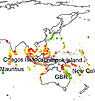
An international team of marine scientists has produced a comprehensive map that documents the world’s coral reefs and categorizes the stress factors that threaten the survival of many of their ecosystems, from increased
temperatures to overfishing and ultraviolet radiation. Using satellite data and mathematical analysis of coral physiology, the researchers ranked coral resources on a scale from 0 to 1 based on their overall exposure to stresses, factors that counteract those stresses, and the extent to which they can be managed through human intervention. “The key to effectively identifying where conservation efforts are most likely to succeed is finding reefs where high biodiversity and low stress intersect,” said Joseph M. Maina of the Wildlife Conservation Society and lead author of the study published in the journal PLoS ONE. According to the study, coral regions facing the greatest threats are located in Southeast Asia and the eastern Pacific, where radiation stress is high and temperature variability is low, as well as the Middle East and western Australia, where high levels of sedimentation and phytoplankton threaten coral reefs.
Map Documents Stresses Facing the World’s Coral Reefs
More From E360
-
Climate
Why Germany Is Building an Ark for U.S. Climate Data
-
INTERVIEW
From Indigenous Loss, a Potent Legal Argument on Climate
-
Biodiversity
Sargassum Superbloom: Seaweed Scourge or Ecological Boon?
-
Oceans
A Surge of Marine Heat Waves Threatens to Scramble Ocean Life
-
Policy
A Hard-Won Rule to Cut Chemical Plant Pollution Is Being Unraveled
-
E360 FILM CONTEST WINNER
Filipino Cacao Growers Learn to Live With a Hotter Climate
-
E360 FILM CONTEST
A Bicycle Journey Across Brazil to Find a Vanishing Savanna
-
OPINION
For America’s Rarest Wildlife, Survival May Hinge on a Single Word
-
E360 Film Contest
Who Gets to Decide the Fate of a Pristine Alaskan Rainforest?
-
Biodiversity
‘Wastelands’ No More: India Charts a Future for Its Grasslands
-
Climate
After Decades of Drought, Water Is Rising in the African Sahel
-
Cities
In Steel Country, the Fight for Clean Air Faces New Obstacles