14 Apr 2011: Report

The Cerrado: Brazil’s Other
Biodiverse Region Loses Ground

While Brazil touts its efforts to slow destruction of the Amazon, another biodiverse region of the country is being cleared for large-scale farming. But unlike the heralded rainforest it borders, the loss of the cerrado and its rich tropical savanna so far has failed to attract much notice.

by fred pearce

Brazil is justly proud of how much it has reduced deforestation in the Amazon, with rates of forest loss down 70 percent since 2004. Indeed, delegates to last year’s world biodiversity conference in Nagoya, Japan, and climate conference in Cancun, Mexico, could hardly miss the Brazilian government’s boasting about its conservation achievements.

But how has this been accomplished? The answer, at least in part, is by invading a new ecological frontier of equal importance — but with much less public visibility. Today, Brazil’s bush clearers from agribusiness are moving across the cerrado, the most biologically rich savanna in the world, which occupies a huge expanse of the high plains of central Brazil on the Atlantic side of the Amazon basin.
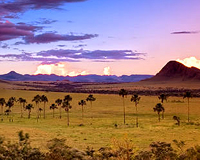
Brazilian Cerrado
Photo by Marcio Cabral
Brazil’s cerrado is the world’s most biologically rich savanna.
In recent years, the rate of ecological destruction in the cerrado has been twice that in the Amazon. And while the majority of the Amazon rainforest survives, more than 60 percent of the cerrado’s former 200 million hectares has disappeared under the plow, mostly within the last two decades.

The cerrado has its own rich array of unusual mammals, including armadillos, anteaters, tapirs, and maned wolves, as well as thousands of endemic vascular plants adapted to drought and fire. But while the cerrado shares a place with the Amazon on Conservation International’s list of the world’s top 25 biodiversity hotspots, so far the outrage over its devastation has remained minimal.

This month the Brazilian environment ministry claimed that the rate of ecological loss in the cerrado declined between 2008 and 2009. But when I visited the region last month, nobody agreed with that assessment, and even local environment regulators saw no end to the land-clearing in sight.

The soils of the cerrado — a complex mosaic of grass and woodland — were once regarded as too acidic to grow crops. But since Brazil’s agronomists began applying industrial quantities of lime in the 1980s, these soils have been transformed. The cerrado now produces 70 percent of Brazil’s farm output.

As more roads and railways penetrate the once empty interior north of the country’s shiny modernist 1960s capital, Brasilia, the land rush is intensifying and land prices are soaring. While most of the corn grown in the cerrado is consumed in Brazil, and much of the sugar cane goes to fill the tanks of the country’s ethanol-fueled vehicles, the soya, cotton, coffee, and other crops largely go for export.

The world’s largest soya grower, Blairo Maggi, was also until recently the governor of the cerrado state of Mato Grosso. Thanks to industrial-scale farmers like him, Brazil is today the world’s largest exporter of soya, beef, chicken, sugar, ethanol, tobacco, and orange juice. The success has been so complete that the World Bank and others now see the industrializing of the cerrado as a model for transforming Africa’s savanna grasslands.

I spent several days visiting giant industrial farms, many funded by U.S. and UK capital, in the frontline of western Bahia in northeast Brazil. Some 40 kilometers down a track off the main road to Brasilia, I found Agrifirma,
In recent months, the Brazilian parliament has debated whether to drop the forest code altogether.
the 42,000-hectare agricultural empire of Jacob (Lord) Rothschild, scion of one of Europe’s richest families, which grows seemingly endless fields of corn, soya, cotton, and coffee.

At lunch I met a dapper British financier and his wife, who had flown in to the Agrifirma airstrip that morning to survey their investment, and a European lottery entrepreneur spending his winnings from other peoples’ bets on another farm down the road. Close by was George Soros’s Adecoagro enterprise.

All this, says local biology professor Fernando Lutz, is a tragedy. The world has shown its enthusiasm for saving the Amazon, he says, but it has ignored the fate of the cerrado for too long. The cerrado has more than 4,000 endemic species of plants. It contains a third of all Brazilian biodiversity — more, for some groups of species, than the Amazon.

We were sitting in a bare lecture room in the newly established campus of the University of Bahia in Barreiras, the epicenter of the carnage. A couple of miles away, trucks from all over the region were lining up down the road outside Cargill’s soya-collecting silos. Lutz told me he was planning an expedition to explore the biodiversity of the nearby district of Formosa do Rio Preto. But he may not find much left. When I later met Flavio Marques, environmental advisor to the Bahia state prosecutor in Barreiras, he told me that the fastest loss of cerrado today is in Formosa do Rio Preto. It lost more than 2,000 square kilometers to agriculture between 2002 and 2008.

The cerrado has been a black hole for conservation, said Marques. Only 2 percent of the ecosystem is protected. Brazilian agriculturalists and ministers still talk as if it had no conservation value at all. The leading global financial analyst Nomura Asset Management was recently touting the investment potential of the cerrado, reporting that it still contains “an estimated 90 million hectares of land capable of being cultivated — all without any environmental consequences.”

While Brazil’s national forest code requires developers in the Amazon to leave 80 percent of the forest intact as “legal reserves,” the requirement in the cerrado is a mere 20 percent.
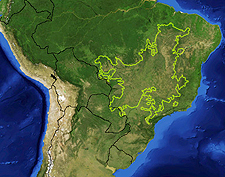
Cerrado
NASA/World Wide Fund for Nature
More than 60 percent of the cerrado’s former 200 million hectares has been cleared for agriculture.
And even that is largely ignored. “The private landowners have traditionally done whatever they want here,” said Marques. Three years ago, in an effort to enforce the code, he sent out a letter asking holders of more than 5,000 hectares to document their legal reserves. So far, he told me, only 10 percent have even replied.

Many are holding out because, in recent months, the Brazilian parliament has been debating whether to drop the forest code altogether. “If that happens,” says Lutz, “the consequences for the cerrado will be very bad.”

Two hours down the road from Barreiras is Luis Eduardo Magalhaes, an agricultural boomtown built around Brazil’s largest soya processing plant, which is owned by commodities giant Bunge. The town has grown from nothing to a population of 60,000 in a decade. Its recently appointed environment secretary, lawyer Fernanda Aguiar, told me: “When this place got started, they just wanted people to come, and get rich quick. Things were done without any respect for the law. People have no idea here about taking care of the cerrado.”

Respect for the law is slowly improving. Marques and Aguiar are testimony to that. The buccaneering land-grabbers of the 1970s, some of whom confiscated land and commandeered local Indians on work camps in near-slave conditions, are now mostly selling out to corporate agribusiness.

Brazil’s largest agricultural enterprise, SLC Agricola, has 11 farms in the cerrado covering 230,000 hectares, each built according to a standard design, with the same cotton-soya-corn crop rotation, the same health and safety signs, and the same floodlit football fields.

And the surviving farmers from the early days have gone large-scale and cleaned up their acts. As a red crop-spraying plane buzzed around his Sao Sebastio Farm, Anildo Kurek, a Brazilian of Dutch extraction, told me how
Laws remain weak, and commercial pressures to clear the cerrado continue to grow.
he began here 20 years ago with a thousand hectares, bought with bags of soya from the first harvest. He now runs 23,000 hectares.

But the laws remain weak, and the commercial pressures to clear the cerrado continue to grow. Poor roads are the main impediment to further expansion of the region’s already prodigious agricultural output. But soon a new 1,500-kilometer railroad to the coast will be built, reaching Barreiras by the end of next year.

Can anything hold back the tide and protect what remains of the cerrado? I traveled through western Bahia with the Brazil staff of Conservation International (CI). They have a strategy for engaging with the farmers, creating a coalition of those willing to comply with existing conservation laws and to establish conservation corridors across the cerrado. CI’s corporate partner and initial link to the farmers is one of the biggest beneficiaries of the agribusiness bonanza, Monsanto.

Is the strategy working? I certainly met farmers who now talk the talk — but only, they made clear, if conservation and profit can go together. And some of the effects of Conservation International’s interventions have been perverse.

When I asked Kurek how his the newfound respect for environmental the law was going, he told me an unexpected story. CI’s help with the minutiae of conservation bureaucracy meant he now had an environment licence that allowed him to clear another 4,000 hectares of bush on his land. “We were waiting for the environmental licence before going ahead with the clearance, and CI helped us get it,” he said.

MORE FROM YALE e360

Agribusiness Boom Threatens
Key African Wildlife Migration

Agribusiness Boom Threatens Key African Wildlife Migration
The Ethiopian region of Gambella is home to Africa’s second-largest mammal migration, with more than a million endangered antelope and other animals moving through its grasslands. But, as Fred Pearce reports, the government has now leased vast tracts to foreign agribusinesses who are planning huge farms on land designated a national park.
READ MORE
However, Kurek was keen to underline how wildlife could thrive on his farm. “We see maned wolves here sometimes,” he told me as we drove around his domain. “And rhea.” Right on cue, one of the large flightless birds shot out of a soya field and ran down the track ahead of our SUV. We chased it for a mile before the exhausted bird found an exit back into the field. Nature is surviving here, but only just.

And for how much longer? At Barreiras airport, as I checked in for the flight home, a delegation of more than 20 Chinese were arriving in a private plane. Local journalists besieged them as they explained that they were from the Chongqing Grain Group and had $2.4 billion to spend setting up a plant in the city to process 1.5 billion tons of soya beans a year. The plant will displace Bunge’s LEM operation as Brazil’s largest soya processing plant, and could handle half the state’s current soy harvest. Most of the output is destined to feed cattle to meet China’s soaring demand for meat.

The Portuguese word cerrado literally translates as “closed” or “inaccessible.” But now that the cerrado is open and accessible, it may be doomed.

POSTED ON 14 Apr 2011 IN Biodiversity Biodiversity Policy & Politics Central & South America 

COMMENTS


In traveling through some of the Cerrado landscape in Mato Grosso for a story I wrote for VQR http://bit.ly/dV8zEO, I was also struck by Brazilians' disregard for the savannah as a region worth protecting. But as more than one Brazilian pointed out to me, it's not much different than the disregard North Americans have shown for the tall-grass prairie and the other native ecosystems we've exploited in the name of progress.

Or rather, it's different in so far as Brazilian farmers in the region -- which, as you point out generally means agribusiness on a giant scale -- are legally required to protect riparian zones and, in forested areas, set aside large percentages of their holdings. True, the laws are poorly enforced and have resulted in a strange patchwork -- effectively, islands of forest surrounded by oceans of soy -- but again, that is not so different from our clearcut forests and our tiny islands of, say, old-growth redwoods.

As for the profit motive in clearing land, well, it could also be expressed in terms of meeting real demand. No one is plowing up the Cerrado for the fun of it. The destruction isn't gratuitous. It has to do with more people in China wanting to eat beef.

We can all lament what that means in terms of destroyed ecosystems. But we shouldn't be sanctimonious about it.

Posted by Pat Joseph on 14 Apr 2011


Mr. Pearce, you wrote a fine report. But we cannot leave your report with the feeling that farming is wrong, development is bad and so on. Farming development in the Cerrado, is bringing this area to new opportunities. Many towns you visited had really bad public services, and were forgotten by the politicians. But now, western Bahia (and Cerrado as whole) found it's way to development through agriculture, and now, the drivers of this development carry a target on their back with many NGO's, journalists, and so on "shooting" on them, and very often all this movement are based on political-idealist thinking, rather than cientific-tecnical driven. Brazil has on of the worst ambiental rules of the world, were it obliges the farmer/land owner to absorb the onus of preservation (less production in the farm) for the benefit of civilization as whole. Like you said, in Bahia, if a farmer buys 100 hectares, 20 hectars must be left undeveloped, to the benefit of biodiversity and so.

Now, I would like to know, which other industry has to suffer this onus? If someone really care about nature, they have to help with true efforts and not only talk the talk. Today there is a very promissing iniciative (http://www.brasilmataviva.com.br/index.php?lang=en) here in Brazil, where nature conservancy will work, and actually act on the tripod of sustainability (economic, social and environmentally focused), with true revenues (money) for the conservancy conscient farmer, for the comunity envolved (by driving change in the local economy with improvements being sponsored by part of the same money the farmers get by protecting the biodiversity of his property), and as mentioned, with true benefits for nature. Who will pay far all this? The same American, UK and European money that's driving Cerrado destruction (or developement on a more sophisticated analysis), since the developed world, have very little natural forests and biodiversity left, and with that goes all the polution caused by the many industrial clusters which puts the first world on a deficituary side of conservancy.

Please, like Pat Joseph posted above, lets not be sanctimonious about it. And I really expect, that a journalist of you caliber, can really help on this effort! After we talked the talk let's walk the walk. Please try to understand the Brasil Mata Viva effort and promote it. You will see how this is the smartest and fair way to preservation. We cannot drive preservation by banning social and economical development, and by the way, I'm a farmer in Brazil looking to sustainably get sustainable, as today I pay alone to preserve nature for the benefits of all!

Best Regards,

Eduardo Guimarães de Castro Prado

Posted by EGCP on 15 Apr 2011


Should take a look on Colombia, where the Cerrado's model is being put in practice as a golden
promise in the natural eastern wild savannas, in order to increase food production in a region of a million hectares. Also with a strong potential of environmental impacts...

Posted by Brigitte Baptiste on 15 Apr 2011


Fred,

Today's news has articles racing around the Internet touting planting sugar cane for biofuel as a way to cool the climate of the cerrado. Here's a case where excellent but poorly framed research may spread disinformation and make everything worse.

Please check it out at: http://lougold.blogspot.com/2011/04/how-poor-framing-can-turn-good-science.html

Thanks for your attention,

Lou Gold

Posted by Lou Gold on 18 Apr 2011


i dont understand why they dont see the importance in the Cerrado, a savanah the size of mexico is disappearing for development and its unacceptable, the Cerrado should be protected from danger and development to be kept original and safe.

Posted by jolene haliwell on 23 May 2011


Edoardo,
I rather agree with your opinion, but please take care of the information you present as true when you say that: "Brazil has on of the worst ambiental rules of the world, were it obliges the farmer/land owner to absorb the onus of preservation (less production in the farm) for the benefit of civilization as whole. Like you said, in Bahia, if a farmer buys 100 hectares, 20 hectares must be left undeveloped, to the benefit of biodiversity and so". If one own undeveloped land in Italy (as in many other European countries) (s)he is obliged to keep 100\% of it undeveloped. Agriculture might be considered "industry" in Brazil, but common people (and economics!) understand agriculture just as agriculture. The concept that the owner of land is free to do whatever (s)he wants with that land and that somebody else should pay for the limitations society put on his land is morally sick and practically incompatible with social and environmental wellbeing.

Posted by Carlo Castellani on 17 Apr 2012


Too bad that the usual captialist/american/agribusiness model was adopted in this part of Brazil. The could have done it right the first time, using a more sustainable model. Brazil and corporate agribiz seemed to have learned NOTHING from the mistakes of N. America. And the house of Rothschild and George Soros should be ASHAMED. But of course the corporate mainstream media are not reporting on this because it doesn't jive with their corporate ethos.

Posted by j l on 18 May 2012


Comments have been closed on this feature.
fred pearceABOUT THE AUTHOR
Fred Pearce is a freelance author and journalist based in the UK. He serves as environmental consultant for New Scientist magazine and is the author of numerous books, including When The Rivers Run Dry and With Speed and Violence. In recent articles for Yale Environment 360, Pearce has written about how an agribusiness boom threatens Africa’s second-largest mammal migration and about a dispute in Africa over rights to the waters of the Nile.
MORE BY THIS AUTHOR


RELATED ARTICLES


Probing Impact of Warming
On the World's Food Supply

One of the few potential advantages attributed to soaring carbon dioxide levels has been enhanced crop growth. But in an interview with Yale Environment 360, botanist Stephen Long talks about his research showing why rising temperatures and an increase in agricultural pests may offset any future productivity gains.
READ MORE

Should Environmentalists
Just Say No to Eating Beef?

Conservation organizations are working with industry to try to make beef production more sustainable. But some are questioning whether green groups should be accepting funds from the beef industry or whether they should instead be urging consumers to stop eating beef.
READ MORE

Why Are Environmentalists
Taking Anti-Science Positions?

On issues ranging from genetically modified crops to nuclear power, environmentalists are increasingly refusing to listen to scientific arguments that challenge standard green positions. This approach risks weakening the environmental movement and empowering climate contrarians.
READ MORE

Helping U.S. Farmers Increase
Production and Protect the Land

American agriculture is steeped in a chemical-intensive system that wastes money and pollutes the environment. But by making use of new technology and innovative approaches, farmers can boost production and profits — while at the same time improving soil quality, enhancing biodiversity, and protecting habitat.
READ MORE

The Folly of Big Agriculture:
Why Nature Always Wins

Large-scale industrial agriculture depends on engineering the land to ensure the absence of natural diversity. But as the recent emergence of herbicide-tolerant weeds on U.S. farms has shown, nature ultimately finds a way to subvert uniformity and assert itself.
READ MORE


MORE IN Reports


A Plague of Deforestation
Sweeps Across Southeast Asia

by daniel drollette
Illegal logging and unchecked economic development are taking a devastating toll on the forests of Vietnam and neighboring countries, threatening areas of biodiversity so rich that 1,700 species have been discovered in the last 15 years alone.
READ MORE

In Post-Tsunami Japan, A Push
To Rebuild Coast in Concrete

by winifred bird
In the wake of the 2011 tsunami, the Japanese government is forgoing an opportunity to sustainably protect its coastline and is instead building towering concrete seawalls and other defenses that environmentalists say will inflict serious damage on coastal ecosystems.
READ MORE

How Mussel Farming Could
Help to Clean Fouled Waters

by paul greenberg
Along the shores of New York Harbor, scientists are investigating whether this ubiquitous bivalve can be grown in urban areas as a way of cleansing coastal waters of sewage, fertilizers, and other pollutants.
READ MORE

A Key Experiment to Probe the
Future of Our Acidifying Oceans

by peter friederici
In a Swedish fjord, European researchers are conducting an ambitious experiment aimed at better understanding how ocean acidification will affect marine life. Ultimately, these scientists hope to determine which species might win and which might lose in a more acidic ocean.
READ MORE

Declining Bee Populations Pose
A Threat to Global Agriculture

by elizabeth grossman
The danger that the decline of bees and other pollinators represents to the world’s food supply was highlighted this week when the European Commission decided to ban a class of pesticides suspected of playing a role in so-called “colony collapse disorder.”
READ MORE

Fires Burn More Fiercely
As Northern Forests Warm

by dylan walsh
From North America to Siberia, rising temperatures and drier woodlands are leading to a longer burning season and a significant increase in forest fires. Scientists warn that this trend is expected continue in the years ahead.
READ MORE

Will Electric Bicycles Get
Americans to Start Pedaling?

by marc gunther
Electric bicycles are already popular in Europe and in China, which has more e-bikes than cars on its roads. Now, manufacturers are marketing e-bikes in the U.S., promoting them as a "green" alternative to driving.
READ MORE

Copenhagen’s Ambitious Push
To Be Carbon Neutral by 2025

by justin gerdes
The Danish capital is moving rapidly toward a zero-carbon future, as it erects wind farms, transforms its citywide heating systems, promotes energy efficiency, and lures more people out of their cars and onto public transportation and bikes.
READ MORE

How Ontario Is Putting an End
To Coal-Burning Power Plants

by keith schneider
Ontario is on the verge of becoming the first industrial region in North America to eliminate all coal-fired electrical generation. Here’s how Canada’s most populous province did it — and what the U.S. and others can learn from it.
READ MORE

Long Outlawed in the West,
Lead Paint Sold in Poor Nations

by rebecca kessler
A new study finds that household lead paint — banned for years in the U.S. and Europe because of its health effects on children — is commonly sold in the African nation of Cameroon. Is lead paint the latest case of Western companies selling unsafe products in developing countries?
READ MORE


e360 digest
Yale
Yale Environment 360 is
a publication of the
Yale School of Forestry
& Environmental Studies
.

SEARCH e360


Donate to Yale Environment 360

CONNECT

Twitter: YaleE360
e360 on Facebook
Donate to e360
View mobile site
Bookmark
Share e360
Email newsletter
Subscribe to our feed:
rss


ABOUT

About e360
Contact
Submission Guidelines
Reprints

e360 PHOTO GALLERY

To Catch a Rhino Welz
South African photojournalist Adam Welz documents the harrowing relocation of six white rhinos to a region that has lost all its rhinos to poaching. View the gallery.


DEPARTMENTS

Opinion
Reports
Analysis
Interviews
e360 Digest
Podcasts
Video Reports

TOPICS

Biodiversity
Business & Innovation
Climate
Energy
Forests
Oceans
Policy & Politics
Pollution & Health
Science & Technology
Sustainability
Urbanization
Water

REGIONS

Antarctica and the Arctic
Africa
Asia
Australia
Central & South America
Europe
Middle East
North America

e360 VIDEO

Into Heart of Ecuador Yasuni
A Yale Environment 360 video explores Ecuador’s threatened Yasuni Biosphere Reserve with scientists inventorying its stunning forests and wildlife. Watch the video.

e360 MOBILE

Mobile
The latest
from Yale
Environment 360
is now available for mobile devices at e360.yale.edu/mobile.

e360 VIDEO

Colorado River Video
In a Yale Environment 360 video, photographer Pete McBride documents how increasing water demands have transformed the Colorado River, the lifeblood of the arid Southwest. Watch the video.


header image
Top Image: aerial view of Iceland. © Google & TerraMetrics.

e360 VIDEO

Warriors of Qiugang
The Warriors of Qiugang, a Yale Environment 360 video that chronicles the story of a Chinese village’s fight against a polluting chemical plant, was nominated for a 2011 Academy Award for Best Documentary (Short Subject). Watch the video.


OF INTEREST


Yale