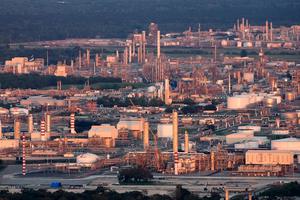
Eric Kounce TexasRaiser via Wikipedia
Last week, the Trump administration declared the federal government has no legal authority to regulate greenhouse gases, its latest move aimed at weakening regulations and boosting fossil fuels. And yet, analysts continue to see waning fortunes for miners and drillers.
On Thursday, the administration rejected the scientific finding that greenhouse gases pose a danger to human health, which gives the government authority to regulate carbon dioxide and other heat-trapping gases. In its announcement, the Trump administration also eliminated limits on emissions from cars and trucks. Going forward, it could further roll back limits on power plants, oil wells, and other sources. The moves are likely to face legal challenges.
The weakening of environmental regulations belies the downward trajectory for fossil fuels under President Trump, analysts say. Over the last decade and a half, coal burning has seen a precipitous decline, as has production. Today, the U.S. coal fleet is the smallest it has been in decades, having shrunk roughly in half since 2010, according to a new analysis from Carbon Brief. It notes that the vast majority of remaining coal plants are nearing retirement.
The administration is extending the lives of some aging coal plants, but there are no new coal plants under construction in the U.S. Last year solar, wind, and batteries made up 96 percent of new power capacity, with natural gas comprising the rest.
Oil is faring better than coal, with production hitting a record high last year. But output is expected to stagnate. According to the International Energy Agency, the proliferation of EVs globally is blunting demand for oil, and as global production outpaces demand, prices are too low to justify a ramp-up in U.S. drilling, according to Wood Mackenzie.
Oil executives say the shale boom, during which advances in fracking turned the U.S. into the world’s top oil producer, may be coming to an end. Over the long term, U.S. production is headed for decline, according to the Energy Information Administration.
Natural gas remains a bright spot for U.S. fossil fuels, with production expected to reach new highs in 2026 and 2027, the EIA projects. A recent boom in gas exports continues to drive demand for U.S. gas.
ALSO ON YALE E360
How Ukraine Is Turning to Renewables to Keep Heat and Lights On