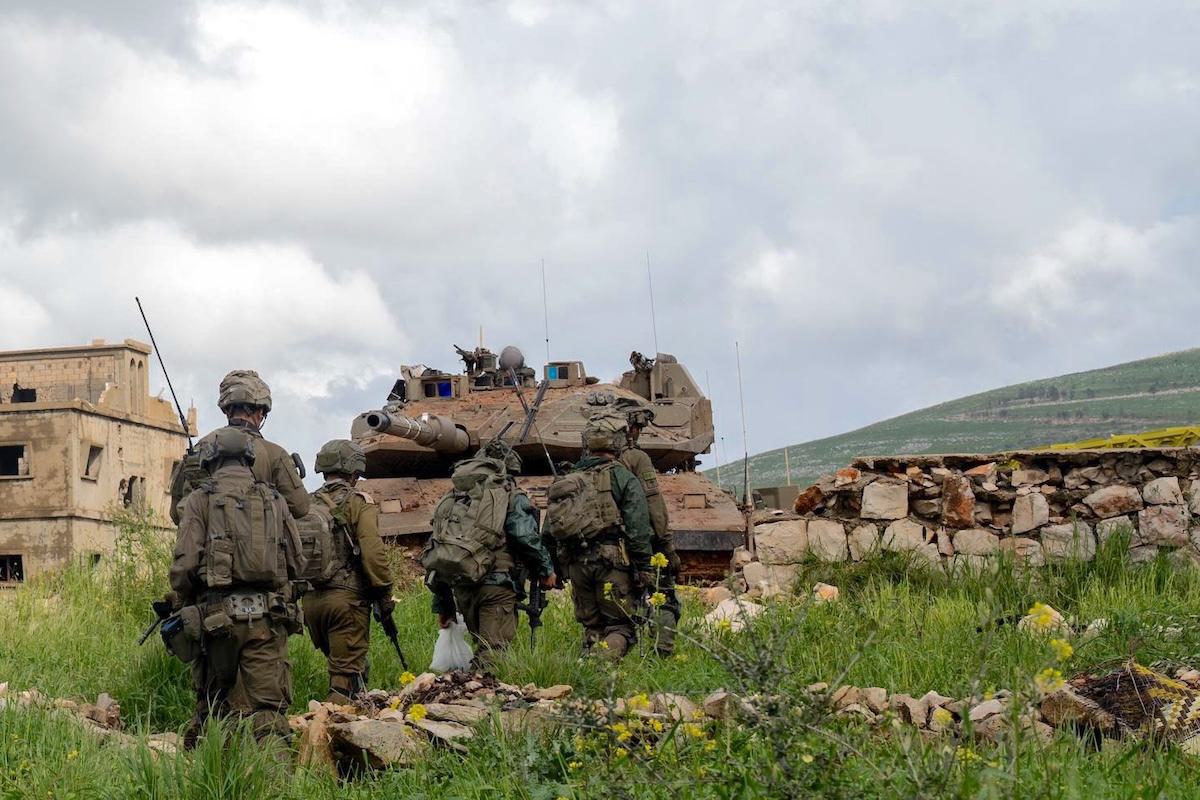
Israeli forces in southern Lebanon. IDF
Israeli strikes in southern Lebanon have devastated orchards and fields. Lebanese officials say that one-fifth of the country’s farmland has been damaged in the course of the war.
The latest bout of fighting began in March, when Israel deployed troops in southern Lebanon against Hezbollah, a militant group backed by Iran. The fighting — part of the larger war between Israel, the U.S., and Iran — has uprooted more than 1 million people in Lebanon. Some 600,000 will be indefinitely displaced as Israel works to take control of the region, destroying villages along its border with Lebanon to create a “buffer zone” with Hezbollah. Thus far, Israeli strikes have killed more than 2,100 people, including 168 children.
Lebanese leaders have condemned Hezbollah for its attacks on Israel and demanded the group disarm. They have also called the Israeli incursion into southern Lebanon a “land grab” and said that Israel has “blatantly violated the principles of international law and international humanitarian law.”
So far, fighting has damaged 180 square miles of farmland in Lebanon, most of it in the south, according to a report by the Ministry of Agriculture. Olive groves have been hardest hit, along with field crops, citrus trees, and bananas. The war has also affected cattle, sheep, fish farms, and beehives. Amid the fighting, Lebanese troops and U.N. peacekeepers are working to keep livestock as safe as possible, Agriculture Minister Nizar Hani told The New Arab.
Nearly four in five farmers in southern Lebanon have been displaced, according to the report, and fighting may be complicating their return. White phosphorus, a toxic chemical scattered by Israeli artillery shells, is damaging soil, Lebanese officials say.
In early February, before the current conflict began, Lebanese officials accused Israel of dropping the herbicide glyphosate on villages along the border — areas affected by the last Israeli incursion into southern Lebanon, in 2024.
“These areas are heavily dependent on agriculture — olive groves, tobacco, and other crops — and this incident complicates people’s ability to return to their homes, maintain their livelihoods, and rebuild after extensive destruction,” Ramzi Kaiss, a researcher with Human Rights Watch in Lebanon, told the BBC.
The 2024 Israeli campaign left deep scars on farms and forests, said Mireille Rebeiz, chair of Middle East Studies at Dickinson College. “Avocado orchards are gone and beehives destroyed. So, too, are the livelihoods they supported. Meanwhile, fields and forests have disappeared under the intense fire caused by white phosphorus shelling. Shrapnel and unexploded bombs, however, remain,” she recently wrote in The Conversation. Even prior to that ground invasion, Israeli air strikes had destroyed more than 60,000 olive trees, Lebanese officials say.
Rebeiz said the environmental damage from the 2024 conflict “indicates a grave breach of international environmental law and raises the question of whether Israel committed war crimes in Lebanon.”