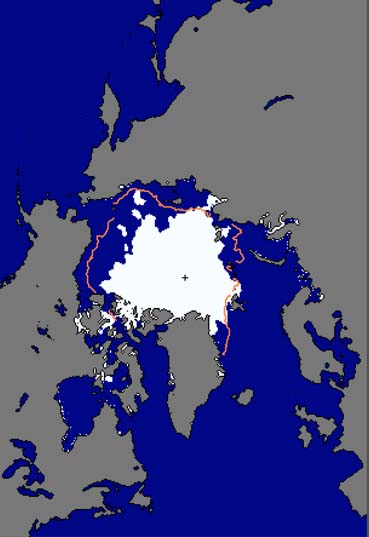
The Arctic Ocean’s rapidly disappearing cover of summer sea ice has shrunk to the second lowest level on record and may reach a record minimum extent by the time the melt season ends next month, according to the National Snow and Ice Data Center (NSIDC). The image at left shows sea ice cover, in white, as of August 26, with the orange line indicating the average sea ice cover for that day from 1979 to 2000; this year’s ice extent is 760,000 square miles smaller than the historical average, meaning the ice has shrunk by an area nearly three times as large as Texas. Arctic sea ice now covers 2 million square miles. The record low, set last September, was 1.65 million square miles, and NSIDC scientists say that record could be broken next month if this summer’s melting trends continue.
Arctic Sea Ice Nears Record Low
More From E360
-
ANALYSIS
What Is Driving the Global Resurgence of Mangrove Forests?
-
Biodiversity
Arctic Wildlife Research Suffers as Geopolitical Competition Grows
-
OPINION
The U.S. Public Is Losing Its Say on Environmental Policy
-
Solutions
Fifty Billion Seedlings: Can Ethiopia Replant Its Ravaged Forests?
-
OPINION
The Solar Boom in Developing Nations: Fast, Chaotic, and Unequal
-
Climate
Why Germany Is Building an Ark for U.S. Climate Data
-
INTERVIEW
From Indigenous Loss, a Potent Legal Argument on Climate
-
Biodiversity
Sargassum Superbloom: Seaweed Scourge or Ecological Boon?
-
Oceans
A Surge of Marine Heat Waves Threatens to Scramble Ocean Life
-
Policy
A Hard-Won Rule to Cut Chemical Plant Pollution Is Being Unraveled
-
E360 FILM CONTEST WINNER
Filipino Cacao Growers Learn to Live With a Hotter Climate
-
E360 FILM CONTEST
A Bicycle Journey Across Brazil to Find a Vanishing Savanna